- The paper presents PhysioLite, a compact architecture that achieves near foundation-model performance for ECG/EMG tasks using <0.3M parameters and a ≈370KB footprint.
- It replaces dynamic attention mechanisms with multi-branch temporal convolutions and static pointwise mixers, ensuring efficient real-time inference on µNPUs.
- Benchmark results show sub-20ms latency and robust metrics, highlighting its potential for scalable, privacy-preserving wearable health monitoring.
PhysioLite: Real-Time ECG and EMG Modeling on Microcontroller NPUs
Motivation and Context
The integration of neural processing units (NPUs) into microcontroller-class wearable hardware presents an opportunity for ultra-low-latency and privacy-preserving physiological signal inference. However, the adoption of Transformer-based models for electrocardiography (ECG) and electromyography (EMG) signal modeling has been restricted by the incompatibility of dynamic attention mechanisms and high parameter counts with embedded, resource-constrained hardware. Large foundation models generalize well but are too large for microcontrollers, especially given the limited on-chip memory and static operator support of current µNPUs. These constraints necessitate innovative neural architecture designs that retain multi-scale, context-aware modeling on edge hardware.
Architectural Innovations
PhysioLite is introduced as a compact architecture tailored for ECG and EMG signal analysis within the operational bounds of microcontroller-scale NPUs. The model design retains the representational advantages seen in wavelet-Transformer foundation models but enforces compatibility with static operators and tight memory constraints.
PhysioLite replaces attention mechanisms with multi-branch temporal convolutions and static pointwise token mixers, approximating learnable wavelet decompositions via parallel convolutional filter banks. Positional encoding, essential for temporal context, is externally generated on the CPU and concatenated with the signal prior to NPU execution. This offloading eliminates the need for dynamic attention within the accelerator, facilitating deployment under strict hardware limits.
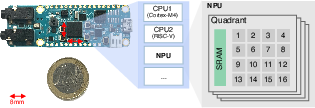
Figure 1: The MAX78000-FTHR alongside a coin, highlighting the on-chip NPU with a systolic array of 64 processing elements and quadrant-specific SRAM.
Multi-scale convolutional branches capture frequency-specific dynamics, mimicking wavelet decomposition, while feature mixing is achieved using pointwise convolutional bottlenecks. The architecture is further regularized by knowledge distillation from larger foundation models, maintaining both efficiency and structural inductive bias.
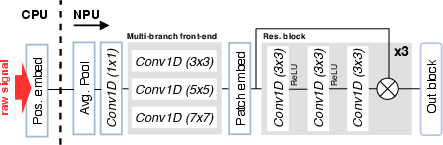
Figure 2: PhysioLite’s hybrid architecture: signal preprocessing and positional encoding on CPU, followed by multi-scale convolutions and mixing on the NPU for efficient embedded inference.
Benchmarking and Numerical Results
PhysioLite was evaluated across multiple public ECG and EMG datasets, including PTB-XL, CPSC, Chapman–Shaoxing, Ninapro DB5, EPN-612, and UCI EMG, for both supervised classification and arrhythmia/gesture recognition tasks.
Key numerical outcomes:
- ECG: PhysioLite achieved AUROCs between 0.893–0.994 and F₁ scores of 0.600–0.942, rivaling large Transformer-based models, despite having <0.3M parameters and ≈370KB footprint.
- EMG: F₁ scores of 0.738–0.949, AUROC 0.994–0.996. On DB5, EPN-612, and UCI-EMG, PhysioLite matched or exceeded prior models using a fraction of the parameters.
- Hardware profiling on MAX78000 and HX-WE2 µNPUs showed sub-20ms end-to-end latency for ECG and EMG inputs (1024–2048 samples) and SRAM usage well within hardware limits, highlighting efficient deployment for real-time monitoring scenarios.
- Power draw on MAX78000 during inference averaged 33mW (peak 35mW), confirming battery suitability.
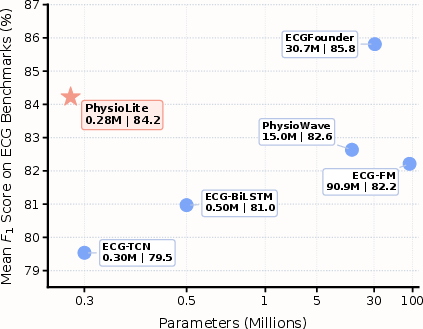
Figure 3: Comparison of average F₁ across ECG benchmarks for PhysioLite versus foundation models demonstrates competitive performance at ten-fold reduced model size.
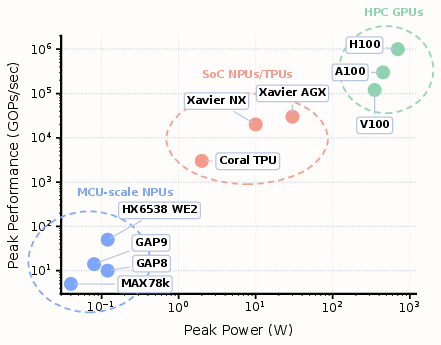
Figure 4: Hardware accelerator performance profiles validate the suitability of low-power MCU-scale NPUs for continuous wearable signal processing.
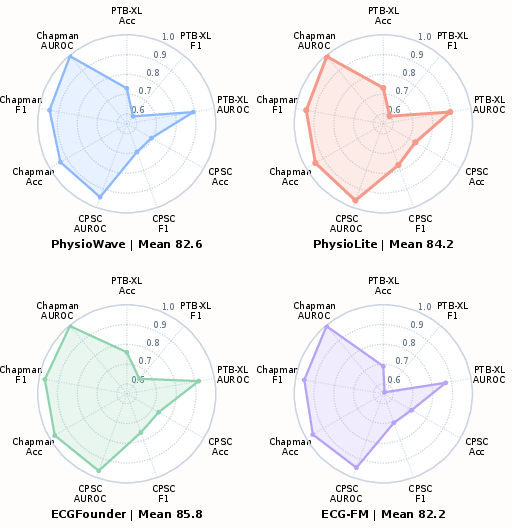
Figure 5: Radar plot illustrates PhysioLite’s compact footprint and parity with foundation models across various ECG metrics.
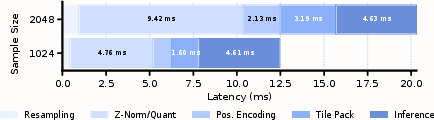
Figure 6: Latency breakdown on MAX78000 for ECG inputs (1024/2048 samples) demonstrates preprocessing and inference stages stay within real-time requirements.
Component Ablation and Architectural Claims
Ablation studies showed:
- Knowledge distillation provided an average F₁ uplift of ≈4% across benchmarks, with consistent performance improvement across datasets.
- The multi-scale kernel design (K={3,5,7}) yielded best F₁ on 4/6 benchmarks, outperforming fixed-kernel baselines.
- Positional encoding, when omitted, incurred 1–13% drops in F₁, especially for datasets with richer temporal structure.
- Pointwise convolutional mixing modules closely approximated MHSA in downstream performance, supporting the claim of hardware-efficient attention substitution.
Theoretical and Practical Implications
From a theoretical perspective, PhysioLite demonstrates that multi-scale temporal dependencies in physiological signals––crucial for ECG/EMG modeling––can be captured via structured convolutions and static context encoding, obviating the need for dynamic attention in embedded settings. The distillation-based transfer from foundation models ensures robust feature extraction, even under severe parameter and compute constraints.
Practically, PhysioLite establishes feasibility for continuous and private biosignal monitoring with low-latency, battery-powered wearable hardware. It unlocks application domains such as privacy-preserving health analytics, prosthetic control, and human-computer interaction, with potential for event-driven, edge-local inference. The released framework and model weights facilitate adaptation and benchmarking across hardware platforms.
Speculation and Future Developments
Advancements in µNPU operator support and memory hierarchies will likely enable further architectural flexibility, including dynamic mixing or low-rank approximations of attention. Extension to more domains (e.g., inertial, audio) should be systematically investigated to elucidate the generality of multi-scale convolutional modeling. The architecture may catalyze research in federated or continual learning on wearables, as well as cross-device transportability studies. Robustness to real-world, longitudinal, and multi-user signal drift remains a key challenge, driving future research toward adaptive and personalized embedded physiological models.
Conclusion
PhysioLite provides a hardware-aware, efficient solution for real-time ECG/EMG modeling on microcontroller-scale NPUs. By synthesizing multi-branch temporal convolutions, knowledge distillation, and CPU-offloaded positional encoding, it delivers near foundation-model performance within orders-of-magnitude reduced latency and resource footprint. This supports scalable, private, and low-power biosignal analysis, advancing capabilities for medical and interactive applications on the edge.