- The paper introduces PanLUNA, a 5.4M-parameter model that unifies EEG, ECG, and PPG using a query-augmented cross-attention mechanism for efficient multimodal biosignal analysis.
- The paper demonstrates state-of-the-art performance in tasks like abnormality detection and sleep staging, maintaining robustness even with missing modalities compared to models up to 57x larger.
- The paper validates aggressive INT8 quantization and edge deployment, achieving over 96% of full-precision performance on ultra-low-power MCUs with significant energy efficiency.
PanLUNA: An Efficient Query-Unified Multimodal Model for Edge Biosignal Intelligence
Introduction
PanLUNA introduces a 5.4M-parameter pan-modal foundation model (FM) capable of efficient and robust inference over heterogeneous physiological biosignals, specifically electroencephalography (EEG), electrocardiography (ECG), and photoplethysmography (PPG). The model directly addresses three persistent bottlenecks in physiological FMs: extensive model footprints imposed by late-fusion architectures, poor robustness in the presence of missing modalities, and infeasibility of deployment on resource-constrained wearable devices. By unifying the representation of biosignal modalities via a learned query set augmented with sensor-type embeddings, PanLUNA achieves holistic and scalable processing while remaining amenable to aggressive quantization and low-power edge deployment.
Architecture and Fusion Mechanism
PanLUNA is architected upon LUNA's topology-invariant channel-unification cross-attention mechanism [Doner2025-by]. The model concatenates sensor channels from EEG, ECG, and PPG to form a unified patch-level input space. Sensor-type discrimination is facilitated through learned modality embeddings, which are incorporated directly into the channel representation.
Per-modality spatial encoding follows physiological conventions: EEG electrodes are encoded using normalized 3D coordinates; ECG leads employ lead-angle spatial features from anatomical priors [Chen2021-gq]; PPG, as a spatially ambiguous signal, receives a neutral embedding. Input segmentation leverages 32-sample patches with bandpass and notch filtering as preprocessing.
Convolutions operate individually on temporal segments, whose outputs are fused along the channel-modality axis. The core unification module uses a cross-attention operation between learnable queries and feature patches; the queries, depending on the sensor embedding, specialize to distinct modalities and channel features.
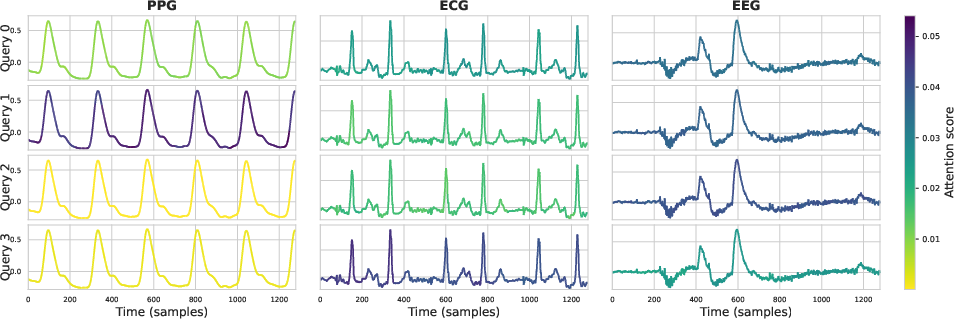
Figure 1: Per-patch channel-query cross-attention specialization, with queries mapping to distinct modalities (QRS-complexes in ECG, waveform features in PPG, and EEG-specific patterns).
This design guarantees linear complexity with respect to the channel count and naturally generalizes to arbitrary channel-topology and missing-modality situations. Downstream heads are appended after fine-tuning for classification or other end-tasks; for self-supervised pretraining, a reconstruction decoder is used.
Pretraining and Downstream Tasks
PanLUNA is pretrained on approximately 40,000 hours of biosignal data spanning five large publicly available datasets: TUH and Siena (EEG), MIMIC-IV and CODE-15% (ECG), and PulseDB (ECG+PPG). Task-agnostic windowing, filtering, and normalization protocols facilitate sharing of parameters across recording paradigms. Pretraining is followed by either full or adapter-based fine-tuning (LoRA) across a range of EEG and ECG downstream tasks: TUAB abnormality detection for EEG; four PTB-XL sub-tasks plus the CSN arrhythmia corpus for ECG [PhysioNet-ptb-xl-1.0.3], and five-class sleep stage classification on multimodal (EEG+ECG) HMC.
Numerical Results and Robustness
PanLUNA’s central empirical claim is its competitive or superior performance relative to models up to 57x larger in parameter count. On TUAB abnormal EEG classification, PanLUNA (81.21% balanced accuracy, 0.8999 AUPR) matches or exceeds leading compact EEG FMs—outperforming LUNA-Large (43M parameters) while remaining only marginally below LUNA-Huge (311M parameters) and FEMBA-Huge (386M parameters).
On multimodal HMC sleep staging, PanLUNA achieves state-of-the-art balanced accuracy (0.7416), Cohen’s Kappa (0.6946), and weighted F1 score (0.7659), outperforming both unimodal EEG models (LaBraM-Base, CBraMod) and the prior leading multimodal FM, PhysioOmni [Jiang2025-sz]. Critically, when evaluated under missing-modality settings (only ECG, only EEG), PanLUNA maintains robust performance, validating its seamless generalizability to partial or degraded sensor configurations.
The model’s underlying mechanism is clarified via query-specialization visualization: modality-augmented queries develop distinct temporal and morphological sensitivities, as evidenced by their strong activation on relevant signal phenomena—distinct EEG, ECG, or PPG features (Figure 1).
Quantization and Edge Deployment
PanLUNA demonstrates strong quantitative resilience to aggressive quantization. Post-training INT8 quantization (PTQ) typically preserves 85-95% of FP32 performance across all cardiac tasks. With quantization-aware training (QAT), INT8 weights and activations recover >96% of full-precision performance; even INT2 QAT models achieve acceptable degradation levels, yielding a storage reduction factor of up to 16x.
On the GAP9 RISC-V ultra-low-power MCU, PanLUNA achieves a 325.6 ms inference latency and 18.8 mJ energy per 10-second, 12-lead ECG window—more than twice as fast and energy-efficient as other FMs deployed on similar platforms (TinyMyo and FEMBA). For full (EEG+ECG) multimodal sleep staging (30 s epochs), it completes inference in 1.206 s with 68.65 mJ energy, supporting continuous inference workloads on constrained wearable batteries with a viable real-time budget.
Implications and Future Prospects
The model’s single-encoder, query-unified design sets a new parameter efficiency frontier for multimodal physiological FMs. By obviating the need for modality-specific encoders or fusion backbones, PanLUNA facilitates deployment in practical edge scenarios where sensor availability is dynamic, memory/energy are at a premium, or paired data is scarce.
The capacity to robustly handle missing modalities and achieve SoA performance across highly divergent domains (EEG, ECG, PPG) opens the door for real-time, lifelong biosignal intelligence in resource-limited ambulatory or implantable systems. Importantly, the query-based fusion paradigm is extensible—future scaling to richer sensing suites (e.g., EMG, EOG), graph-based spatial priors, or federated continual pretraining is a direct avenue for expansion. Clinical validation in continuous wearable studies remains a natural next direction.
Conclusion
PanLUNA demonstrates that a compact, query-unified transformer architecture can deliver SoA performance on both unimodal and multimodal physiological tasks while achieving robustness to missing modalities and enabling deployment within the operating envelope of ultra-low-power wearable MCUs. Its core approach—sensor-augmented cross-attention fused over shared queries—presents a scalable blueprint for next-generation biosignal FMs that bridge the gap from self-supervised edge learning to deployable health intelligence.

