- The paper demonstrates that the Indus sign system cannot be fully reproduced by tested non-linguistic models, challenging simplistic symbolic interpretations.
- It applies a multi-dimensional framework evaluating text brevity, formulaic repetition, hapax legomenon rate, and positional rigidity to discern structural differences.
- The findings imply that while the sign system exhibits structured constraints, its ambiguous profile necessitates models that account for both linguistic and non-linguistic possibilities.
Multi-Metric Evaluation of the Indus Sign System Against Non-Linguistic Baselines
Introduction
The question of whether the Indus Valley script encodes language remains deeply unsettled in computational epigraphy and ancient writing systems research. Prevailing statistical arguments have failed to conclusively support or refute the linguistic hypothesis, in part due to methodological limitations—foremost, the practice of comparing single metrics in isolation. The present study, "How Non-Linguistic Is the Indus Sign System? A Synthetic-Baseline Scorecard" (2604.17828), establishes a multi-dimensional framework, evaluating the Indus corpus relative to two parametrically-tuned synthetic non-linguistic baselines—"heraldic" and "administrative" systems. This approach operationalizes the objections first codified by Farmer, Sproat, and Witzel (FSW, 2004), and demands coincident matching across four independent structural properties, thereby raising the standard for competing explanatory models.
Data and Sign System Properties
The analyzed dataset comprises 1,916 deduplicated inscriptions sourced from the ICIT database, encompassing 584 unique signs and 11,110 sign tokens, spanning 52 archaeological sites. The inscriptions are characteristically brief (mean 4.4, median 4.0 symbols), a regime where random effects are prominent and conventional distributional statistics are challenged.
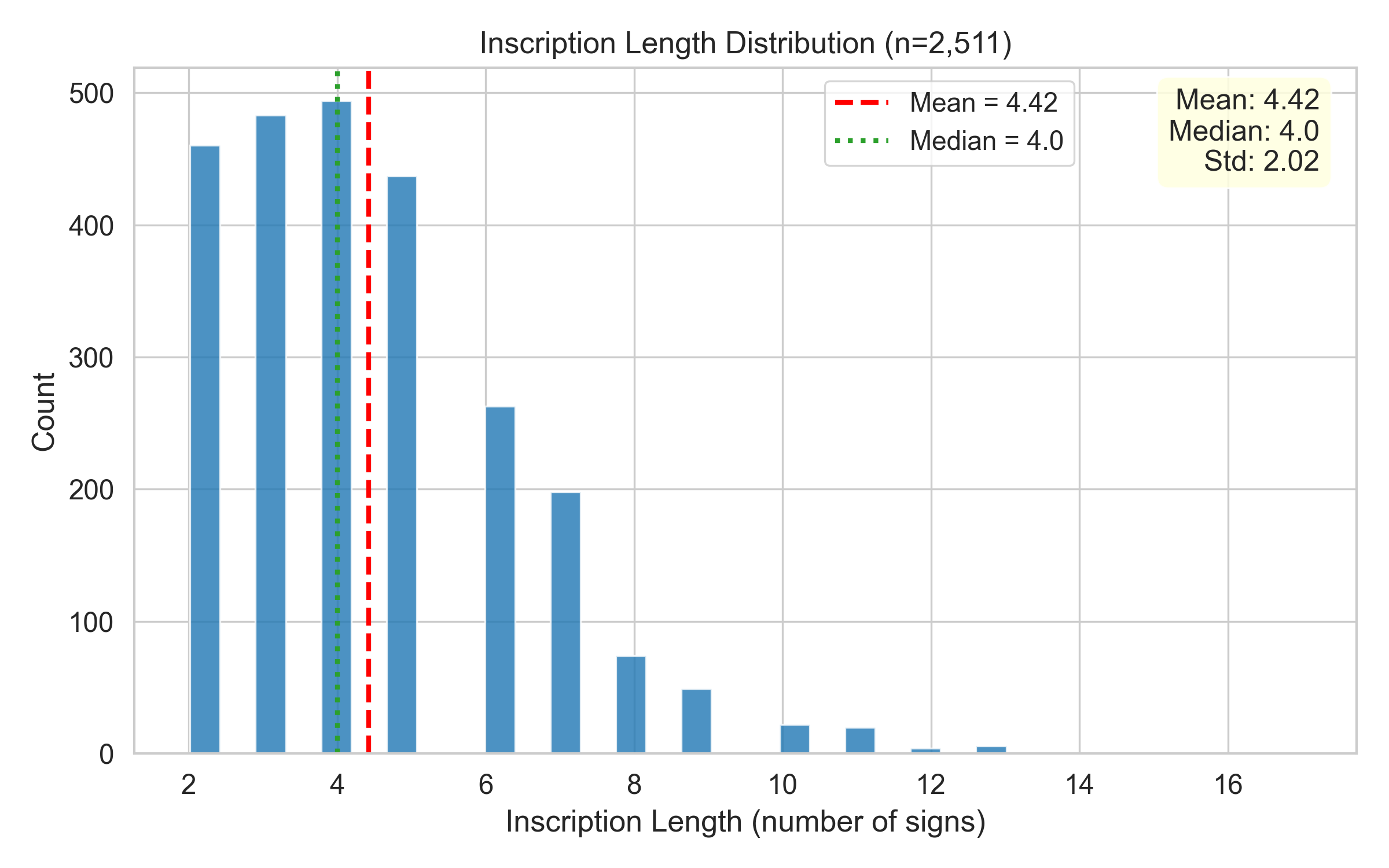
Figure 1: Distribution of inscription lengths across the Indus corpus shows extreme brevity, with a mean of 4.42 and median of 4.0 signs.
The sign inventory is coded distinctly from Mahadevan and Parpola’s reference corpora, so absolute vocabulary numbers are not directly cross-comparable.
Statistical Structure: Zipf and Predictability
The frequency-rank relationship closely approximates Zipf's Law, with a measured slope of −1.49 and R2=0.96, consistent with claims of heavy-tailed distribution.
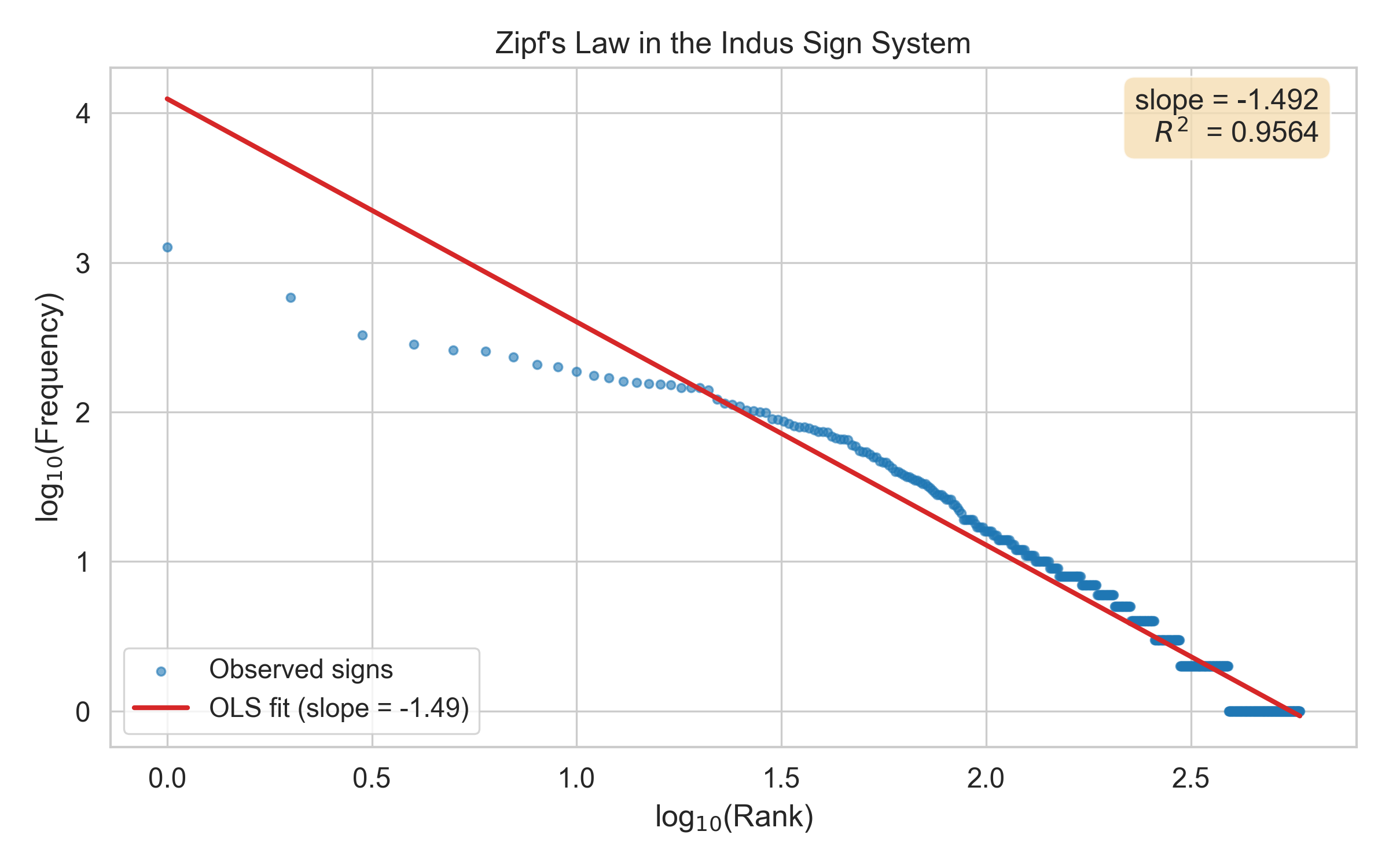
Figure 2: The log-log frequency vs. rank plot confirms a Zipfian distribution in the Indus sign system, with a near-linear fit.
Conditional entropy of sign transitions (3.232 bits) is sharply lower than a within-inscription permutation null (mean 4.613 bits, p<0.001), demonstrating that sign order is highly non-random.
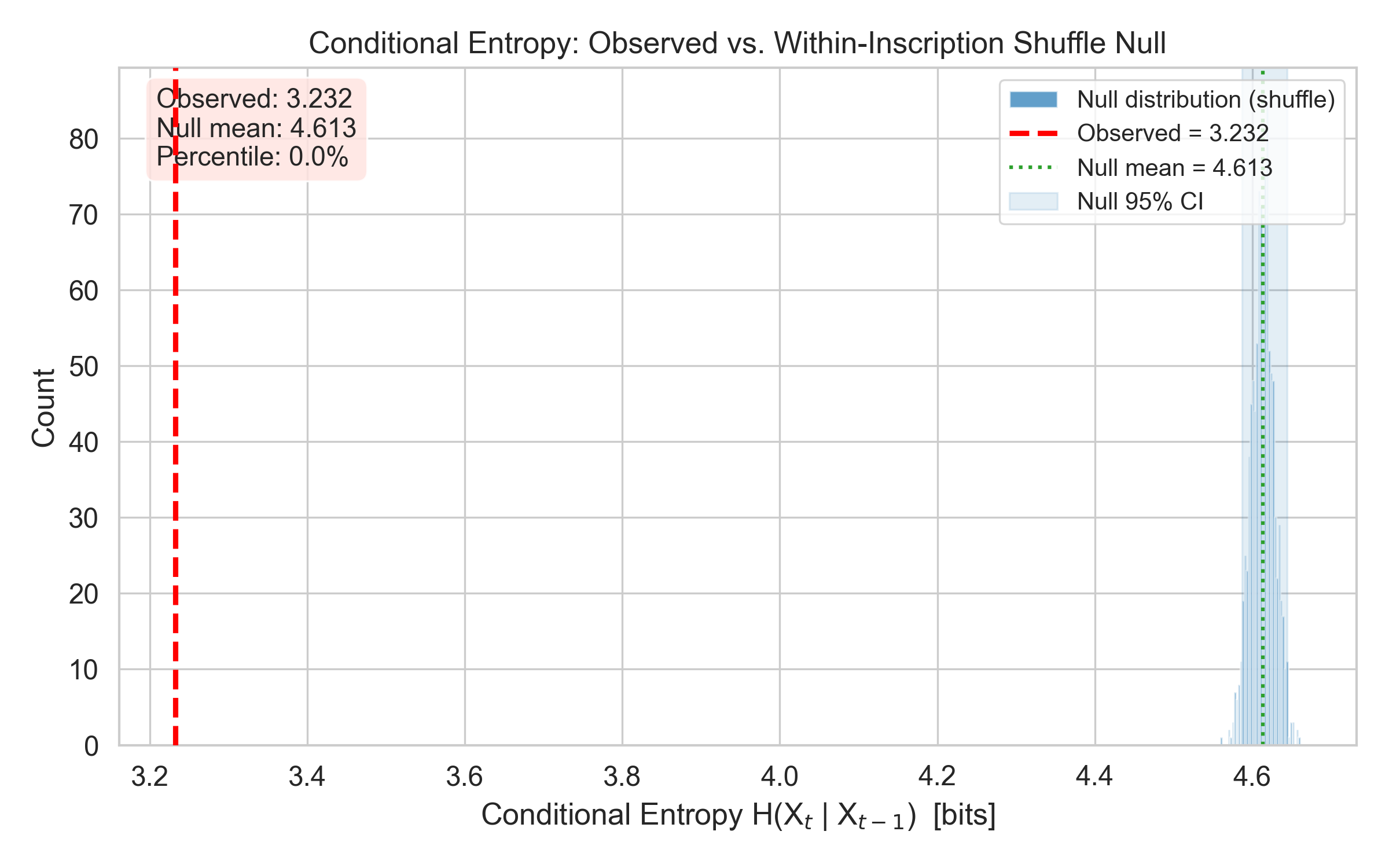
Figure 3: The observed conditional entropy (red dashed) is lower than all 1,000 shuffled realizations (blue), underscoring significant sequential structure.
This substantiates the presence of sequence constraints, though not uniquely linguistic ones.
Synthetic Baseline Models
Two provenance-tunable symbolic generators were constructed:
- Heraldic model: Emulates emblematic systems with strong position classes, Zipfian sign frequencies, and empirical bigram dependencies.
- Administrative model: Implements template-driven sequences with fixed and variable slots, noise, and controlled repetition structures.
The generators span empirically observed parameter ranges derived from attested non-linguistic corpora (kudurrus, totem poles, barn stars, Pictish stones, proto-cuneiform, and SCA heraldic blazons).
Robustness was validated by parameter sweeps and direct comparison with empirical corpora, ensuring model outputs reflect plausible non-linguistic distributions.
Multi-Metric Scorecard Analysis
The core contribution is the operationalization and simultaneous evaluation of four FSW-inspired metrics:
- Text brevity (mean inscription length)
- Formulaic repetition (counts of distinct n-gram phrases repeating across inscriptions, for n=3–6)
- Hapax legomenon fraction (fraction of signs occurring only once)
- Positional rigidity (mean Cramér’s V for top-10 signs with respect to initial, medial, terminal occurrence biases)
The Indus corpus occupies an intermediate region in this four-dimensional space: it is distinguishable from both the heraldic and administrative baselines on several, but not all, metrics.
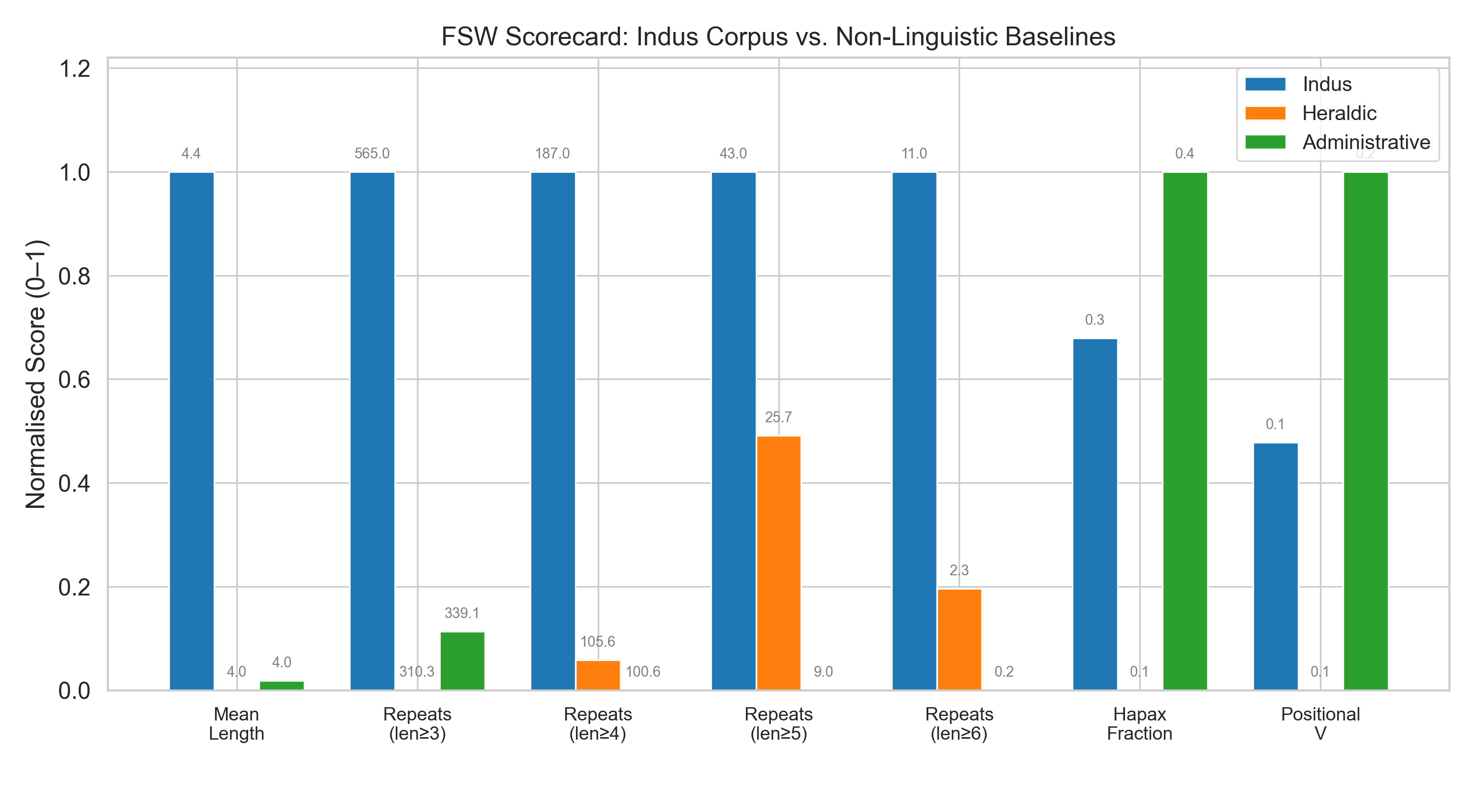
Figure 4: Scorecard comparison highlights the Indus corpus (blue) intermediate to heraldic (orange) and administrative (green) baselines; notably, it cannot be fully reproduced by either.
Key findings include:
- Text brevity and formulaic repetition: The Indus corpus is robustly distinct from the heraldic baseline across all phrase lengths (n=3–6). The administrative model converges to the Indus values for longer repeated phrases but not for shorter ones, and fails on other properties.
- Hapax legomenon rate: The Indus value (33.2\%) falls between administrative (higher) and heraldic (lower) comparators.
- Positional rigidity: Again, intermediate: above heraldic, below administrative, distinct in both directions.
No parameter setting for either baseline generator, nor any attested non-linguistic corpus, simultaneously matches the Indus values on all four metrics. Sensitivity analysis (including synthetic allograph collapsing) demonstrates that the findings are robust to artifactual inflation of sign inventory.
Cross-Corpus and Typological Comparisons
Metrics were measured for real-world non-linguistic corpora. SCA heraldic blazons match Indus values for mean sequence length and positional rigidity but diverge sharply on hapax rate and repetition frequency. Conversely, Pictish stones and proto-cuneiform tally-like scripts fail to match all four dimensions simultaneously.
Cross-site validation demonstrates that the statistical profile is not a localized phenomenon but recurs across major centers (Mohenjo-daro, Harappa, etc.), supporting arguments for a standardized system-wide protocol.
Theoretical Implications
The failure of two distinct non-linguistic model classes to match all observed structural properties in the Indus corpus, even with parameters set to empirical limits, imposes critical new constraints on the non-linguistic interpretation. This multi-metric scorecard demands that any future non-linguistic hypothesis be embodied in a generator formalism—not simply hand-waved—and that it reproduces all distributional features concurrently.
The results do not support the notion that the Indus sign system is a trivial emblematic or administrative code. The presence of repeated multi-sign formulae, significant but not absolute positional rule adherence, and non-extreme hapax rates together admit the possibility of proto-linguistic or highly structured schematic notation as well as language coding. However, neither a straightforward non-linguistic nor a simplistic linguistic model suffices.
Limitations
Salient limitations include the G### code set’s lack of allograph normalization, sampling effects from inscription brevity, possible cataloging artifacts, and baseline model architectural simplifications. The framework does not claim to definitively settle the language encoding debate, nor to exhaust the universe of possible non-linguistic generators.
Conclusion
This study presents a reproducible, extensible, and stringent framework for distinguishing the Indus sign system from candidate non-linguistic systems using jointly evaluated structural metrics. The principal finding is that, under these constraints, the Indus corpus cannot be matched by any tested heraldic or administrative model nor by any attested emblem system. While the linguistic status of the Indus script remains unresolved, future hypotheses, especially non-linguistic ones, must specify and replicate the observed multi-metric signature to remain viable (2604.17828).