- The paper proposes PDDL-Mind, a framework that decouples narrative parsing from belief reasoning by leveraging explicit symbolic PDDL representations.
- It demonstrates superior accuracy across ToM benchmarks with significantly fewer LLM calls, indicating gains in both performance and cost-efficiency.
- The study emphasizes that reliable state tracking is critical for reducing LLM errors in belief reasoning, paving the way for enhanced neuro-symbolic models.
Explicit State Tracking for Theory of Mind: The PDDL-Mind Neuro-Symbolic Framework
Introduction
The paper "PDDL-Mind: LLMs are Capable on Belief Reasoning with Reliable State Tracking" (2604.17819) presents a neuro-symbolic approach for improving LLMs on Theory-of-Mind (ToM) tasks. The central claim is that LLMs' failures on ToM benchmarks primarily arise due to unreliable, implicit state tracking rather than limitations in high-level reasoning. The authors propose PDDL-Mind, a method that decouples state tracking from reasoning by leveraging explicit symbolic representations via Planning Domain Definition Language (PDDL) as the backbone for state evolution during ToM narrative processing.
PDDL-Mind Framework
PDDL-Mind introduces a two-stage pipeline for ToM tasks: (1) narrative parsing and action/state verification, and (2) chain-of-thought inference over verified states.
Given a narrative from a ToM benchmark, an LLM is prompted to (i) parse the environment description into a PDDL problem file detailing the initial world state and objects; (ii) map the sequence of actions/events to PDDL actions; and (iii) verify each action via an explicit simulation of state transitions constrained by a predefined PDDL domain file. Only actions with satisfied preconditions are executed, ensuring consistency and filtering out narrative hallucinations or ambiguities. This yields a verified trajectory of world states, which serves as the LLM's input for downstream ToM question answering.
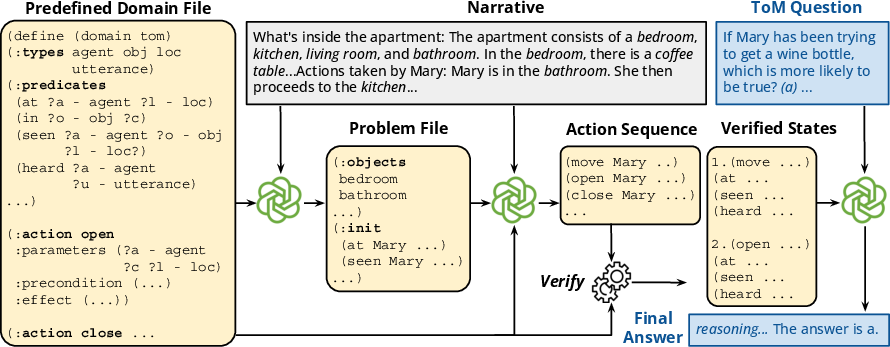
Figure 1: The PDDL-Mind pipeline parses narrative to structured states and actions, verifies state transitions with a PDDL domain, and conditions ToM inference on these explicit trajectories.
This explicit separation isolates ToM reasoning from the noisy, error-prone process of extracting latent world states from free text. The PDDL domain encodes four object types (agent, loc, obj, utterance) with state predicates (at, in, is-open, holding, seen, heard) and seven action templates (move, open, close, grab, drop, ask, tell), matching the underlying event semantics of benchmarked environments.
Evaluation and Numerical Results
PDDL-Mind is evaluated on three challenging ToM QA benchmarks—MMToM-QA, MuMa-ToM, and FanToM—spanning single/multi-agent narratives over actions and conversations. The framework consistently yields superior accuracy compared to strong baselines, including AutoToM, DWM, and hypothesis-driven inference approaches.
Key empirical highlights:
- On MMToM-QA and MuMa-ToM, PDDL-Mind with GPT-4o surpasses the best prior method by more than 5% absolute accuracy, reaching 88.3% and 88.8% average accuracy, respectively.
- While AutoToM requires on average 27 LLM calls per instance, PDDL-Mind needs only 3, demonstrating a substantial gain in cost-efficiency through logical abstraction.
- In a manual inspection, over 90% of PDDL-Mind’s verified state-action chains align perfectly with the underlying narrative, in contrast to the high error rate for implicit/heuristic methods.
The error analysis delineates that, given perfect state tracking, LLMs’ error rate on ToM questions would drop to approximately 8%, pinpointing state tracking—not reasoning per se—as the persistent bottleneck.
Structural Analysis of ToM Benchmarks
The authors formalize a unified abstraction for ToM narratives, highlighting that both physical (Sally–Anne style) and communicative (multi-agent dialogue) benchmarks are reducible to event-driven state sequences amenable to symbolic planning models. Physical actions induce tree-structured state evolution (containment hierarchy and perceptual access), while conversational updates are modeled as broadcast and reception within the agent set, governed by join/leave dynamics and synchronous memory updates.
Implications and Theoretical Insights
Neuro-symbolic Decoupling and LLM Augmentation
PDDL-Mind demonstrates the efficacy of neuro-symbolic scaffolding in ToM evaluation: LLMs are adept at mapping constrained narratives into symbolic actions/states, and, when unburdened from state aggregation, can perform belief attribution with significantly higher reliability. The paradigm shift here is to recognize that ToM “reasoning” failures often originate upstream in flawed latent state construction—in prior methods, probabilistic aggregation over latent variables amplifies these errors (e.g., Bayesian inverse planning). By externalizing state updates via PDDL, PDDL-Mind sidesteps the “scalar bottleneck” of methods relying on internal probabilities and instead preserves and operationalizes explicit structure throughout both event parsing and inference.
Benchmark Limitations and Directions
The pipeline exposes longstanding structural regularities and inductive biases in ToM benchmarks—most are reducible to deterministic, tree-like event-state transitions that can be faithfully captured by a fixed set of action templates and predicates. This raises questions regarding the ecological validity and discriminative power of current benchmarks; the capacity to generalize to less structurally regular, compositionally richer, or knowledge-intensive scenarios remains untested. The authors recommend future benchmarks should move beyond “symbolic closure” and fixed event hierarchies, e.g., by diversifying action semantics contextually or incorporating world knowledge that escapes domain file enumeration.
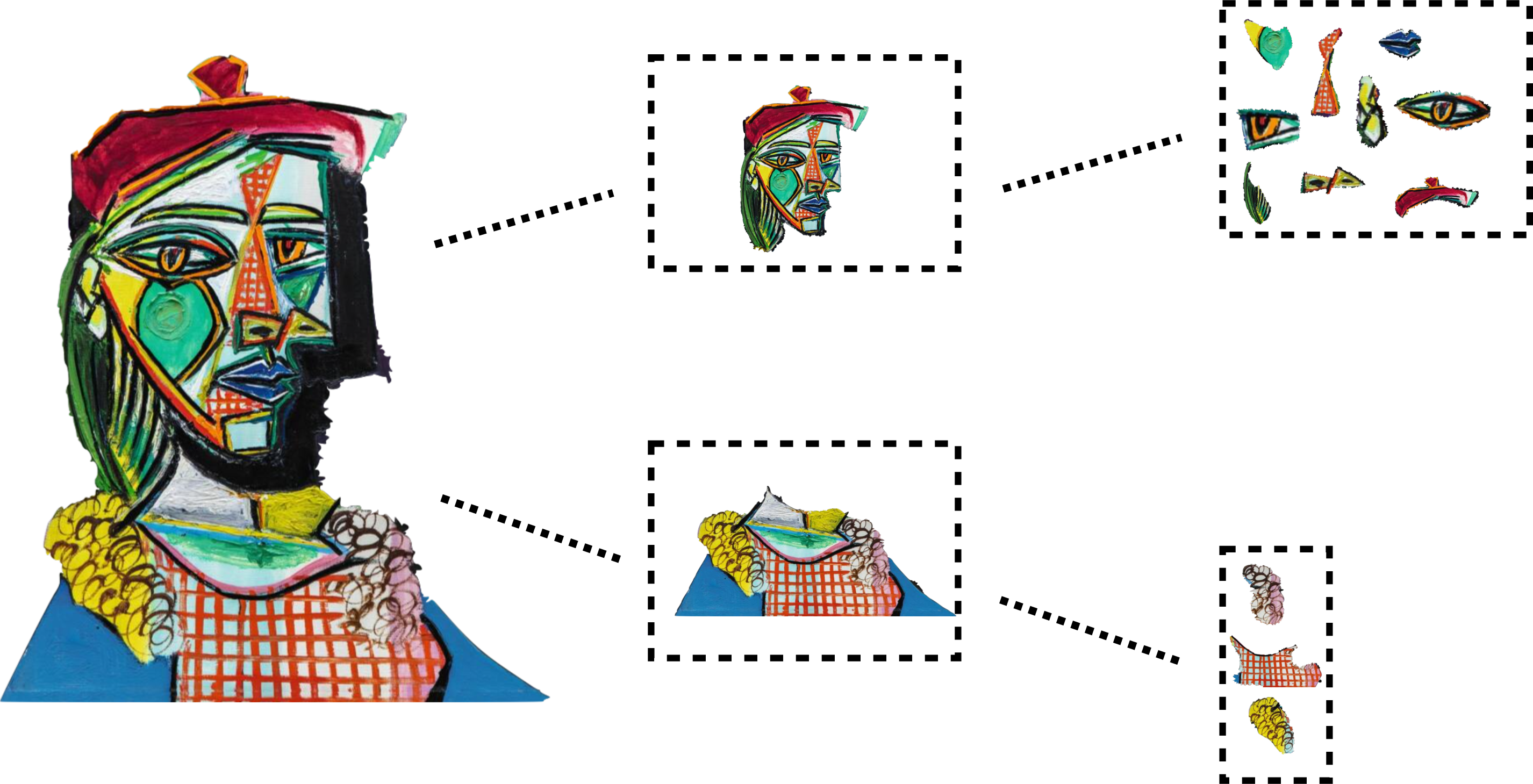
Figure 2: The Picasso Thesis—state complexity and event partitioning depend on observer-centric world models; “state” is not invariant to background knowledge or conceptual vocabulary.
Limitations
PDDL-Mind operates purely over textual descriptions within a closed symbolic domain, and thus does not directly extend to multimodal ToM (spatial/visual input, perceptual grounding). There is residual brittleness when weaker LLMs incorrectly parse or abstract narrative elements, limiting applicability for models below GPT-4o/Claude-Sonnet-4.5 tier. Expanding to open-world, long-tail, or multimodal ToM remains an open challenge.
Conclusion
PDDL-Mind bridges the performance and interpretability gap in ToM reasoning by enforcing explicit, deterministic state tracking—demonstrably the dominant failure mode in prior LLM-centric approaches. The framework substantiates that, under reliable state tracking, LLMs are far closer to human-level ToM inference than previously inferred. The research invites new explorations at the intersection of neuro-symbolic modeling, robust event abstraction, and adaptive ToM benchmarks, with substantial implications for measuring and advancing machine social reasoning in complex, partially specified worlds.