- The paper demonstrates that tropical stable intersections correspond to Datta’s cycle cover combinatorics, equating the algebraic degree to matrix permanents.
- It introduces a geometric derivation via Newton polytopes and Minkowski sums, linking equilibrium complexity in network games with tropical intersection theory.
- The work distinguishes bounded and explosive growth regimes in network games and validates its predictions through numerical homotopy simulations.
Tropical Geometric Foundations of Algebraic Degree in Network Games
Abstract and Motivation
The study investigates the algebraic degree of network games—quantifying the complexity inherent in their totally mixed Nash equilibria—through the lens of tropical geometry. The underlying motivation stems from Datta's combinatorial formula for counting complex equilibrium solutions, which relies on the permanent of a structure matrix encoding the game's dependency graph. While Datta's approach was fundamentally combinatorial, it lacked a geometric explanation for why the cycle-cover structure governs solution counts, especially for sparse multilinear games. This work fills that gap by providing a geometric derivation, demonstrating that tropical stable intersections of hypersurfaces correspond precisely to Datta's cycle cover combinatorics, with the permanent arising as an intersection count.
Network games are structured as sparse multilinear polynomial systems, where each player’s payoff depends only on local neighborhoods dictated by a directed interaction graph. The equilibrium conditions translate to indifference equations, multilinear in form, for each independent strategy variable per player. Variables are normalized per player, and the resulting indifference system admits a polynomial graph representation capturing variable dependencies.
The structure matrix defines adjacency between equation and variable vertices in this polynomial graph, incorporating normalization factors motivated by BKK theory. These factors are distributed across the matrix such that the algebraic degree—number of isolated complex torus solutions—is given directly by the permanent, aligning combinatorial representation with polyhedral root-counting.
Tropical Geometric Interpretation
The core contribution is a geometric reinterpretation of Datta’s formula. Multilinear structure induces Newton polytopes that decompose as Minkowski sums of simplices on disjoint coordinate blocks. Tropical geometry provides a piecewise-linear shadow of root counting: stable intersections of tropical hypersurfaces correspond to full-dimensional mixed cells in polytope decompositions. Tropical intersection theory guarantees that admissible cycle covers of the polynomial graph map one-to-one with stable intersection points, and the permanent of the structure matrix subsequently counts intersection multiplicities.
This geometric mechanism is formalized via a sequence of lemmas, connecting disjoint cycle covers to one-dimensional simplex faces selected in each equation’s polytope, showing that combinatorial admissibility (injectivity, block uniqueness) guarantees a coherent mixed cell can be realized. The key result is the tropical proof of Datta’s theorem: the algebraic degree equals the sum over tropical stable intersections, each weighted by mixed-cell normalized volume, which aligns exactly with the permanent.
Structural Laws and Topological Complexity
The paper derives structural consequences for network game complexity, separating bounded and explosive regimes:
- Multiplicativity over strongly connected components: Algebraic degree factors over SCCs. The structure matrix decomposes block-wise, and permanents multiplicatively reflect compositional complexity.
- Coupling mechanisms—bounded versus explosive growth: Cartesian couplings (product structures) admit transfer-matrix trace formulas, maintaining bounded algebraic degrees under network scaling. Tensor-type (cross-layer) couplings induce exponential growth, governed locally by the permanents of coupling gadgets ($\mathcal{D}(G \otimes H) = (\perm(A_H))^{|V(G)|}$).
The distinction is rigorously illustrated with explicit network constructions—cycles, standard prism couplings, and cross/prism tensor couplings.
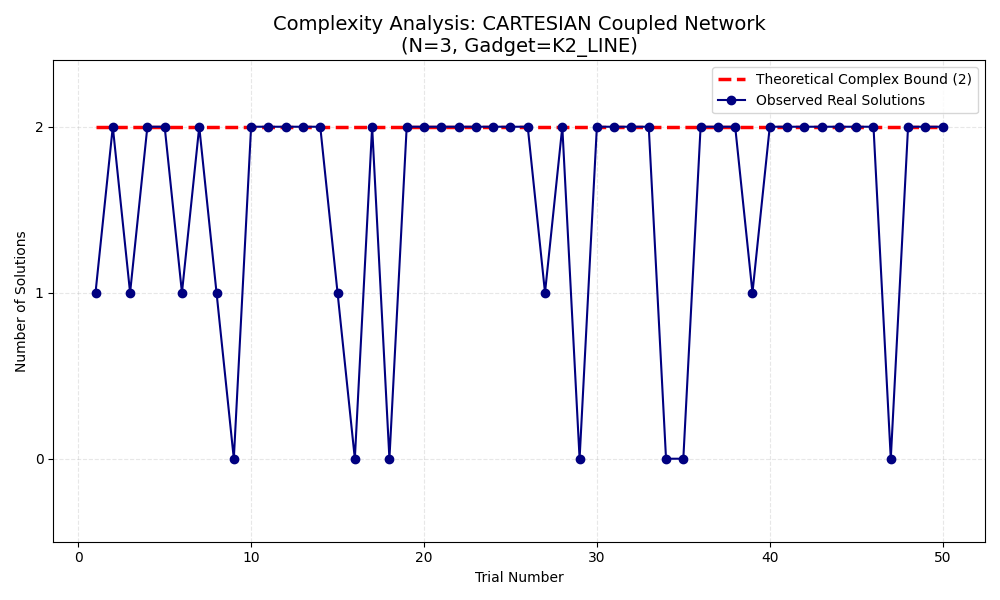
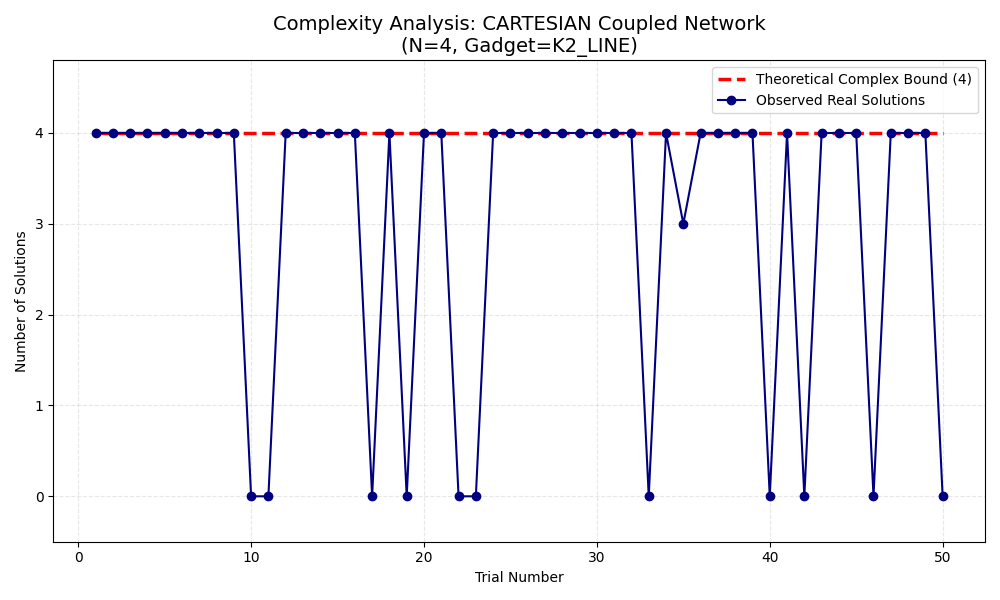
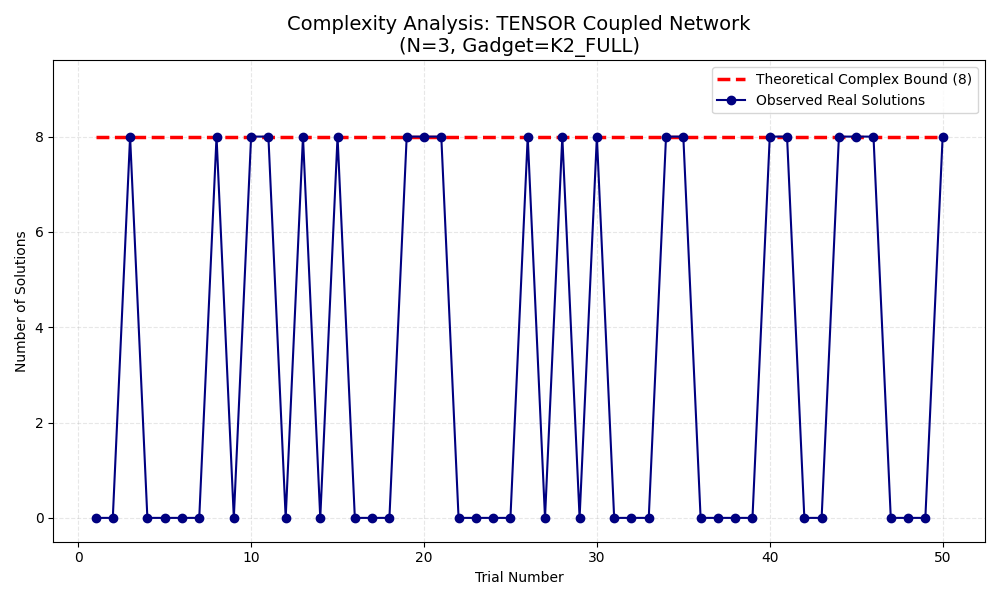
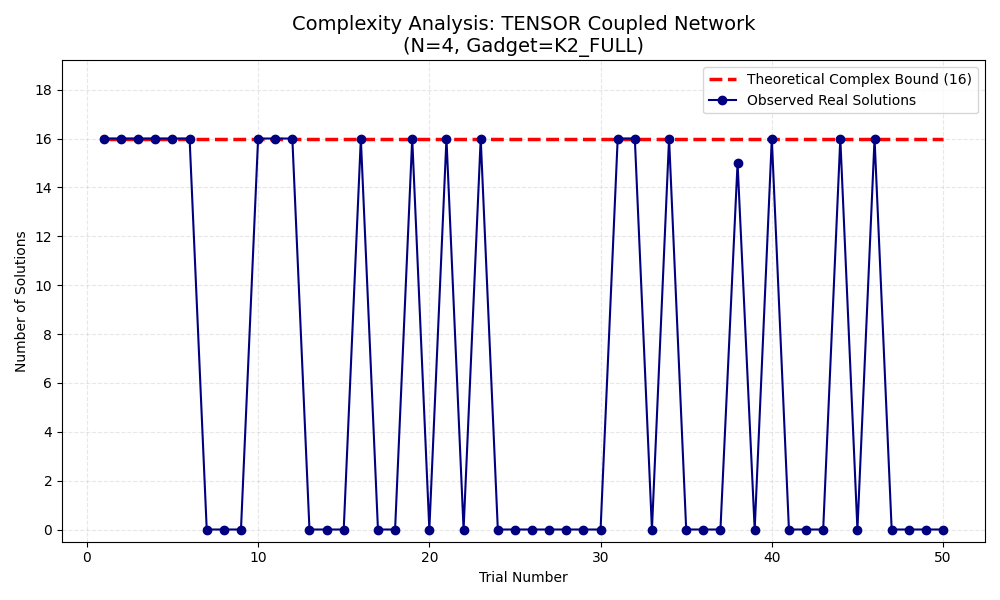
Figure 1: The Cartesian Coupled structure for N=3 demonstrates bounded algebraic degree, as proven by transfer-matrix trace formulas.
Illustrative Examples and Application Implications
Several game-theoretic models illustrate the implications of these structural results:
- Cyclic Matching Pennies: A cycle of binary-strategy players yields a rigid system with algebraic degree $1$, confirming the structural simplicity of cycles.
- Cross-Fire Inspection Games: Dual-layer, cross-coupled games translate to tensor product structures, inducing exponential solution proliferation.
- Smart Microgrid Models: Practical cyber-physical systems, when cross-coupled (e.g., peer-to-peer energy trading between physical and market layers), exhibit combinatorial explosion in equilibrium count as network size increases. This suggests that intricately coupled architectures engender complex, unstable strategic landscapes, with potential implications for system sensitivity and robustness.
Numerical Validation and Complexity Analysis
Numerical simulations leveraging Bertini and homotopy continuation corroborate theoretical complexity predictions. Cartesian coupling architectures exhibit bounded algebraic degree and solution counts even as network size increases, while tensor couplings rapidly scale—e.g., for N=4, tensor coupling yields 16 complex solutions, matching the predicted 2N.
Conclusion
By establishing a tropical geometric framework for analyzing algebraic degree, this work bridges combinatorial graph-theoretic reasoning with polyhedral and intersection-theoretic methods. The algebraic degree is shown to encapsulate structural complexity, compatible with network composition laws, tensor product constructions, and transfer mechanisms. Practically, this advances understanding of equilibrium complexity in networked strategic systems, indicating strong topological effects on tractability and multiplicity. Theoretically, it asserts that combinatorial formulae for equilibrium counts are geometric invariants, not mere artifacts of counting. Future developments may extend these geometric structures to generalized Nash equilibrium problems, mechanism design, and real algebraic contexts in multi-agent systems.
References
See full reference list in (2604.17741).

