- The paper establishes a unified variational framework for potential games on unimodular random graphs by leveraging local weak convergence and the mass-transport principle.
- It derives precise Nash equilibrium conditions and explicit solutions, notably in linear-quadratic settings using techniques analogous to solving Poisson equations.
- It demonstrates that finite-population potentials converge to an infinite-population limit, enabling drastic dimensionality reduction for analyzing large sparse networks.
Potential Games on Unimodular Random Graphs: A Technical Summary
Introduction: Motivation and Framework
This work presents a rigorous analytic foundation for potential games on unimodular random graphs of bounded degree (2604.13836). The principal goal is to unify the potential-theoretic approach to network games with sparse graph limit theory, addressing limitations in prior dense-graph (graphon) frameworks by developing a general method applicable to both finite and infinite-player regimes on sparse graphs. The mathematical backbone is the theory of unimodular random rooted graphs, leveraging local weak convergence and the mass-transport principle to obtain well-posed notions of potential, Nash equilibria, and their limits.
The authors define games where agents, represented by the vertices of a (possibly infinite) bounded-degree graph, interact only with direct network neighbors. Each agent's admissible actions lie in a Hilbert space, encompassing both static and dynamic (including stochastic control) models. The resulting mathematical objects are random rooted graphs endowed with unimodular probability measures, thus capturing typical (local) neighborhoods while abstracting away global structure.
Unimodular Random Graphs and Local Weak Limits
A central concept is the unimodular random rooted graph: a graph endowed with a probability measure that satisfies the mass-transport principle. This ensures that, from the perspective of a typical vertex (the "root"), the distribution of its neighborhood is consistent under rerooting. The local weak convergence formalism provides the connection between sequences of finite graphs (with increasing size and bounded degree) and their infinite sparse limits.
Three illustrative families of examples clarify the framework:
- Cycle graphs (Cn): Finite cycles converge to an infinite 1D lattice (Z,root) as n→∞. All players are symmetric; there is a single representative type.
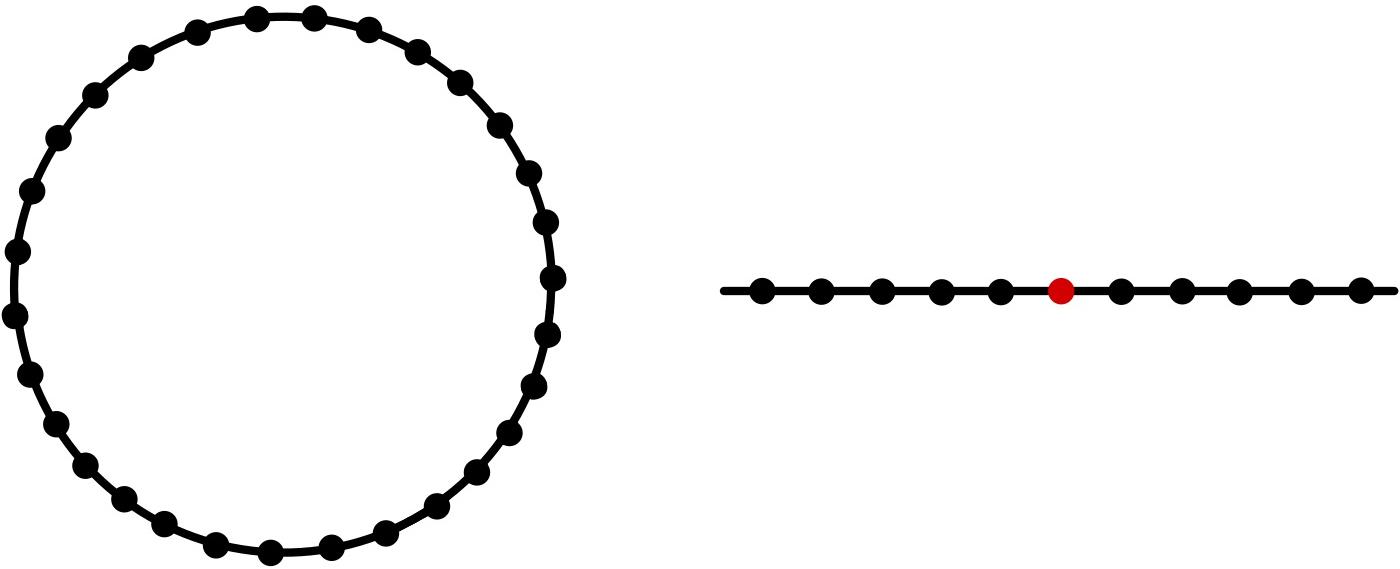
Figure 1: The n-cycle Cn and its local weak limit, the infinite path Z rooted at the red node.
- Box graphs ([n]d nearest-neighbor): Finite d-dimensional grids converge to Zd rooted at a random vertex. Asymptotically, only one player type remains.
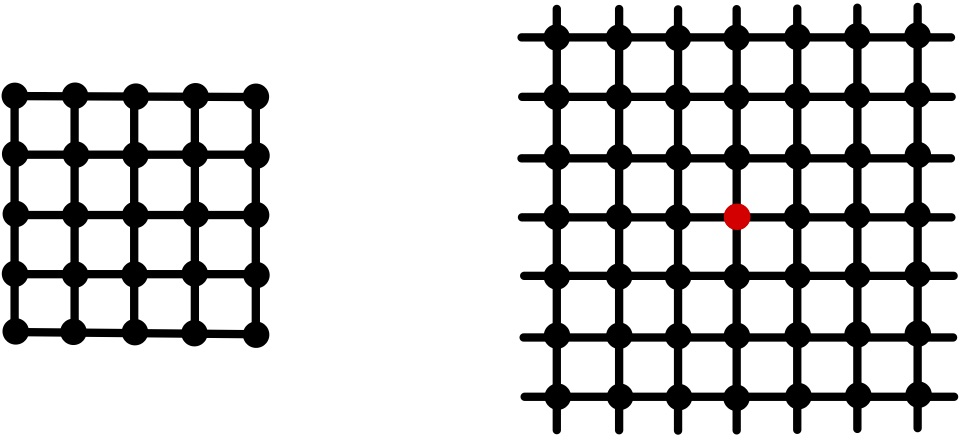
Figure 2: 2D box graph Gn and local weak limit (Z,root)0 rooted at the red node.
- Random (Z,root)1-regular graphs ((Z,root)2): Finite random regular graphs converge locally to the infinite (Z,root)3-regular tree. In the limit, automorphisms reduce the number of representative players to one.
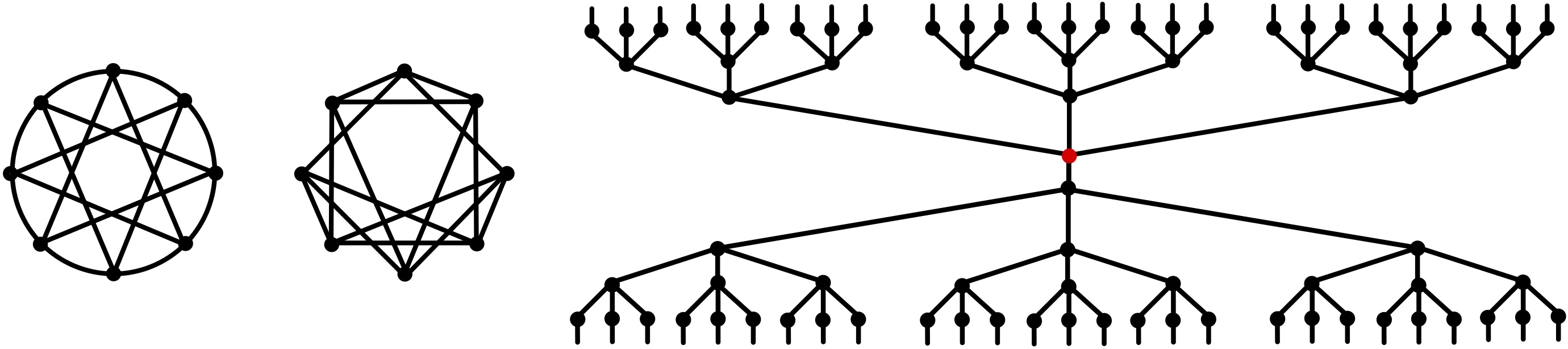
Figure 3: Realizations of random 4-regular graphs and their local weak limit, the infinite 4-regular tree.
These examples demonstrate how the representative player formalism, via isomorphism classes of rooted neighborhoods, leads to dramatic dimensionality reduction in equilibrium analysis for large sparse graphs.
Potential Games: Construction and Variational Structure
The network game is defined via two cost functionals: a private cost (Z,root)4 for the root (Z,root)5 and an interaction cost (Z,root)6 across edges, where (Z,root)7 is a rooted graph sample and (Z,root)8 ranges over the neighbors of (Z,root)9. An admissible action rule assigns actions based on isomorphism class, ensuring that structurally identical players adopt identical policies.
A Nash equilibrium (precisely, a quenched Nash equilibrium) is then an admissible rule such that, for almost every rooted realization, the root cannot decrease its cost by deviating unilaterally.
The principal technical innovation is the construction of a global potential functional:
n→∞0
where n→∞1 is an exact differential potential for n→∞2. Both the existence and finiteness of n→∞3 are proven under general conditions.
A key analytic result, enabled by the mass-transport principle, is that the first variation (Gâteaux derivative) of n→∞4 yields the first-order necessary condition for a Nash equilibrium of the root player, i.e., the variational inequality
n→∞5
with n→∞6 capturing the sum of the gradients of the private and all interaction terms.
Main theorem: Under convexity of all agent costs in their own action, minimizers of n→∞7 over admissible rules coincide with (quenched) Nash equilibria, and, if n→∞8 is convex, all equilibria are minimizers.
Thermodynamic Limit and Dimensional Reduction
The framework naturally accommodates taking the "thermodynamic limit" along sequences of finite graphs converging in the local weak sense. The main result is that the finite-population potentials n→∞9 converge to the infinite-population potential n0 under mild regularity conditions.
This connection justifies analyzing potential games on infinite unimodular random graphs in lieu of their large finite approximations: static and dynamic equilibria can be described in the limit by a variational problem involving at most as many variables as there are rooted isomorphism classes of the infinite graph. In transitive cases, this reduces the analysis to a single equation.
Explicit Solutions in Linear-Quadratic and Nonlinear Games
The paper presents several families of explicit or semi-explicit solutions for Nash equilibria in specific models:
- Linear-quadratic games: When n1, n2, and n3, the equilibrium is the solution to a linear "Poisson" equation involving the random walk Laplacian on the network:
n4
where n5 is the Laplacian associated to network averaging.
- Green kernel characterization: If the simple random walk operator on the (possibly infinite) underlying graph has spectral radius n6, the solution is given explicitly via the Green's function:
n7
where n8 is the Green kernel and n9 collects the exogenous inputs divided by node degrees.
- Nonlinear (e.g., Cn0-Laplacian) games: For interaction costs of the form Cn1 with Cn2 convex, even, and Cn3, equilibria are characterized as solutions to a nonlinear Poisson equation involving the (random) nonlinear Laplacian.
This establishes a direct connection between Nash equilibria on large sparse networks and classical analytic objects from the theory of random walks and elliptic PDEs on infinite graphs.
Implications and Future Directions
The theoretical developments in this work have wide-ranging implications for the analysis and computational tractability of strategic interactions on large, locally sparse networks. The reduction in equilibrium dimensionality when passing to the local weak limit regime enables the application of variational and analytic machinery, including existence, uniqueness, and regularity theory, as well as explicit solution formulas in classical cases.
For applications, this framework offers rigorous tools for understanding equilibrium behavior in models of decentralized control, networked economic environments, and distributed learning where network topology is only partially observed or inherently random.
Open directions include: extending to dynamic games with memory, incorporating stochastic or adaptive network evolution, and developing algorithmic approaches to computing equilibria in infinite-player sparse settings. Furthermore, analyzing fluctuations and large deviations for Nash equilibria along sparse graph sequences remains a promising research avenue.
Conclusion
This work provides a comprehensive variational framework for potential games on unimodular random graphs, elucidating the precise relationship between local graph structure, strategic decision-making, and equilibrium characterization. By leveraging unimodularity and local weak convergence, the analysis reveals a unified theory that connects Nash equilibria in large sparse networks to solutions of potential-driven variational problems, accommodating both linear and nonlinear interactions with broad applicability in economics, control, and learning on networks.

