- The paper finds that dynamical dark energy models, especially w0CDM, significantly improve data fit with a Δχ² > 15 over ΛCDM.
- The analysis employs multiple parameterizations using MCMC to jointly analyze DESI DR2, Pantheon+, and cosmic chronometer measurements.
- Implications include a 4σ deviation from w = -1 and modest Hubble tension mitigation, underscoring the importance of evolving dark energy.
Probing Dynamical Dark Energy with DESI DR2, Pantheon+, and Cosmic Chronometers
Motivation and Context
This study delivers a joint, likelihood-based analysis of current late-time cosmological datasets—specifically, DESI DR2 BAO, Pantheon+ Type Ia supernovae, and cosmic chronometer Hubble parameter measurements—to probe the evolution of the dark energy equation-of-state (EoS). The analysis is motivated by persistent theoretical and empirical shortcomings of the ΛCDM model, including the cosmological constant problem and the statistically significant Hubble tension. Precise BAO and SNe Ia datasets, particularly from DESI DR2 and Pantheon+, now provide an opportunity to robustly evaluate phenomenological extensions to ΛCDM.
Methodological Framework
The work systematically implements parameterizations of wDE(z), including w0CDM (constant, free w0), Chevallier-Polarski-Linder (CPL), Barboza-Alcaniz (BA), Jassal-Bagla-Padmanabhan (JBP), logarithmic, and exponential forms. All scenarios assume a spatially flat FLRW metric, neglect radiation energy density at late times, and numerically solve for H(z) using MCMC (emcee implementation), leveraging the combined likelihood across all datasets.
The model selection leverages both Akaike and Bayesian Information Criteria (AIC/BIC), providing penalization for parameter number and establishing statistical parsimony. The robustness of parameter estimation is ensured by combining SNe Ia, BAO, and cosmic chronometers, which probe complementary redshift regimes.
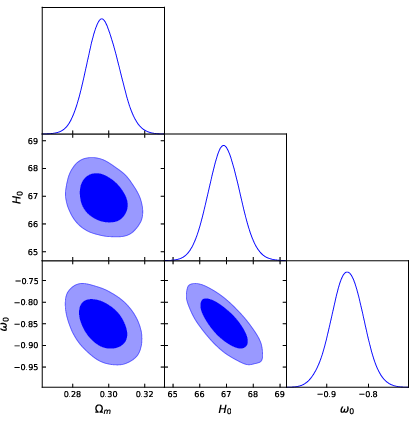
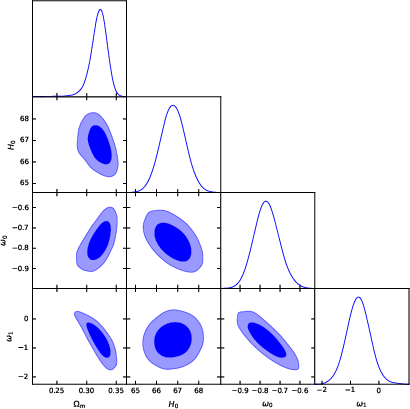
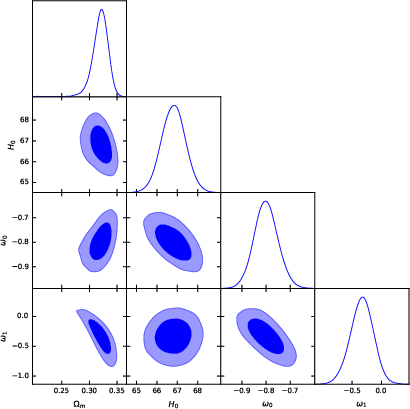
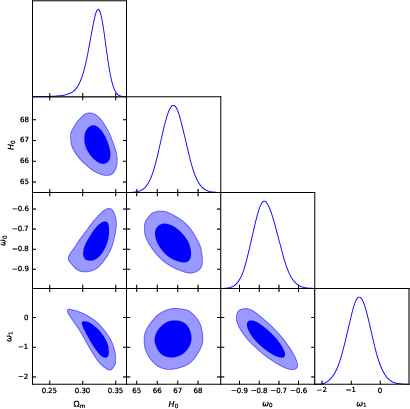
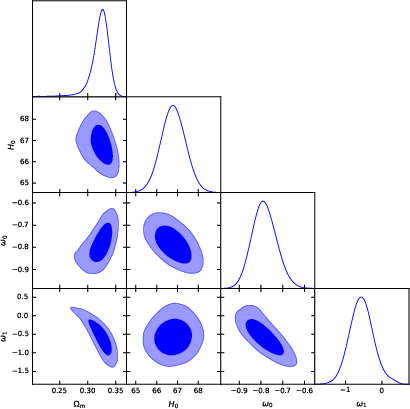
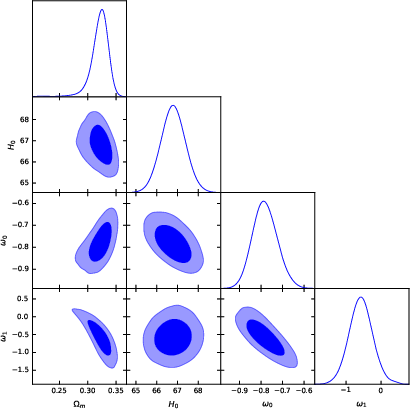
Figure 1: Marginalized posterior constraints for the w0CDM parameterization, displaying one- and two-dimensional confidence contours for H0, Ωm, and w0.
Principal Results
The standard Λ0CDM (Λ1) fit yields a best-fit Λ2 km sΛ3 MpcΛ4 and Λ5. Introduction of dark energy dynamics leads to a substantial reduction in Λ6 by Λ7 across all tested extensions, with no significant difference in Λ8 among the various dynamical EoS parameterizations.
The Λ9CDM model yields wDE(z)0, a statistically significant wDE(z)1 deviation from the cosmological constant value. Corresponding wDE(z)2 is moderately reduced to wDE(z)3 km swDE(z)4 MpcwDE(z)5, addressing a fraction of the Hubble tension, though not eliminating it. Two-parameter models (CPL, BA, JBP, logarithmic, exponential) constrain wDE(z)6, with associated evolution parameters wDE(z)7 to wDE(z)8. While wDE(z)9 is negative in all explored cases, uncertainties remain such that these models provide only a mild indication of time-evolving dark energy.
AIC differences (w00) and favorable BIC for dynamical models indicate strong evidence against w01CDM in favor of a dynamical w02. The simplest one-parameter w03CDM is statically preferred due to its economy, while two-parameter forms are competitive but not distinguishable given current data precision.
Theoretical and Practical Implications
The analysis robustly disfavors w04 at high significance in combined late-Universe probes, implying either a breakdown of the cosmological constant hypothesis or the presence of systematic effects yet unidentified in these datasets. All dark energy parameterizations with w05 at w06 and w07 suggest a scenario where dark energy density becomes less negative or evolves away from vacuum energy dominance at higher w08.
From a model-selection perspective, these results lend substantial weight to the investigation of dynamical dark energy phenomenology in late-time cosmology, but current observational precision and degeneracy among parameterizations prohibit distinguishing between different functional forms. The findings underscore the necessity for next-generation datasets with tighter systematics, increased redshift reach, and higher precision on Hubble measurements.
Prospects for Future Exploration
While current CMB-independent late-time constraints signal a mild-to-moderate preference for dark energy evolution, future wide-field BAO, cosmic chronometer, and high-w09 SNe surveys will be required to distinguish between classes of w00 models and to statistically confirm or refute the deviation from w01CDM. In particular, further cross-correlation with early Universe data and careful consideration of cross-survey systematics remain vital for future cosmological inference.
Conclusion
The joint analysis of DESI DR2, Pantheon+, and cosmic chronometer datasets reveals that models of time-varying dark energy are favored over w02CDM by current late-time cosmological data. The w03CDM extension, with w04, provides the best-fit, most parsimonious scenario, though all dynamical models are statistically competitive. Despite this, dataset precision and degeneracy prevent discriminatory power regarding the functional form of w05. Forthcoming advancements in late-Universe probes are required for decisive statements on the underlying physics of dark energy.
Reference: "Probing the Evolution of Dark Energy: A Joint Analysis of DESI DR2, Pantheon+, and Cosmic Chronometers" (2604.05849)