- The paper develops a holographic reconstruction method leveraging optimal transport theory and Husimi Q-representation to produce an emergent 1D Wasserstein spacetime.
- It demonstrates that 1-Wasserstein distances applied to harmonic oscillator eigenstates yield an exactly one-dimensional geometric embedding that maps to a bulk spacetime analogy.
- The work unifies optimal transport, Lindblad dynamics, and Krylov complexity to model emergent black hole evolution and establish connections with AdS2 holography.
Emergent Holographic Spacetime via Optimal Transport: Wasserstein Geometry in Quantum Systems
Introduction and Conceptual Framework
The paper develops a new paradigm for bulk reconstruction in holography, leveraging optimal transport theory—specifically, Wasserstein distances—and the manifold hypothesis central in representation learning and AI. The challenge addressed is the emergence of higher-dimensional, curved gravitational spacetime from the lower-dimensional quantum boundary theory in AdS/CFT, reframed as a dimensionality-reduction problem in infinite-dimensional Hilbert spaces of quantum states. The hypothesis is that the holographic bulk emerges as a low-dimensional, possibly curved Wasserstein space—comprised of probability distributions representing quantum states—with the manifold hypothesis acting as the selection criterion for the appropriate (i) metric (distance), (ii) representation, and (iii) quantum state ensemble.
The authors focus on the following choices:
- Distance (i): p-Wasserstein metrics induced by optimal transport, rather than information-theoretic (e.g., KL divergence) or Hilbert space-based distances (e.g., Fubini-Study), as only Wasserstein distances capture the geometric structure and costs for "moving" one quantum state distribution to another.
- Representation (ii): Husimi Q-representation of quantum states, preferred over bare probability density ∣ψ(x)∣2 or the Wigner function, due to its positivity and smoothness, which are necessary for a proper Wasserstein geometry and for sidestepping the sign/negativity issues in phase-space representations.
- Quantum state set (iii): Energy eigenstates (for the harmonic oscillator), reflecting the physical connection between energy and the emergent holographic direction.
The practical implementation, detailed in the context of the harmonic oscillator, Lindblad dynamics, and SYK model, seeks a basis and metric under which the quantum state space exhibits low intrinsic dimension and can be interpreted as an emergent spacetime.
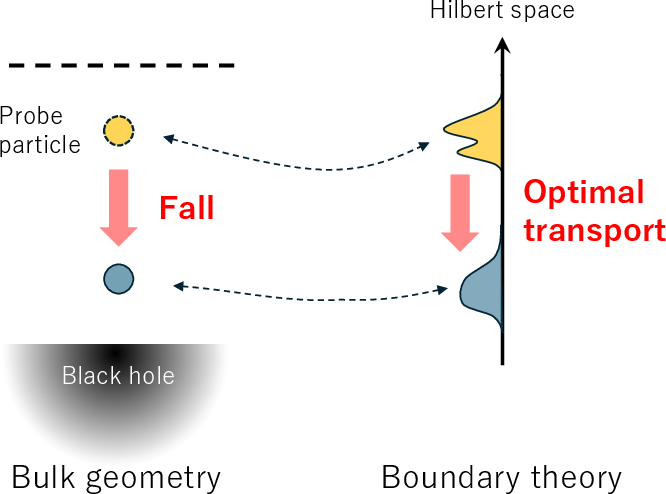
Figure 1: Schematic picture illustrating the proposal—holographic spacetime emerges as a low-dimensional Wasserstein manifold from quantum probability distributions.
Wasserstein Geometry from Quantum Harmonic Oscillator
The investigation begins with the quantum harmonic oscillator as a computationally tractable prototype for infinite-dimensional quantum systems. The eigenstates are mapped to probability distributions (in both x-space and phase space via the Husimi Q-function). Wasserstein distances Wp between these distributions for various p are computed, assembling the pairwise distance matrices, and embedding analysis is conducted via classical multidimensional scaling (MDS).
Strong numerical and analytic evidence is presented that p=1 (the 1-Wasserstein distance, or Earth-Mover's Distance) applied to the Husimi Q representation gives rise to an exactly one-dimensional Wasserstein space for the set of oscillator eigenstates. For all pairs, the Wasserstein distance aligns not only numerically but also analytically (via explicit calculation of CDFs and quantile functions) with a coordinate Z(n) that depends solely on the energy quantum number, confirming a totally ordered set of cumulative distributions without crossings.
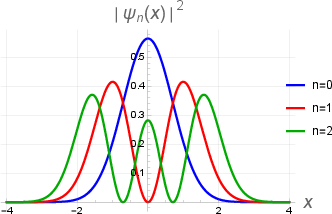
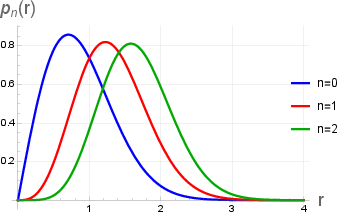
Figure 2: Probability densities and Husimi Q-representations for n=0,1,2; Q-representations exhibit no intersection, crucial for 1D geometry.
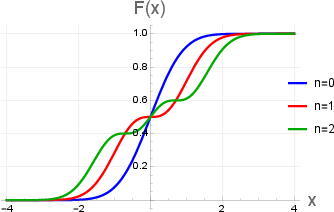
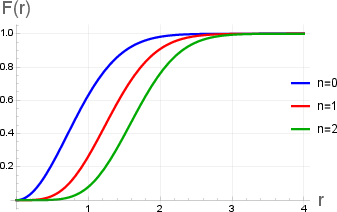
Figure 3: Cumulative distributions (CDFs) for probability and Husimi Q-representations. The strict ordering for Q-representation underlies the exact 1D Wasserstein embedding.
This construction is nontrivial: for all other p and for other representations, either higher embedding dimension or non-Euclidean behavior emerges (verified via spectrum and rank of the MDS Gram matrix). Thus, the Wasserstein geometry is shown to be not only regular but also minimal—a key requirement for a "holographic" reconstruction.
Temporal Evolution: Lindblad Dynamics and Emergent Black Hole Geometry
To add a "time" direction and induce nontrivial trajectories in the quantum distribution space, open quantum system dynamics are employed: the oscillator is coupled to a bath, generating Lindblad dynamics with the annihilation operator as the jump operator. This leads to classical Fokker-Planck dynamics for the Husimi Q-representation, permitting analytic and numerical calculation of the time-dependence of Wasserstein distances as states relax from excited to ground state.
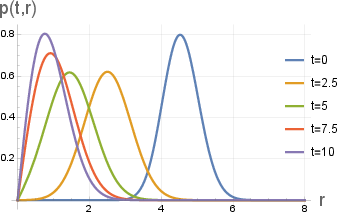
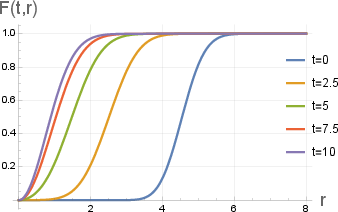
Figure 4: Time evolution of the Husimi Q-distribution and its CDF under Lindblad dynamics from an initially excited state.
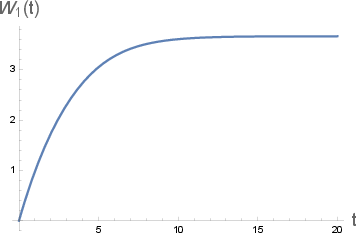
Figure 5: Monotonic increase of 1-Wasserstein distance from initial excited state, approaching the maximal Z(m) asymptotically.
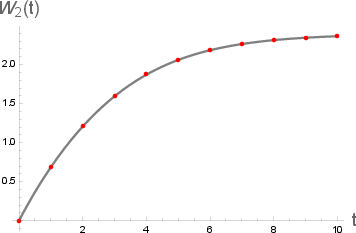
Figure 6: Comparison of 2-Wasserstein and 1-Wasserstein distance dynamics; both coincide, highlighting the robustness of the emergent geometric description.
At early times, the Wasserstein distance grows linearly with time, while at late times it saturates exponentially—a behavior characteristic of black hole redshift in the near-horizon region. By identifying the 1-Wasserstein distance as the radial coordinate of emergent space (∣ψ(x)∣20), the authors reconstruct a spatial geometry:
∣ψ(x)∣21
where the blackening function ∣ψ(x)∣22 possesses a horizon at ∣ψ(x)∣23, in precise analogy with Rindler and near-horizon AdS geometries. Multiple initial energy eigenstates generate congruent falling trajectories in this spacetime upon suitable rescaling, further confirming the geometric picture.
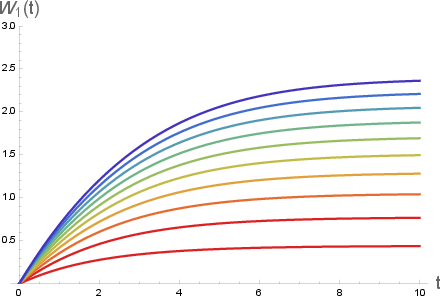
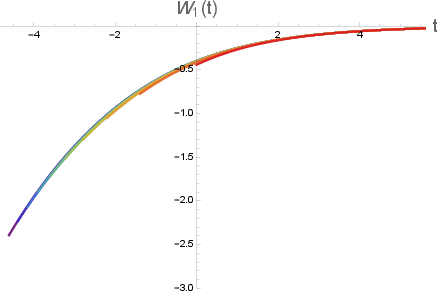
Figure 7: Time evolution of 1-Wasserstein distance for varying initial conditions; after appropriate shifting, all trajectories collapse to the same null-like trajectory, reinforcing the emergent bulk interpretation.
Application to the SYK Model and Consistency with AdS∣ψ(x)∣24 Geometry
To test the generality of this construction beyond a simple toy model, the Lindblad framework is applied to the Sachdev-Ye-Kitaev (SYK) model, widely believed to possess a low-energy AdS∣ψ(x)∣25 gravitational dual. By considering two-Majorana subsystems with a qubit Hilbert space, Lindbladian time evolution (driven by both creation and annihilation operators in the set of possible bath interactions) leads to exponential-in-time evolution of Wasserstein distances:
∣ψ(x)∣26
By reconstructing the bulk geometry from these distance functions, the metric and dynamical properties are found to match those of the AdS∣ψ(x)∣27 Schwarzschild black hole, with identification ∣ψ(x)∣28 as the holographic coordinate and ∣ψ(x)∣29 as the Hawking temperature.
Wasserstein Distance and Krylov Complexity: Structural Equivalence
An essential theoretical finding is the identification of the 1-Wasserstein distance trajectory (for Lindblad-evolving mixed states) with a generalized Krylov complexity, a modern operator growth measure linked to bulk geometric quantities in holography. This is made explicit by writing the time-dependent density matrix as a superposition over energy eigenstates with coefficients x0, and 1-Wasserstein distance as:
x1
which is in direct correspondence with Krylov complexity's basis-expansion weighted by operator-level "distance" measures. Unlike standard Krylov complexity, however, Wasserstein space is defined independently of the initial operator and features a universal metric distance structure, not contingent on a particular system's algebra or basis.
Comparison of Representations, Metrics, and Uniqueness
The necessity and uniqueness of Husimi Q-representation for achieving exactly 1D Wasserstein geometry under the manifold hypothesis is underscored by the failure of probability distributions and other x2 to provide isometric embeddability for physically meaningful quantum state sets. Euclidean embeddability, non-crossing of CDFs, and dimension reduction derive directly from the Q-representation and x3 choice.
Furthermore, the authors emphasize that Wasserstein distances discriminate between orthogonal quantum states (Hilbert space distances and KL divergences do not), are not invariant under arbitrary change of basis (and therefore encode more geometric information), and allow for meaningful distinction between states with non-overlapping support.
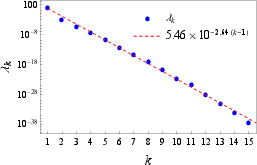
Figure 8: Eigenvalue spectrum of the Gram matrix for x4 Wasserstein distance (Q-representation); only x5 exhibits strict rank-1 (1D) structure, others show larger effective dimension or non-Euclidean features.
Theoretical and Practical Implications, and Future Directions
Theoretical Implications: The framework positions holography as an effective, data-driven dimensional reduction mechanism specified by the optimal transport geometry of quantum state distributions. The strict selection of x6 and Husimi Q-representation, as justified via both analytic and machine-learning-motivated arguments, provides a more "intrinsic" notion of the emergent bulk coordinate and metric. The seamless mapping onto Krylov complexity suggests broader connections between information-theoretic, dynamical, and geometric measures of quantum many-body dynamics and their gravitational duals.
Practical Implications: The methodology is computable for a range of quantum systems; Wasserstein metrics have well-developed computational infrastructure, and the approach can generalize to higher-dimensional QFTs and other metric flows (potentially under Lindblad or unitary dynamics). The construction may inform basis selection and metric learning in ML-based bulk reconstruction and bridge understanding between quantum complexity, operator growth, and geometry.
Contradictory or Bold Claims: The assertion that exact one-dimensional emergent geometry is only possible for the 1-Wasserstein distance of Husimi Q-representations among energy eigenstates is sharply supported and would not extend to other x7 or representations, given the rigorous embedding results.
Speculation and Future Prospects: Application to interacting quantum field theories, CFTs, and larger SYK variants are natural next steps. Extending the analysis to strictly "quantum" Wasserstein metrics between density matrices (rather than classical distributions) may better capture the nuances of quantum-to-classical emergence and encode operational quantum information flow.
Conclusion
By synthesizing optimal transport theory, the manifold hypothesis, and contemporary concepts of operator complexity and open-system quantum dynamics, this work demonstrates that a holographically emergent bulk spacetime can be universally constructed as a Wasserstein space of quantum probability distributions—provided the metric and representation are properly selected. The approach accurately captures both static and dynamical (black hole-like) geometric features even in simple quantum mechanical systems and correctly reproduces the known bulk geometry for SYK systems, supporting its validity as a formal organizing principle for holography, quantum complexity, and geometric emergence.

