- The paper develops a framework that quantifies large-scale cosmic structure via entropic curvature computed in Wasserstein space.
- It introduces a scale-localized notion of Ricci curvature derived through optimal transport and entropy evaluations, bridging abstract measure geometry with observable structure.
- The approach reduces to classical Hessian-based cosmic web classification under a quadratic approximation, enabling multiscale analysis of anisotropy and structure.
Geometric Entropic Curvature in Wasserstein Space: A Framework for Cosmological Large-Scale Structure
Introduction and Motivation
The work "A Geometric Theory of Cosmological Structure via Entropic Curvature in Wasserstein Space" (2604.00593) proposes a formalism for analyzing cosmological large-scale structure (LSS) using optimal transport and Wasserstein geometry. Traditional methodologies for LSS quantification predominantly leverage local differential characteristics of the density field, such as Hessian eigenvalue patterns to distinguish cosmic web environments (voids, sheets, filaments, halos), or amplitude-based statistics including the two-point correlation function and power spectrum. These approaches are primarily amplitude-centric and only implicitly encode the spatial redistribution of matter.
Contemporary developments in applied mathematics have clarified that spaces of probability measures equipped with the Wasserstein distance—arising from optimal transport—possess nontrivial geometric and (in a generalized sense) Riemannian structure, with several types of Ricci curvature defined through the convexity of entropy functionals along Wasserstein geodesics. The present paper translates these achievements to the cosmological context, defining a scale-localized, observationally accessible notion of Ricci curvature on the space of probability measures, and demonstrating its natural reduction to standard Hessian-based classifications under a quadratic approximation.
Wasserstein Geometry, Entropic Curvature, and Curvature-Dimension Theory
Central to the framework is the geometry of the probability measure space P2(M) endowed with the 2-Wasserstein distance W2, defined via optimal transport with quadratic cost. For measures μ,ν∈P2(M), W22(μ,ν) measures the minimal quadratic cost required to rearrange μ into ν.
In this geometry, Wasserstein geodesics define displacement interpolations between probability measures, and are the natural analogs of straight lines for distributions, not locations. Entropy functionals (Kullback-Leibler and R\'enyi types) act as convex potentials whose geodesic convexity characterizes lower bounds on Ricci curvature (in the synthetic, Lott-Sturm-Villani/ Bakry-Émery sense). Specifically, the CD(K,N) curvature-dimension condition encodes these lower bounds and an upper bound on the "dimension" of the measure space, with finite-N effects corresponding to volume distortion.
Crucially, curvature in this framework is not a pointwise tensor but emerges as an entropic response: the deficit of entropy at the geodesic midpoint compared to the linear interpolation. The effective entropic Ricci curvature
Keff(μ0,μ1;t)=t(1−t)W22(μ0,μ1)2[(1−t)E(μ0)+tE(μ1)−E(μt)]
quantifies the strength of this convexity.
Localization: From Abstract Measure Curvature to Observable Structure
A main technical step is the localization of Wasserstein entropic curvature to finite spatial scales—crucial for practical application to real or simulated cosmological datasets. For a point x and window W20, a local probability measure W21 is constructed by restricting and normalizing the observed density within W22. An appropriate reference (e.g., uniform or smoothed) measure W23 is similarly constructed. Comparison between W24 and W25 via optimal transport provides a Wasserstein geodesic; evaluating the entropy drop at W26 yields a localized curvature observable:
W27
(and analogously for the finite-W28 R\'enyi case).
This construction enables the analysis of LSS not merely by local density gradient, but by quantifying the "flexibility" of local mass rearrangements as controlled by entropic curvature.
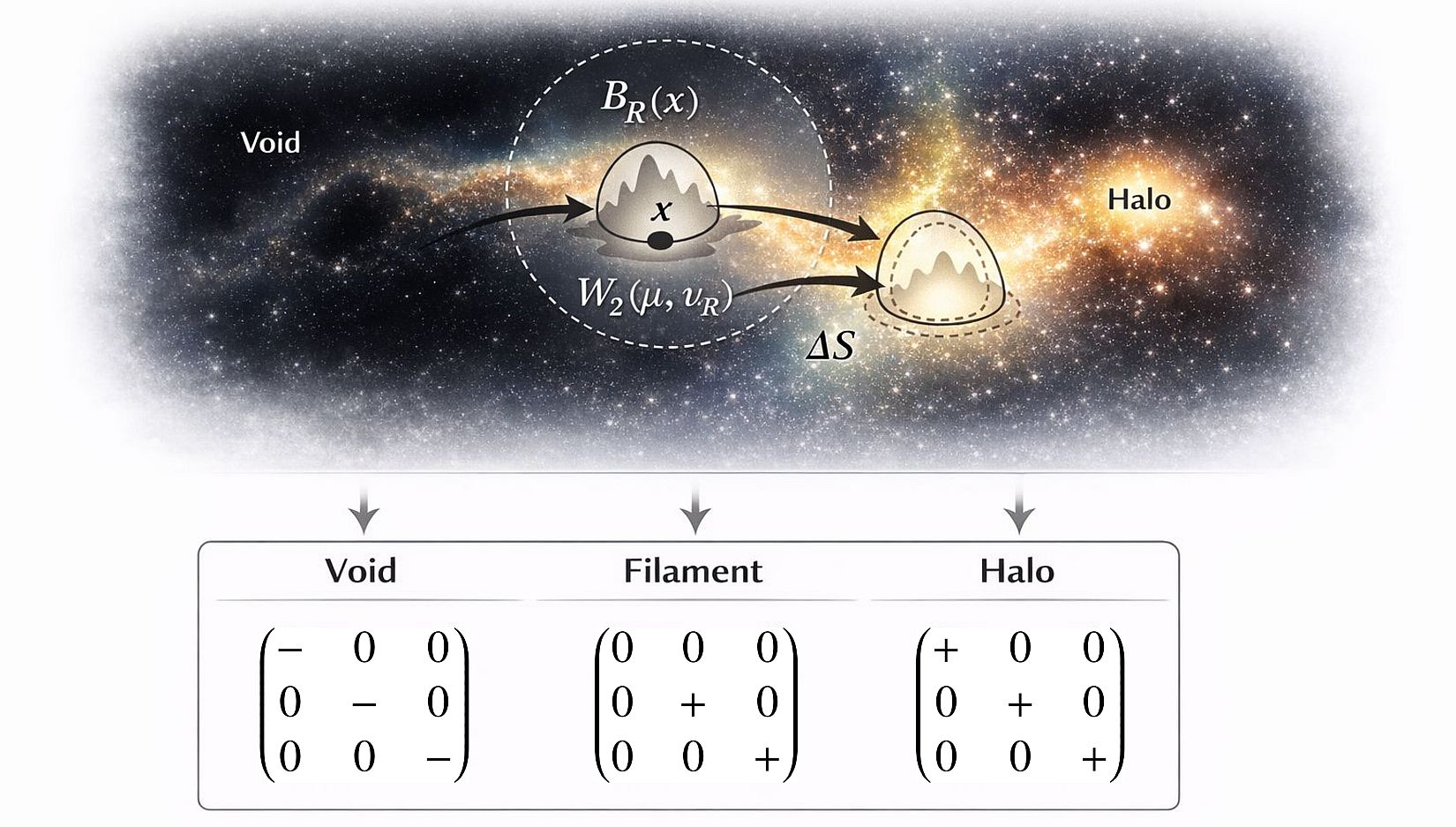
Figure 1: Schematic illustration of the local effective curvature in large-scale structure. Top: a local region W29 defines a probability measure μ,ν∈P2(M)0, which is compared to a reference μ,ν∈P2(M)1 via optimal transport; the entropy variation along the Wasserstein geodesic quantifies the local curvature. The bottom panel links effective curvature structure to the Hessian of the log-density, clarifying the connection to classical cosmic web classifications.
Connection to Cosmic Structure Classification: The Local Quadratic Limit
In the limit where the window size μ,ν∈P2(M)2 and the density field is smooth, the local entropy-based Ricci curvature reduces to the Rayleigh quotient of the Hessian of the log-density. Explicitly,
μ,ν∈P2(M)3
with μ,ν∈P2(M)4, thus establishing a direct connection to eigenvalue-based cosmic web identification. The sign and degeneracy of the eigenvalues correspond to voids, sheets, filaments, and halos:
- All eigenvalues negative: void
- Two positive, one zero (or nearly so): filament
- All positive: halo
The R\'enyi-based curvature accentuates high-density regions, providing relative indicators of structure concentration (μ,ν∈P2(M)5). Direction-averaged mean curvature and anisotropy are then formally linked to the spectrum of μ,ν∈P2(M)6.
Scale Dependence and Multiscale Structure
Unlike static definitions of Ricci curvature, the local entropic curvature introduced here is explicitly scale-dependent (i.e., a function of μ,ν∈P2(M)7), with nontrivial behavior under changes in window size. This scale flow does not correspond to geometric time evolution (Ricci flow), but to coarse-graining in observational or smoothing resolution. Structural transitions and sign reversals can arise as mixed environments interpolate between, e.g., halo and filament at different μ,ν∈P2(M)8, a consequence of both the nonlinear corrections in the covariance expansion and the multiscale geometry of the cosmic web.
By treating the localized curvature observable as a random field induced by the underlying stochastic density field, the author connects the moments of the curvature field to derivatives of the two-point correlation function and μ,ν∈P2(M)9, W22(μ,ν)0 moments of the power spectrum. Thus, curvature statistics encode geometric content and high-frequency (small-scale) structure sensitivity not captured by amplitude statistics alone. The R\'enyi-based corrections further isolate nonlinear, high-density environments.
Implications, Extensions, and Future Directions
This geometric, entropic transport formulation of LSS yields a unified theoretical basis encompassing classical Hessian techniques as the local, quadratic-density limit, but introduces a fundamentally scale- and environment-sensitive, physically interpretable notion of curvature for general probability distributions. The resulting estimators naturally decompose into local measure construction, reference selection, optimal transport computation, and entropy evaluation, and are directly applicable to discrete galaxy (or simulation particle) data via empirical measures.
From a practical standpoint, this approach provides a new avenue for classifying cosmic web environments, quantifying structural anisotropy at multiple scales, and potentially defining new, geometric statistics of galaxy and matter distributions sensitive to nonlinear structure formation. The theoretical link between the measure-space curvature and peak statistics suggests reconstructive connections between BBKS-type approaches and the present framework.
Further developments would encompass:
- Numerical validation of finite-sample estimators, including considerations of windowing, bias, and sample variance.
- Systematic comparison to and integration with persistent homology and other topological data analysis methods.
- Application to reconstructed cosmic initial conditions, Lagrangian structure clustering, and cosmological parameter inference using curvature-enhanced statistics.
- Extensions to time-dependent (Lagrangian) structure flow in non-equilibrium cosmologies.
- Exploitation of curvature-driven notions for bias modeling and halo/object assignment in cosmological fields.
Conclusion
This work systematizes cosmological large-scale structure analysis in the language of entropic Wasserstein geometry, providing scale-localized, entropy-derived measures of curvature that interpolate between abstract optimal transport geometry and traditional Hessian-based web classification. It formalizes a response-based, multiscale framework for geometric statistics, with clear pathways to both methodological innovation and phenomenological application in computational and observational cosmology.