- The paper demonstrates that creep dynamics are controlled by a temperature-independent activation length and a T-dependent avalanche scale.
- It uses a Dijkstra-based search and kinetic Monte Carlo methods to capture spatial heterogeneity and temporal relaxation in disordered media.
- The findings decisively rule out alternative scaling models, firmly establishing the depinning exponent scenario in finite-temperature creep.
Two Emerging Length Scales in Finite-Temperature Creep Dynamics of an Elastic Interface
Introduction
The study “Activation and Avalanche Length Scales in the Finite-Temperature Creep of an Elastic Interface” (2604.17600) rigorously delineates the interplay between thermally activated dynamics and spatial correlation phenomena in driven elastic interfaces within disordered media well below depinning. This work provides a quantitative and conceptual advance by demonstrating that finite-temperature creep is controlled by two distinct length scales: a temperature-independent activation length and a temperature-dependent avalanche length. The findings bridge phenomenology observed in athermal depinning, glassy relaxation, and thermally activated domain-wall creep, and decisively settle competing theoretical predictions for avalanche scaling in the creep regime.
Model, Numerical Scheme, and Observables
The system is a one-dimensional directed elastic line, subject to random Gaussian disorder and driven by a sub-threshold force f<fc. The authors apply a Dijkstra-based search to enumerate optimal energy-lowering rearrangements and use kinetic Monte Carlo (KMC) with Arrhenius barrier rates to select activated moves, followed by deterministic relaxation using a variant Monte Carlo (VMC) protocol. This dynamic is exact in the T→0+ limit and is systematically extended to finite T. The core observables are the structure factor S(q), characterizing roughness across length scales, the persistence function, and the four-point dynamical susceptibility χ4(τ).
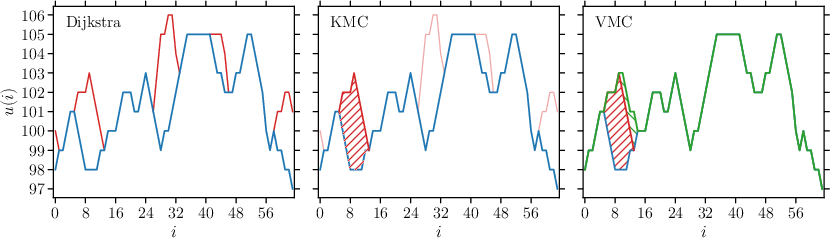
Figure 1: Schematic workflow: (left) identification of energy-lowering rearrangements (red) from a metastable configuration (blue) via Dijkstra search; (middle) stochastic KMC selection with Arrhenius rates; (right) deterministic VMC relaxation to metastability (green).
Activation and Avalanche Length Scales
Optimal Rearrangement Scale (ℓopt)
At T→0+, the roughness at small scales is controlled by an equilibrium exponent ζeq=2/3. The crossover to depinning-like roughness ζdep=5/4 occurs at length scale ℓopt(f), associated with the size of droplets overcoming the largest barriers—this scale is temperature independent, determined solely by the force T→0+0. The interface geometry confirms that droplet/barrier scaling is valid for metastable configurations at all T→0+1.

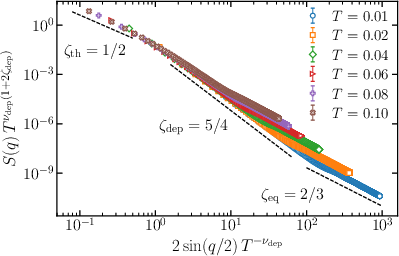
Figure 2: T→0+2 reveals the equilibrium-to-depinning crossover at T→0+3, which does not vary with temperature, and a second, emergent large-scale crossover dependent on T→0+4. Data collapse identifies the scaling of the avalanche length.
Avalanche Scale (T→0+5)
Beyond T→0+6, spatiotemporal fluctuations are dominated by thermally activated avalanches—cascades of deterministic relaxations triggered by thermal kicks. The fundamental assertion, supported by independent geometrical and dynamical measures, is that the avalanche scale diverges as temperature decreases,
T→0+7
where T→0+8 is the depinning correlation length exponent. This result is incompatible with alternative functional RG predictions T→0+9 and with T0 scaling posited for amorphous solids, decisively selecting the “depinning exponent” scenario [de Geus et al., Phys. Rev. E (2025)].
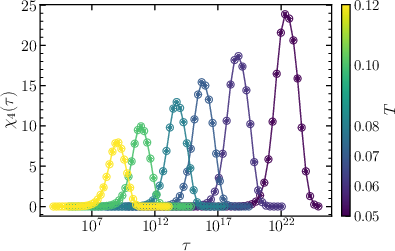
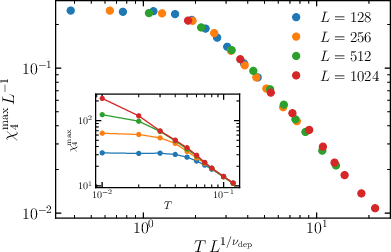
Figure 3: (Left) Four-point susceptibility T1 demonstrates growing dynamical correlation at lower T2; (Right) Scaling collapse of T3 shows T4.
Temporal and Spatial Decoupling
Temporal properties are examined via the persistence T5 and the alpha-relaxation time T6, defined by T7. The relaxation is strongly heterogeneous and exhibits clear Arrhenius scaling with T8, reflecting the dominance of rare, large-barrier activation events at T9. However, the spatial organization of motion, as evidenced by the scaling of S(q)0, is governed by S(q)1, set by the energy dissipated in deterministic cascades regardless of the temporal bottleneck.
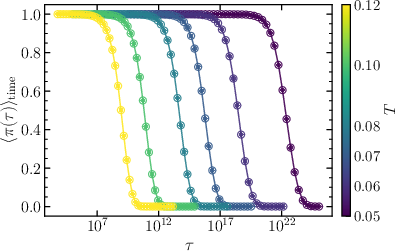
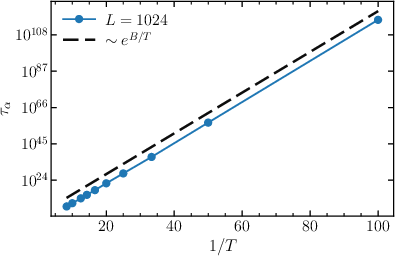
Figure 4: (Left) Persistence relaxes more slowly and heterogeneously for lower S(q)2; (Right) Arrhenius scaling of S(q)3 confirms that the timescale is set by temperature-independent energy barriers.
Regimes at Finite S(q)4 and S(q)5: Structural Crossovers
The scale-dependent roughness exponents (S(q)6 at small, S(q)7 at intermediate, S(q)8 at large S(q)9) are confirmed, with χ4(τ)0 and χ4(τ)1 setting the geometry. At χ4(τ)2, only the equilibrium-to-depinning crossover is present. At finite χ4(τ)3, the large-scale interface relaxes toward the thermal exponent χ4(τ)4 for χ4(τ)5. This provides a unified picture consistent with known athermal and high-χ4(τ)6 limits.
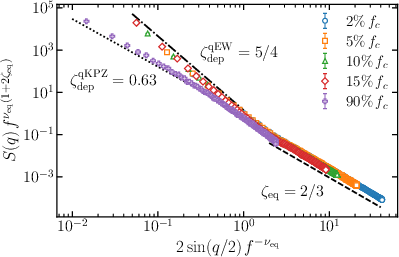
Figure 5: χ4(τ)7 at χ4(τ)8 for various χ4(τ)9 exhibits equilibrium-to-depinning crossover, matching the scaling scenario when ℓopt0.
Broader Implications and Connections
The establishment of two distinct, scale-separating processes—activation at fixed ℓopt1 governing temporal dynamics and collective, temperature-dependent avalanches at ℓopt2—generalizes across disordered elastic systems. The results unify intermittency in interface motion with dynamical heterogeneity in glassy relaxation and predict that spatial correlations in creep and glassy flow should be governed by the same ℓopt3 phenomenology, even in amorphous solids and frictional interfaces. This work thus has significant implications for the interpretation of experimental fluctuation/dynamical length scale measurements across a range of driven glassy and disordered systems [Ciamarra et al., (Ciamarra et al., 5 Mar 2026)].
Figure 1: Algorithmic sequence as realized in simulation directly implements the two-step separation of timescales and lengthscales central to the theoretical picture.
Conclusion
This work conclusively demonstrates that the finite-temperature creep dynamics of an elastic line below depinning are governed by two distinct length scales: a temperature-independent activation length ℓopt4 that fixes the relaxation timescale and a temperature-dependent avalanche length ℓopt5 controlling spatial correlations. The avalanche cutoff scaling effectively rules out prior RG-based and amorphous solid phenomenologies, firmly establishing the depinning exponent scenario. These insights lay the foundation for a comprehensive understanding of spatiotemporal heterogeneity in disordered driven systems, informing both the analysis of experimental data and the construction of minimal theories for slow relaxation in glasses, magnetic systems, and frictional interfaces.