- The paper introduces a zero-temperature avalanche criticality framework that explains the system-size and temperature dependence of dynamical susceptibility in supercooled liquids.
- It employs molecular simulations of the Kob-Andersen binary Lennard-Jones model, uncovering power-law scaling of correlation lengths and critical exponents indicative of avalanche dynamics.
- The study links avalanche criticality to the breakdown of the Stokes-Einstein relation, providing a quantitative bridge between thermal relaxation and athermal yielding phenomena.
Zero-Temperature Avalanche Criticality in Supercooled Liquids
Introduction
Dynamic heterogeneity (DH) in supercooled liquids manifests as spatiotemporal coexistence of mobile and immobile regions, with the typical domain size increasing as temperature is lowered. The mechanistic origin of this growth of DH, especially the observed system-size and temperature dependences of dynamical susceptibility (DS), remains contested despite extensive analyses within frameworks such as mode-coupling theory, random first-order transition theory, and various kinetic and structural order-based theories. The present work demonstrates that these dependencies in the canonical Kob-Andersen binary Lennard-Jones mixture can be interpreted within a zero-temperature avalanche criticality scenario, hitherto associated primarily with athermal yielding phenomena.
Dynamical Heterogeneity and Susceptibility
Molecular simulations of the Kob-Andersen model were used to systematically investigate DH across 0.44≤T≤1.0 (TMCT≈0.435) and system sizes 200≤N≤1500, constrained to temperatures above the mode-coupling crossover. DH is visualized by thresholding particle displacements, yielding growing clusters of mobile regions as T decreases.
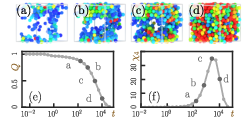
Figure 1: Snapshots illustrating growth of dynamical domains and evolution of the overlap Q(t) and dynamical susceptibility χ4(t), demonstrating pronounced heterogeneity upon cooling.
The four-point susceptibility χ4(t) peaks at the structural relaxation time and its maximum χ4∗ quantifies the spatial extent of correlated rearrangements. Critically, χ4∗ increases strongly with decreasing T and exhibits pronounced finite-size effects for TMCT≈0.4350.
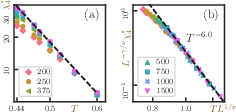
Figure 2: Log-log representation of the peak susceptibility TMCT≈0.4351, revealing power-law scaling with TMCT≈0.4352 and supporting finite-size scaling indicative of criticality.
Scaling and Avalanche Criticality
Crucially, TMCT≈0.4353 and its associated correlation length TMCT≈0.4354 in this regime are consistent with avalanche-type scaling: TMCT≈0.4355, TMCT≈0.4356, with independently determined exponents TMCT≈0.4357, TMCT≈0.4358, TMCT≈0.4359. Finite-size scaling collapse of 200≤N≤15000 confirms the existence of a thermal critical point below 200≤N≤15001.
A central result is that extraction of unstable modes at saddle points, equivalent to incipient shear transformation events, produces a system-size independent fraction 200≤N≤15002 with 200≤N≤15003 for 200≤N≤15004, yielding a consistent estimate for the fractal dimension of avalanches. The correlation length 200≤N≤15005 obtained from finite-size scaling of the Binder cumulant is quantitatively consistent with that determined from the susceptibility scaling.
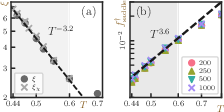
Figure 3: Temperature dependence of correlation lengths 200≤N≤15006, 200≤N≤15007, and fraction of unstable saddle modes 200≤N≤15008, confirming power-law scaling in the critical regime.
Stability and Onset of Criticality
The onset temperature 200≤N≤15009 marks a clear stability enhancement, as quantifiable via low-frequency vibrational density of states prefactor T0 associated with quasilocalized modes. For T1, T2 is constant, while for lower T3 it decreases, signaling increasing mechanical stability. This bound on the scaling regime is independent of dynamical observables.
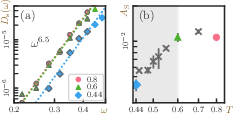
Figure 4: Log-log plot of the prefactor T4 of the vibrational density of states; its decrease below T5 indicates enhanced stability and the onset of critical scaling.
Breakdown of the Stokes-Einstein Relation
A secondary focus is the decoupling between diffusion and structural relaxation, i.e., Stokes-Einstein (SE) violation. Two metrics of DH—the overlap-based T6 and the displacement-based T7—probe lattice- and event-based definitions of avalanches, yielding different exponents T8 and T9. The SE breakdown is then interpreted as Q(t)0, where Q(t)1 is the diffusion constant and Q(t)2 the event time scale. The scaling holds provided Q(t)3 tracks the event-based susceptibility peak rather than the Q(t)4-relaxation time.
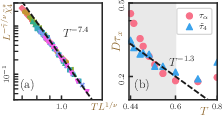
Figure 5: Temperature dependence of the displacement-based susceptibility Q(t)5 and scaling of Q(t)6 using the event-based time scale, consistent with avalanche criticality prediction.
Implications and Outlook
This study operationalizes a rigorous analogy between thermal relaxation in supercooled liquids and zero-temperature criticality in athermal glasses, demonstrating that dynamic heterogeneity and breakdowns in classical transport relations arise from the statistical properties of thermal avalanches well-captured by universal exponents. Notably, this framework provides a unified interpretation for the growth and finite-size scaling of DH, the emergence of critical correlation lengths, and nontrivial features such as SE relation violation in the deeply supercooled regime.
The theoretical implication is that the supercooled liquid, above its MCT crossover but below Q(t)7, experiences thermal facilitation of correlated rearrangements manifesting as scale-free avalanches with system-size dependent signatures—mirroring athermal yielding physics. Contrastingly, for Q(t)8, DS saturates, and another, as yet unidentified, mechanism becomes dominant.
Practically, these findings provide a robust basis for anticipating and characterizing the behavior of glass-forming liquids in finite geometries, motivate the use of criticality-inspired statistical measures and scaling forms in soft matter, and suggest new routes for controlling or predicting transport anomalies in glassy materials.
Conclusion
A zero-temperature avalanche criticality scenario accounts for the full system-size and temperature dependence of dynamical heterogeneity in the Kob-Andersen supercooled liquid for Q(t)9. This result establishes that, to leading order, supercooled liquids in this regime operate under the universality class of thermal avalanche dynamics rather than the static growing-order paradigms of the RFOT or MCT. Saturation of DS below χ4(t)0 leaves open the question of the dominant physical mechanism in the deeply glassy state, but sets rigorous limits for the applicability of avalanche criticality. The present analysis thereby provides a bridge connecting athermal deformation physics to equilibrium relaxation in the supercooled regime and a quantitative foundation for further theoretical refinement and experimental validation of glass formation.