- The paper demonstrates that spectrographs with R > 1,000 can mitigate correlated noise issues that diminish biosignature signals in Earth analog observations.
- It employs a template-matching maximum-likelihood framework incorporating both correlated and uncorrelated noise to robustly estimate signal-to-noise ratios.
- Simulation results indicate that detecting molecules like O₂ reliably requires moderate-to-high resolution, guiding key design trade-offs for future exoplanet missions.
Moderate or High-Resolution Spectroscopy as a Requirement for Earth-Analog Characterization
Introduction
The detection and characterization of biosignature molecules such as H2O and O2 in the atmospheres of terrestrial exoplanets is a central scientific goal for upcoming flagship direct-imaging missions like NASA's Habitable Worlds Observatory (HWO). The prevailing instrument architecture for such missions has historically emphasized low spectral resolution (e.g., R∼140) to mitigate photon noise and detector noise penalties due to the extremely low flux ratios of Earth-analogs in reflected light. However, this work presents a rigorous statistical and simulation-driven framework that challenges the paradigm of exclusively low-resolution spectroscopy. Instead, it demonstrates that correlated noise—particularly chromatic speckle residuals—can severely limit biosignature detectability at low resolution, and that moderate-to-high spectral resolution (R>1,000) may not only confer increased robustness, but may even become a necessity when observational systematics are realistically considered (2604.17554).
Statistical Framework for S/N Estimation
The paper formulates a template-matching signal-to-noise ratio (S/N) approach, applicable at arbitrary spectral resolution and incorporating both uncorrelated (shot, background, detector) and correlated (speckle, systematics) noise sources. This is accomplished via a maximum-likelihood fit of a spectral template to simulated data, treating the noise as a Gaussian process with both diagonal and off-diagonal covariance terms.
The broadband (planet detection) S/N and the molecular-specific S/N (after subtracting the continuum envelope) are both computed through this template-matching formalism. In addition, a high-pass filtered molecular S/N is defined, which quantifies the detectability of narrow molecular features after low-frequency (broadband) correlated noise is removed. These definitions provide a consistent, information-theoretic measure of detectability that is valid from R∼20 to R>10,000.
The study underscores that correlated noise—especially residual starlight due to imperfect PSF subtraction, wavefront instability, fringing, and spectral systematics—cannot be ignored, particularly at low spectral resolution where molecular features occur on similar scales as the correlated systematics. As illustrated in (Figure 1):
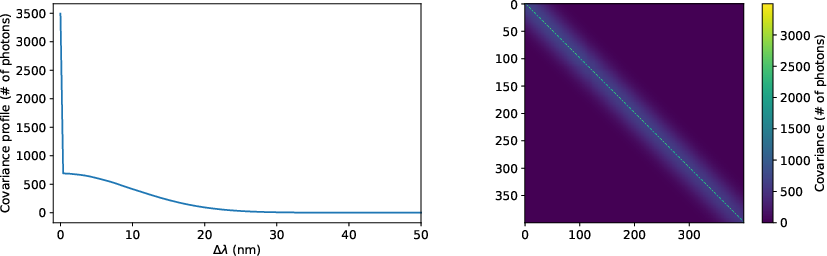
Figure 1: Covariance model exhibiting both uncorrelated (diagonal) and correlated (off-diagonal) noise components, with parameters chosen to reflect realistic instrument stability and starlight suppression characteristics.
A Gaussian covariance kernel is adopted, parameterized by a noise floor (set by post-processing gain and coronagraph suppression) and a correlation length scale (typically on the order of 10 nm, comparable to the width of oxygen absorption bands). This model captures the broad, variable spectral baseline below which molecular detection S/N quickly collapses if the spectral resolution is too low relative to the correlation scale.
Simulation Environment and Assumptions
The authors implement the framework within the EXOSIMS simulation platform, generating a synthetic survey of 164 target stars with one Earth analog each, drawing on the ExEP HWO star list. Critical assumptions include a LUVOIR-analog aperture (7.87 m), realistic coronagraph and spectrograph throughputs (see Figure 2), and detector noise models that reflect current and near-future instrument capabilities.
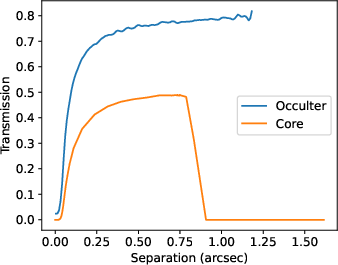
Figure 2: Throughput assumptions for coronagraphy, showing differential transmission for planet flux and background sources (zodiacal/exozodiacal light).
Detector and astrophysical noise components are comprehensively modeled, and 400-hour integrations are adopted as the baseline for signal-to-noise calculations for faint Earth-analogs. Figure 3 illustrates the typical distribution of photon counts and key noise terms for such an observation:
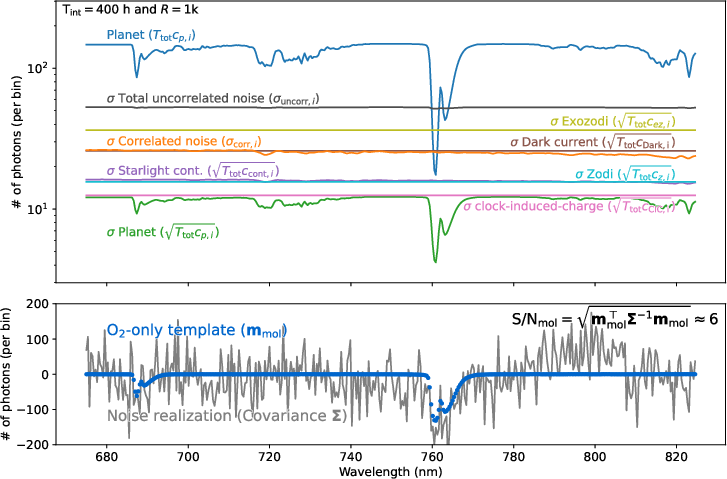
Figure 3: Exemplar mock exoEarth spectrum for a G2V target at 14 pc, showing the relative magnitude of planet signal and various noise components at R=1,000.
Numerical Results and Exploration of Trade Space
Spectral Resolution vs. Noise Sources
A primary result is the quantification of S/N as a function of spectral resolution and dominant noise source (Figure 4). At low R, molecular and planet detection S/N are suppressed by correlated noise if not adequately modeled and subtracted. Specifically, with a correlated noise floor of 10−11 (for a 10−10 starlight suppression coronagraph), the median broadband S/N drops from 20 (detector-noise limited) to 21 (correlated noise-limited).
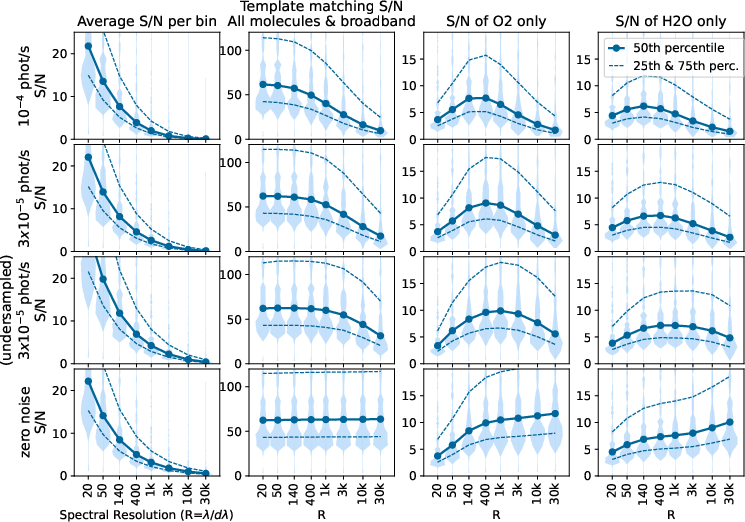
Figure 4: S/N for various diagnostic definitions (per bin, template-matching, molecular, high-pass-filtered) for 164 HWO targets as a function of 22 and detector noise.
Detector noise only dominates at 23 for current best-in-class EMCCD detectors. In the regime where correlated noise is dominant, high-pass filtering becomes essential for robust molecular detection. The high-pass filtered molecular S/N becomes independent of correlated noise amplitude, depending only on the uncorrelated photon and detector noise.
Requirements for Biosignature Discovery
Figure 5 (and analogously Figure 6) demonstrates that unless correlated noise floors are suppressed to 24 or below, biosignature S/N (for O25 specifically) vanishes with 26. This provides a strong quantitative justification for either improved wavefront error control, or adoption of moderate/high 27 modes to shift molecular information content above the correlated noise correlation length scale.
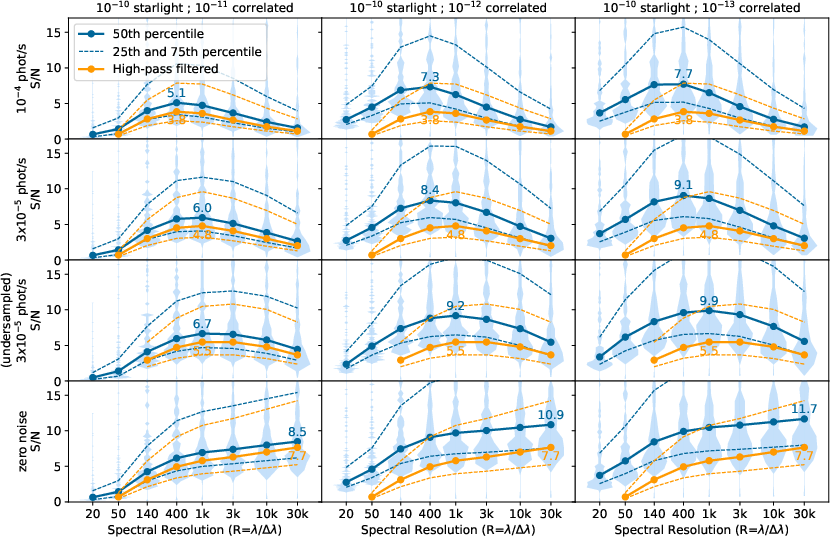
Figure 5: O28 molecular S/N as a function of 29, detector noise, and correlated noise floor, revealing the resolution threshold below which biosignature detectability collapses for realistic instrument systematics.
Furthermore, the study shows that improvements in either raw coronagraphic suppression or post-processing gain (see Figure 6) can be traded against each other, but both are functionally equivalent in their impact on correlated noise-limited performance.
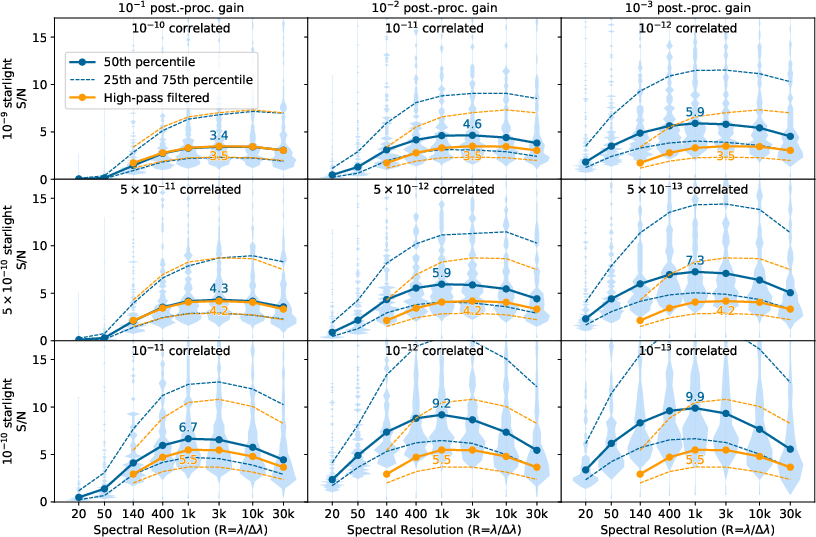
Figure 6: Trade-off between coronagraph suppression and post-processing gain on OR∼1400 detectability, highlighting the interplay between system stability and instrument architecture.
The conceptual design space is summarized in Figure 7, showing the qualitative optimization: correlated noise dominates at low R∼1401, detector noise at high R∼1402, implying an optimal R∼1403 between R∼1404 and R∼1405 under plausible scenarios.
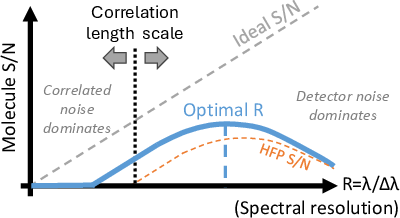
Figure 7: Schematic of the spectral resolution trade-off: correlated noise sets a lower bound on R∼1406 for molecular detection, while detector noise sets an upper bound beyond which S/N declines for fixed total observation time.
Implications for Mission Design and Future Directions
The results presented indicate that persistent use of exclusively low-resolution spectrographs for Earth-analog characterization would pose substantial risks of false negatives in biosignature searches and could even preclude detection if correlated noise cannot be suppressed far below current laboratory or spaceflight levels. Moderate/high-resolution spectrographs (R∼1407), in contrast, offer superior robustness to correlated systematics, enable more effective template-matching and cross-correlation techniques, and facilitate richer science cases including measurement of precise planetary velocities, rotational modulation, and trace species detection.
Key quantitative findings include:
- A moderate to high R∼1408 (R∼1409) spectrograph increases the median OR>1,0000 S/N over low-R>1,0001 modes by a factor of several, contingent upon correlated noise floor.
- Even at 400-hour integrations, detector noise typically does not dominate the noise budget for current EMCCDs until R>1,0002; at higher R>1,0003, ultra-low noise detectors become essential.
- If correlated noise floor for a R>1,0004 starlight suppression system cannot be suppressed below R>1,0005–R>1,0006, low-R>1,0007 biosignature detection becomes unviable.
These results strongly recommend that future instrument trade studies and yield calculations for flagship exoplanet missions adopt comprehensive covariance modeling, resist the temptation to focus solely on S/N per bin metrics, and include moderate-to-high R>1,0008 options as baseline instrument modes. The statistical framework also needs to be extended for retrieval accuracy on atmospheric abundances, not just detection S/N.
Progress towards zero-noise detectors and improved coronagraphic stability can further relax design constraints and provide multiplicative science returns.
Conclusion
This work forcefully demonstrates that the canonical approach of low-resolution spectroscopy for exoEarth characterization is vulnerable to systemic, correlated noise sources that are inherent to high-contrast imaging. A moderate or high-resolution spectrograph is not merely advantageous but may be operationally necessary to ensure biosignature detectability and robust avoidance of false positives/negatives. These findings have clear implications for the architectural design, operational modes, and performance validation of future missions targeting Earth-analog spectroscopy (2604.17554). As instrument designs mature, covariant noise modeling and end-to-end information-theoretic analyses must become standard practice in mission planning.