- The paper demonstrates that, with next-generation observatories, O₂ detection on Earth-like exoplanets at 10 pc is feasible in tens of hours under optimal conditions.
- It employs detailed SNR and photon noise calculations to quantify the limitations of current instruments in detecting both biosignatures and technosignatures.
- It emphasizes the need for future high-contrast missions and advanced starlight suppression techniques to overcome instrumental noise and achieve robust atmospheric characterization.
Spectroscopic Detection of Habitable Zone Exoplanets: Current Limits and Future Prospects
The paper "Spectroscopic signatures from the habitable zone" (2604.08993) by Vincent Kofman presents a technical evaluation of the detectability of biosignatures and technosignatures in the atmospheres of terrestrial exoplanets located within habitable zones of nearby stars. The work critically assesses the current instrumental capabilities and outlines the requirements for future observatories, providing a quantitative Signal-to-Noise Ratio (SNR) analysis for the detection of molecular oxygen (O₂) and technologically-produced hydrogen iodide (HI). The implications for observational strategies and mission architectures are discussed with reference to the transition from current JWST-class platforms to the next generation of both ground- and space-based facilities.
Present Landscape of Exoplanet Characterization
The rapid development of exoplanet science has yielded numerous discoveries of planets across a vast mass–orbital separation parameter space (Figure 1). While JWST has delivered new levels of spectroscopic sensitivity, the atmospheric characterization of terrestrial planets in habitable zones remains strongly limited—currently feasible only for transiting planets orbiting relatively cool M-dwarfs, which, however, may not be the most favorable hosts for habitability due to increased stellar activity and tidal locking. Signal constraints and noise sources, especially stellar variability, still dominate the error budget in high-precision transit transit spectroscopy (e.g., for TRAPPIST-1 e), making even the best current measurements insufficient by at least an order of magnitude to robustly detect Earth-like atmospheric signatures.
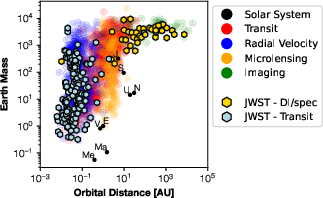
Figure 1: The mass versus orbital distance of currently discovered and characterized exoplanets, including solar system planets and those with JWST spectroscopic data, indicating present detection and characterization limits.
Technical Constraints and Limits
Direct imaging represents the most promising path to the robust spectroscopic characterization of Earth analogs around solar-type stars, but requires achieving planet–star contrast levels of 10−7 for transit methods and down to 10−10 for direct imaging of an Earth–Sun analog system, a domain currently out of reach for existing coronagraphy and high-contrast instrumentations. The photon-limited SNR calculations in the paper demonstrate that, for an Earth analog at 10 pc, detection and initial O₂ characterization are achievable in ∼20 hr with next-gen space-based platforms assuming optimal conditions, but technosignature gases like HI—even at enhanced theoretical abundances—remain undetectable without hundreds of hours of integration, confirming that their spectral features are orders of magnitude below practical detectability thresholds.
Future Facilities and Accessible Parameter Space
The upcoming Habitable Worlds Observatory (HWO) and proposed mid-infrared interferometer concepts (e.g., LIFE) are designed to overcome current limitations. The inner working angle, set by the diffraction limit (∼2λ/D), fundamentally restricts the accessible habitable zones depending on telescope aperture and observing wavelength (Figure 2). For a 6.5-m HWO-like telescope, the habitable zones of the majority of Sun-like and hotter stars will be accessible for direct imaging in visible and near-IR bands, allowing robust atmospheric characterization in reflected light. The use of advanced starlight rejection techniques such as coronagraphs and starshades is essential for achieving the required contrasts, particularly for O₂ detection at 760 nm. They also highlight that habitable zones around cooler stars are harder to access due to tighter angular separation.
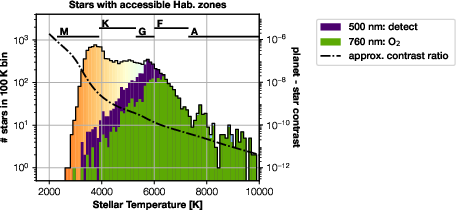
Figure 2: Sufficiently bright stars with habitable zones accessible to a 6.5-m telescope, with planet–star contrast curves for Earth-size planets and inner working angle limits as a function of spectral type.
The next-generation ground-based ELTs (ELT/ANDES, GMT) with apertures up to 39 m will extend contrasts further and, due to continued instrumentation upgrades, may become competitive with space missions for the nearest, most favorable systems.
Spectral Feature Detection Methodology
Spectral feature detectability is governed by two diagnostic criteria: (1) significant offset from the continuum—typically SNR > 5, and (2) unique identifiability to attribute absorption to a specific molecular transition. The detailed radiative transfer simulations (Figure 3) reveal that O₂ and H₂O are optimal targets for reflected-light spectroscopy around 0.7–1.0 μm due to their distinctive, isolated features in high-albedo regions. O₃, despite robust absorption in the UV and mid-IR, produces very broad features less uniquely attributable. In most cases, the detectability of technosignature gases is severely hampered by overlap with strong atmospheric absorbers (CO₂, H₂O) and lower expected mixing ratios.
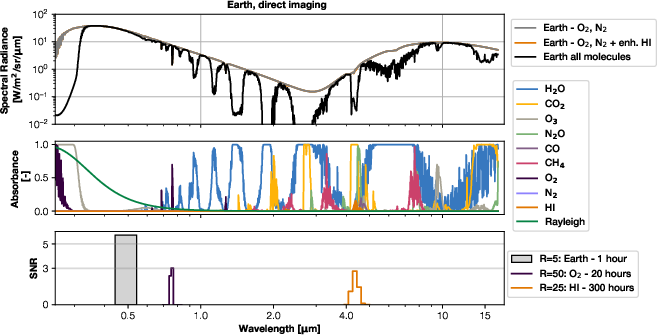
Figure 3: Reflected and emitted light spectra of a cloudless Earth. Top panel: spectral radiance; middle: opacity source breakdown; bottom: SNR predictions for Habitable Worlds Observatory–scale platforms at relevant resolving powers.
Quantitative SNR Analyses
Careful application of radiometric and photon noise calculations confirms that, with aggressive future instrumentation, O₂ can be detected in an Earth-twin at 10 pc in tens of hours. However, HI and similar technosignature gases, even at artificially enhanced abundances, will remain undetected unless further orders-of-magnitude improvement is realized. SNR computations consider realistic quantum efficiencies, dark current, and read noise for contemporary CCD/CMOS sensors, but exclude systematics such as speckle noise, exozodiacal light, or instrumental artifacts, thus offering upper-bound sensitivity estimates.
Theoretical and Practical Implications
This work provides a quantitative roadmap for evaluating biosignature and technosignature claims with realistic SNR and sensitivity considerations, establishing that robust constraints must be made with future direct imaging missions equipped with stringent starlight suppression and high quantum-efficiency detectors. Practical claims of atmospheric characterization must be benchmarked against both photon statistics and, critically, source confusion from overlapping opacity sources. The results reinforce the necessity for a rigorous detection framework and caution against over-interpreting marginal-signature cases.
In a broader context, the findings set expectations for the types of atmospheric signals accessible with next-decade observatories, prioritize biosignature search strategies (favoring O₂ and combinations of H₂O/O₂/CO₂), and clarify the non-detectability of technosignatures without dramatically increased observational investment or fundamentally new detection frameworks.
Prospects and Future Developments
Detection of atmospheric O₂, H₂O, and CO₂ in reflected light is expected to be the primary channel for habitability assessment for exo-Earths in the 2030s. Achieving the required contrast and SNR will likely depend on combining data from multiple missions and exploiting synergy between thermal emission (mid-IR, e.g., LIFE) and reflected-light observations (e.g., HWO), fostering robust Bayesian atmospheric retrieval frameworks. Inclusion of temporal variability and cloud modeling (currently an uncertainty factor) will further refine signal detection [e.g., Kofman et al., in prep.; Yang et al., 2025].
Astrobiology will require both a consistently skeptical stance towards detection thresholds and a careful statistical interpretation as community standards evolve and as larger samples of directly imaged terrestrial planets become available.
Conclusion
Vincent Kofman's work systematically demonstrates that while characterization of biosignature gases in habitable-zone exoplanets is reaching feasibility with the next generation of instruments, robust detection of technosignatures stands outside practical reach barring significant advances in sensitivity or observing methodology. The SNR-based approach provides a quantitative, transferable framework for evaluating both current observational claims and future mission requirements. This supports the development of rigorous standards for biosignature detection and underscores the critical need for continued investment in high-contrast, high-stability observational technologies and robust atmospheric retrieval capabilities.