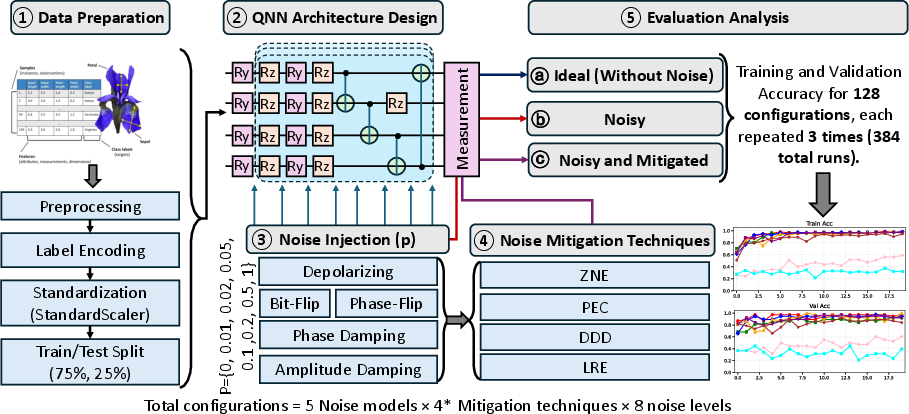
- The paper demonstrates that depolarizing and amplitude damping noise most drastically reduce QNN accuracy, even with current mitigation methods.
- The paper benchmarks four error mitigation techniques (ZNE, PEC, DDD, LRE), revealing inconsistent improvements across different noise regimes.
- The study emphasizes that noise-aware QNN design and dynamic error mitigation are essential for reliable quantum machine learning in NISQ devices.
Robustness Evaluation of Hybrid Quantum Neural Networks under Noise Models via System-Level Error Mitigation
Introduction
Hybrid Quantum Neural Networks (HQNNs) have emerged as a salient direction in Quantum Machine Learning (QML), leveraging Parameterized Quantum Circuits (PQCs) for data-driven modeling. However, the utility of QNNs is fundamentally constrained by the susceptibility of Noisy Intermediate-Scale Quantum (NISQ) hardware to decoherence, gate and readout errors, and crosstalk. This paper conducts a comprehensive empirical investigation of QNN robustness under various physical noise models, with a particular emphasis on the real-world efficacy of error mitigation strategies such as Zero-Noise Extrapolation (ZNE), Probabilistic Error Cancellation (PEC), Digital Dynamical Decoupling (DDD), and Layerwise Richardson Extrapolation (LRE) (2604.17515). The study benchmarks the interaction between quantum noise channels, circuit structure, and mitigation pipelines in a system-level QNN workflow, exposing the nuanced sensitivities that govern QML reliability in practical settings.
HQNNs and NISQ Noise
QNNs utilize hybrid quantum-classical computation, encoding classical inputs, executing variational unitary evolutions, and extracting observables through quantum measurements. The classical optimizer iteratively updates parameters according to the computed loss, yielding a hybrid training loop.
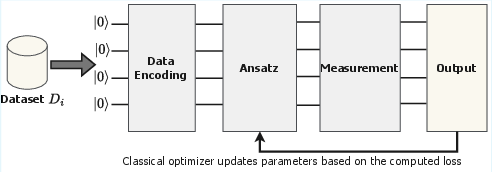
Figure 1: General QNN architecture, delineating quantum data encoding, parameterized ansatz, observables measurement, and classical parameter optimization.
The principal challenge for NISQ-era QNNs is the prevalence of non-Markovian and correlated noise, manifest primarily as depolarizing, amplitude damping, phase damping, bit-flip, and phase-flip errors. The interplay of these channels with circuit design, depth, and observable selection notably shapes the loss landscape, optimization trajectory, and generalization capacity.
Noise Models and Mitigation Methodologies
To realize extensive benchmarking, the study designs a modular pipeline comprising five noise models—depolarizing, amplitude damping, phase damping, bit-flip, and phase-flip—applied at multiple strengths during QNN training on the Iris dataset. Four error mitigation strategies are interfaced with the circuit execution:
Empirical Results
Baseline Noise Sensitivity
Under noise-free conditions, the QNN achieves a validation accuracy exceeding 95% for Iris classification, attesting to the sufficiency of the architectural expressiveness. Introduction of physical noise dramatically alters this performance profile. Depolarizing and amplitude damping noise channels produce the most pronounced accuracy decay as noise strength escalates, consistent with their impact on both state populations and coherence.
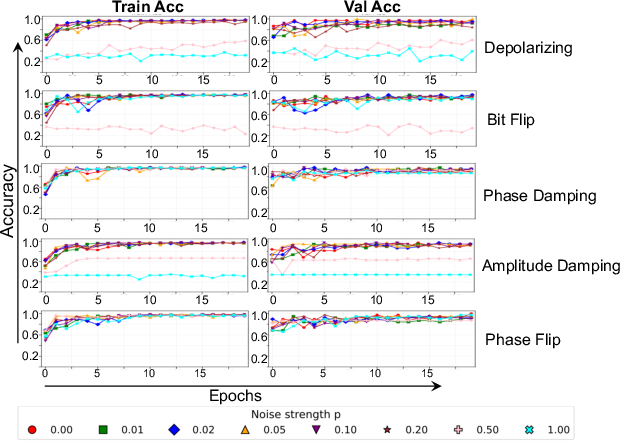
Figure 3: QNN validation accuracy without mitigation across different noise types evidences channel-dependent degradation.
Bit-flip noise is moderately disruptive, while phase-flip and phase-damping noise lead to markedly smaller performance losses, likely due to partial compensation by the QNN ansatz.
Efficacy of Error Mitigation Strategies
ZNE fails to consistently ameliorate performance loss; for depolarizing and amplitude-damping noise, ZNE essentially tracks the unmitigated accuracy decline. In certain cases (e.g., bit-flip noise at selective strengths), minor and inconsistent validation improvements are observed, but these lack generality.
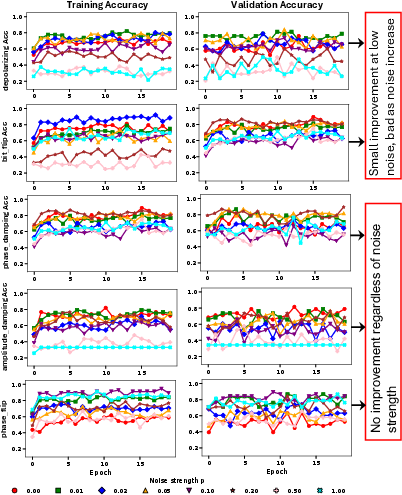
Figure 4: Comparative trends for ZNE vs. baseline; ZNE generally does not halt accuracy decay as noise increases.
Probabilistic Error Cancellation
PEC, due to its computational cost, is benchmarked only under depolarizing noise. Its influence is marginal—efficacy is restricted to the low-noise regime, and no significant benefits are seen as noise increases.
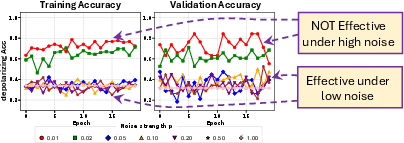
Figure 5: PEC vs. baseline under depolarizing noise; PEC confers minor benefit only at low noise.
Digital Dynamical Decoupling
DDD exhibits limited effectiveness, with slight, noise-dependent preservation of accuracy observable mainly at low-to-moderate noise strengths, predominantly for bit-flip, phase-flip, and phase-damping noise. However, under strong depolarizing or amplitude damping, DDD does not avert severe degradation.
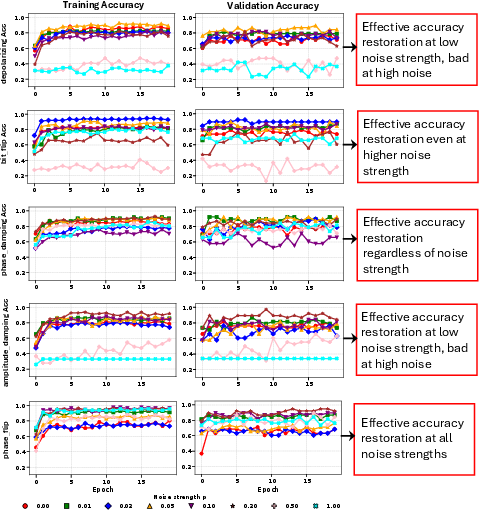
Figure 6: DDD accuracy trends generally align with baseline except in selected low-noise scenarios.
LRE displays negligible and selective efficacy. It fails to substantially restore accuracy under high depolarizing or amplitude damping noise, mirroring the baseline in most settings. Improvements, if any, are sporadic and specific to regime characteristics.
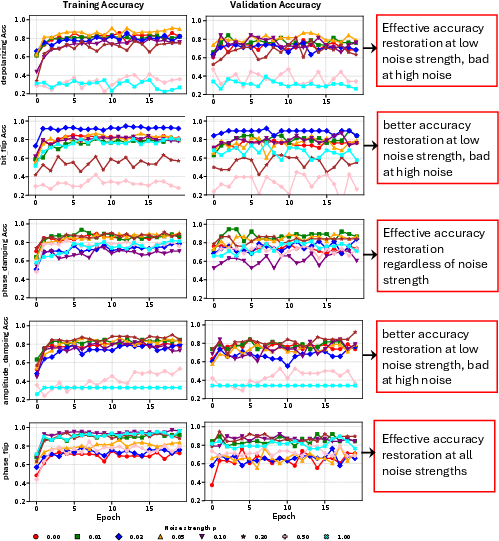
Figure 7: LRE vs. baseline across multiple channels; robust mitigation is absent.
Aggregate Analysis
Across the entire suite of 128 experiment configurations, several robust empirical patterns emerge:
- Noise channel characteristics strongly dictate degradation: Depolarizing amplitude damping inflict the highest cost on QNN performance, while phase-related errors are less damaging.
- Mitigation effects are neither consistent nor strong: None of ZNE, DDD, LRE, or PEC provides systematic accuracy recovery across noise channels or strengths.
- Circuit-specific interaction matters: Variations in robustness are a function of the alignment between model structure and noise profile (e.g., error propagation, expressibility).
These findings are reinforced by the motivational analysis, which highlights that mitigation can occasionally exacerbate, rather than ameliorate, performance decay.
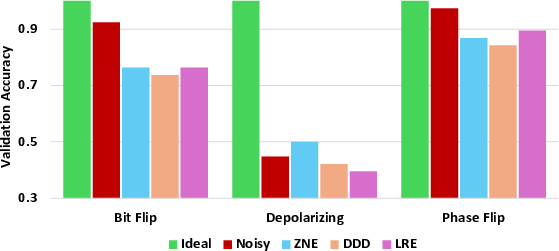
Figure 8: Illustrative analysis: error mitigation is not universally beneficial—performance varies idiosyncratically by noise type and mitigation scheme.
Implications for QML and Future Directions
The results underscore several critical implications for robust QNN deployment:
- Universal mitigation is infeasible in current NISQ settings: Context-specific, noise-adapted mitigation protocols are required.
- Adaptive and hybrid strategies are a promising avenue: Future research should focus on integrating noise diagnosis, selective ansatz optimization, and dynamic switching among mitigation schemes depending on observed error distributions and hardware noise spectra.
- Hardware-aware QNN architecture design is essential: Parameter initialization, observable selection, and circuit depth must be matched to the dominant noise source of the target quantum platform.
The study also exposes limitations of existing QEM toolkits, motivating the development of more scalable, resource-efficient, and noise-aware solutions tuned for variational QML workflows.
Conclusion
This systematic evaluation demonstrates that QNN robustness under NISQ noise is highly context-sensitive. Depolarizing and amplitude-damping models are most deleterious, while typical mitigation methods—ZNE, DDD, LRE, PEC—do not ensure reliable accuracy restoration. The results argue compellingly that future progress depends on the co-design of QNN architectures, noise-aware training objectives, and dynamically adaptive mitigation pipelines, rigorously benchmarked on realistic noise channels. This work establishes a reproducible basis for the nuanced study of QML robustness and error mitigation, directly informing both experimental best practices and the long-term scaling of quantum learning systems.