- The paper systematically studies the joint impact of classical and quantum noise on variational quantum classifiers, showing that quantum circuit noise leads to dramatic performance drops.
- It introduces a hierarchical noise modeling framework that integrates dataset-level, encoding-level, and circuit-level perturbations to simulate realistic NISQ-device errors.
- The results highlight the urgent need for noise-aware pipeline designs and advanced error mitigation strategies to improve the scalability and robustness of hybrid quantum-classical machine learning.
Systematic Evaluation of Noise Effects in Hybrid Quantum-Classical Machine Learning
Introduction
This work, "A Systematic Study of Noise Effects in Hybrid Quantum-Classical Machine Learning" (2604.11541), targets a critical and largely under-addressed question in Quantum Machine Learning (QML): how do compounded noise sources—originating from classical data corruption and quantum hardware imperfections—jointly impact the robustness and performance of variational quantum classifiers (VQCs) on Noisy Intermediate-Scale Quantum (NISQ) devices? Most prior analyses isolate quantum circuit noise, disregarding the realistic scenario where imperfections from both classical and quantum stages are present. This paper bridges the gap by constructing a comprehensive experimental pipeline that subjects each level of the quantum-classical stack to systematic perturbations, yielding rigorous quantitative insights pertinent for scalable quantum machine learning.
Methodology: Hierarchical Noise Modeling and Hybrid Pipeline
The experimental protocol is structured around a unified, hierarchical noise modeling framework integrating dataset-level, encoding-level, and quantum circuit-level perturbations within a single, end-to-end VQC pipeline.
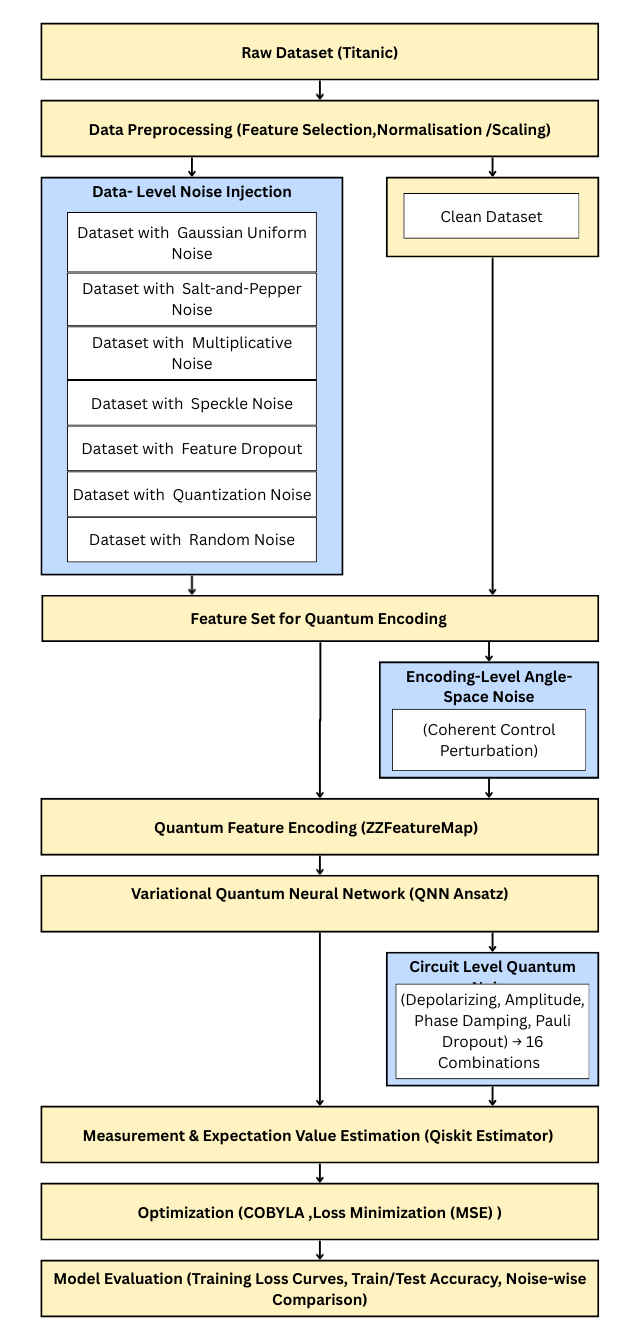
Figure 1: Block diagram of the proposed methodology illustrating dataset preprocessing, dataset-level noise injection, quantum feature encoding using ZZFeatureMap, variational quantum neural network execution under quantum noise, and hybrid quantum-classical optimization and evaluation.
Dataset Selection and Preprocessing:
Binary classification is performed using the Titanic dataset after normalization and categorical encoding, ensuring compatibility with quantum feature encoding protocols.
Quantum Feature Encoding:
Classical features are mapped to quantum states via a parameterized entangling feature map (ZZFeatureMap), incorporating nonlinear correlations through single-qubit rotations and pairwise entanglement.
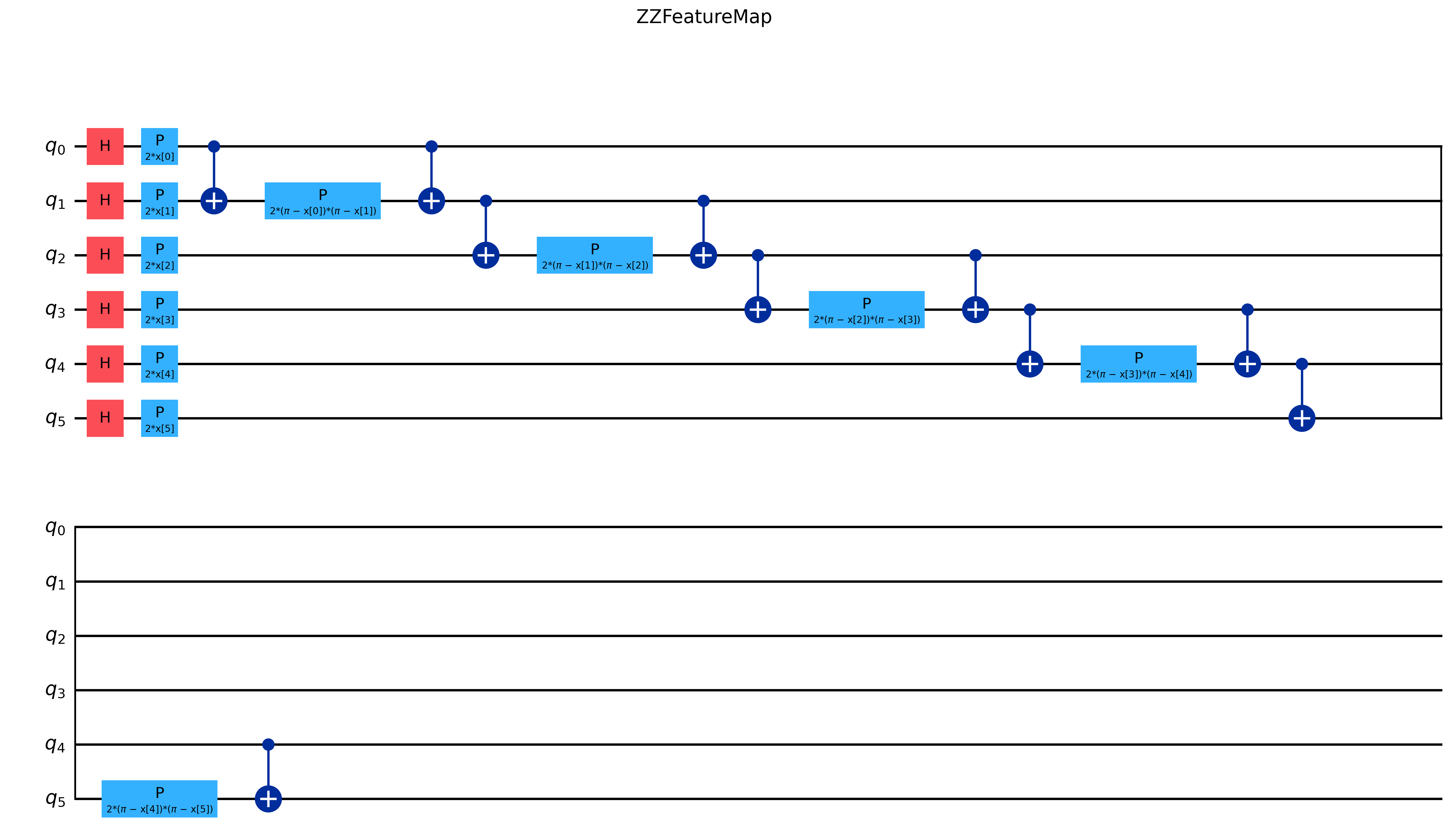
Figure 2: ZZFeatureMap used for encoding classical input features into a quantum Hilbert space. The feature map introduces parameterized single-qubit rotations and pairwise ZZ entanglement to capture correlations among input features.
Variational Quantum Neural Network (QNN) Ansatz:
A hardware-efficient variational circuit composed of parameterized rotations and entanglers is employed. Parameters are iteratively optimized by a classical optimizer targeting the mean squared error (MSE) loss between circuit outputs and ground-truth labels.
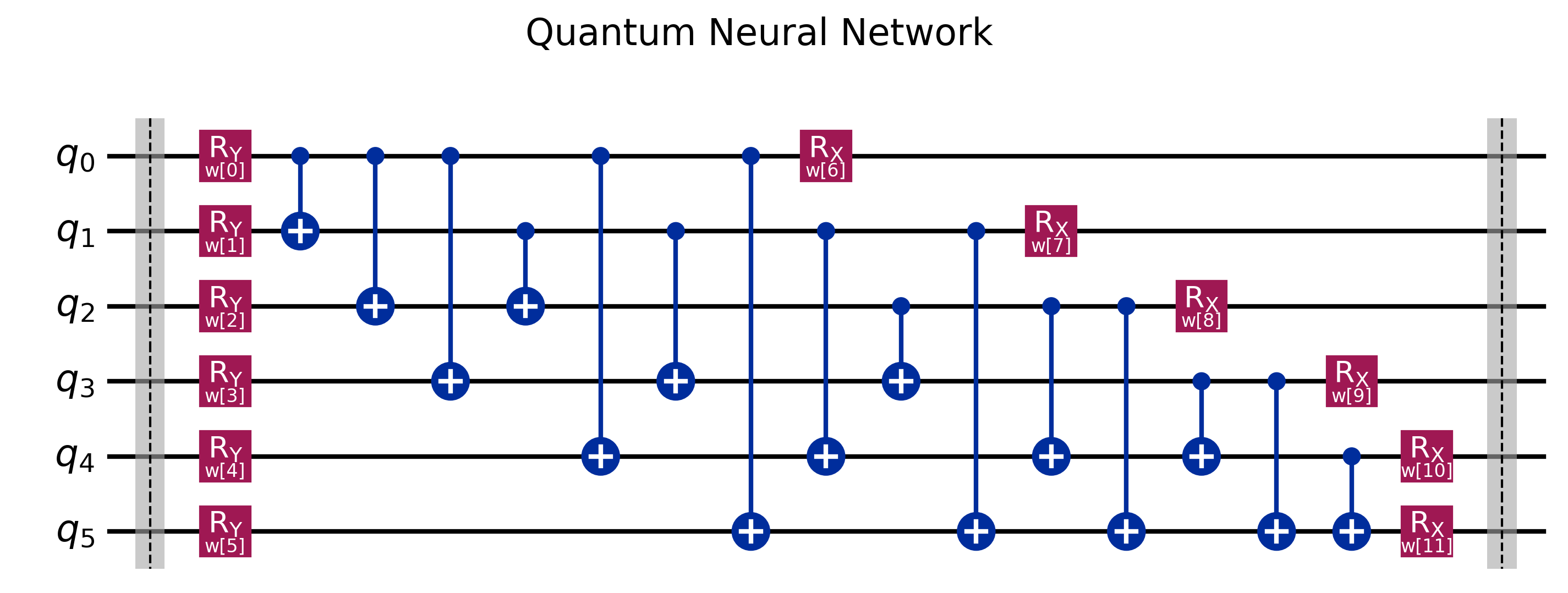
Figure 3: Hardware-efficient variational quantum neural network (QNN) ansatz consisting of parameterized rotation gates and entangling operations. The trainable parameters are optimized using a classical optimizer to minimize the classification loss.
Complete Circuit Construction:
The quantum classifier is architected by concatenating the feature encoding and variational ansatz blocks.
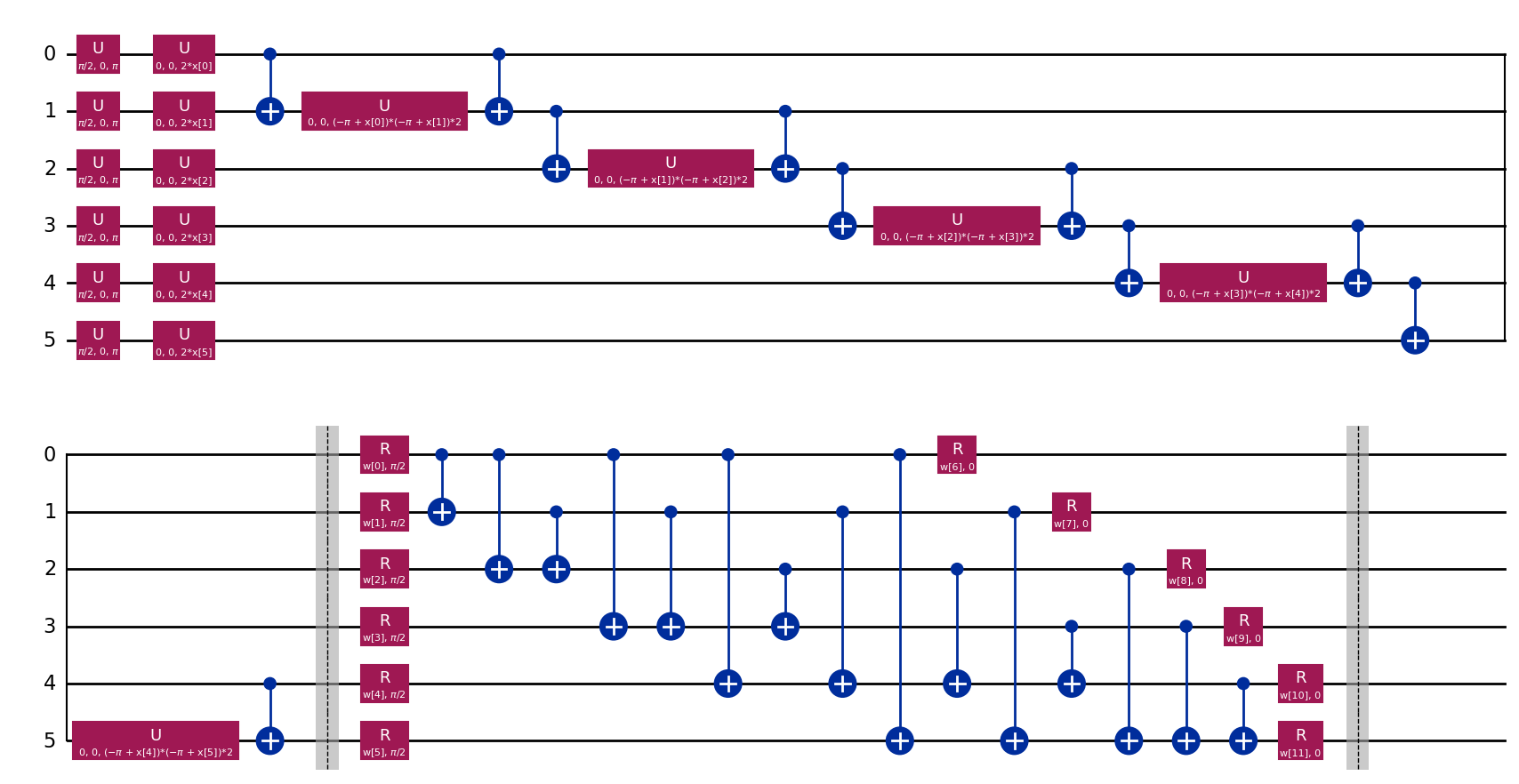
Figure 4: Complete variational quantum classifier obtained by composing the ZZFeatureMap with the hardware-efficient QNN ansatz. The feature-encoding block embeds classical data into a quantum feature space, followed by a trainable variational circuit used for supervised classification.
Noise Models:
- Dataset-level: Additive (Gaussian, uniform), multiplicative, impulse (salt-and-pepper), quantization, sparsity-induced (feature dropout), and random-sign noise are injected into normalized classical features before quantum encoding, simulating sensor errors, finite precision, and missing data.
- Encoding-level: Coherent angle-space perturbations are applied to mapped rotation parameters, emulating calibration drift, control resolution limitations, and pulse errors.
- Quantum circuit-level: Depolarizing, amplitude damping, phase damping, Pauli, and readout errors are instantiated through Qiskit Aer, incorporating both stochastic and coherent noise channels active on gates and measurements.
All noise parameters are selected to reflect state-of-the-art NISQ-device error profiles while ensuring non-trivial performance degradation, and experiments are conducted on fixed seeds for full reproducibility.
Experimental Results and Analysis
Under ideal (noise-free) conditions, the VQC achieves a training accuracy of 76.40% and a test accuracy of 76.12% (zero variance), validating both the expressiveness of the circuit-centric architecture and the suitability of the feature map for this benchmark.
Marginal and Combined Noise Effects
Quantum Circuit Noise Dominance:
The introduction of only quantum circuit noise—specifically, amplitude damping and depolarizing channels—leads to an abrupt accuracy collapse by nearly 50% (to ≈39%), with both training and test accuracies converging. This reflects the overwhelming influence of hardware-induced decoherence on variational hybrid algorithms, aligned with prior evidence of noise-induced barren plateaus severely impacting gradient landscape and trainability.
Dataset-Level Noise:
In the absence of quantum noise, dataset-level perturbations induce gradual, non-catastrophic performance reduction (within 1%–4% of baseline accuracy for most cases), consistent with classical robustness literature for moderate feature corruption. However, when classical and quantum noise are co-present, the accuracy saturates at the lower bound set by the quantum circuit noise: dataset-level degradation becomes statistically insignificant beyond this point.
Encoding-Level Perturbations:
Coherent angle-space noise produces a smooth decrease in performance, with no abrupt collapse, offering a nuanced distinction between coherent (control) and incoherent (decoherence) error dominance. As noise variance increases, accuracy drops and optimization converges more slowly, indicating that fine-tuned coherent control is essential for high-fidelity quantum learning.
Amplification and Masking:
Under compound noise regimes, classical noise sources can exacerbate quantum noise impact in moderate noise settings but are ultimately masked as quantum noise strength increases. Notably, amplitude damping is consistently the most destructive, corroborating the irreversible effect of T1-like relaxation on quantum encodings.
Quantitative Summary:
Empirical results across 192 experimental configurations confirm that quantum circuit noise—especially amplitude damping—is the principal bottleneck for QML robustness on current hardware, while classical data corruption and encoding errors constitute secondary effects in the presence of significant decoherence.
Implications for Scalable QML and NISQ Regime
Rigorous experimentation underscores a critical conclusion: in the NISQ era, hardware-induced quantum noise dictates the upper bound of achievable model performance for VQCs, constraining both expressivity and trainability even on relatively small instances. As qubit counts and ansatz depth scale, these trends are predicted to intensify, with compounding noise effects amplifying optimization difficulties and reducing information propagation through parameterized circuits. Classical dataset noise, although less detrimental in isolation, can further accelerate the collapse of quantum learning as it propagates through entangling feature maps.
This has direct consequences for both algorithmic design and deployment:
- Noise-aware pipeline design is mandatory: Hybrid models must be evaluated under compound perturbations for realistic performance estimation and guaranteed pipeline robustness.
- Error mitigation needs to evolve: Current techniques are insufficient for coherent-circuit-dominated regimes; advances are necessary for both classical preprocessing and quantum-aware error reduction methods.
- Ansatz and feature map construction: Hardware-efficient, shallow circuits and robust feature encodings must be co-designed with knowledge of compounded noise sensitivities.
Conclusion
By presenting a thorough, hierarchical robustness study, this work demonstrates that the primary limitation to VQC success on NISQ hardware is quantum circuit noise, outweighing classical data corruption and encoding errors in realistic hybrid quantum-classical pipelines. The methodology, results, and released experimental artifacts set a reference standard for future QML robustness evaluations. The path forward requires new architectures, scalable error mitigation, and the integration of noise-resilient quantum feature maps to meaningfully extend quantum advantage claims beyond the constraints of current NISQ hardware.
Future work should systematically evaluate these behaviors on higher-dimensional, class-imbalanced, and real-world datasets and validate simulation predictions against executions on physical quantum devices, guiding the evolution of QML toward practical, noise-resilient, large-scale learning applications.