FLASH: Fast Learning via GPU-Accelerated Simulation for High-Fidelity Deformable Manipulation in Minutes
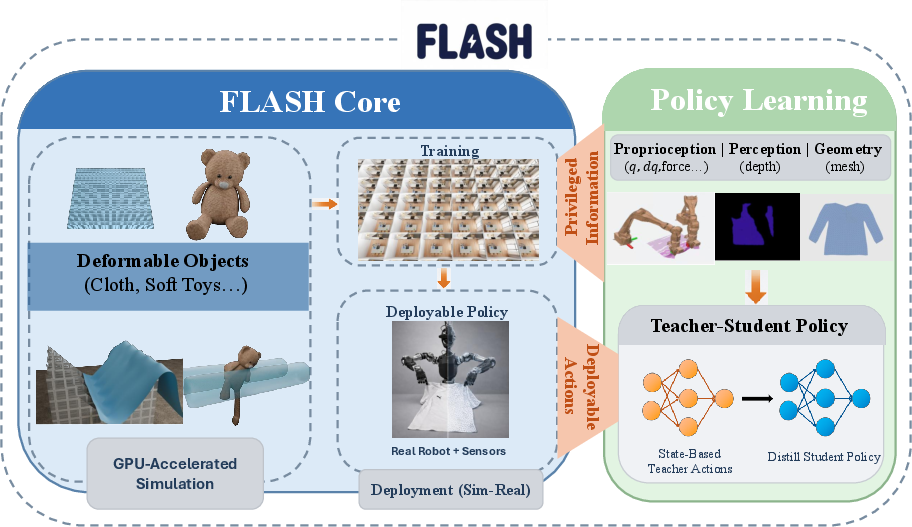
Abstract: Simulation frameworks such as Isaac Sim have enabled scalable robot learning for locomotion and rigid-body manipulation; however, contact-rich simulation remains a major bottleneck for deformable object manipulation. The continuously changing geometry of soft materials, together with large numbers of vertices and contact constraints, makes it difficult to achieve high accuracy, speed, and stability required for large-scale interactive learning. We present FLASH, a GPU-native simulation framework for contact-rich deformable manipulation, built on an accurate NCP-based solver that enforces strict contact and deformation constraints while being explicitly designed for fine-grained GPU parallelism. Rather than porting conventional single-instruction-multiple-data (SIMD) solvers to GPUs, FLASH redesigns the physics engine from the ground up to leverage modern GPU architectures, including optimized collision handling and memory layouts. As a result, FLASH scales to over 3 million degrees of freedom at 30 FPS on a single RTX 5090, while accurately simulating physical interactions. Policies trained solely on FLASH-generated synthetic data in minutes achieve robust zero-shot sim-to-real transfer, which we validate on physical robots performing challenging deformable manipulation tasks such as towel folding and garment folding, without any real-world demonstration, providing a practical alternative to labor-intensive real-world data collection.
Paper Prompts
Sign up for free to create and run prompts on this paper using GPT-5.
Top Community Prompts
Explain it Like I'm 14
FLASH: Fast robot learning with super‑quick, realistic cloth simulation
Overview: What is this paper about?
This paper introduces FLASH, a new computer simulation system that helps robots learn how to handle soft, squishy things—like towels, T‑shirts, and foam—much faster and more accurately than before. Think of it like a super‑realistic, super‑fast “video game” physics engine built for robots to practice on, so they can learn in minutes and then work well in the real world without extra practice.
Key goals and questions
The paper focuses on a few simple questions:
- How can we simulate soft objects (like cloth) both accurately and fast enough for robot learning?
- Can we design the simulator to use GPUs (graphics cards) so it runs many worlds in parallel, like having thousands of practice rooms at once?
- If a robot learns only in this simulator, will its skills work immediately on real robots (“zero‑shot” sim‑to‑real)?
- Can this work for different soft objects and different robots without custom tweaks each time?
How FLASH works (in everyday terms)
Robots need tons of practice to learn, but practicing on real objects is slow and expensive. FLASH solves this by giving them a fast, realistic practice world.
Here’s the idea in simple pieces:
- Soft objects are tricky: A towel isn’t one solid piece; it’s like a huge net with millions of tiny points that can bend, fold, and wrinkle. Simulating all that while handling touch and friction (so the towel doesn’t slide unrealistically or clip through things) is hard.
- GPU to the rescue: A GPU can do many small tasks at the same time—like thousands of helpers working in parallel—so FLASH is designed from the ground up to run on GPUs efficiently.
- Better “rules of touch”: FLASH uses a contact solver (a fast rule system) that makes sure things don’t pass through each other and that friction feels right, even when lots of contacts happen at once (like cloth rubbing on a table or grippers).
- Smart math, simplified for speed: Instead of using older CPU-style methods, FLASH uses a method similar to “adjust a little, check, and repeat” (called a non‑smooth Newton method) and a “snap-to-best‑shape” trick (related to projective dynamics). It also uses a clever shortcut that keeps the hardest math sparse and fast, which GPUs love.
- Many practice rooms at once: FLASH runs lots of robot training environments in parallel (multi‑env), so the robot gathers experience much faster.
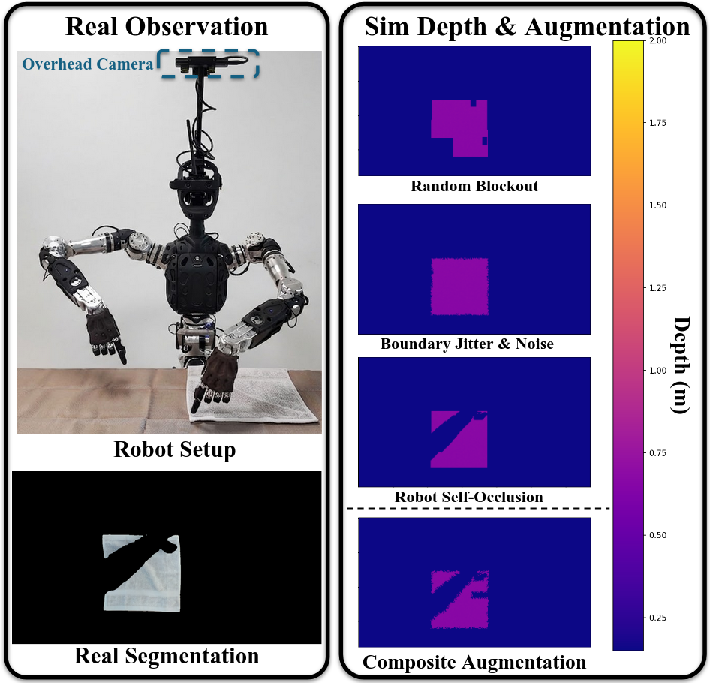
- Vision that matches reality: The simulator generates depth images (like what a real robot sees with a depth camera). It also handles occlusions (when the robot arm blocks the view) and adds random variations so the robot doesn’t overfit to perfect simulation visuals.
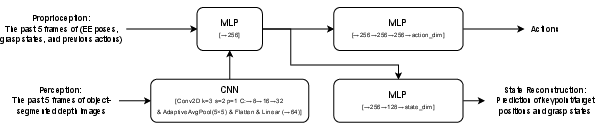
For training, they use a “teacher–student” setup:
- Teacher: Simple rule-based strategies (using full simulator state) show how to do tasks like folding.
- Student: A vision-based neural network learns to copy the teacher using only camera and robot data—the same inputs it will have in the real world.
Main findings and why they matter
Here are the key results, explained simply:
- Very fast and very big: FLASH can simulate over 3 million moving “points” (degrees of freedom) at 30 frames per second on a single GPU, and runs 100–300× faster than real time for training. That means robots can learn in minutes instead of days.
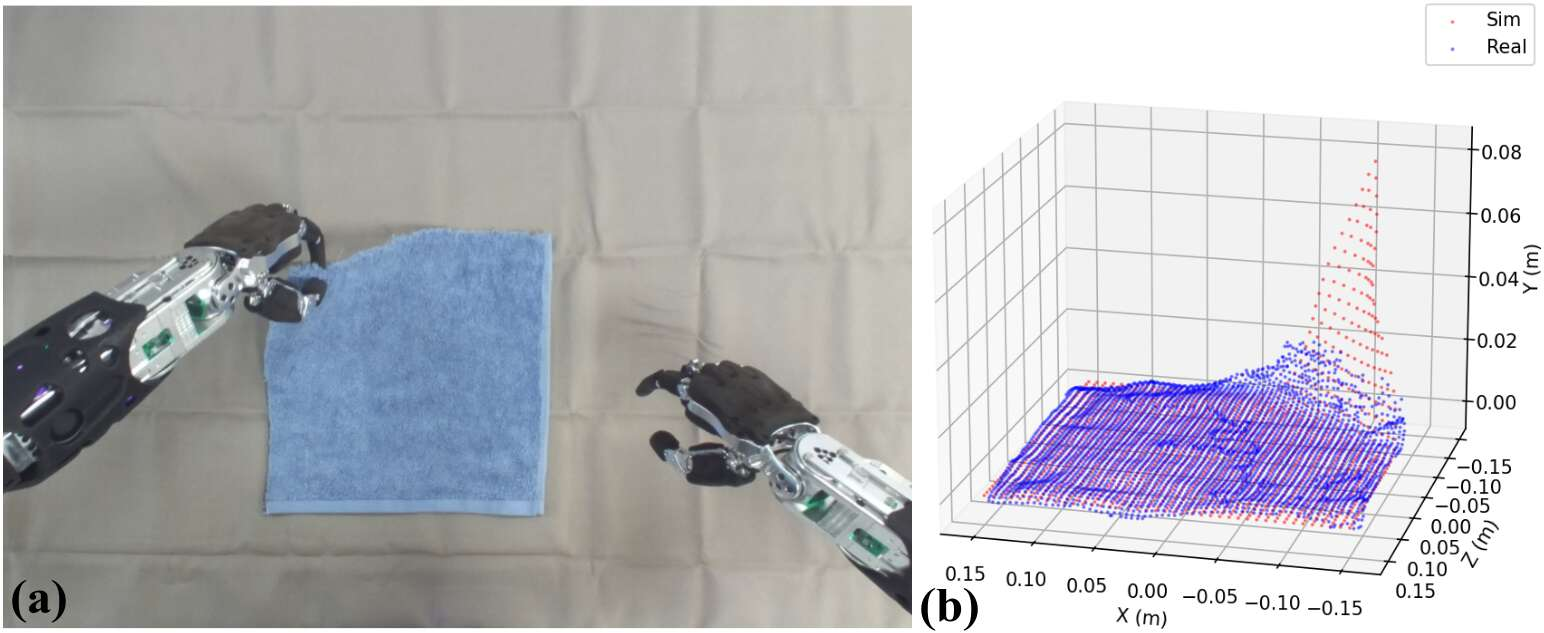
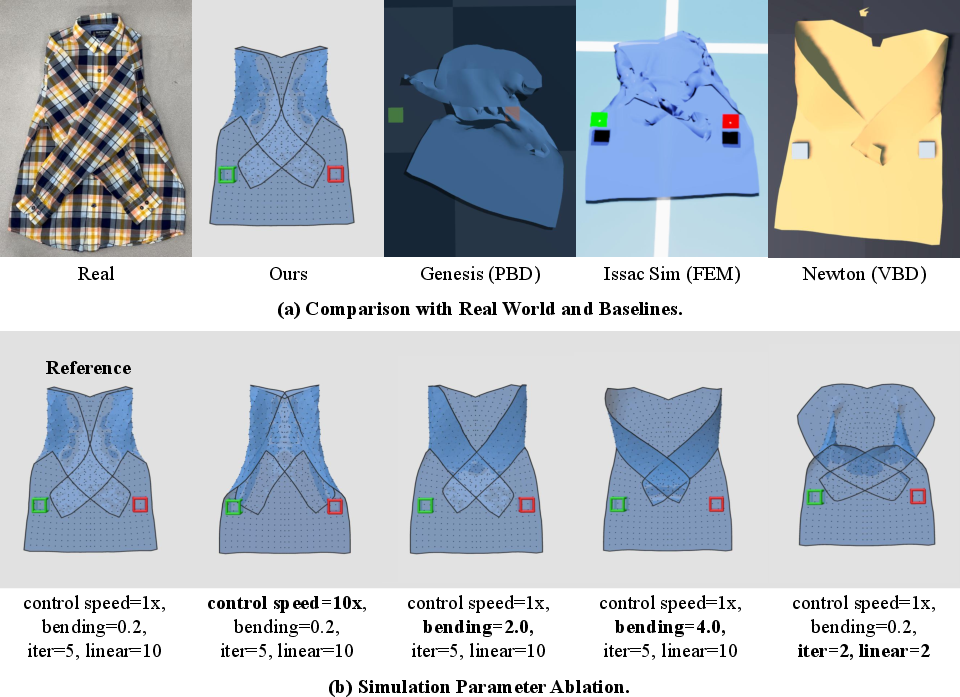
- More realistic folding: In tests like folding a T‑shirt’s sleeves, FLASH matched real-world outcomes better than other popular simulators (like Genesis, Isaac Sim, and Newton). The folds looked right and stayed put—no weird sliding or snapping.
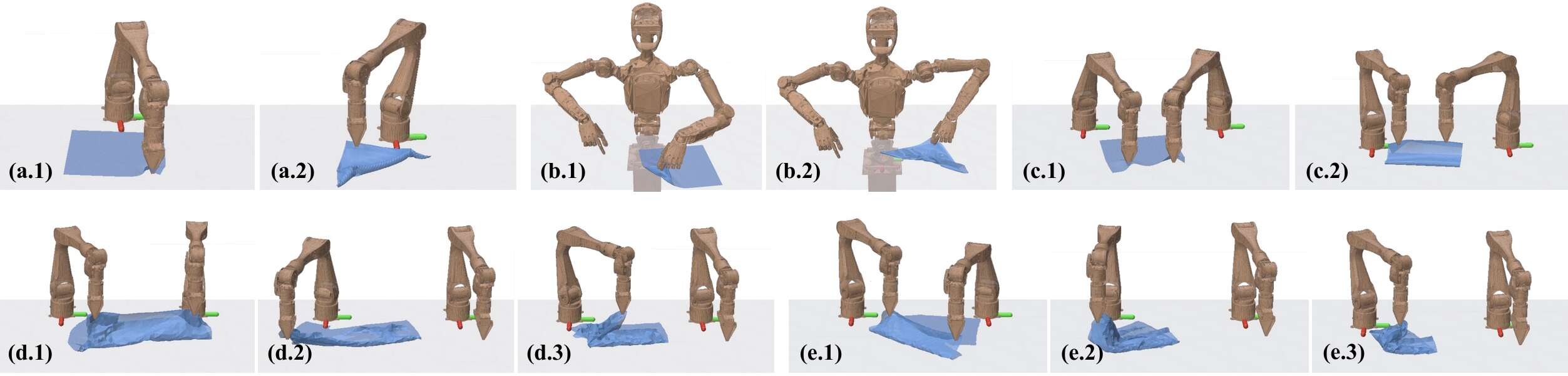
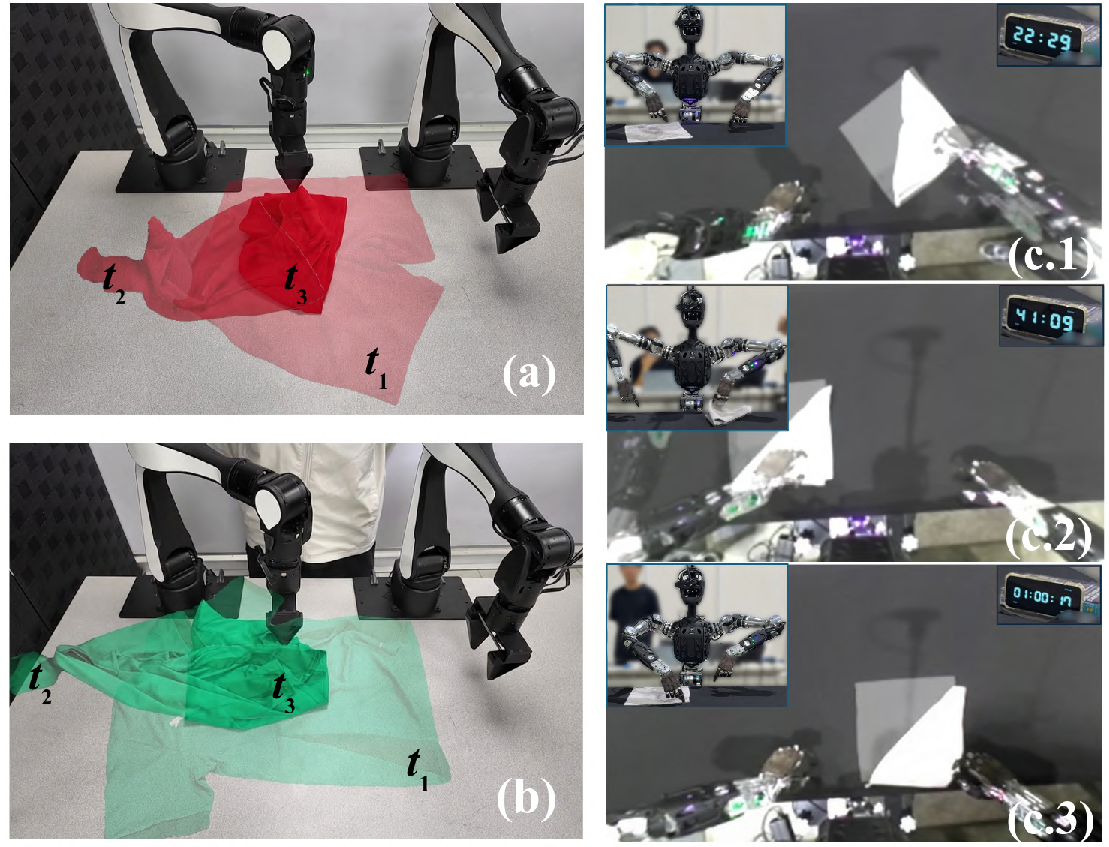
- Zero‑shot transfer: Policies (robot skills) trained only in FLASH worked on real robots without any real-world training. Robots folded towels and clothes successfully on two different platforms—desktop dual arms and a humanoid—using only what they learned in simulation.
- Works across different tasks: The same system handled towels, T‑shirts, and shorts. It didn’t need to rewrite the simulator for each task.
- Solid real-world performance:
- Towel folding, long run: On a humanoid robot, 91 successes out of 106 trials (85.8%) across a continuous one‑hour test.
- Shorts folding: 60% success (12/20).
- T‑shirt folding: 70% success (35/50).
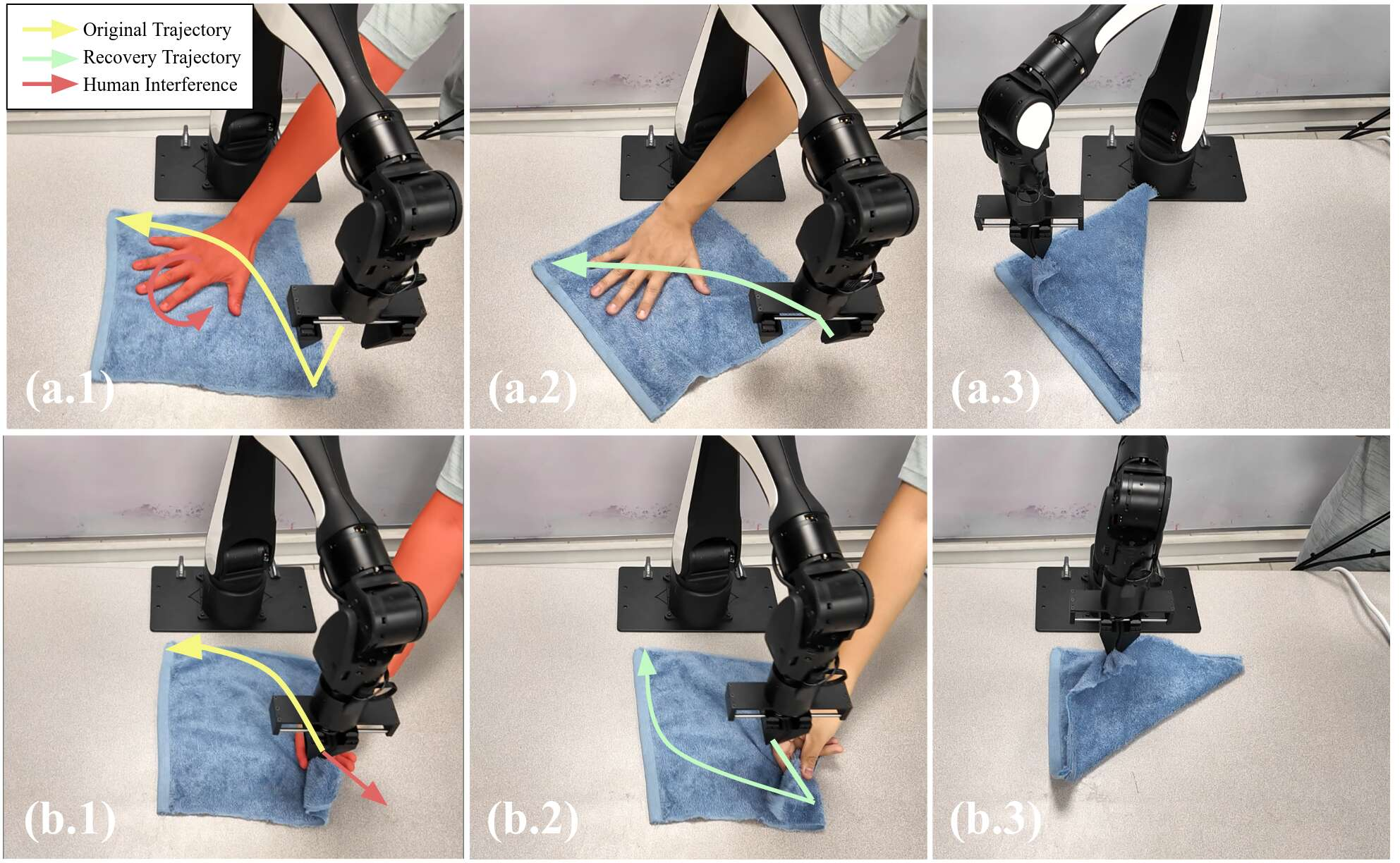
- The policy handled messy starts and even recovered from failures (like a missed grasp or someone tugging the towel).
These results matter because they show that fast, accurate simulation can replace a lot of real-world data collection, speeding up robot skill development for handling soft things—one of the hardest problems in robotics.
What this could change
- Faster robot training: Companies and labs could train robots to handle laundry, bedding, or soft packaging much more quickly and cheaply.
- Better generalization: Because FLASH can simulate lots of variations (different materials, lighting, and camera noise), robots trained this way are more likely to handle the unpredictable real world.
- Broader use: The same approach could help in hospitals (handling sheets or medical pads), homes (folding laundry), and factories (packing soft goods).
The paper also notes a few limitations to keep improving:
- Some parts still move data between CPU and GPU, leaving room for even more speed.
- Very long, complex tasks may need better learning strategies or better sensors (like touch).
- Depth cameras can be noisy on thin fabric, which sometimes causes grasp mistakes.
Overall, FLASH shows that with the right simulator—one that’s both fast and faithful to real physics—robots can learn complex soft‑object skills in minutes and then use them in the real world right away.
Knowledge Gaps
Knowledge gaps, limitations, and open questions
Below is a concise, actionable list of the main gaps, limitations, and unresolved questions left by the paper. Each item is formulated to suggest concrete directions for future work.
- Convergence and error guarantees of the inertia-dominated Schur complement approximation: quantify the approximation error versus the fully implicit metric, establish convergence/stability conditions for the non-smooth Newton iterations, and characterize when the approximation breaks down (e.g., dense, globally coupled contact regimes).
- Adaptive contact metric selection: design and evaluate criteria to automatically switch between the mass-based and fully implicit contact metrics within and across time steps based on contact density, stiffness ratios, and conditioning.
- Globalization strategies for the non-smooth Newton method: specify and assess line-search/trust-region schemes, damping, or merit functions to guarantee progress with highly non-convex/frictional constraints; report failure rates and recovery strategies.
- Preconditioning, warm-starting, and stopping rules: develop principled preconditioners for the Schur system, assess warm-start strategies across time steps/environments, and provide adaptive tolerances that balance accuracy and throughput.
- Time integration and adaptivity: evaluate stability and energy behavior under large steps and high-speed maneuvers (fling/whip), and explore adaptive time stepping/substepping policies for dynamic cloth interactions.
- Self-collision handling at scale: the cross-simulator garment benchmark disables self-collision; the paper does not detail FLASH’s GPU self-contact detection/response. Specify the broadphase/narrowphase algorithms, parallelization, robustness to thin-shell interpenetrations, and validate at scale over long horizons.
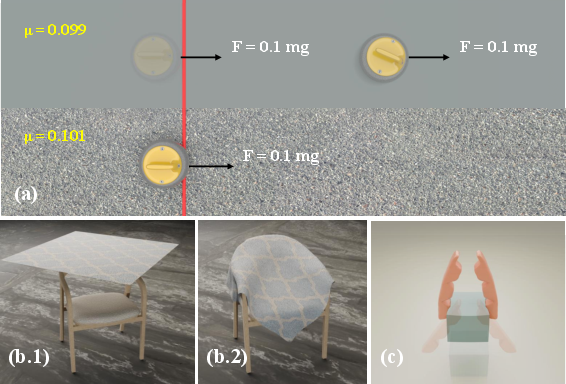
- Contact/friction modeling fidelity: detail the friction cone discretization (polyhedral vs analytic), treatment of stick–slip transitions, anisotropic/velocity-dependent friction (e.g., Stribeck), and quantify physical errors (constraint violations, drift) under diverse contact regimes.
- Material modeling breadth: extend beyond isotropic hyperelastic models to orthotropic/anisotropic cloth (weave directions), viscoelastic damping, and bending–stretch coupling; validate against standardized textile benchmarks across a wide variety of fabrics.
- Parameter identification and calibration: replace manual tuning with automated system identification from real trajectories (e.g., differentiable/black-box optimization) to estimate Young’s modulus, Poisson’s ratio, damping, and friction with statistical uncertainty.
- Topological changes and damage: the framework does not address cutting/tearing, seam constraints, or yarn-level failures; define algorithms and GPU data structures to support topology changes and evaluate their impact on learning.
- Collision detection scalability details: the paper claims optimized collision handling but omits algorithms (BVH/HLBVH, spatial hashing), update costs, and degeneration handling; provide complexity analysis, GPU occupancy profiles, and failure cases.
- Determinism and numerical reproducibility: assess determinism across GPUs/drivers, floating-point precision (FP32 vs mixed precision), and its effect on training reproducibility and policy variance.
- Memory footprint and scaling limits: report memory usage breakdown (state, constraints, BVHs, render buffers) versus DoF and environment count; assess limits and out-of-core strategies for >3M DoF or >256 environments.
- Multi-GPU and distributed scaling: investigate performance and synchronization strategies across multiple GPUs/nodes, including inter-GPU communication costs and environment sharding.
- CPU–GPU transfer bottlenecks: the paper acknowledges remaining host–device overheads; quantify where they occur (e.g., perception, logging, control), and evaluate zero-copy pipelines and unified kernels to eliminate transfers.
- Rendering realism and sensor models: the depth-rendering pipeline lacks explicit modeling of sensor effects (noise, rolling shutter, holes, multi-path interference); quantify their impact on transfer and develop learned/parametric sensor simulators.
- Occlusion and multi-view perception: assess benefits of multi-view depth, active viewpoint selection, or learned occlusion completion versus single-view depth used here.
- Domain randomization ablations: perform sensitivity analyses to identify the most impactful randomized parameters (physics, lighting, sensor noise) on sim-to-real success, and devise automated curriculum/randomization schedulers.
- RGB-based policy learning: explore photorealistic/NeRF-style rendering or mesh-attached neural textures for RGB policies and compare against depth-only policies in transfer robustness.
- Differentiability and gradient-based learning: the solver is non-smooth and not exposed as differentiable; investigate adjoint methods or implicit differentiation (with subgradient handling) to enable trajectory optimization and gradient-based RL.
- High-speed dynamic manipulation: results focus on quasi-static or slow motions; evaluate FLASH on dynamic cloth tasks (e.g., fling, snap, toss) with quantitative metrics (energy, momentum, settling time).
- Broader object classes: validate on ropes/strings (1D), bags with air entrapment, soft volumetric objects with large deformation/contact, and layered garments with significant self-contact.
- Gripper and robot dynamics modeling: current abstraction ignores gripper compliance, actuation delays, backlash, and contact sensing; integrate compliant gripper models and tactile feedback, and quantify improvements in grasp reliability.
- Closed-loop latency characterization: report end-to-end control loop frequency (perception→policy→IK→execution), jitters, and their effect on success rates; optimize pipeline for bounded latency.
- Safety and failure-handling policies: formalize safe exploration and collision-avoidance constraints for real deployment, especially under perception dropouts and unexpected human interaction.
- Policy learning without scripted teachers: investigate RL or model-based planning to avoid finite-state teachers, assess long-horizon credit assignment, and compare sample efficiency and robustness.
- Uncertainty-aware policies: incorporate observation and dynamics uncertainty estimation (e.g., ensembles, Bayesian heads) for risk-aware actions and robust recovery.
- Generalization tests: evaluate zero-shot transfer to unseen fabrics (thickness, weave, size), colors/patterns, lighting changes, and novel garments/topologies; provide standardized test suites and metrics.
- Comparative baselines and statistics: add quantitative baselines on more tasks with statistical confidence (multiple seeds, variance bars), and compare against recent sim-to-real cloth manipulation methods.
- Release and reproducibility: specify code/data availability, seeds, exact hyperparameters, and environment definitions needed for faithful reproduction of the reported numbers.
- Energy/accuracy trade-offs: systematically map the Pareto frontier of solver iterations, time step, and throughput versus physical accuracy (e.g., constraint violation, strain energy error) to guide practitioner choices.
- Learned or adaptive meshing: explore spatial/temporal adaptivity (AMR, mesh coarsening/refinement) to concentrate computation near contacts while preserving global behavior and GPU efficiency.
- Aerodynamics and environment coupling: assess importance of air drag, airflow, and table-surface microgeometry on cloth behavior and whether simple models can close residual sim-to-real gaps.
- Contact metric resolution claim: the “0.001 friction coefficient resolution” is shown qualitatively; provide quantitative identification accuracy with confidence intervals and real-world validation across surfaces.
- Bimanual coordination and collisions: detail inter-arm collision handling in sim and real, communication latencies, and constraint formulations for coordinated grasping and folding.
Practical Applications
Immediate Applications
Below are specific, deployable use cases that can be built directly on the paper’s methods and reported results, along with sector tags, likely tools/workflows, and assumptions/dependencies that affect feasibility.
- Sector: Manufacturing, Logistics (Textiles, Apparel), Hospitality, Healthcare operations
- Use case: Rapid training and deployment of cloth-folding and packing robots (towels, T-shirts, shorts) for laundries, hotels, hospitals, apparel factories, and e-commerce fulfillment centers.
- Tools/products/workflows: FLASH-driven digital twins; SKU-specific simulation parameter presets; policy factory that trains folding/flattening policies in minutes; vision pipeline using depth segmentation (YOLOv8 + SAM); zero-shot deployment onto dual-arm systems (e.g., Airbot Play, humanoids).
- Assumptions/dependencies: Access to an RTX-class GPU (e.g., 4090/5090) for training; reliable hand–eye calibration; grippers capable of stable frictional grasps; sensor quality (depth noise and occlusions) and on-robot IK; safety interlocks for human–robot proximity.
- Sector: Manufacturing (Intralogistics QA)
- Use case: Preflight validation of folding/packaging sequences for new textiles and layouts before production changeovers.
- Tools/products/workflows: FLASH-based what-if simulation workflows; automated sweep over bending/stretch parameters and gripper speeds; acceptance criteria (fold accuracy, settling time, slip rate).
- Assumptions/dependencies: Reasonable physical calibration (Young’s modulus, Poisson’s ratio, friction coefficients) for new materials; accurate digital models of tables/conveyors.
- Sector: Recycling, Sustainability
- Use case: Automated flattening, spreading, and sorting of post-consumer textiles to streamline material identification and downstream mechanical/chemical recycling.
- Tools/products/workflows: FLASH-trained policies for flattening and regrasp; occlusion-aware depth rendering for robust segmentation of crumpled garments; rule-based funnels for sorting.
- Assumptions/dependencies: Strong domain randomization for high material variation; contamination and moisture handling; ruggedized end-effectors.
- Sector: Robotics R&D (Academia and Industry)
- Use case: Scalable benchmarks and ablations for deformable manipulation algorithms under contact-rich conditions (cloth–tool–table friction, multi-contact).
- Tools/products/workflows: FLASH SDK for multi-environment experiments; reproducible evaluation suites (e.g., dual-sleeve fold); Jupyter/PyTorch integration for imitation/RL; parameter ablations (solver iterations, stiffness, speed).
- Assumptions/dependencies: Modern NVIDIA GPU; code integration with existing ML stacks; community-shared scenarios and metrics.
- Sector: Software, Computer Vision
- Use case: Generation of high-fidelity synthetic depth datasets (with robot self-occlusion) to train and stress-test perception modules for deformables.
- Tools/products/workflows: FLASH rendering pipeline coupled to sim states; automated domain randomization for lighting, pose, background; synthetic-to-real evaluation harnesses.
- Assumptions/dependencies: Matching camera intrinsics/extrinsics; careful randomization to prevent overfitting to sim artifacts.
- Sector: Robotics Hardware (End-effector and system design)
- Use case: Rapid in-simulation evaluation of gripper designs, contact surfaces, and motion strategies for deformable items (e.g., fingertip materials, force thresholds).
- Tools/products/workflows: Parametric studies of contact friction/compliance; throughput vs. quality trade-off plots; design gates based on settling stability and slip metrics.
- Assumptions/dependencies: Approximation fidelity for contact and material anisotropy; consistent material samples for validation.
- Sector: Education, Training
- Use case: Hands-on coursework and competitions in deformable manipulation reproducible on commodity GPUs.
- Tools/products/workflows: Course kits with canonical cloth tasks, baselines, and grading scripts; multi-env labs for algorithmic comparisons (XPBD/PD/FEM vs. NCP).
- Assumptions/dependencies: Student access to a single high-end GPU or departmental servers; simplified install scripts and documentation.
- Sector: Cloud/DevOps for Robotics
- Use case: Simulation-as-a-service for rapid policy training and regression testing of deformable tasks.
- Tools/products/workflows: Containerized FLASH clusters; CI pipelines that rerun folding benchmarks after code or hardware changes; artifact tracking (policies, seeds, metrics).
- Assumptions/dependencies: GPU-capable cloud infrastructure; data governance for synthetic datasets.
- Sector: Quality Assurance (Apparel, Home Goods)
- Use case: Automated inspection aided by flattening policies to present textiles for vision-based defect detection.
- Tools/products/workflows: FLASH-trained flattening to create inspection poses; line-scan or overhead vision triggers; reject/recirculate loops.
- Assumptions/dependencies: Reliable segmentation; defect ground-truth for supervised inspection.
- Sector: Daily life, Maker/Prosumer robotics
- Use case: DIY deployment of towel-folding or garment-folding behaviors on desktop arms.
- Tools/products/workflows: Pre-trained policy packs; calibration wizards; safety-limited motion profiles; community recipe exchange.
- Assumptions/dependencies: Affordable dual-arm or single-arm platforms; household-safe grippers; consumer-grade depth cameras.
Long-Term Applications
The following opportunities are enabled by FLASH’s core advances but will likely require further research, scaling, or ecosystem development (e.g., perception robustness, tactile sensing, more complex materials, regulatory approvals).
- Sector: Consumer Robotics (Home)
- Use case: Generalist laundry assistants that handle the full pipeline (unpile, untangle, sort by type/owner, fold, put away).
- Tools/products/workflows: Task graphs over multiple FLASH-pretrained skills; uncertainty-aware regrasping and failure recovery; long-horizon memory/planning.
- Assumptions/dependencies: Robust perception in clutter; tactile/force feedback; safe long-duration autonomy; cost-effective hardware.
- Sector: Assistive Healthcare
- Use case: Dressing assistance and bedding management for elderly and patients (hospital/home).
- Tools/products/workflows: Patient-specific digital twins; compliant bimanual policies that adapt to movement; real-time safety monitors.
- Assumptions/dependencies: Rich human–robot interaction models; advanced contact sensing; rigorous clinical validation and regulatory clearance.
- Sector: Surgical Robotics and Training
- Use case: Real-time surgical rehearsal and policy learning on deformable soft tissues (suturing, retraction) using high-fidelity GPU simulation.
- Tools/products/workflows: FLASH extended with validated viscoelastic and anisotropic tissue models; CT/MRI-aligned geometry; haptic/force reflection.
- Assumptions/dependencies: Biomechanical parameter estimation; verification/validation frameworks; integration with surgical platforms; certifications.
- Sector: Apparel and Soft-Goods Manufacturing
- Use case: End-to-end automated garment processing lines (flattening, folding, bagging, stacking, inspection), rapidly reconfigurable per SKU.
- Tools/products/workflows: Facility-level digital twins with FLASH at cell level; simulation-based scheduling and layout optimization; automated SKU onboarding (scan→sim→policy).
- Assumptions/dependencies: Interoperability with MES/ERP; standardized garment CAD/scan pipelines; robust anomaly handling.
- Sector: Foundation Models for Manipulation
- Use case: Pretraining “generalist” manipulation models on billions of high-fidelity deformable interactions generated in GPU-parallel simulation.
- Tools/products/workflows: FLASH-driven data farms; mixed-modality pretraining (depth, proprio, actions); policy distillation into efficient on-robot networks.
- Assumptions/dependencies: Large-scale compute; data filtering/curation; transfer learning protocols and safety guards.
- Sector: Agriculture and Food Processing
- Use case: Handling flexible produce (lettuce leaves, herbs), packaging soft foods, leaf defoliation with minimal damage.
- Tools/products/workflows: Extended material models for damp, delicate items; contamination-aware grippers; tuned friction/contact randomization.
- Assumptions/dependencies: Accurate viscoelastic/slippery contact modeling; hygienic design; compliance with food safety standards.
- Sector: Cable/Wire Harness and Rope Manipulation
- Use case: Automated routing, bundling, and inspection of flexible linear objects in electronics and automotive assembly.
- Tools/products/workflows: FLASH extended to slender rod/rope models; knot-aware planning primitives; vision–tactile fusion.
- Assumptions/dependencies: Robust 1D deformable (rod) solvers; topological reasoning; regrasp dexterity.
- Sector: Space, Nuclear, Hazardous Environments
- Use case: Managing flexible materials (thermal blankets, cables, insulation) in microgravity or high-radiation settings via simulators that de-risk operations.
- Tools/products/workflows: Environment-specific physics (microgravity, radiation-tolerant sensing); teleoperation + autonomy blends; rehearsal twins.
- Assumptions/dependencies: Validation under domain-specific conditions; limited sensing; communication delays.
- Sector: Retail and E-commerce Experience
- Use case: On-demand customization (e.g., folding style, presentation), returns processing automation that robustly deals with varied packing states.
- Tools/products/workflows: Policy libraries for retailer-specific standards; robust “unpack→inspect→refold” flows; customer-configurable presentation templates.
- Assumptions/dependencies: Integration with order systems; real-world variability of returns; throughput targets.
- Sector: Policy, Safety, and Standards
- Use case: Simulation-backed certification protocols for contact-rich deformable manipulation near humans (garments, linens).
- Tools/products/workflows: Standardized FLASH scenarios and metrics (slip/stick, energy dissipation, failure recovery); pre-cert test suites for vendors.
- Assumptions/dependencies: Consensus among standards bodies; correlation studies between sim and field performance.
- Sector: MLOps for Robotics (“DeformableOps”)
- Use case: Continuous deployment pipelines that close the sim–real loop for deformable tasks (monitoring, drift detection, retraining).
- Tools/products/workflows: Telemetry capture, auto-sim replay with domain randomization, guarded rollout; policy versioning and rollback.
- Assumptions/dependencies: Data privacy/security; robust failure detection; low-latency training infrastructure.
- Sector: HRI and Service Robotics (Hospitality/Retail)
- Use case: Robots that set tables, prepare linens, and arrange displays of soft goods with human-aware motion and recovery behaviors.
- Tools/products/workflows: FLASH-pretrained skills adapted with social navigation; task schedulers for mixed rigid–soft workflows.
- Assumptions/dependencies: Reliable perception in crowded settings; compliance with service safety norms; UX co-design.
- Sector: Enterprise Digital Twins (Operations Research)
- Use case: Facility-level optimization where deformable handling cells are bottlenecks; simulate throughput under product mix and staffing changes.
- Tools/products/workflows: Coupled discrete-event simulation with FLASH physics cells; sensitivity analyses; capacity planning.
- Assumptions/dependencies: Accurate upstream/downstream timing; integration with live KPIs; calibration maintenance.
Cross-cutting assumptions and dependencies
- Hardware availability: Access to high-end GPUs (RTX 4090/5090) for training and, optionally, for on-prem inference; industrial robot arms with precise IK and stable grippers.
- Perception stack: Depth sensors with manageable noise/occlusion; segmentation models robust to domain shift; potential need for tactile/force sensing in harder tasks.
- Physical modeling: Material parameters (bending/stretch, friction) calibrated per item class; extended models (anisotropy, viscoelasticity, moisture) for non-textile domains.
- Pipeline integration: Reliable hand–eye calibration; safety layers and standard operating procedures; CI/CD for policies (logging, rollback).
- Limits noted in the paper: Residual CPU–GPU transfer overhead in parts of the pipeline; perception bottlenecks for thin fabrics; abstraction gaps in hardware (e.g., actuation delays, backlash, lack of tactile feedback).
Glossary
- Block-diagonal: A matrix structure composed of square blocks along the diagonal with zeros elsewhere, enabling independent processing of subproblems. Example: "block-diagonal system matrix"
- Cholesky factor: The lower-triangular matrix from the Cholesky decomposition of a symmetric positive-definite matrix, used for efficient linear solves. Example: "explicit inverse of the Cholesky factor of ."
- Cone Complementarity Problem (CCP): A complementarity formulation where the feasible set is a convex cone, commonly used for contact and friction modeling. Example: "LCP/CCP/NCP: Linear/Cone/Nonlinear Complementarity Problem"
- Constitutive manifold: The set of configurations satisfying a material’s constitutive (stress–strain) law, used to project states in projective dynamics. Example: "defines the constitutive manifold"
- Coulomb friction: A classical friction model where the tangential force is bounded by the normal force scaled by a coefficient μ. Example: "with Coulomb friction ()"
- Degrees of freedom (DoF): Independent parameters that define the configuration of a mechanical system. Example: "3M+ DoF"
- Digital twin: A high-fidelity virtual replica of a physical system used to align geometry, physics, and perception for transfer. Example: "a high-fidelity digital twin"
- Domain randomization: Systematic variation of simulation parameters and appearance to improve policy robustness when transferring to reality. Example: "systematic domain randomization"
- Extended Position-based Dynamics (XPBD): An extension of PBD that decouples stiffness from iteration count via a compliance parameter for better modeling of stiff materials. Example: "Extended PBD (XPBD) addresses this limitation"
- Finite Element Method (FEM): A numerical method that discretizes continuum mechanics equations over elements to simulate deformable bodies. Example: "The FEM offers high accuracy by discretizing continuum mechanics equations"
- Finite-state machine: A control structure that sequences behaviors through discrete states and transitions for multi-stage tasks. Example: "multi-stage finite-state machines."
- Hand-eye calibration: Estimating the rigid transform between a robot’s end-effector and a camera to align simulated and real sensor views. Example: "Leveraging standard hand-eye calibration"
- Hyperelastic: Refers to materials whose stress–strain relationship derives from a strain energy density function; used here for deformable simulation. Example: "high-performance hyperelastic simulation framework"
- Implicit Euler integration: A stable time-integration scheme that evaluates forces at the next timestep by solving an implicit optimization or equation. Example: "the implicit Euler integration computes the updated positions"
- Inverse Kinematics (IK): Computing joint configurations that achieve a desired end-effector pose, often via numerical solvers. Example: "using a numerical Inverse Kinematics (IK) solver"
- Jacobian: A matrix of partial derivatives mapping changes in generalized coordinates to changes in constraint or task space. Example: "The contact Jacobian maps the generalized coordinates to the contact space"
- Lagrange multiplier: An auxiliary variable enforcing constraints by representing constraint forces in constrained optimization/dynamics. Example: "the Lagrange multiplier formulation"
- Linear Complementarity Problem (LCP): A problem of finding vectors that satisfy nonnegativity and orthogonality conditions with a linear mapping, common in contact models. Example: "LCP/CCP/NCP: Linear/Cone/Nonlinear Complementarity Problem"
- Local–global strategy: An iterative scheme alternating local projections and global solves to improve stability and efficiency. Example: "a localâglobal strategy further improves robustness under long-horizon time steps."
- Material Point Method (MPM): A hybrid particle–grid method for simulating continuum materials and complex deformations. Example: "Material-Point Method (MPM)"
- Mass matrix: The matrix encoding mass distribution that maps accelerations to forces in discrete mechanics. Example: "where is the mass matrix"
- Nonlinear Complementarity Problem (NCP): A complementarity formulation with nonlinear mappings, often used for frictional contact with nonlinearity. Example: "NCP-based solver"
- Non-smooth Newton method: A Newton-type solver for problems with non-differentiable components (e.g., contact/friction). Example: "a non-smooth Newton method is employed."
- Poisson's ratio: A material parameter describing lateral strain response to axial loading, used in calibrating deformable models. Example: "Poisson's ratio and Young's modulus"
- Position-based Dynamics (PBD): A simulation approach that enforces constraints directly on positions via projections for speed and stability. Example: "Position-based Dynamics (PBD)"
- Projected Gauss–Seidel (PGS): An iterative method that enforces complementarity or inequality constraints by projecting after Gauss–Seidel updates. Example: "PGS: Projected Gauss-Seidel method."
- Projective Dynamics (PD): A fast simulation framework combining local constraint projections with a global quadratic solve for efficiency and stability. Example: "Projective Dynamics (PD)"
- Proprioception: Internal sensing of a robot’s joint states and body configuration used as part of the observation. Example: "constructs observations from proprioception and perception"
- Proximal problem: An optimization subproblem that penalizes deviation from a current estimate, used to compute local projections. Example: "solving a proximal problem"
- Quasi-static: Motion regime where inertial effects are negligible and the system evolves through near-equilibrium states. Example: "gripper motions are slow and quasi-static"
- Saddle-point system: A KKT-type linear system with coupled primal and dual variables arising from constrained optimization. Example: "solves the saddle-point system"
- Schur complement: A reduced system formed by eliminating variables, used to efficiently solve block-structured linear systems. Example: "forming the Schur complement"
- Signorini–Coulomb contact law: A unilateral contact model with complementarity for normal contact (Signorini) and Coulomb friction constraints tangentially. Example: "Signorini--Coulomb contact laws"
- Sim-to-real transfer: Deploying policies learned in simulation directly on real robots with minimal or no adaptation. Example: "zero-shot sim-to-real transfer"
- Vertex Block Descent (VBD): An optimization scheme that updates vertex blocks iteratively for deformable simulation or differentiable physics. Example: "Vertex Block Descent (VBD)"
- Young's modulus: A material stiffness parameter defining the ratio of stress to strain in the elastic regime. Example: "Poisson's ratio and Young's modulus"
- Zero-shot: Transfer or deployment without additional fine-tuning or real-world training after simulation learning. Example: "zero-shot sim-to-real transfer"
Collections
Sign up for free to add this paper to one or more collections.