- The paper introduces the Edit Fidelity Field, a semantics-aware framework that isolates target regions, dramatically reducing unintended edits.
- It utilizes OCR-driven analysis and Gaussian smoothing to define editable, transition, and protected zones, significantly improving region PSNR.
- The method reduces spillover from 94% to 25% and offers a tunable accuracy-fidelity tradeoff while being training-free and model-agnostic.
Edit Fidelity Field: Semantics-Aware Region Isolation for Training-Free Scene Text Editing
Scene Text Editing (STE) using diffusion-based models has made notable progress in delivering accurate and visually consistent modifications. Despite these advances, the crucial problem of edit spillover—unintended modifications to non-target text regions during editing—has not been sufficiently addressed. Systematic evaluation over 50 real-world images reveals that state-of-the-art diffusion models exhibit a 94% spillover rate, fundamentally compromising the preservation of non-target text. This phenomenon is especially problematic in settings with dense text, such as receipts or signage, where each region's semantic integrity is critical.
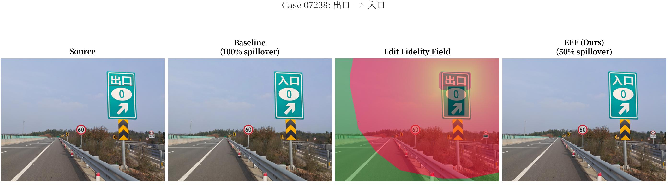
Figure 1: Edit spillover in scene text editing—baseline models frequently erase or alter non-target text when editing a target sign.
Edit Fidelity Field Methodology
To address spillover, the paper introduces the Edit Fidelity Field (EFF), a semantics-aware, per-pixel continuous field that governs editable zones. Rather than relying on binary or spatially naive masks, EFF integrates OCR-driven analysis to semantically isolate and protect non-target regions regardless of their spatial relationship to the target edit.
The EFF comprises four operational zones:
- Edit Core (w=1): Fully editable target region.
- Transition Zone ($0 Smooth distance-based decay to minimize boundary artifacts.
- Protected Zone (w=0): Non-target text—explicitly locked from editing, based on OCR outputs.
- Background (w→0): Non-text background areas, also protected but with less strict enforcement.
EFF is both training-free and model-agnostic, functioning as a post-processing module applicable to any diffusion-based STE pipeline.
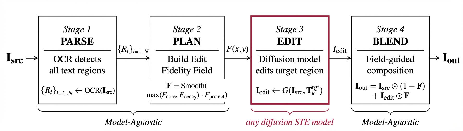
Figure 2: Pipeline overview—EFF comprises OCR parsing, field planning, regular STE editing, and fidelity-guided post-hoc blending.
EFF construction proceeds by parsing all text regions (via OCR), identifying the edit target, designing the zones (with explicit transition and protected regions), and applying Gaussian smoothing. After the edited image is generated by the diffusion model, EFF blends the original and edited outputs post-hoc, locking protected (non-target) pixels and blending elsewhere based on the fidelity weights.
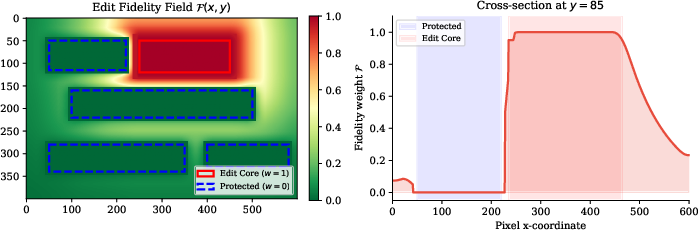
Figure 3: The EFF visualizes core, transition, and protected zones—regardless of their spatial overlap—in a continuous field.
Quantitative Evaluation and Analysis
A new protocol for per-region spillover quantification is introduced, leveraging both OCR text similarity and pixelwise PSNR to flag modifications on a per-region basis and aggregate rates and preservation quality. This protocol provides finer granularity than global metrics, capturing the differential vulnerability of individual text zones.
Extensive experiments on TBench v2 with Qwen-Image-Edit-2511 demonstrate the effectiveness of EFF in minimizing spillover:
- Baseline: 94% spillover rate, average region PSNR 22.4 dB.
- EFF: 25% spillover rate, average region PSNR 113.8 dB (+91.4 dB improvement).
- Min region PSNR (worst-case): 59.6 dB for EFF vs. 14.8 dB for baseline.
- Spillover reduction is consistent across categories, notably reducing app screenshot spillover from 100% to 16%.
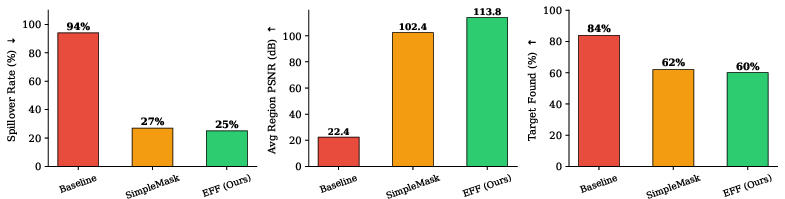
Figure 4: EFF drastically reduces text spillover while maintaining strong target modification fidelity.
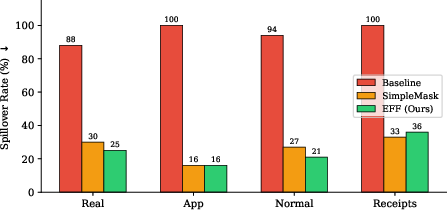
Figure 5: Spillover rate reductions per data category; strongest advantage seen in structured UI/app screenshots.
An ablation study highlights the critical importance of the protected zone mechanism: compared to a distance-based SimpleMask (no OCR), EFF achieves a further +19.0 dB improvement in worst-case region PSNR, confirming that semantic (OCR-driven) protection is significantly more effective for spatially adjacent text.
Accuracy-Fidelity Tradeoff and Parameterization
The inclusion of strict isolation comes with an accuracy-fidelity tradeoff: EFF's strong isolation reduces measured target accuracy from 84% to 60%. However, the tradeoff is highly tunable via expansion of the edit core and transition zones, allowing task-dependent operation. The authors note that OCR-based target accuracy underestimates human-perceived text correctness in blended outputs.
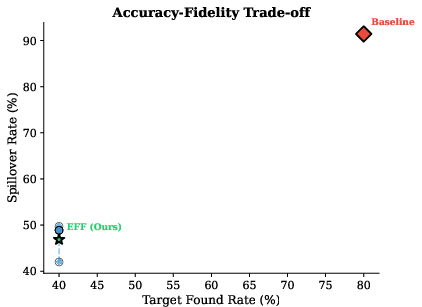
Figure 6: Pareto frontier between target accuracy and non-target fidelity—EFF shifts the operating regime to low spillover.
Implications, Limitations, and Future Directions
EFF establishes a semantics-aware standard for post-hoc region isolation in STE, directly composable with existing and future model architectures. Its training-free, model-agnostic nature ensures broad applicability. Strong isolation is achieved without degradation to naturalness outside the edit core—particularly important for document, AR, and digital asset workflows where semantic integrity is non-negotiable.
A salient limitation is the dependence on OCR quality; undetected regions remain vulnerable. Additionally, EFF focuses on single-target edits—the semantics and implementation of multi-target or globally coordinated edits remain open. The observed 60% target accuracy (OCR measured) suggests the need for advancements in edit core-localized diffusion guidance.
Future developments may integrate attention-based refinement of the edit core, OCR-free visual saliency detection, or hybrid approaches leveraging text and non-text structure awareness at earlier stages in the diffusion process. EFF's modularity lends itself to composition with identity-preserving and style-adaptive methods.
Conclusion
The Edit Fidelity Field method introduces a semantics-aware, training-free, and model-agnostic framework for mitigating edit spillover in scene text editing. By enforcing OCR-detected protection of non-target text, it reduces spillover from 94% to 25%, dramatically enhancing non-target fidelity metrics. EFF establishes robust isolation as a new default for STE pipelines, facilitating practical deployment in high-integrity text editing scenarios and serving as a foundation for further research into semantics-guided visual content editing.