- The paper introduces the MAP-V framework, a multi-agent, multimodal system that decouples intent parsing and factual verification to reduce false positives.
- It employs a dual-layer user preference graph and interactive human-in-the-loop controls to offer precise, transparent recommendation filtering.
- Evaluation shows near-doubling of F1-score and significant reductions in manual blocking actions, enhancing filtering accuracy through robust adjudication.
Transparent and Controllable Recommendation Filtering via Multimodal Multi-Agent Collaboration
Introduction and Motivation
Recommendation platforms are characterized by high-volume, multimodal streams and increasingly subjective user discomfort around content. While deep learning architectures have elevated the relevance of recommended content, the dominant engagement-centric paradigm exposes users to undesirable, misleading, or anxiety-inducing recommendations without sufficient agency or recourse. Existing LLM-based moderation systems are bottlenecked by modal blindness (inability to reason over non-textual cues) and systemic over-association (aggressive, erroneous generalization from sparse user feedback), both of which result in high false positive rates and loss of fine-grained intent memory.
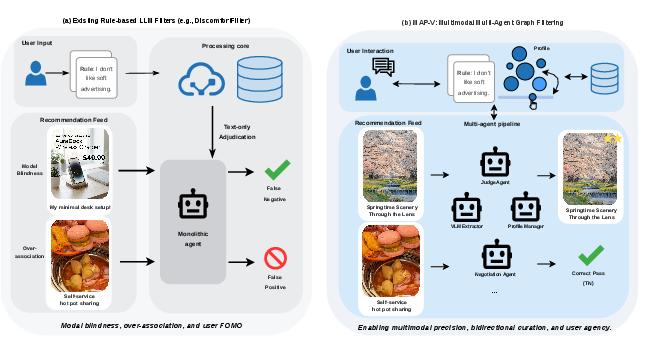
Figure 1: Comparison of recommendation filtering paradigms. (a) Text-only monolithic filters show modal blindness and over-association; (b) MAP-V aligns multimodal multi-agent pipelines with user-editable preference graphs for precise filtering and positive curation.
The "Transparent and Controllable Recommendation Filtering via Multimodal Multi-Agent Collaboration" paper (2604.17459) proposes a MAP-V framework that systematically addresses these challenges via a cloud-edge, multi-agent pipeline combining vision-LLM (VLM) grounding, explicit dual-layer user preference graphs, and interactive human-in-the-loop tooling. The work rigorously benchmarks MAP-V against adversarial multimodal datasets and demonstrates robust real-world performance, governance efficiency, and user trust gains.
MAP-V System Architecture
MAP-V divides the filtering pipeline into four semantically distinct layers: client intervention, multi-agent backend orchestration, hybrid model microservices (LLM/VLM), and persistent knowledge storage.
- Client Layer: Integrates as a browser extension, intercepts recommendation cards, and exposes mask/unmask, appeal, and feature-graph control widgets.
- Multi-Agent Backend: Decouples intent parsing, factual visual grounding, and adjudication. The Judge Agent operates under strict “fact-grounded, no speculative association” prompting, disallowing inference beyond multimodal evidence and partitioning the pipeline into narrow, verifiable roles.
- Hybrid Model Services: Employs Qwen-VL-Plus for hierarchical image feature extraction (perception, cognition, semantics), Qwen-Plus for textual and multimodal judgment, and local CLIP/MiniLM fallback microservices to ensure resilience against model downtime.
- Knowledge Storage: Archives every intent rule, override, adjustment, and adjudication audit, enabling granular user- and conflict-centric forensics.
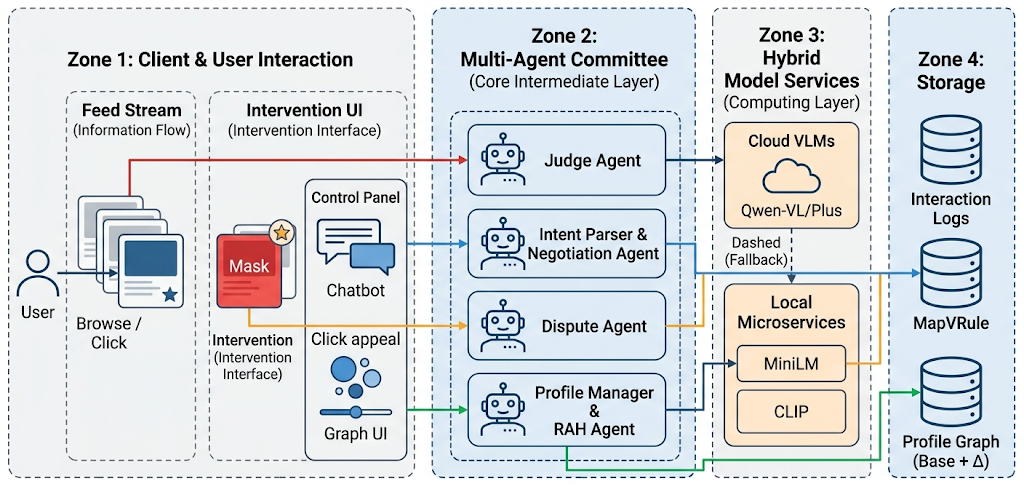
Figure 2: MAP-V system architecture with integrated client, backend, hybrid model, and knowledge storage; paths denote filtering, intent alignment, and preference evolution.
Key to intent retention and user control is the dual-layer preference graph. Manual Δ-bias adjustments, exposed via interactive frontend graphs, directly override backend algorithmic salience propagation based on vector similarity and Personalized PageRank, preserving fine-grained directives against catastrophic forgetting.
Decoupled Multimodal, Multi-Agent Adjudication
Monolithic LLM moderation fuses intent parsing and evidence assessment, leading to modal blindness and over-association. MAP-V orthogonalizes these functions: image features are extracted and structured before any cross-rule matching, ensuring all block/allow triggers are justified solely by explicit, human-auditable cues. Even during snippet truncation or vision service downtime, local cross-modal matching (CLIP) conservatively blocks ambiguous exposures, ensuring zero protection downtime.
Interactive human-in-the-loop loops allow users to both articulate new discomfort beyond rigid keyword triggers and refine boundaries via chat-based agentic negotiation. Each appeal invokes a Dispute Agent, referencing the exact adjudication snapshot and offering actionable, intelligible rule modifications (exemption, specificity, or weight tuning).
Evaluation: Adversarial Robustness and Longitudinal Alignment
Offline Adversarial Evaluation
On a curated set of 473 high-confusion, multimodal samples, MAP-V achieves:
- 74.3% false positive reduction compared to the strongest text-only LLM baseline.
- Near-doubling of F1-score from 0.3757 to 0.7143.
- Orthogonal ablation shows multimodal perception is necessary for high recall, while multi-agent decoupling is critical for high precision; only their combination yields optimal filtering under adversarial ambiguity.
Longitudinal Field Study
In a 7-day deployment (N=19, 66,603 content exposures), MAP-V maintains Proxy-F1 stability (>0.82), with manual filtering actions per block declining 33.9% as systemic governance adapts to users’ evolving profiles.
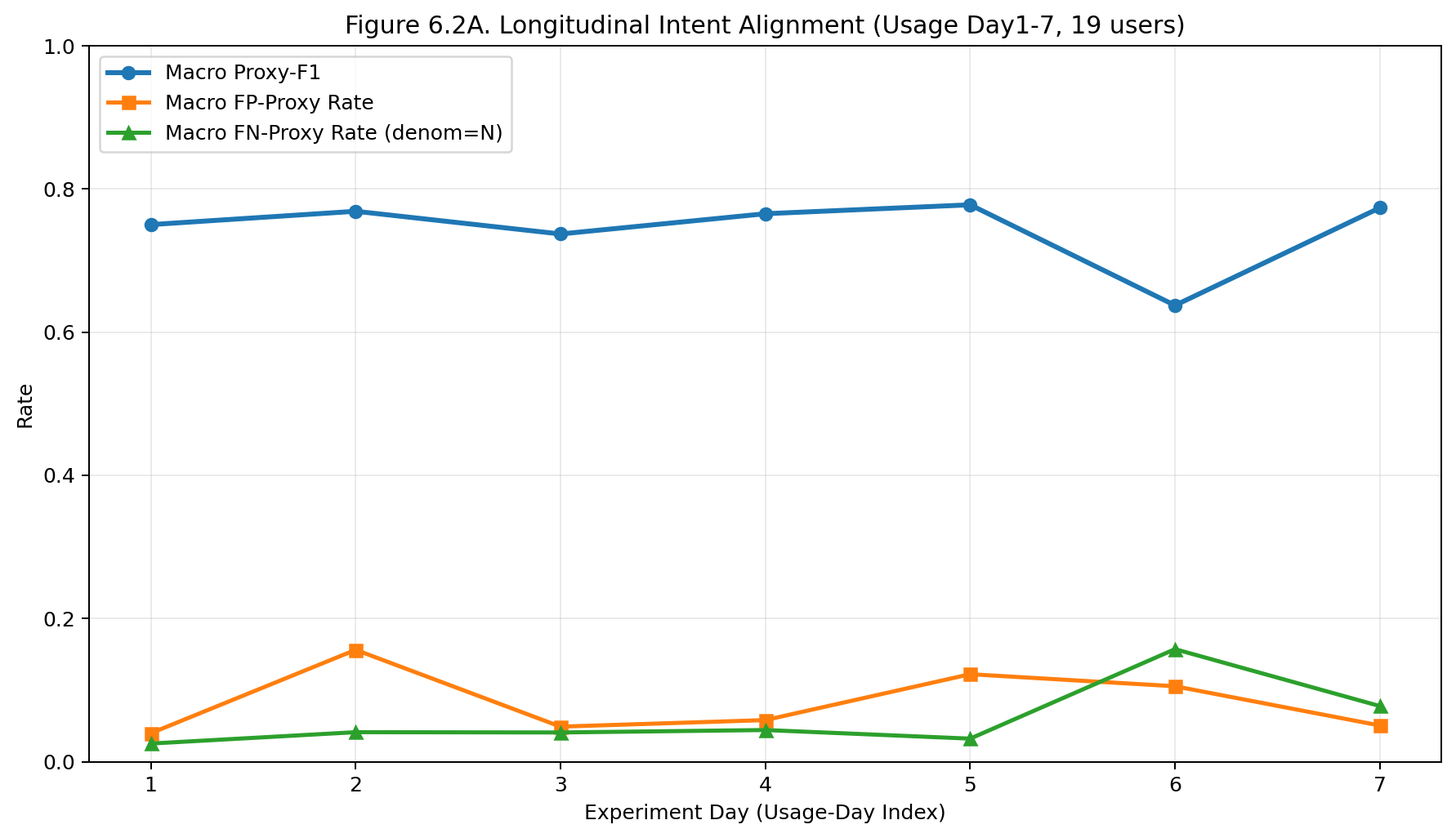
Figure 3: MAP-V intent alignment over one week, with high Proxy-F1 and suppressed FP/FN rates.
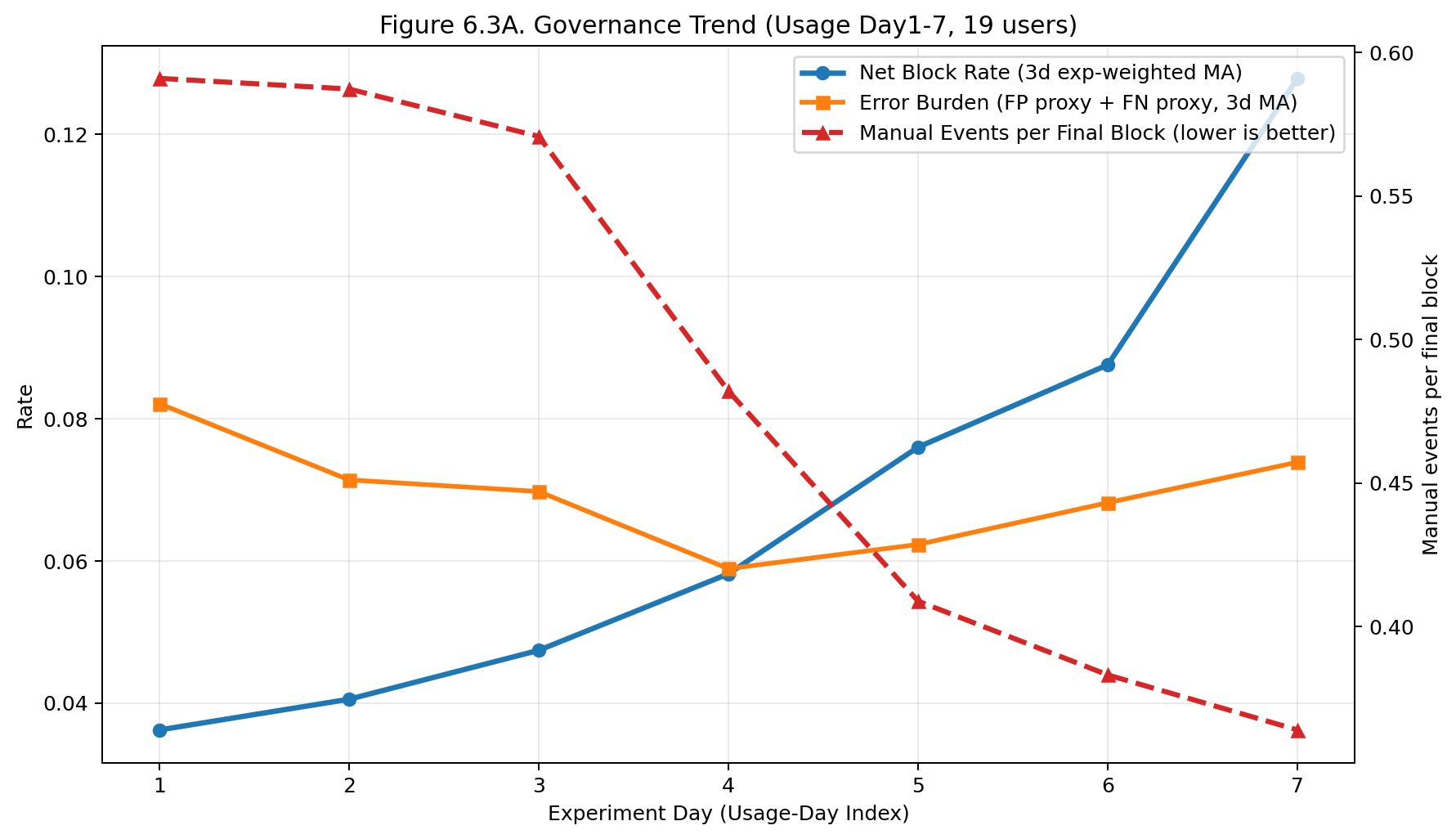
Figure 4: As automated interception increases, required manual interventions per block sharply decrease, indicating governance efficiency.
User Experience and Module-Level Usability
Likert-scale and module-level ratings confirm marked advantages over native platform controls in accuracy, transparency, correctability, and perceived agency (p<0.001). All MAP-V feature modules exceed usability thresholds (>6.0 mean, 95% CI).
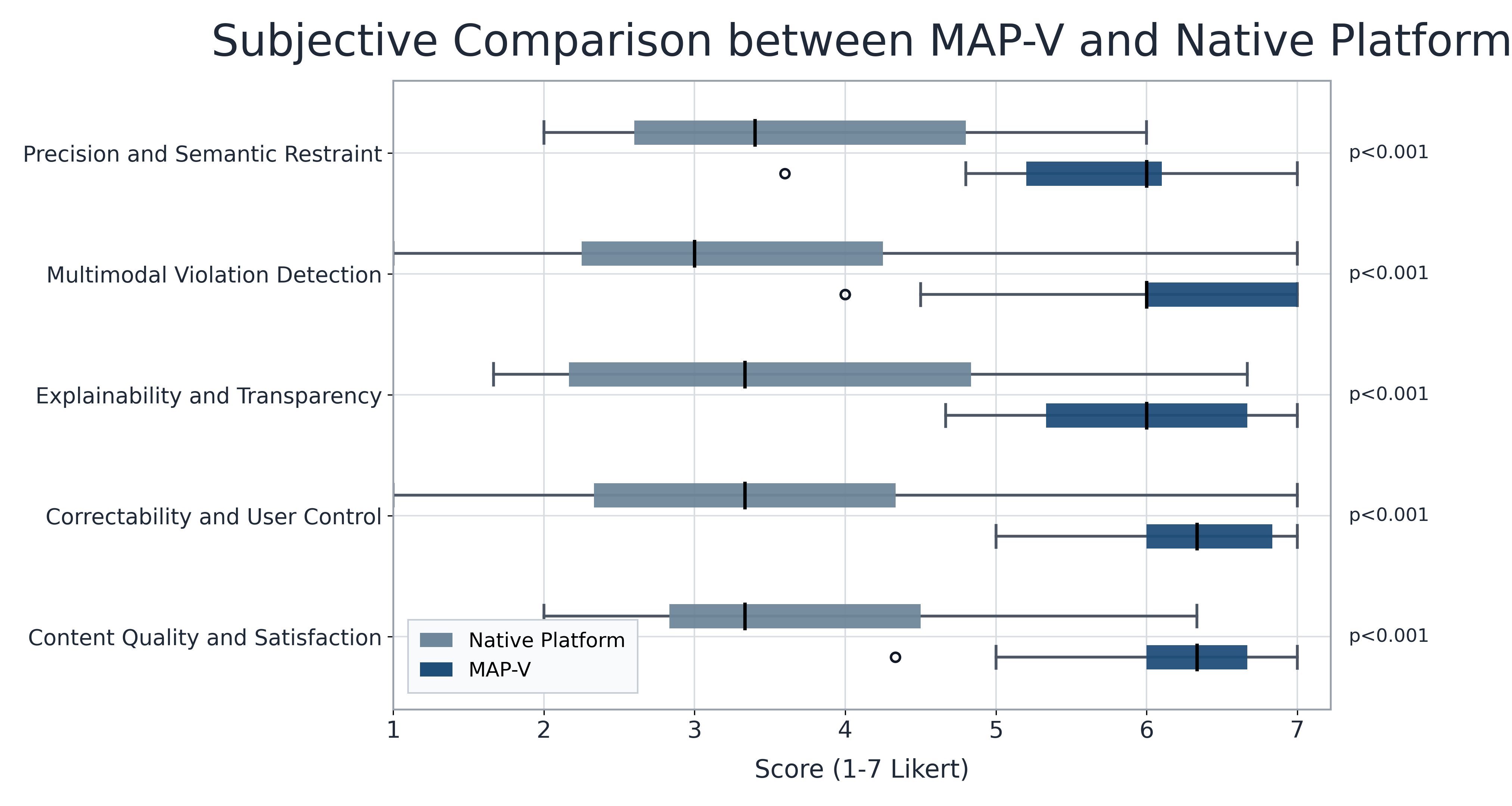
Figure 5: MAP-V outperforms native platform tools across five core dimensions (user agency, transparency, etc.) in subjective evaluations.
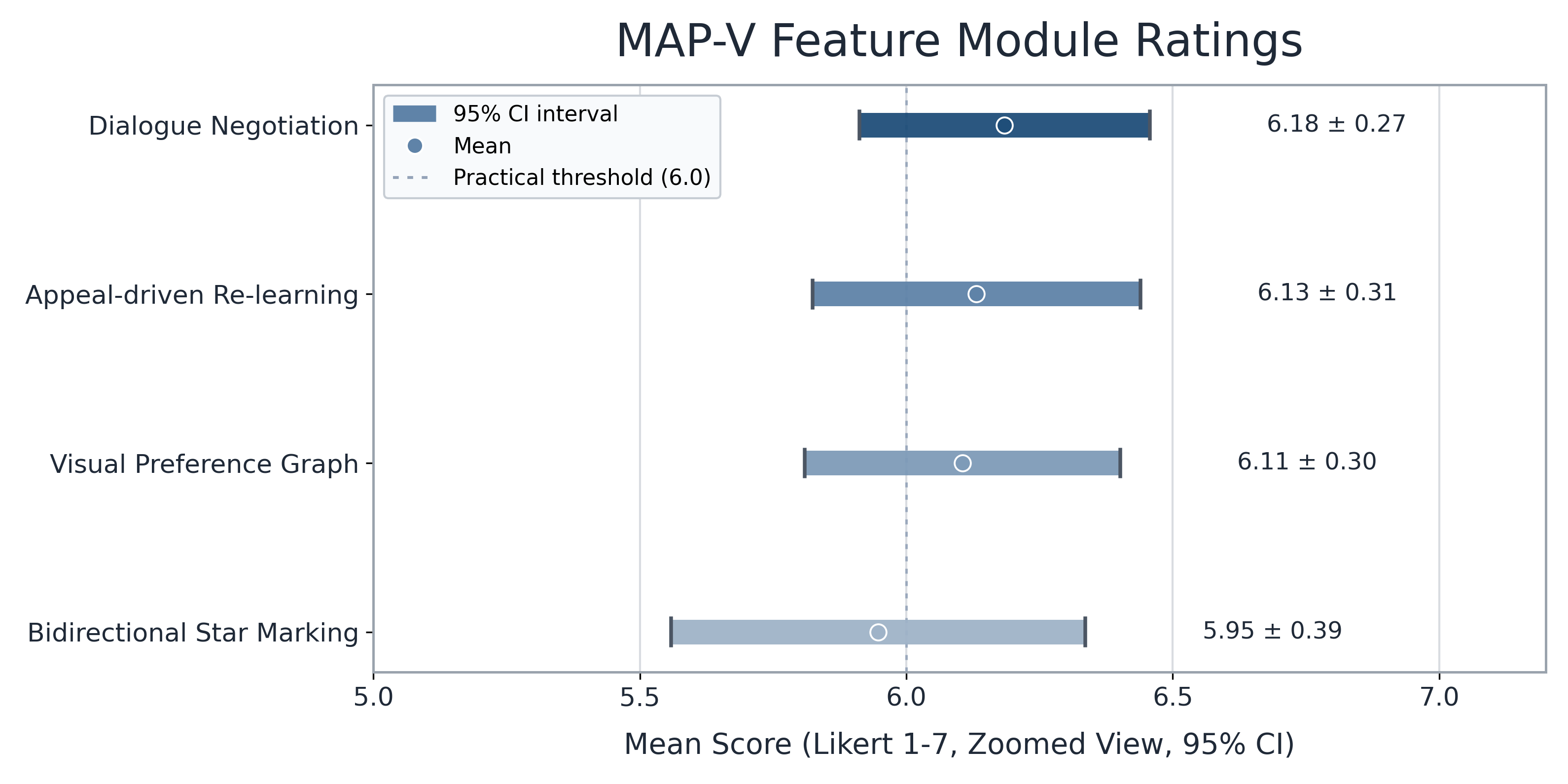
Figure 6: Usability of all MAP-V modules is rated highly, with particularly strong scores for negotiation and visual profile functions.
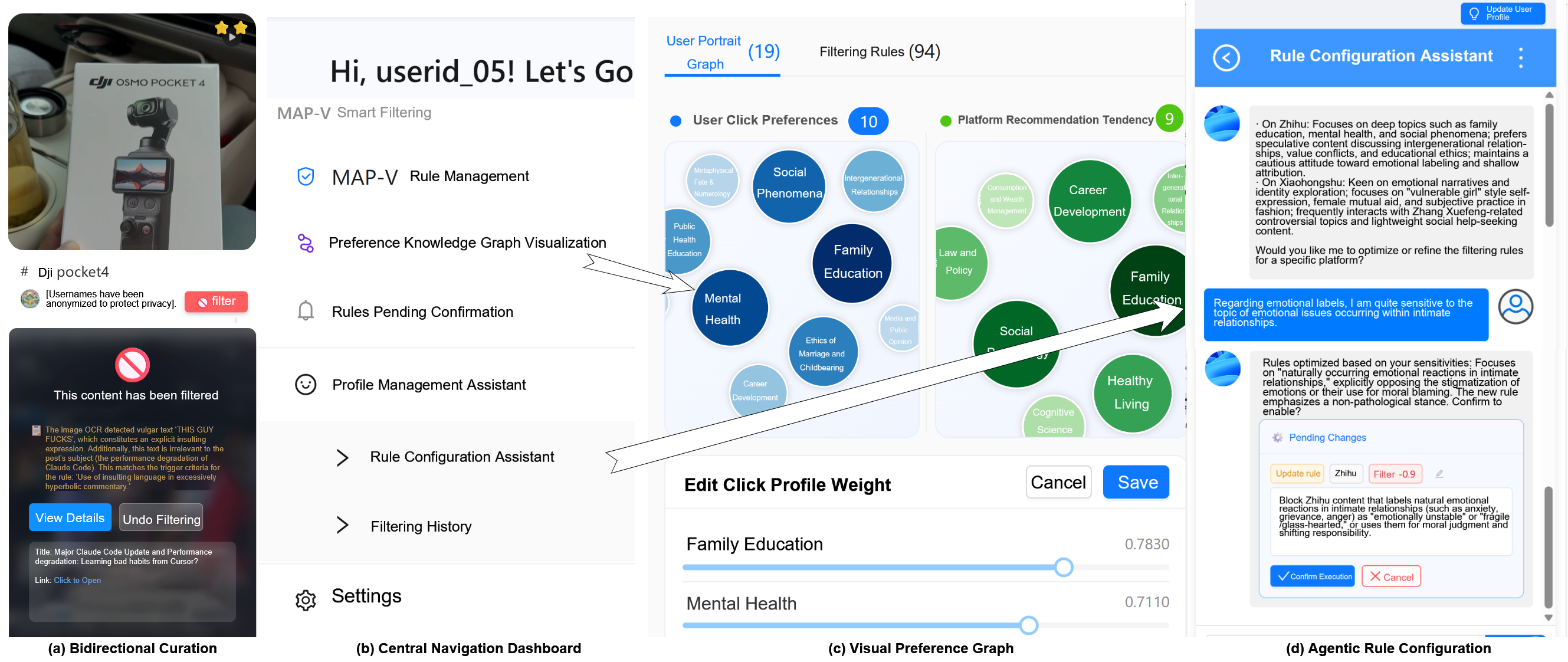
Figure 7: MAP-V user interface overview: rationalized blocks, positive curation with Star Badges, interactive profile graph, and chat-based rule refinement.
Systemic and Practical Implications
MAP-V’s dual-graph architecture effectively balances the transparency/user reliability required in the short-term (direct Δ-adjustment, deterministic feedback) against the robustness and fuzziness needed for long-term, scale-efficient preference propagation (embedding-based PageRank associations). Its protocol for multimodal, fact-grounded adjudication establishes a replicable template for any platform encountering image-text mismatches or adversarial content presentation.
Critically, block and appeal logs empirically validate the necessity of fine-grained, idiosyncratic user rules (long-tail effect) and demonstrate that erroneous speculative blocks are concentrated in a small number of rules—making the system maintainable and debuggable at lower operational expense.
The architecture is robust to upstream downtime and resilient to cloud dependency through local fallback, with explicit operational guarantees around coverage and conservative fallback blocking.
Limitations and Trajectories
The limited sample size of the in-the-wild study and the dependence on cloud VLM APIs introduce uncontrolled exposure heterogeneity and latency/privacy risks. Next-step research should expand randomized controlled group deployments and transition the multi-agent stack to on-device, quantized open VLMs, enabling fully decentralized, privacy-preserving governance. Additionally, the system could be adapted to domains exhibiting similar adversarial multimodality (e.g., real-time communication moderation, educational content curation).
Conclusion
MAP-V demonstrates that the systemic limitations of current recommendation filtering—modal blindness, catastrophic over-association, and opacity—are architectural and tractable. By decoupling user intent parsing from factual verification and leveraging a Δ-adjusted, dual-layer preference representation, the framework achieves significant reductions in false positives and human effort without diminishing recall or transparency. These results suggest a viable blueprint for recommendation ecosystem governance as a transparent, auditable, and user-controllable collaboration between humans and AI-driven agents (2604.17459).

