- The paper introduces StrEBM, which applies distinct, learnable energy-based biases per latent dimension to achieve interpretable blind source separation.
- It demonstrates that using GP-inspired energy functions and an optional separation regularizer improves source recovery and speeds up convergence in linear scenarios.
- Empirical results reveal challenges in nonlinear regimes, underscoring the need for additional regularization to stabilize generator expressivity and parameter identifiability.
StrEBM: Structured Latent Energy-Based Models for Blind Source Separation
Overview and Motivation
StrEBM introduces a novel approach to structured latent modeling, targeting the long-standing blind source separation (BSS) challenge and framing it within a more general perspective of identifiable and decoupled latent organization. The framework departs from typical global regularization or shared-prior paradigms by assigning distinct, learnable energy-based structural biases to each latent dimension. In this setup, the latent variables (sources) are directly optimized, along with the observation-generation map and source-wise structural parameters, allowing the latent factors to evolve toward specialized and source-like representations during training.
The primary demonstration grounds for StrEBM are both linear and nonlinear BSS settings, where the empirical identifiability and differentiation of latent dimensions are practically verifiable. Experiments leverage Gaussian-process (GP) inspired source-wise energies, offering parametrized smoothness for each latent source. This per-dimension energy assignment is presented as a flexible meta-architecture, not restricted to GP energies or time-series domains.
StrEBM models observed multichannel data Y∈RT×m using a structured latent matrix S∈RT×n, with the j-th column representing one candidate source. The methodology fully exposes the latent components to optimization, with no encoders or amortized inference.
Each latent dimension sj is regularized by its own energy function: in the instantiation presented, a GP-inspired prior with learnable length-scale ℓj, so that each component is biased with its own indexed smoothness trajectory. The parametric mapping gθ relates the latent matrix to observed measurements; it is a linear operator in the linear BSS case, and a multilayer perceptron in the nonlinear case.
The objective is composed of three key terms:
- Data fidelity: Isotropic Gaussian observation model aligns gθ(S) with Y using MSE loss.
- Source-wise structural energy: Each sj penalty via EjGP(sj;ℓj)=21sj⊤Kj−1sj+21log∣Kj∣, S∈RT×n0 the RBF kernel with S∈RT×n1.
- Separation regularizer: A weak Frobenius-norm penalty on the off-diagonal correlation of mean-centered, normalized latent dimensions, i.e., S∈RT×n2.
The optimization jointly adjusts S∈RT×n3, S∈RT×n4, and S∈RT×n5 using first-order gradients. The separation regularizer is optional but shown empirically vital for speeding up disentanglement and improving late-stage convergence.
Empirical Analysis: Linear Case
Experiments use synthetic mixtures with three source components under both linear and nonlinear mixing. In the linear setting, StrEBM without the explicit separation regularizer already achieves source recovery, confirming that the source-wise GP energies are the primary driver of decoupling and identifiability.
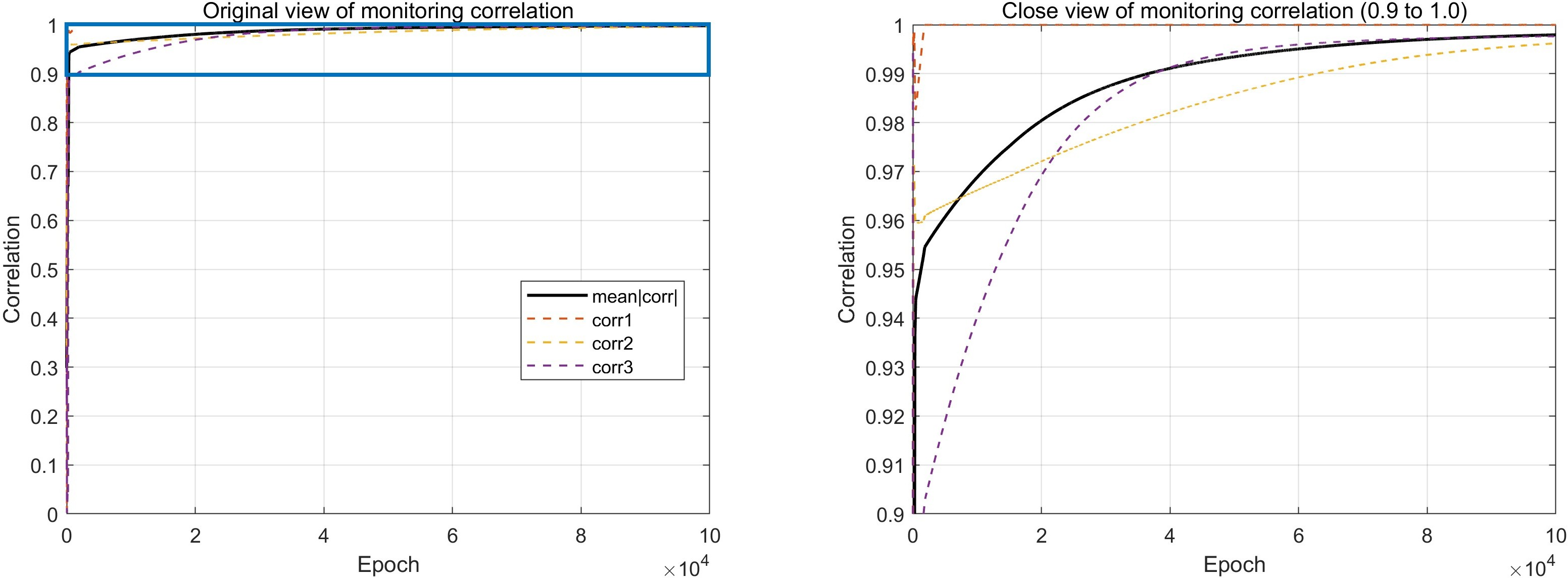
Figure 1: Linear-case monitoring correlation without the separation regularizer—separation is achieved but convergence is slow in later epochs.
Nevertheless, late-stage convergence is inefficient: the alignment between estimated and ground truth sources saturates slowly due to residual redundancy among latent dimensions. This motivates the incorporation of the separation regularizer.
Activation of the separation term yields substantially faster and more robust separation:
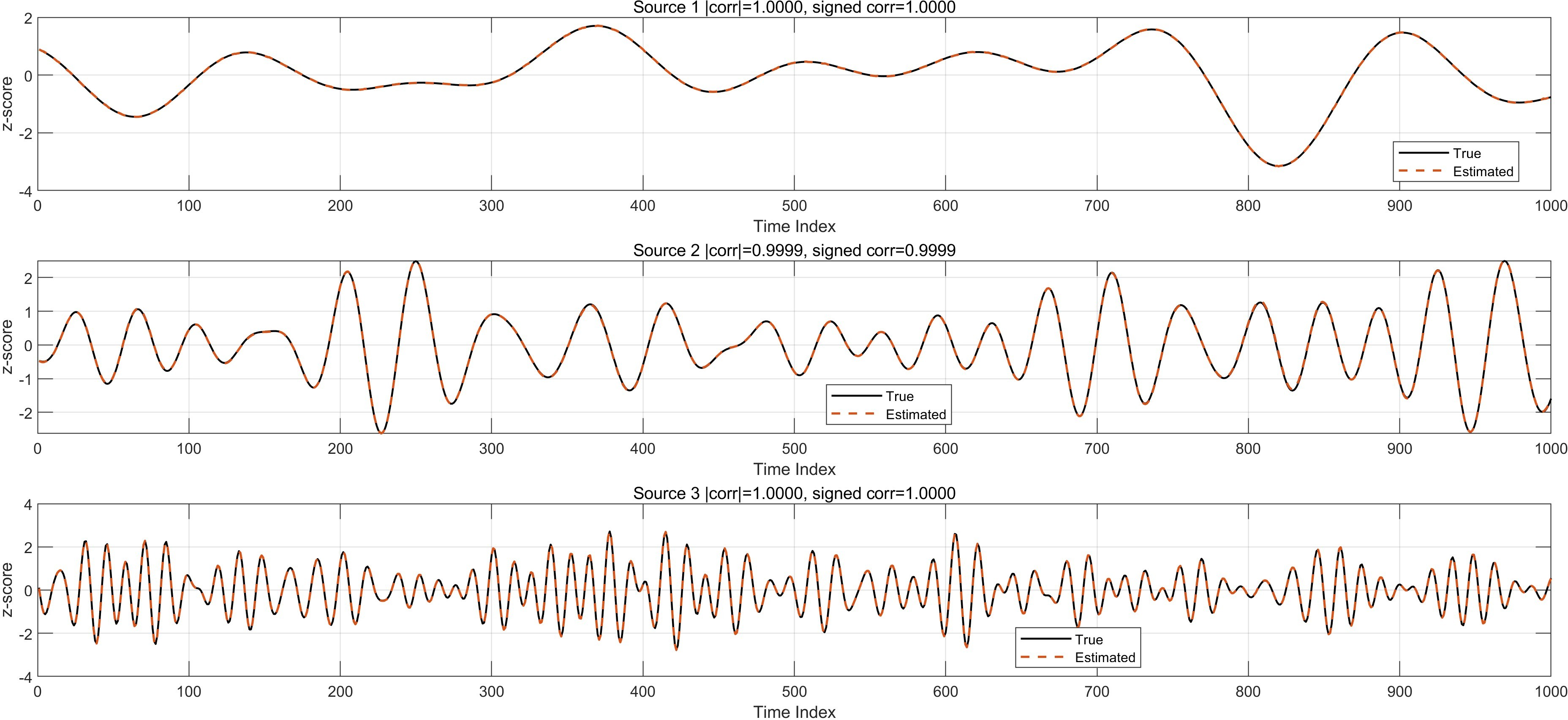
Figure 2: Linear-case matched source comparison with the separation regularizer—estimated sources closely match ground truth sources.
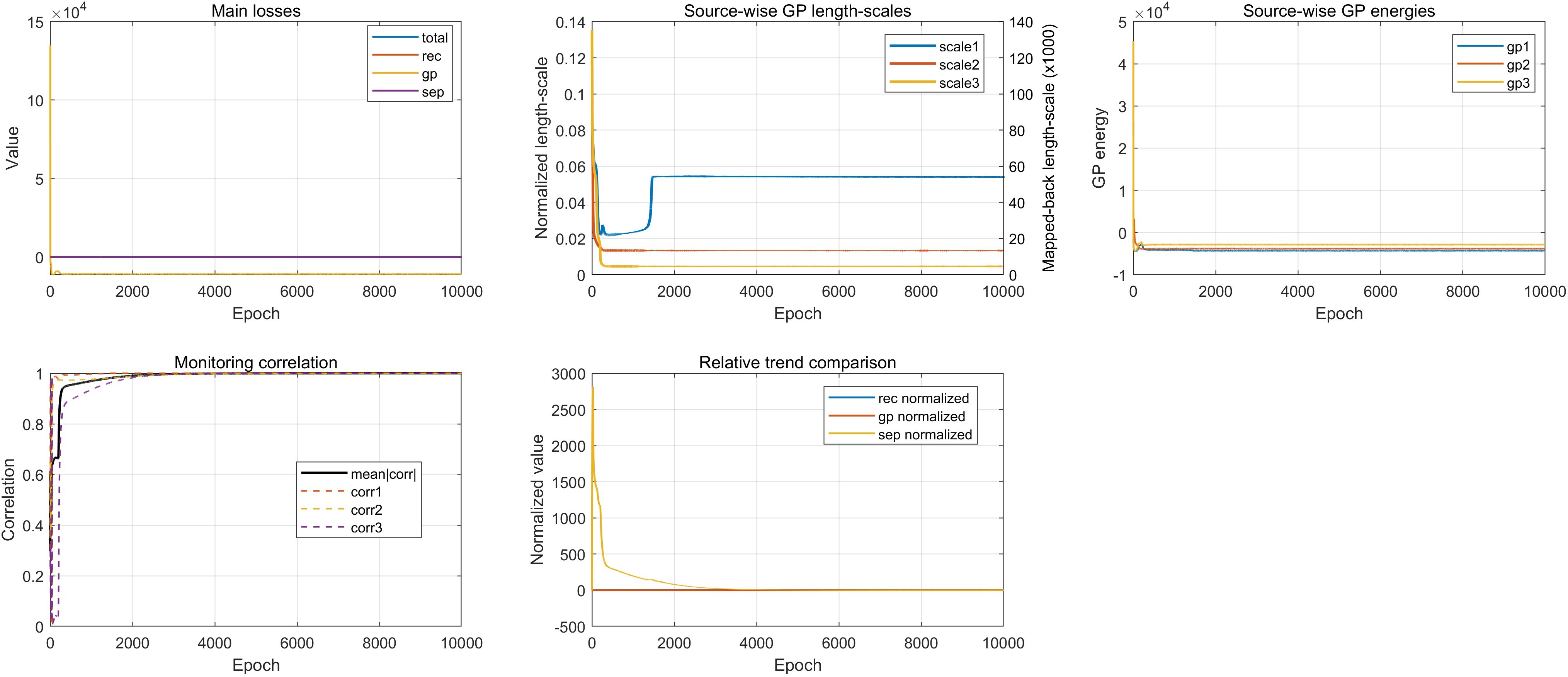
Figure 3: Training dynamics in the linear case with the separation regularizer reveal efficient convergence of all losses, stable differentiation of GP length-scales, and rapid emergence of decorrelated latent trajectories.
The learned source-wise GP length-scales diverge across dimensions, demonstrating that each latent component specializes structurally. Notably, separation is not an artifact of direct correlation maximization—the monitoring metrics are external and not incorporated in the training loss. Instead, the synergy of source-wise GP energies and mild decorrelation constraints is sufficient for stable, interpretable source recovery in the linear mixing regime.
Empirical Analysis: Nonlinear Case
In the nonlinear scenario, the observation mapping is a neural MLP. StrEBM largely retains its separation capability:
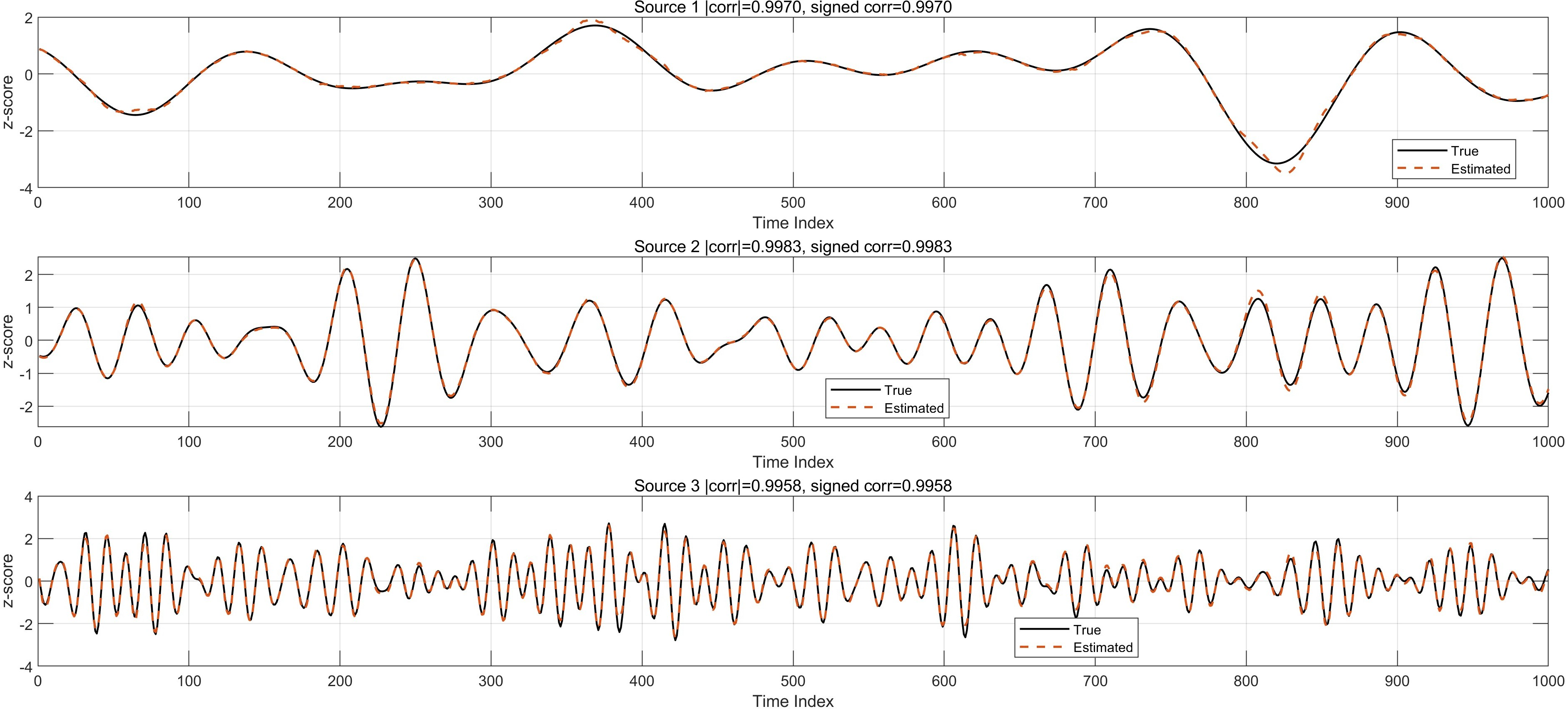
Figure 4: Nonlinear-case matched source comparison—the estimated components maintain high, though imperfect, correlation with ground truth sources.
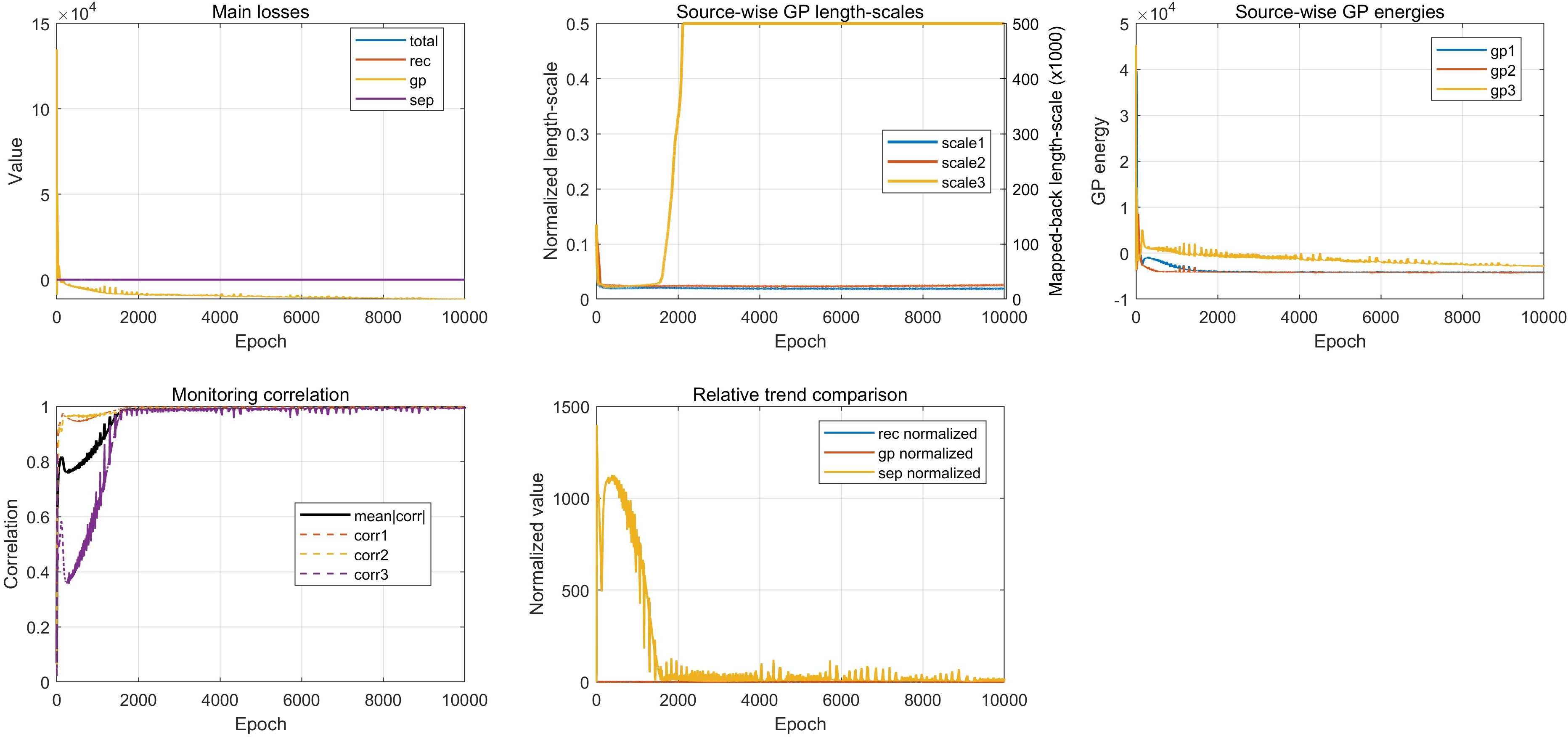
Figure 5: Training dynamics in the nonlinear case: recovery is less robust, and source-wise GP length-scales display instability and parameter boundary effects.
However, key challenges surface:
- Optimization stability deteriorates: monitoring correlation is noisier, and length-scale parameters can saturate at their imposed boundaries, suggesting that the increased expressivity of S∈RT×n6 allows the mapping to "absorb" part of the separation burden, diminishing the pressure on latent structure.
- Identifiability is not as robust as in the linear setting: final correspondence with true sources remains strong but is no longer uniform; some learned latent components may fail to stabilize optimal structural parameters, indicating possible local minima or indeterminacy.
- Auxiliary regularization remains crucial: the separation loss is even more valuable for reducing collapse or redundancy in high-expressivity regimes.
Overall, these results empirically confirm that source-wise regularization is an effective driver of disentanglement, but the balancing of component specialization and generator expressivity is significantly more delicate in nonlinear generative contexts.
Theoretical and Practical Implications
StrEBM offers a general meta-architecture for interpretable, structured, and potentially identifiable latent representations, not restricted to BSS or time-indexed signals. By directly optimizing latent factors with dimension-specific priors—here instantiated as GP energies—StrEBM decouples the specification of inductive bias from global isotropic or independent assumptions, making it adaptable to broader structured data domains.
Key implications include:
- Scalable, source-wise priors: Any latent structural family (e.g., Markov, diffusion, mixture) can, in principle, be deployed per latent dimension, facilitating interpretable and injective mappings between latent factors and data generators.
- Flexible generator compatibility: The framework admits both linear and nonlinear observation models, but empirical results demonstrate that additional regularization or constraint innovations may be essential for robust identifiability as generator flexibility increases.
- Direct latent optimization: Eschewing amortized inference or variational encoders enables precise control and interpretability over latent evolution, but exposes the framework to known EBM optimization challenges, such as local minima and slow convergence.
For BSS, StrEBM's efficacy in the linear regime matches or exceeds classical ICA and modern structured VAE approaches, while also providing a clear path for extension to more general settings.
Future Directions and Extensions
- Energy family generalization: The GP instantiation is one principled choice, but richer or learnable source-wise energy classes could increase robustness and allow for structured priors tailored to specific applications (e.g., AR, diffusions, spectral priors).
- Nonlinear generator stabilization: Approaches such as constrained variational inference, auxiliary variable integration, or structural generator regularization may help stabilize source-wise structure when using expressive observation maps.
- Scalable optimization: Efficient algorithms for high-dimensional, non-Euclidean latent EBM optimization will be critical for extending StrEBM to large-scale or long-sequence data.
- Identifiability theory: Sharpening theoretical conditions under which source-wise energies guarantee identifiability with nonlinear generators remains unresolved and will require rigorous future investigation.
Conclusion
StrEBM represents a meaningful extension of structured latent EBM modeling, promoting source-wise differentiation through learnable, dimension-specific energies and directly optimized latent factors. Empirical results show strong source recovery in the linear BSS setting and expose challenges for nonlinear mixing, particularly around optimization stability and parameter identifiability. The framework's modularity and principled design suggest promising directions for interpretable latent-variable modeling, structured generative learning, and generalization to broader unsupervised disentanglement tasks. Robust extension to complex nonlinear generative scenarios will hinge on future advances in energy family design and joint optimization strategies.
For deeper technical details, refer to "StrEBM: A Structured Latent Energy-Based Model for Blind Source Separation" (2604.17381).

