- The paper introduces novel representations and recurrence relations that enable O(n) pointwise evaluation of Gauss–Legendre curves using shifted power and symmetric Jacobi bases.
- The paper demonstrates that while the shifted power basis offers faster performance at low degrees, it becomes numerically unstable for n > 20 due to coefficient growth.
- The paper validates its methods with benchmark results showing that symmetric Jacobi and Legendre approaches maintain stability and comparable efficiency for high-degree curves.
Evaluation of Gauss-Legendre Curves
Introduction
The paper "Evaluation of Gauss-Legendre curves" (2604.17331) presents a comprehensive investigation of efficient and numerically stable algorithms for evaluating Gauss–Legendre (GL) curves, which are polynomial parametric curves recently introduced with advantageous properties for Computer Aided Geometric Design (CAGD). Unlike classical Bézier curves, GL curves closely follow their control polygons across high degrees, offering enhanced shape control. The technical contributions include new representations for GL polynomials in the shifted power basis and bases related to symmetric Jacobi polynomials, novel recurrence relations, and fast algorithms for pointwise and multipoint evaluation of GL curves in arbitrary dimension.
Mathematical Foundations and New Representations
GL curves are defined over the interval [−1,1] as
Pn(t)=∑i=0nWiFin(t)
where Fin are basis polynomials derived from differences of specifically constructed functions Gin(t) related analytically to Legendre polynomials. The zeros of the nth Legendre polynomial, denoted τi, play a critical role in these constructions.
The paper introduces two major new representations for Fin:
- Shifted Power Basis: GL polynomials are represented as sums of (t+1)k with explicitly computed or recursively generated coefficients. This approach allows use of Horner's scheme for fast O(n) evaluation per Fin, but, as discussed later, exhibits numerical instability at high degrees due to rapidly growing and sign-alternating coefficients.
- Symmetric Jacobi (and Legendre) Bases: Leveraging the structure of Jacobi polynomials and the Christoffel–Darboux identity, the authors derive recursions and expansions for Pn(t)=∑i=0nWiFin(t)0 in terms of Legendre and associated symmetric Jacobi polynomials. The Clenshaw algorithm is utilized for stable and efficient evaluation, resulting in Pn(t)=∑i=0nWiFin(t)1 operations per Pn(t)=∑i=0nWiFin(t)2.
These expansions allow the evaluation of all Pn(t)=∑i=0nWiFin(t)3 for fixed Pn(t)=∑i=0nWiFin(t)4 in Pn(t)=∑i=0nWiFin(t)5 time and the evaluation of a GL curve Pn(t)=∑i=0nWiFin(t)6 in Pn(t)=∑i=0nWiFin(t)7 time for Pn(t)=∑i=0nWiFin(t)8-dimensional control points.
Efficient Algorithms for Single and Multipoint Evaluation
The practical application of GL curves in CAGD and graphics necessitates rapid computation at potentially many sample locations. The authors propose two families of algorithms:
Numerical Stability and Efficiency
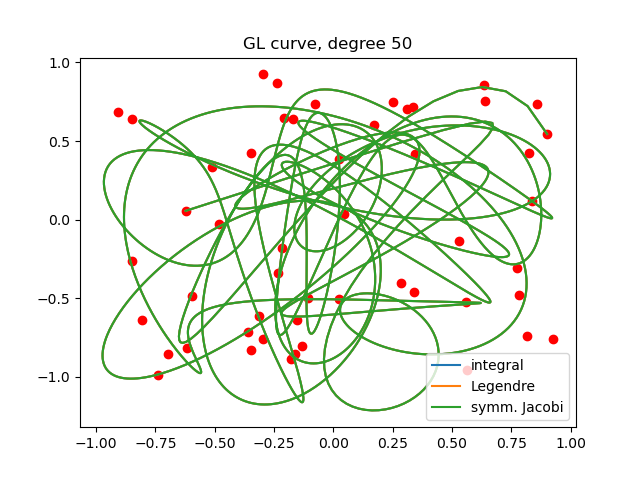
A major empirical finding is the contrast in numerical stability between bases. The shifted power basis, while computationally fastest at low degrees, becomes numerically unstable for Fin7, as the coefficients in the expansion become extremely large and alternate in sign, amplifying rounding and cancellation errors. This is visualized in Figure 2, where instability manifests in GL curves at higher degrees.
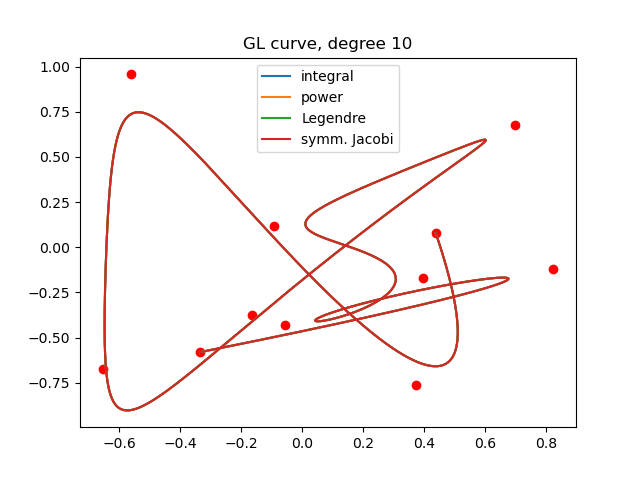
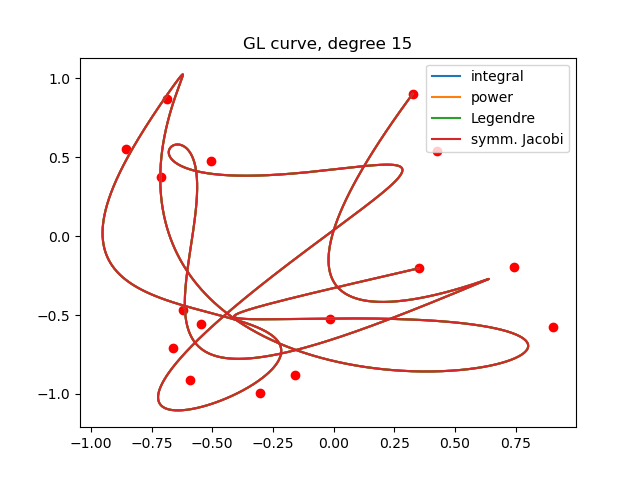
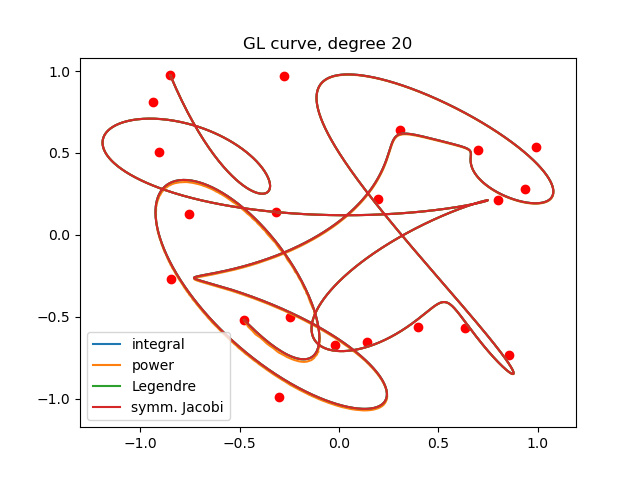
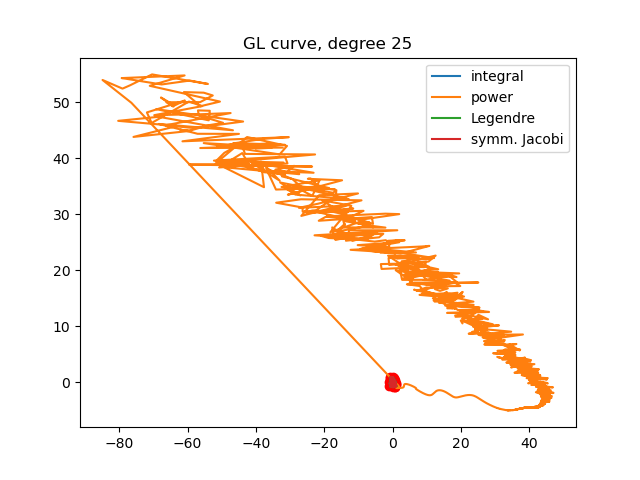
Figure 2: Numerical instability in the shifted power representation of GL curves of higher degree.
In contrast, the Legendre and Jacobi-based algorithms maintain excellent stability even for Fin8, as their coefficient magnitudes remain moderate. Timing benchmarks further demonstrate that for small Fin9 the shifted power approach is fastest, but for Gin(t)0 the orthogonal polynomial approaches become preferable due to their stability and similar computational cost.
Quantitative benchmarks provided in the paper show:
- For Gin(t)1, the shifted power evaluation is roughly 2–4Gin(t)2 faster than Jacobi or Legendre methods, but all are orders of magnitude faster than direct numerical quadrature.
- For Gin(t)3, symmetric Jacobi and Legendre approaches show near-identical and minimal evaluation times, with direct methods becoming prohibitively slow.
Implications and Future Directions
The development of robust, efficient algorithms for GL curve evaluation broadens the practical utility of GL curves in CAGD, numerical analysis, and computer graphics. The representations and algorithms introduced here enable high-degree curve evaluation without sacrificing stability or incurring unacceptable computational cost. Notably, the identification of numerical instability in the shifted power basis informs both theoretical and practical selection of basis representation in future work involving orthogonally generated polynomial bases.
Practically, these methods facilitate real-time rendering and manipulation of high-order parametric curves, and can underpin algorithms requiring rapid multipoint evaluations, such as those encountered in surface modeling, mesh generation, and geometric optimization.
The paper closes with an indication of ongoing research into connections between Bernstein and Gauss–Legendre bases and the construction of dual GL bases, which could further enhance the theoretical toolkit available for advanced approximation and CAGD tasks.
Conclusion
This work establishes well-founded, numerically stable, and computationally efficient methodologies for evaluating Gauss–Legendre curves and their derivatives, resolving a key computational bottleneck in their adoption for high-precision tasks in CAGD and related domains. The results further provide a detailed numerical analysis guiding the selection of basis according to polynomial degree and desired performance. Future developments—such as dual bases and basis transformations—are anticipated to deepen the impact and applicability of GL curve technology across computational mathematics and graphics.