- The paper introduces a YAML-based sidecar specification, KnowsRecord, to augment PDFs with structured claims, evidence, and provenance.
- It employs deterministic linting and cross-model evaluations to achieve up to 93% token savings while significantly boosting accuracy across LLM agents.
- Enhanced traceability and interoperability with existing scholarly standards enable efficient agent consumption and bridge to agent-native publishing.
Knows: A Sidecar Specification for Agent-Native Structured Research Representations
Motivation and Problem Setting
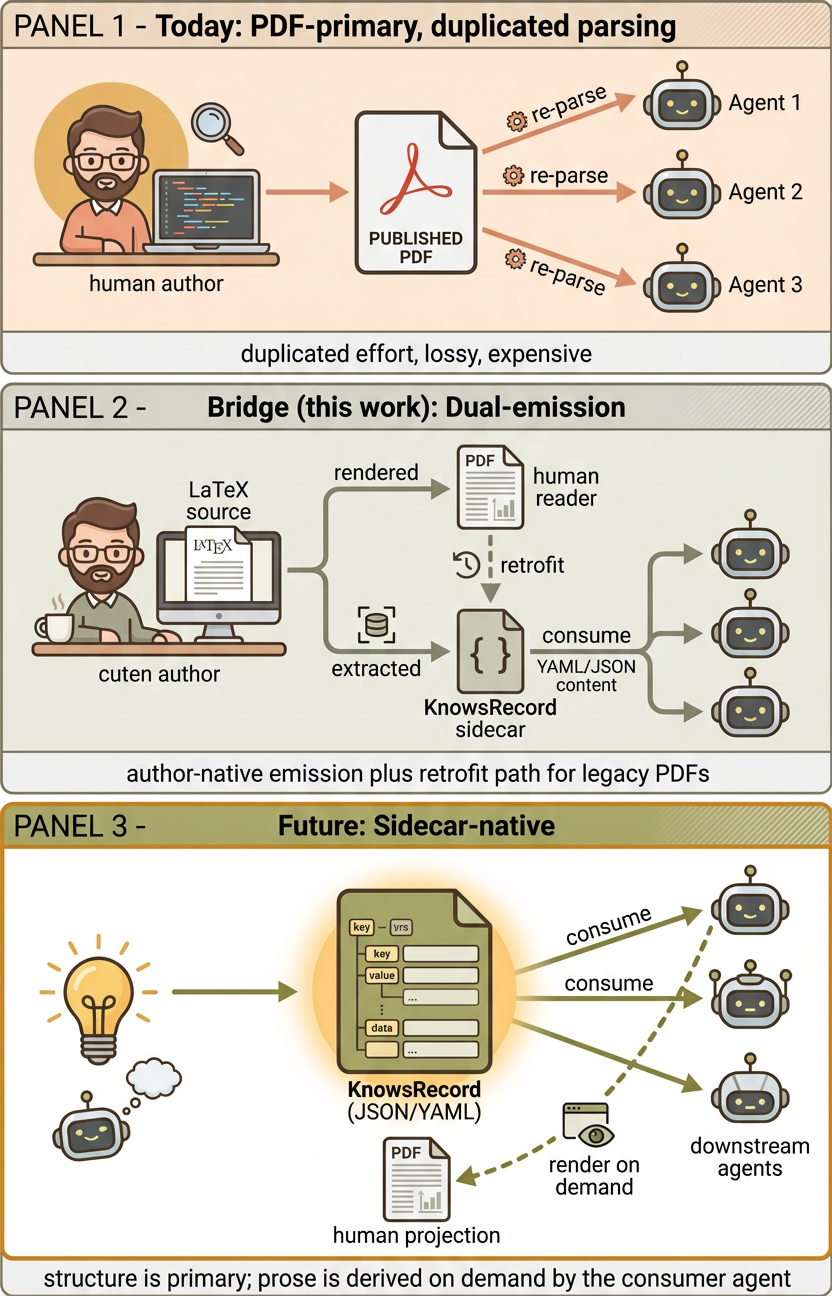
The exponential increase of agent-assisted and agent-native scientific workflows accentuates a long-standing bottleneck: the distribution of scholarly knowledge as reader-centric documents (PDFs, HTML) optimized for humans rather than LLM-based consumers. Extracting fine-grained, task-relevant information (methods, results, evidence) from narrative prose requires computationally intensive, prompt- and context-sensitive processing that is both unstable and highly inefficient. In agent-centric pipelines, every LLM agent redundantly re-parses unstructured prose, resulting in duplicated computation and inconsistent information recovery.
To address this inefficiency and the absence of a machine-consumable intermediate, "Knows: Agent-Native Structured Research Representations" (2604.17309) introduces a lightweight, YAML-based sidecar specification—KnowsRecord—to supplement existing research artifacts with structured, schema-validated claims, evidence, provenance, and relations. This approach targets immediate gains for current research agents and serves as a bridge toward an ecosystem in which structure is primary and prose becomes a byproduct.
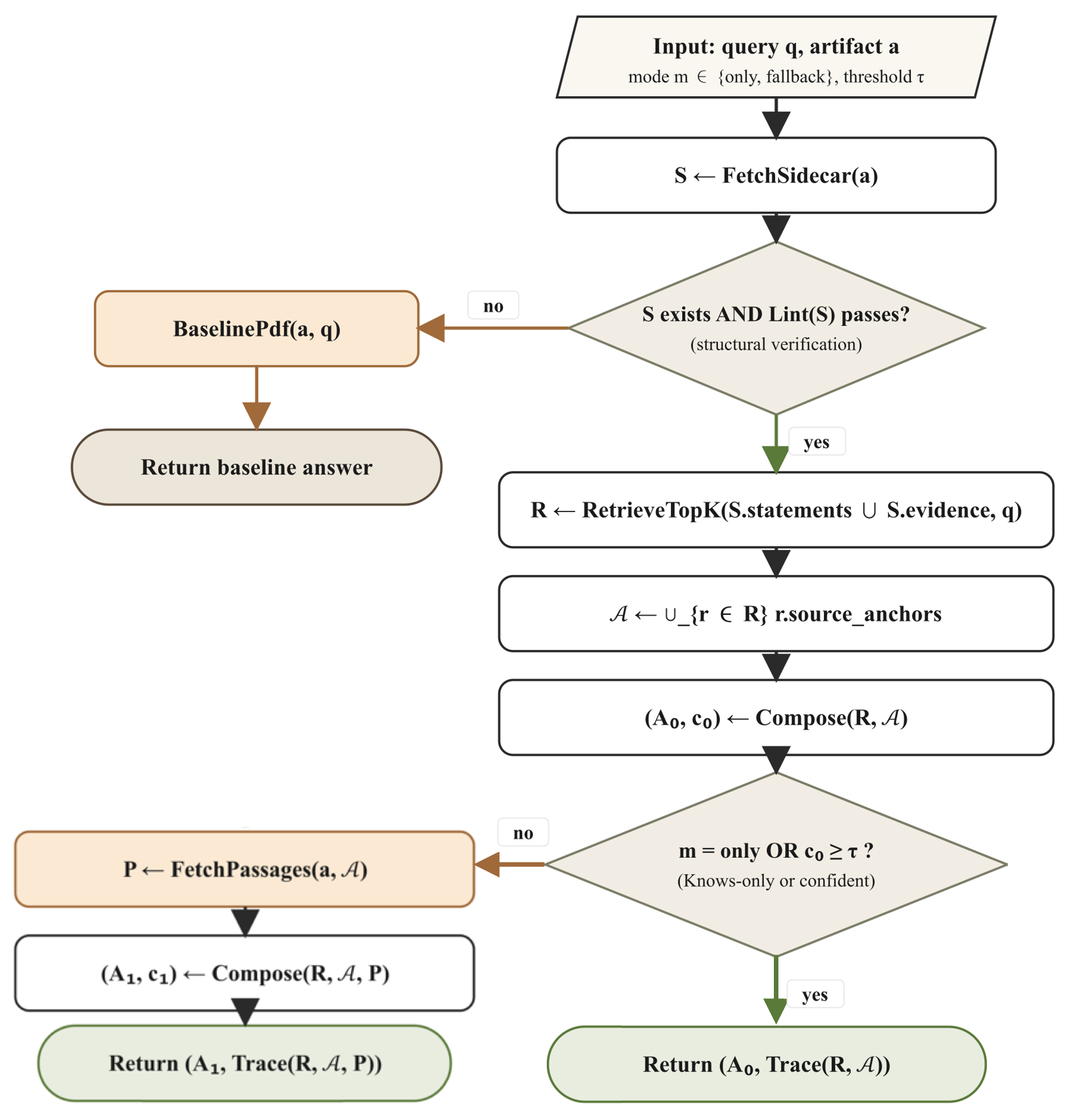
Figure 1: Overview of Knows, where a YAML sidecar augments the PDF with structured claims and evidence, enabling token savings and agent-native consumption.
KnowsRecord Specification and Ecosystem
KnowsRecord v0.9 defines a JSON-schema-conformant YAML document with five primary, schema-enforced collections: artifacts, statements, evidence, relations, and actions, augmented by provenance, versioning, and freshness metadata. Its design covers 30 root-level fields and 23 entity types, validated by deterministic lint. Importantly, KnowsRecords coexist with the original human-readable PDF, requiring zero change to publication workflows or downstream integrations.
Entities resolve inter-/intra-record references (via record_id#local_id) supporting cross-record traceability (e.g., peer reviews referencing claims in the evaluated work). Each structured claim or evidence annotation is explicitly annotated by type, modality, confidence, and extraction fidelity. The schema is forward-extensible via x_extensions, domain profiles (e.g., paper@1, review@1), and semantic versioning. Critically, Knows does not replace but interoperates with scholarly infrastructure standards: DataCite, PROV, CiTO, CodeMeta, RO-Crate, BibTeX, etc.
Figure 2: KnowsRecord architecture and workflow, showing primary entities, sidecar generation/validation, and cross-record linking for reviews.
Retrieval Protocol and Agent Consumption
The normative agent consumption protocol is formalized: upon receipt of a query, an agent attempts to validate and process the KnowsRecord sidecar, retrieving relevant statements/evidence and their source anchors. If coverage/confidence is insufficient, or structural validation fails, the protocol falls back to anchored PDF retrieval. Confidence thresholds (parameterized by τ) and deterministic schema linting enable robust, reproducible behaviors, supporting both sidecar-only and hybrid fallback modes.
Figure 3: Diagram of the agent retrieval protocol, detailing decision points, structural fallback, and the hybrid query path.
This pipeline yields (i) efficient retrieval for task-relevant queries, (ii) audit-ready citation traces, and (iii) cross-record relational reasoning in contexts such as peer review and review-as-sidecar workflows.
Experimental Results
Comprehensive cross-model, multi-discipline evaluation (140 questions, 20 classic papers, 14 disciplines, 6 LLM agents/tiers) demonstrates:
- Weak models (0.8--2B params) gain 29–42 percentage points in accuracy reading sidecars versus PDFs, e.g., 19%→47%/67% (Qwen-0.8B/2B), with 29–86% token savings.
- Sidecar-augmented weak models (75–77% LLM-judged accuracy) approach strong-model PDF performance (78–83%).
- Fallback mode yields highest accuracy for 5/6 models, recovering content absent from the sidecar while maintaining token/cost efficiency.
- For strong models, full sidecars attain comparable accuracy to PDFs using only 55% of the tokens; further ablation finds that statement-only sidecars retain 88% of the accuracy with 93% token savings.
- Traceability is qualitatively improved: under Knows, per-weakness ID references in reviews span 64–91%, contrasting with 0% in PDF-only settings—a crucial property for automated audit and multi-agent reasoning.
- Deterministic linting detects 100% of structural corruption but 0% of semantic corruption, motivating a future LLM-based verification layer.
- The sidecar effect is primarily driven by statement granularity; denser sidecars eliminate discipline-dependent performance gaps.
- LLM-based sidecar generation: Only Claude-family models reach 100% schema-valid outputs with high accuracy when consumed by other agents; non-Claude models presently lack sufficient competence for structurally-valid extraction in complex domains.
Case Studies & Ecosystem Applications
Knows is operationalized at scale, with a public community hub indexing >10,000 publications. Demonstrated use cases include:
- Large-scale literature intelligence: Agent-driven conference analysis, field-wide trend tracking, and survey bootstrapping—where token cost prohibits raw PDF/HTML consumption.
- Human-agent collaborative workflows: Discipline-specific method/evidence extraction, limitations synthesis, and fine-grained comparative analysis across diverse user intents.
- Agent-native research pipelines: Autonomous authoring, reviewing, and meta-research across multi-agent systems, where structured, machine-traversable research objects enable compositional, audit-ready protocol chaining.
Trajectory toward Agent-Native Publishing
Knows establishes a bridge from PDF-centric to agent-native publishing. The forward trajectory envisions:
Implications and Future Directions
Practically, Knows enables immediate acceleration of agentic research, systematic error tracing, and large-scale literature audits. Theoretically, it represents a modular, compositional, and verifiable substrate for autonomous scientific ecosystems. Prominent future lines include LLM-based semantic verification, lifecycle audit-trace formalization, and domain-specific profile expansion (e.g., dataset@1, model@1). As agent-native conferences and publishing venues emerge, Knows or similar schema will become central infrastructure.
Conclusion
Knows delivers a minimal, interoperable, and schema-validated format for structured research representation directly consumable by LLM agents. It achieves significant improvements in efficiency, consistency, and traceability across agent-assistive and agent-native settings, and is deployable at scale without disrupting legacy human-centric workflows. As agent-led scientific workflows grow, modular, schema-first representations such as Knows are poised to become the backbone of the scholarly graph, bridging current and future paradigms of research communication.