- The paper demonstrates a novel framework that identifies and adaptively masks emotion and rhetoric neurons to enhance prediction steering in LLMs.
- It employs activation frequency, probability normalization, and entropy filtering to pinpoint the top 1% of functionally selective neurons.
- Results show that controlled neuron intervention, particularly in top-layer FFN units, significantly boosts emotion recognition accuracy via synergistic mechanisms.
Neuron-level Mechanisms and Steering of Emotion and Rhetoric in LLMs
Introduction
This paper addresses the neuron-level representation and manipulation of emotion and rhetoric in LLMs, with a particular focus on the existence, distribution, and functional roles of specific "emotion" and "rhetoric" neurons within the Llama-3.1-8B-Instruct architecture. It critically analyzes previous approaches that mainly rely on external optimization (prompt engineering, fine-tuning) with limited causal access to internal representations. The authors propose and validate a systematic framework for neuron identification, adaptive causal masking, and controlled intervention, enabling precise steering and enhanced interpretability for emotion and rhetoric prediction tasks.
Motivation and Problem Analysis
Traditional output-oriented techniques for emotion and rhetoric control lack explanatory power over internal model representations. Meanwhile, standard neuron masking (zeroing or mean substitution) often yields non-monotonic and counterintuitive effects on prediction accuracy, complicating causal inference on neuron function. The scope of previous work is largely restricted to emotion neurons, with rhetorical representations and their interaction with emotion signals remaining underexplored.
The authors pinpoint two critical issues: (1) the absence of reliable methods for identifying and validating functional neurons tied to emotion or rhetoric, and (2) insufficient investigation into the synergistic or auxiliary role of rhetorical neuron activation in emotion-related tasks. Figure 1 exhibits the comparative performance of external control, emotion neuron injection, and combined emotion-rhetoric neuron intervention for emotion recognition accuracy.
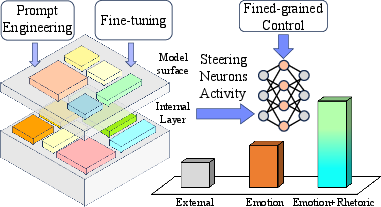
Figure 1: Improvements in emotion recognition accuracy on DailyDialogue when steering via emotion and rhetoric neurons versus external optimization alone.
Adaptive Framework for Neuron Identification and Masking
The proposed framework leverages the transformer decoder’s FFN layers, focusing on their semantic feature encoding. Neuron recognition is formulated through a pipeline: activation frequency statistics identify candidate neurons, probability normalization ensures comparability across samples, and an entropy-based filter isolates functionally selective neurons. Specifically, the top 1% of neurons with the most concentrated activation for each emotion or rhetoric class are retained.
To resolve the unreliability of classical neuron masking, the authors introduce an adaptive attenuation masking mechanism. Rather than fully ablating neuron outputs, the activation values of dynamically selected "core" neurons are systematically attenuated. This approach precludes redundancy-activated compensation in the model, ensuring a consistent performance drop and validating neuron relevance for the targeted task.
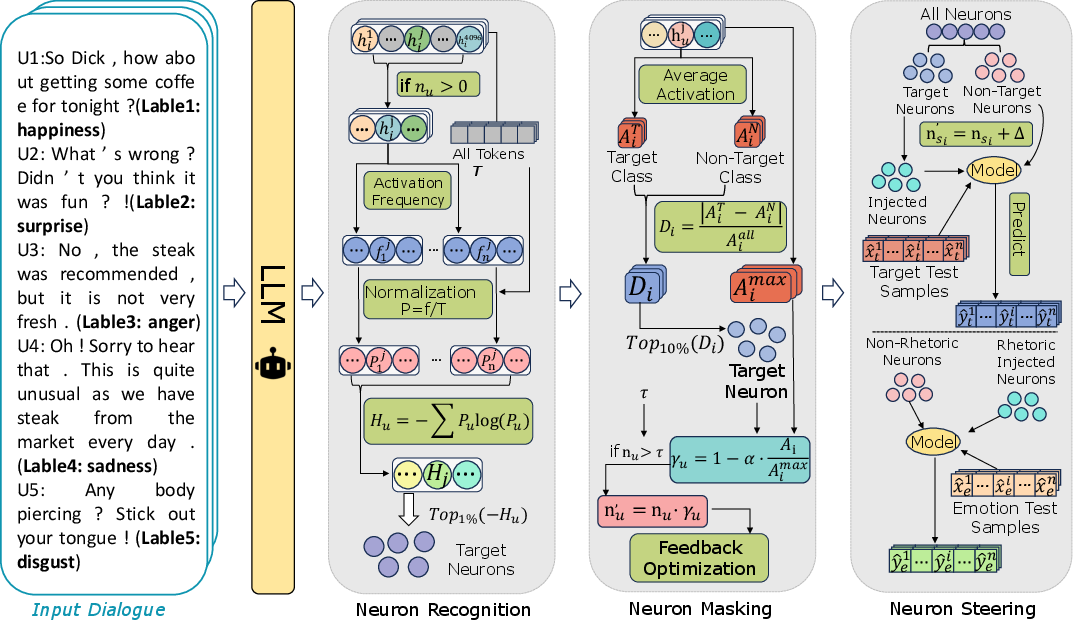
Figure 2: Schematic of the proposed framework highlighting neuron identification, selective masking, and targeted activation for controllable output steering.
Analysis of Neuron Distributions and Synergism
Layer-wise analysis demonstrates that both emotion and rhetoric neurons aggregate most strongly in the upper FFN layers for Llama-3.1-8B. The authors report a dual-concentration pattern in the 70B variant, with high selectivity in both lower and upper layers, indicating that increased model capacity supports early-stage as well as integrative emotion/rhetoric processing. Figure 3 visualizes these distributions.
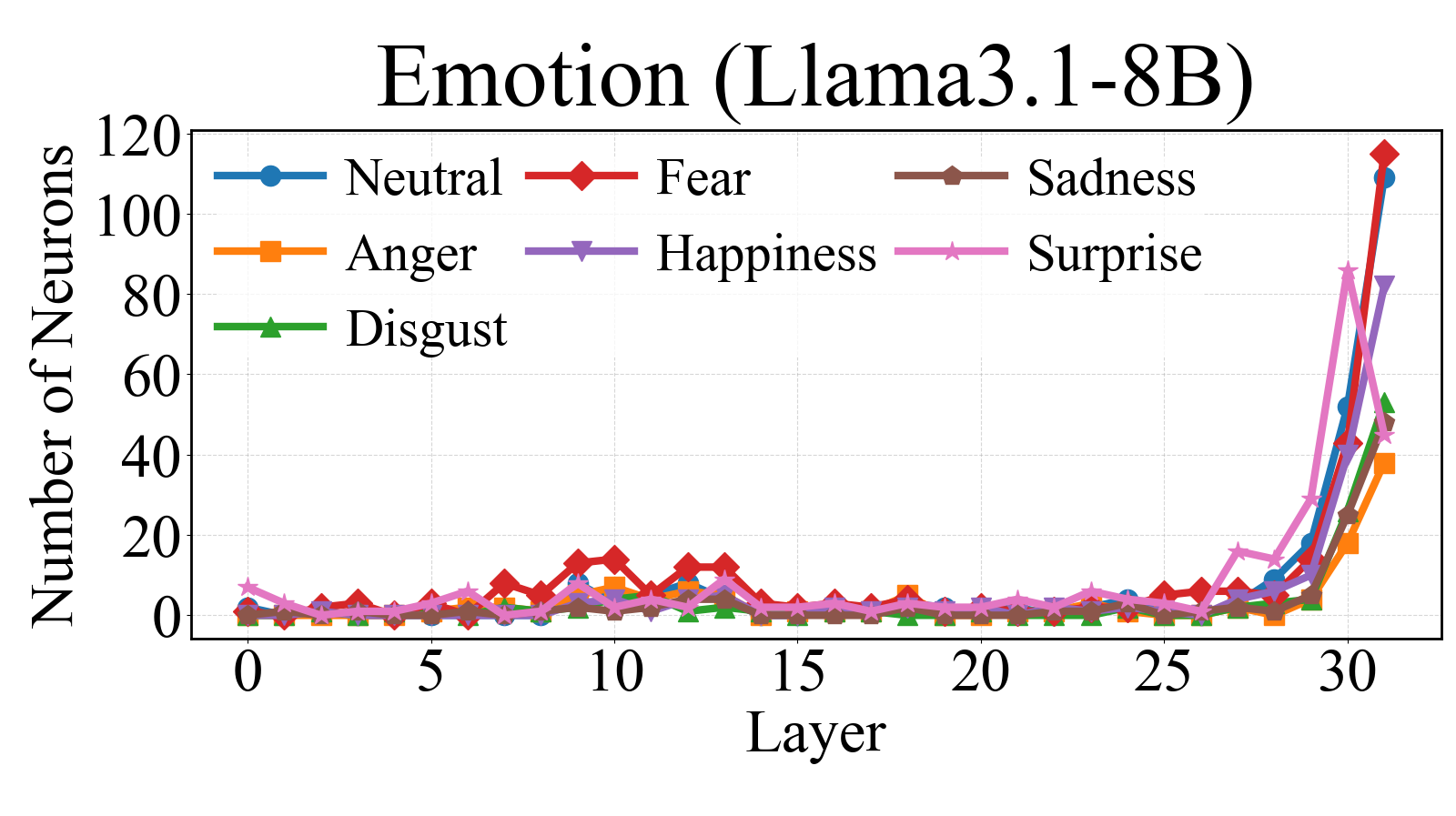
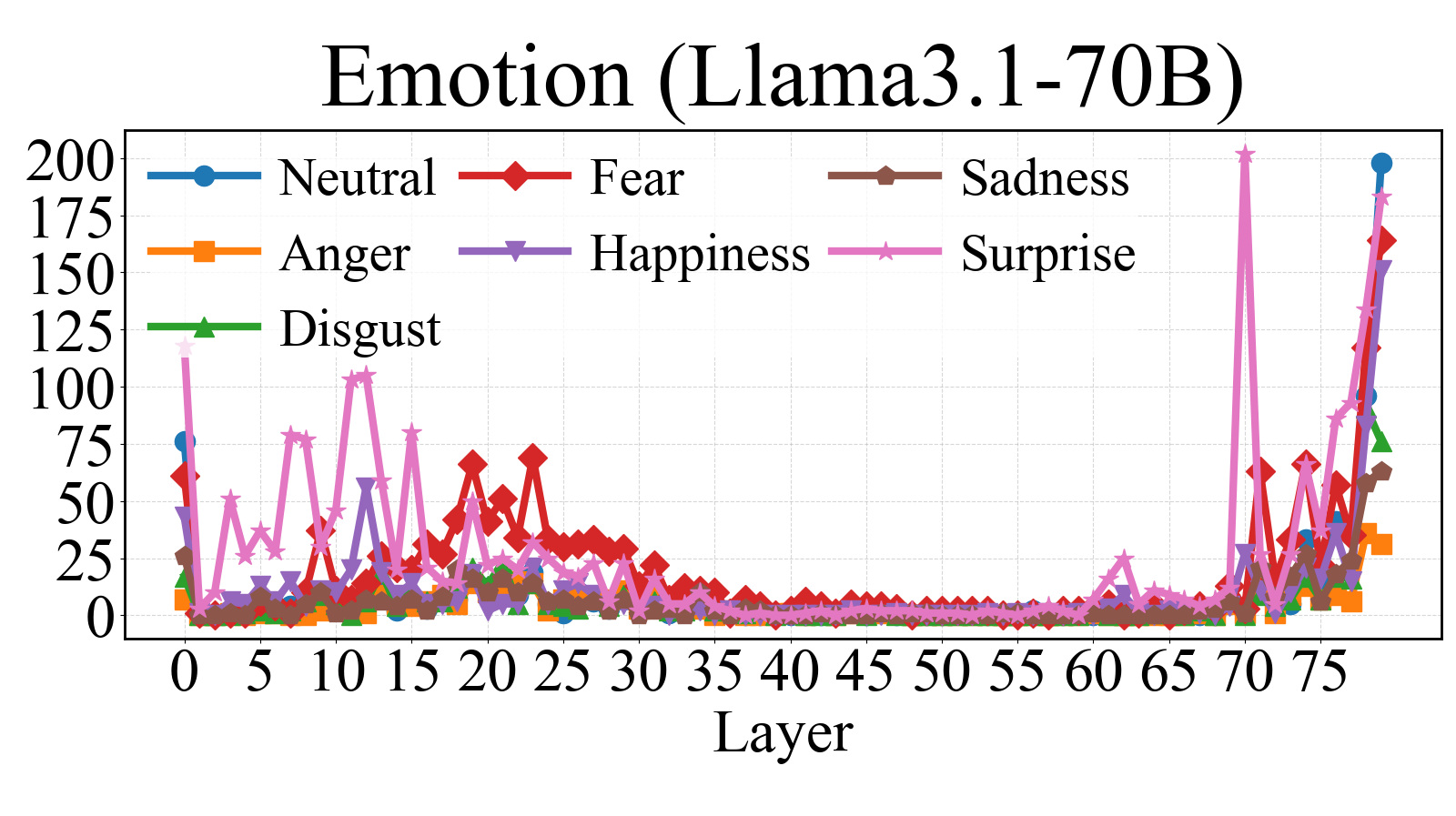
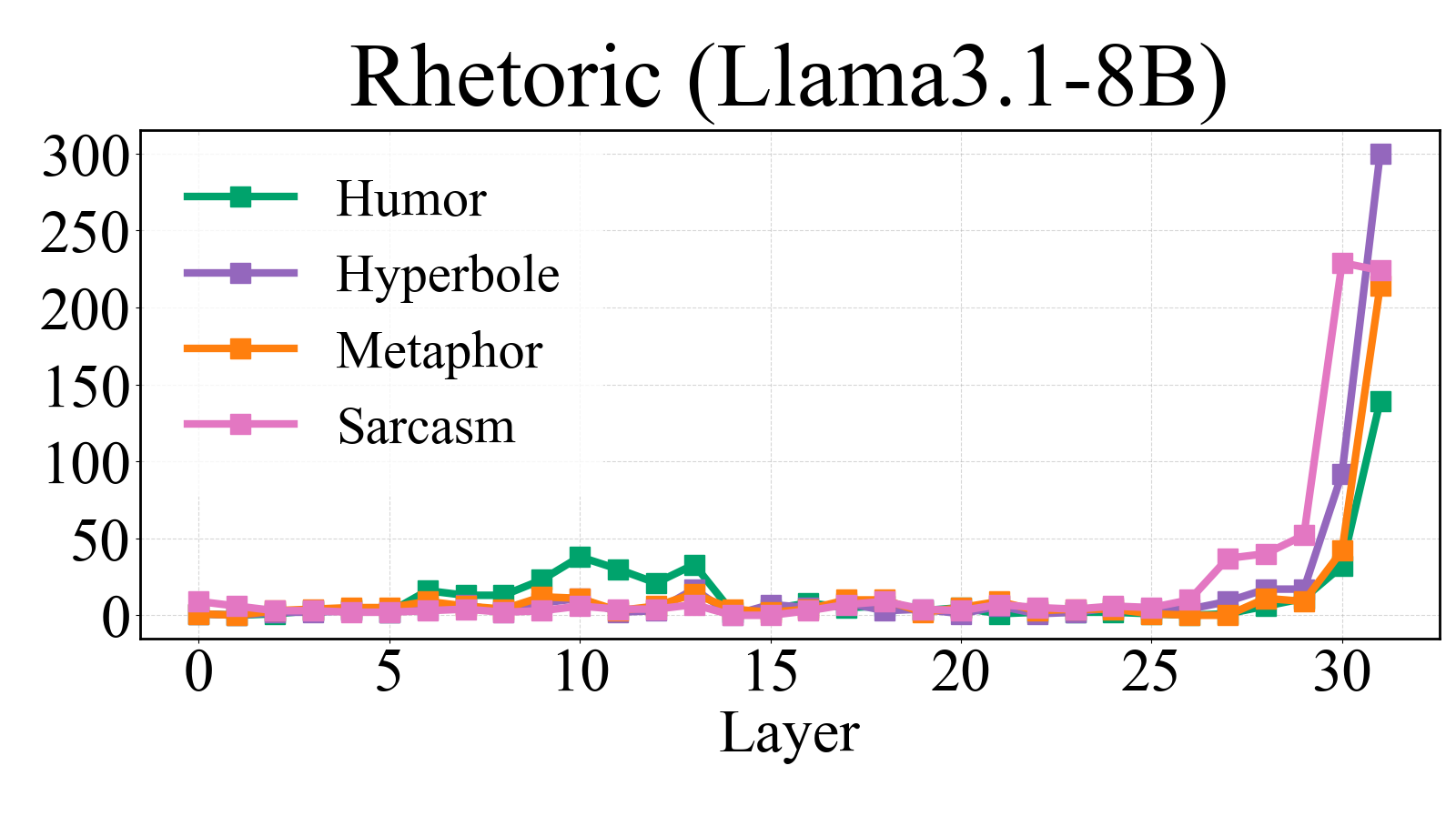
Figure 3: Distribution of emotion and rhetoric-selective neurons across model layers, highlighting top-layer aggregation.
A key result is the observed synergism between emotion and rhetoric neurons. Injecting rhetorical neuron activations into emotion recognition tasks generally improves classification accuracy, e.g., metaphor neurons especially enhance "fear" detection, hyperbole neurons amplify most emotions, and sarcasm neurons most strongly assist "sadness" recognition. These effects provide evidence for functional cross-talk and indicate that rhetorical representations can modulate or disambiguate affective signals in LLMs.
Quantitative Effectiveness of Neuron Masking
Comprehensive experiments on multiple benchmarks confirm that adaptive attenuation masking reliably induces significant and monotonic decreases in task accuracy—both in-domain and cross-domain—whereas traditional hard-masking interventions can yield spuriously increased or negligible changes. This outcome substantiates the adaptively identified neurons' central role in task-relevant representation and supports robust causal attribution.
Additional ablation across layers reveals that top-layer masking leads to the most severe performance degradation, consistent with representational feature aggregation at these stages, but that maximal impairment is only achieved via all-layer masking, emphasizing the distributed and cross-layer nature of emotion and rhetoric encoding.
Controlled Neuron-level Steering
The framework enables controlled modulation of output predictions: after injecting functional vectors (targeted neuron activation patterns) into non-target samples, the ratio of instances reclassified as the target emotion or rhetoric is substantially increased. This demonstrates fine-grained, model-internal steering for both emotional and rhetorical attributes, surpassing the indirectness of prompt design or global fine-tuning.
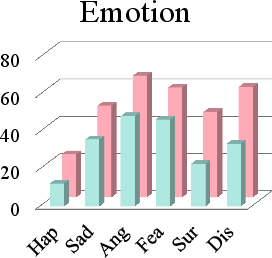
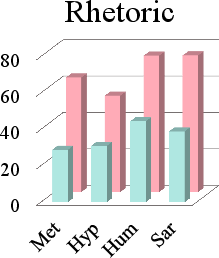
Figure 4: Efficacy of neuron-level manipulation—steering non-target input predictions towards chosen emotion/rhetoric categories via activation vector injection.
Implications and Future Directions
This work expands our understanding of internal feature specialization in LLMs, clearly establishing the existence and manipulability of both emotion and rhetoric neurons. It introduces a validated toolset for causal neuron analysis and fine-grained prediction control, suitable not only for emotion and rhetoric but potentially extendable to other stylistic, semantic, or pragmatic representations. The synergistic findings suggest that future research could develop composite or hierarchical control schemes for complex affective-pragmatic phenomena by leveraging cross-signal neuron interactions.
Practically, this lays the groundwork for applications requiring dynamic affective or stylistic steering in controllable NLU/NLG agents, safe conversational systems, and explainable AI. Theoretically, the adaptive masking methodology addresses a recurrent confounder in causal interpretability studies, with broad transferability across domains that demand stable, informative internal interventions.
Conclusion
The paper provides an authoritative analysis of emotion and rhetoric neurons in LLMs, proposing an adaptive framework that addresses key deficiencies in previous work. Reliable neuron identification, robust causal validation, and effective controllable manipulation are empirically confirmed. These contributions have significant downstream implications for interpretability, controllability, and the principled development of affective and stylistic capabilities in foundation models.

