- The paper introduces the EVU cycle—a structured process of Estimation, Verification, and Update—to correct belief inertia in embodied agents.
- It demonstrates that explicit belief interventions significantly enhance task success rates and generalization in long-horizon, complex environments.
- Experimental results show that EVU outperforms standard baselines in efficiency and state alignment without adding significant computational overhead.
Mitigating Belief Inertia in Embodied Agents via Active Intervention
Introduction and Motivation
Recent advances in LLM-based embodied agents have enabled progress in complex, long-horizon environments. Despite these advances, embodied agents frequently exhibit observational neglect: they fail to integrate critical feedback from the environment into their internal belief state, resulting in suboptimal or redundant actions. As depicted in a typical scenario, the agent may observe a target object (e.g., a knife) but still internally maintain that it needs to find that object, culminating in unnecessary exploratory actions.

Figure 1: Observational neglect—agents persist in searching despite already observing the target object, due to improper belief integration.
A statistical analysis reveals that such observational neglect is a predominant failure mode in standard benchmarks, including ALFWorld.
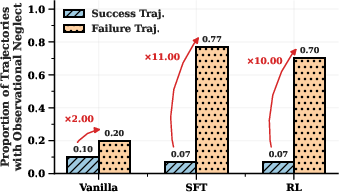
Figure 2: Observational neglect is widespread in ALFWorld, representing a substantial fraction of agent failures.
To formalize this deficit, the agent's decision process is modelled as a POMDP where all states, actions, and observations are encoded in natural language. The pivotal component underpinning correct action selection is the belief update step—how new evidence modulates the agent’s latent representation of environment state.
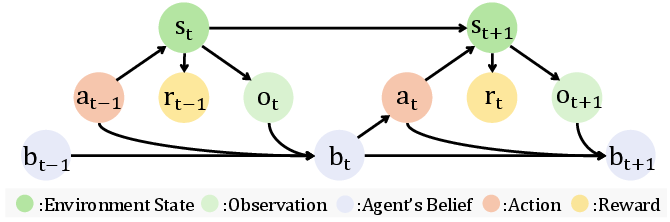
Figure 3: POMDP-based reasoning in embodied agents, illustrating the necessity of iterative belief updates.
Characterization of Belief Inertia
Probing analyses demonstrate that the core barrier is not the availability of the observation but the inertia of the agent’s internal beliefs—agents maintain priors about the outcome of their actions and fail to incorporate contradictory evidence. By constructing task-relevant, variable-targeted probes at key steps of the reasoning chain, it is possible to elicit the agent’s internal belief and compare its evolution against ground truth.
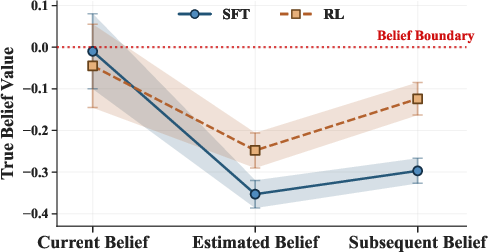
Figure 4: Probed belief dynamics—beliefs remain out-of-sync with true state despite direct observation, implying inertia.
In stepwise diagnosis: initially, the agent holds a weak belief boundary; after action, the belief evolves (often incorrectly); but, crucially, upon receiving contradictory environmental evidence, the belief remains stuck (negative region), showing lack of integration.
To confirm causality, a manual belief intervention (“oracle” alignment of belief with ground-truth state) results in corrected internal beliefs and substantially higher success rates, strongly implicating belief inertia as the core error mode.
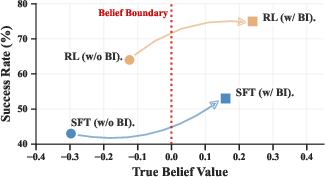
Figure 5: Impact of oracle belief intervention—belief alignment immediately improves decision quality and task success.
Active Belief Intervention: Estimate-Verify-Update (EVU)
Passive, implicit belief modeling fails to correct inertia. The proposed Estimate-Verify-Update (EVU) mechanism introduces an active, explicit belief intervention architecture decoupled from action generation.
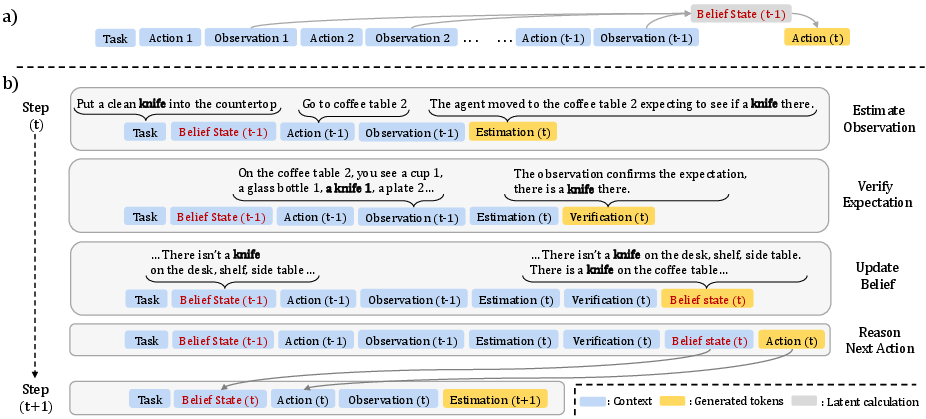
Figure 6: EVU overview—the structured Estimate / Verify / Update loop enables continuous explicit belief refinement.
Mechanism details:
- Estimate: The agent predicts the outcome of its action prior to perception.
- Verify: On receiving observation, the agent generates evidence to evaluate congruence between expectation and reality, functioning as a “surprise signal”.
- Update: The belief state is explicitly revised, conditioned on prior belief, estimate, and verification output.
This loop enforces that the agent cannot bypass or ignore observations, as each update must parse the expectation–evidence mismatch.
EVU can be flexibly integrated both at the prompting level (modifying prompts to force explicit belief state reasoning) and in gradient-based training (optimizing belief/action autoregression).
Experimental Results and Analysis
The EVU architecture is evaluated across multiple benchmarks (ALFWorld, VirtualHome, ScienceWorld) and with multiple LLM backbones in both prompting-based and training-based settings. Across all scenarios, EVU yields consistent and substantial improvements over SFT, PPO, and GRPO baselines.
EVU achieves higher gains in OOD (“Unseen tasks”) conditions and, especially in training-based regimens, indicating that explicit belief management improves generalization and is more effective when end-to-end optimized.
Analysis of distinct belief intervention variants (e.g., Direct, Observation-based, ReflAct, VAGEN) shows that all explicit interventions outperform no intervention, but EVU decisively outperforms all alternatives.

Figure 7: Task success rates—EVU consistently outperforms baseline and variant belief interventions.
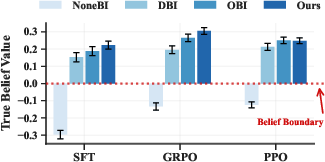
Figure 8: EVU produces highest true belief values, indicating reliable correction of belief inertia.
EVU’s greatest effect is in the update phase, with the estimation and verification stages serving as preconditions for decisive state synchronization.
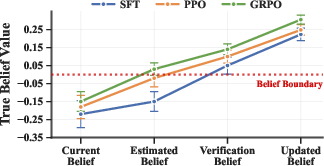
Figure 9: Belief value progression—update phase achieves full belief–state alignment.
The necessity of active belief intervention rises with task difficulty and horizon length; as demonstrated, the gap between EVU and passive baselines widens markedly as task complexity increases.
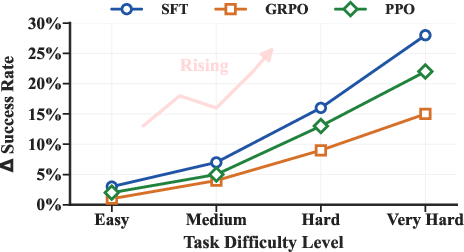
Figure 10: Relative improvement from EVU versus baselines increases with task complexity.
Computation and Efficiency
Despite the introduction of explicit reasoning steps (Estimate, Verify, Update), EVU does not add significant computational overhead compared to ReAct-style policies. In fact, input compression (using belief summaries), higher grounding rate, and more effective planning result in reduced total token usage and latency.
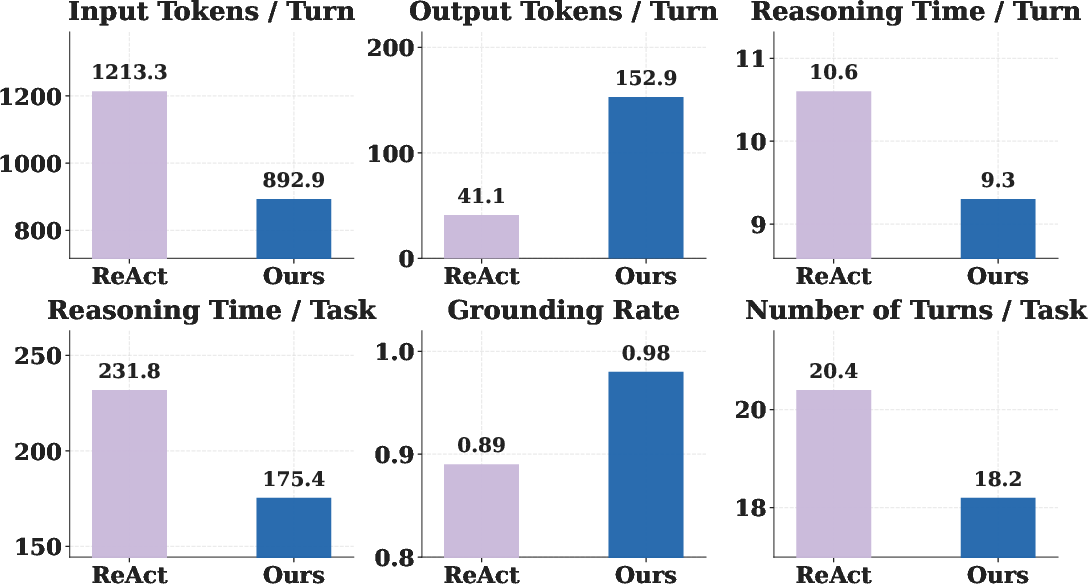
Figure 11: EVU achieves improved reasoning efficiency—fewer tokens and lower latency per task compared to ReAct.
Control experiments show that the gains are not due to test-time scaling (longer reasoning chains). The predictive, surprise-driven update design is key; simply increasing reflection tokens yields lower performance.
Theoretical and Practical Implications
This work formalizes belief inertia as a generalizable, architecture-agnostic failure mode for LLM-based agents in partially observable environments. Empirical evidence supports that the majority of suboptimal behaviors derive from inert (unedited) priors rather than model capacity or lack of long-range memory.
The active intervention paradigm, especially the EVU cycle, provides a framework for modular, explicit, and transparent belief state management. This enables further development of:
- Shaped auxiliary rewards via belief fidelity signals.
- Modular world models for planning, prediction, and error correction.
- Robust integration with advanced agentic planners and larger-scale multimodal environments.
Limitations and Future Work
While EVU depends on the quality and granularity of observations and was primarily evaluated on a fixed set of LLM backbones, future research directions include:
- Extension to environments with ambiguous, sparse, or noisy observation streams.
- Exploration of richer training signals, including dense rewards and auxiliary supervision.
- Integration into continuous control and vision-language-action models.
Conclusion
By isolating belief inertia as a critical bottleneck and targeting it via active interventions, this work demonstrates how explicit, structured belief modeling corrects agent reasoning and action selection in embodied tasks. The Estimate-Verify-Update mechanism systematically enforces belief–observation alignment, yielding robust gains, improved generalization, and efficient computation. This paradigm sets a foundation for next-generation embodied AI systems that reason over and act with dynamically maintained and validated internal world models.