- The paper shows that superconducting pairing in La3Ni2O7 is driven by cooperative interlayer d₍z²₎–d₍z²₎ and intralayer d₍z²₎–d₍x²-y²₎ antiferromagnetic exchanges.
- It employs a bilayer multi-orbital framework to reveal an anisotropic s± gap with internal sign reversal across distinct Fermi pockets.
- The findings extend high-Tc superconductivity principles beyond cuprates, offering strategies for material engineering in new superconductors.
Pairing Mechanism in Bilayer Nickelate La3Ni2O7 Superconductors
Introduction
The emergence of superconductivity at Tc≈80 K in bilayer nickelate La3Ni2O7 (henceforth Ni327) under pressure provides a key opportunity to elucidate organizing principles of unconventional high-temperature superconductivity beyond the cuprates and iron-based superconductors. This work reexamines and extends the frameworks of the "gene principle" and the "collaborative Fermi-surface rule"—both established in prior classification of unconventional superconductors [Hu2012, Hu2015prx, Hu2016]—to clarify their applicability to this bilayer, multi-orbital system. The central result is that the superconducting pairing in Ni327 is cooperatively driven by two distinct antiferromagnetic (AFM) exchange interactions: interlayer intra-orbital exchange between dz2 orbitals (J⊥), and intralayer inter-orbital exchange between dz2 and 20 orbitals (21), mediated by apical and in-plane oxygen, respectively. These interactions synergistically induce a robust anisotropic 22 superconducting gap with internal sign reversal between Fermi pockets characterized by different mirror and orbital parities, situating Ni327 within the organizational paradigm of high-23 superconductors while revealing new multi-orbital bilayer physics.
Electronic Structure and Fermi Surface Classification
Ni327 features a layered structure where each Ni is octahedrally coordinated by oxygens, with two active 24 orbitals—25 and 26—dominating the low-energy electronic states. The high-pressure (tetragonal) phase is characterized by significant interlayer hopping 27 (between 28 states via inner apical O), intralayer hopping 29 (between 70), and inter-orbital hopping 71. Classification of Fermi surfaces leverages mirror symmetry (layer even/odd: L72, L73) and relative orbital phase (O74, O75): the 76 pocket (77-centered) is mirror-even and orbital in-phase, the 78 (79-centered) is mirror-even/orbital out-of-phase, while the key Tc≈800 pocket (large, Tc≈801-centered) is mirror-odd and orbital out-of-phase, involving strong Tc≈802/Tc≈803 hybridization.
Dominant Antiferromagnetic Exchange Couplings
A defining feature of Ni327 is the nonuniform orbital filling: the Tc≈804 bonding state on the Tc≈805 pocket is near half-filling, supporting strong correlations, whereas the Tc≈806 states are far from half-filling. Consequently, the primary superexchange mechanisms are as follows:
- Interlayer Tc≈807-Tc≈808 AFM Exchange (Tc≈809): Mediated by apical O, leads to interlayer AFM coupling between 30 orbitals on opposing layers Figure 1.
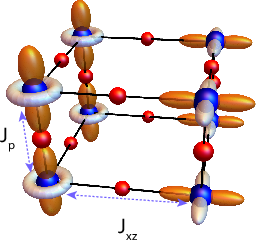
Figure 1: The local AFM exchange couplings: the interlayer AFM exchange between 31 orbitals and the intralayer inter-orbital AFM exchange between 32 and 33 orbitals.
- Intralayer 34-35 AFM Exchange (36): In-plane oxygens mediate inter-orbital AFM between 37 and 38 on neighboring sites within a single layer.
Both mechanisms are fundamentally distinct from the cuprate case, where 39 is a dominant in-plane intra-orbital interaction between half-filled 20 orbitals. The multi-orbital, bilayer environment in Ni327 increases the diversity and complexity of AFM exchange.
Cooperative Pairing Channels and 21 Gap Structure
The superconducting gap emerges from the cooperation of the above two dominant AFM channels:
- Interlayer 22: Favors an s-wave interlayer singlet, creating a sign change of the superconducting gap between even and odd mirror-symmetry Fermi pockets: 23 and 24 acquire one sign, 25 the opposite. This is the direct bilayer analogue of the 26 sign structure in iron pnictides.
- Intralayer 27: Generates inter-orbital singlet pairing, with a 28 (29)–imprinted form factor—projected onto the band basis, the overlap with the 70 pocket is maximized, further stabilizing 71 pairing.
The resulting gap function is anisotropic, with its largest amplitude on the hybridized 72 pocket and an internal sign reversal between mirror-even and mirror-odd Fermi sheets. No symmetry-protected nodes are expected, but strong gap anisotropy is predicted on 73.
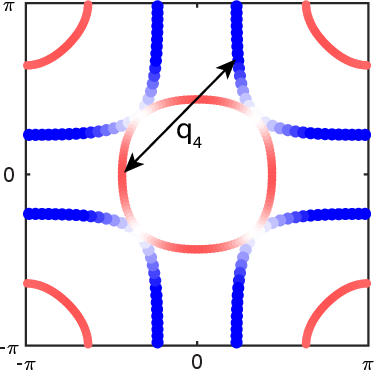
Figure 2: The 74 state: sign distribution of the superconducting order parameters on Fermi surfaces, with red/blue indicating opposite signs.
Notably, both pairing channels are constructive on the 75 pocket, leading to significant gap magnitude there. The theoretical analysis rules out dominant competing 76-wave channels due to negligible overlap with the Fermi pockets in a multi-orbital context.
Comparison with Established High-77 Superconductors
A critical contextualization is provided by contrasting Ni327 with cuprates and iron-based superconductors:
- Cuprates: Single orbital, in-plane nearest-neighbor AFM (78), d-wave symmetry, nodal gap.
- Iron-based: Multiple 79-dominated pockets, next-nearest-neighbor AFM (dz20), dz21 sign structure between dz22 and dz23.
- Ni327: Bilayer multi-orbital (dz24, dz25), interlayer and inter-orbital AFM, dz26 state with sign reversal linked to bilayer mirror symmetry.
This unifies Ni327 within the gene principle as a new realization: both the strong-correlation sector and the dominant exchange pathway reside in distinct orbitals, and a bilayer structure introduces a nontrivial sign structure, testable via advanced spectroscopies or quasiparticle interference analysis.
Theoretical and Practical Implications
- Robustness and Anisotropy of Gap: The work predicts a large, fully gapped, but anisotropic dz27 state on the dz28 pocket. Absence of symmetry-required nodes suggests enhanced phase stiffness and possible implications for raising dz29 via engineering of the underlying Fermi surface or inter-orbital hybridization.
- Experimental Probes: The predicted momentum-dependent sign structure, especially the mirror-selective QPI, is an essential experimental fingerprint for the J⊥0 state [ZhangQPI2025]. Mirror-odd and mirror-even impurity scattering selects inter-pocket processes connecting Fermi surfaces of opposite sign.
- Material Generality and Future Directions: The theoretical framework, emphasizing the cooperative action of interlayer and inter-orbital AFM exchange, can be readily extended to trilayer nickelates and multi-layered analogues, predicting similar J⊥1 structures and guiding the search for even higher J⊥2 in related compounds.
- Comparison with Functional RG and Strong-Coupling Theories: The derived gap structure and mechanisms are congruent with functional renormalization group results [Wang327prb, XWu, zhan2024cooperation], which also find robust J⊥3 states, lending further credence to the physical picture and suggesting applicability across different correlation regimes.
Conclusion
This work demonstrates that superconductivity in LaJ⊥4NiJ⊥5OJ⊥6 arises from the interplay of two principal AFM exchange channels—interlayer J⊥7-J⊥8 and intralayer J⊥9-dz20—resulting in a unique, anisotropic dz21 state with internal sign changes tied to the hybridized bilayer Fermiology. These findings generalize fundamental organizing rules for high-dz22 superconductivity to a new multi-orbital context and offer measurable experimental signatures. The analysis suggests that future advances may leverage multi-orbital and multilayer engineering to design higher-dz23 superconductors, with the topology of the superconducting gap tunable via control of orbital hybridization and interlayer couplings.
References
- "Pairing Mechanism in Bilayer Nickelate Ladz24Nidz25Odz26 Superconductors" (2604.17181)
- J. P. Hu and H. Ding, "Local antiferromagnetic exchange and collaborative Fermi surface as key ingredients of high temperature superconductors" [Hu2012]
- J. P. Hu, C. C. Le, X. X. Wu, "Predicting unconventional high-temperature superconductors in trigonal bipyramidal coordinations" [Hu2015prx]
- J. P. Hu, "Identifying the genes of unconventional high temperature superconductors" [Hu2016]
- Z. Zhang et al., "Mirror-Selective Quasiparticle Interference in Bilayer Nickelate Superconductor" [ZhangQPI2025]