- The paper demonstrates that confinement induces a transition from steady translation to traveling interfacial waves via a Yih–Marangoni instability.
- The experimental methodology uses optical microscopy, PIV, and fluorescent mapping to quantify droplet velocity, lubrication effects, and flow patterns.
- The findings offer design insights for synthetic microswimmers, revealing how surfactant concentration, confinement ratio, and capillary number tune droplet motility and shape dynamics.
Motility and Interfacial Instability of Confined Chemically Active Droplets
Introduction
Chemically active droplets have emerged as paradigmatic model systems for understanding self-propulsion and adaptive behaviors in out-of-equilibrium soft matter. Their ability to mimic biological microswimmer strategies, especially in complex and geometrically confined microenvironments, has led to extensive investigation into the interplay between active stresses, hydrodynamics, and interfacial phenomena. In “Motility and interfacial instability of confined chemically active droplets” (2604.16994), the authors explore how the confinement in quasi-one-dimensional capillaries, together with physicochemical perturbations to the surrounding medium, modulates both the motility and morphological stability of swimming 5CB (4'-Pentyl-4-cyanobiphenyl) droplets. The study systematically reveals the dynamical regimes encapsulating steady translation, the emergence of lateral traveling waves on the droplet interface, and the underlying instability mechanisms.
Experimental System and Regime Structure
The primary configuration consists of 5CB droplets introduced into square glass capillaries (h=500 μm), filled with trimethylammonium bromide (TTAB) surfactant solutions, optionally supplemented with high concentrations of glycerol or polymeric additives. The capillary imposition induces strong geometric confinement, quantified via the confinement ratio k=Ld/w between the droplet length and capillary width.
The selection of surfactant and additive concentrations spans the regimes above the CMC, ensuring robust micelle-mediated solubilization and Marangoni-driven autopropulsion. Confinement ratios k>1 are systematically explored, encapsulating the transition from weakly squeezed to highly elongated, lubrication-dominated morphologies.
The droplet dynamics and flow fields are characterized via optical microscopy, tracer-based PIV, and chemical field mapping using fluorescent dyes.
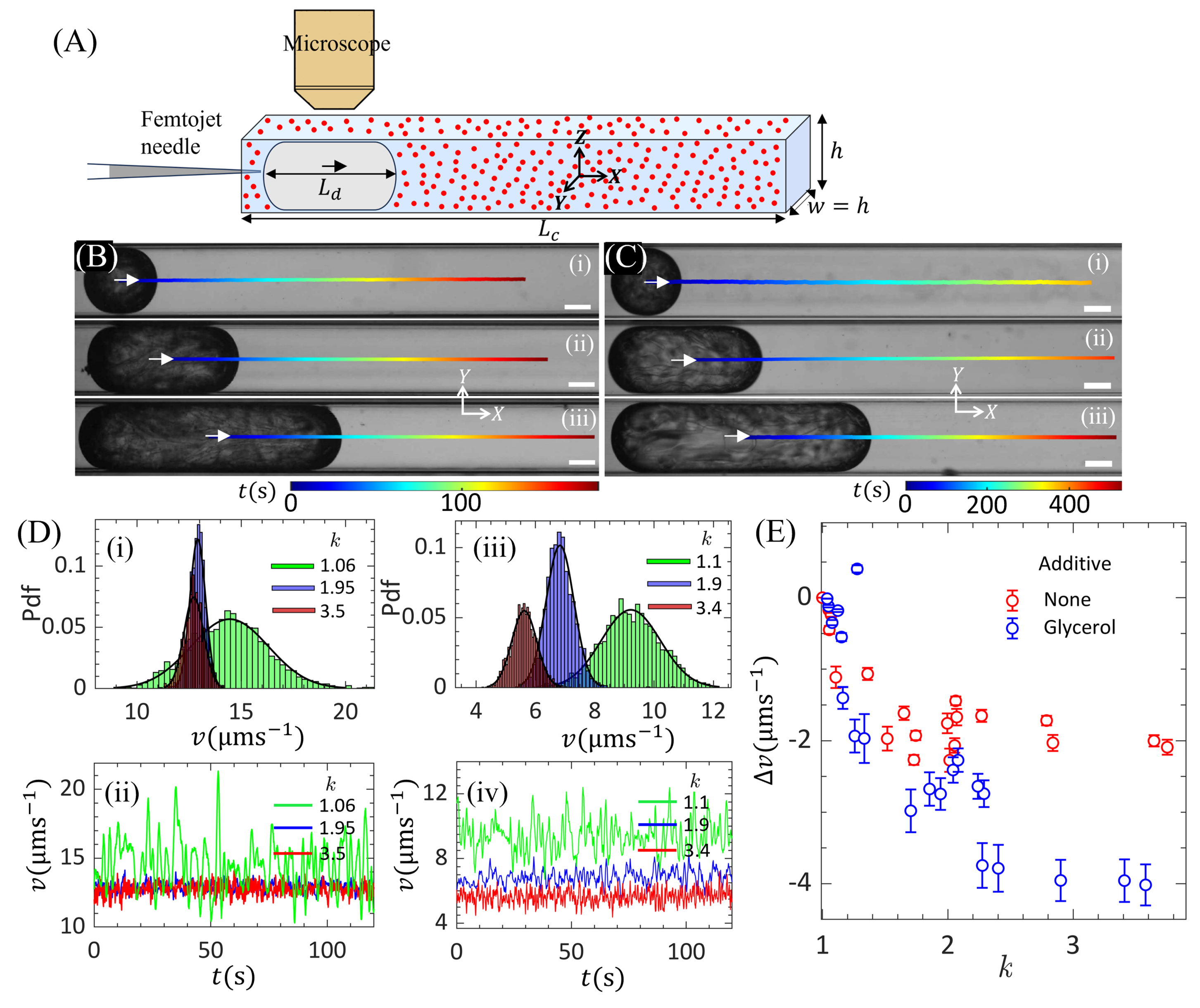
Figure 1: Capillary geometry, representative droplet trajectories, instantaneous velocities, and confinement-dependent velocity shifts highlight the balance of hydrodynamic drag and Marangoni-driven propulsion in steady and fluctuating motility regimes.
Confinement-Modulated Motility and Flow Fields
In dilute TTAB solution, droplets retain steady morphologies with statistically unimodal, rectilinear propulsion along the channel axis. Increasing k initially suppresses instantaneous velocity fluctuations due to transverse constraint and then rapidly reduces mean droplet velocity via enhanced viscous resistance from the thinning lubrication film. This produces a non-monotonic Δv(k), saturating at high k once the Marangoni-stress-driven slip balances viscous drag. The competition between anterior/posterior asymmetry and lubrication layer resistance is evident in both the swimming velocity and the deformation of the advected chemical field.
The introduction of 80 wt.\% glycerol, or equivalent enhancements to the Péclet number, amplifies advective solute transfer and increases the Capillary number (Ca), thickening the lubrication layer. This additionally modifies the adjacent flow topology: in the aqueous TTAB limit, droplets display puller-like flow symmetry, whereas with glycerol, multiple small-scale and time-dependent circulatory vortices manifest and evolve toward non-axisymmetric, often quadrupolar, configurations as k increases.
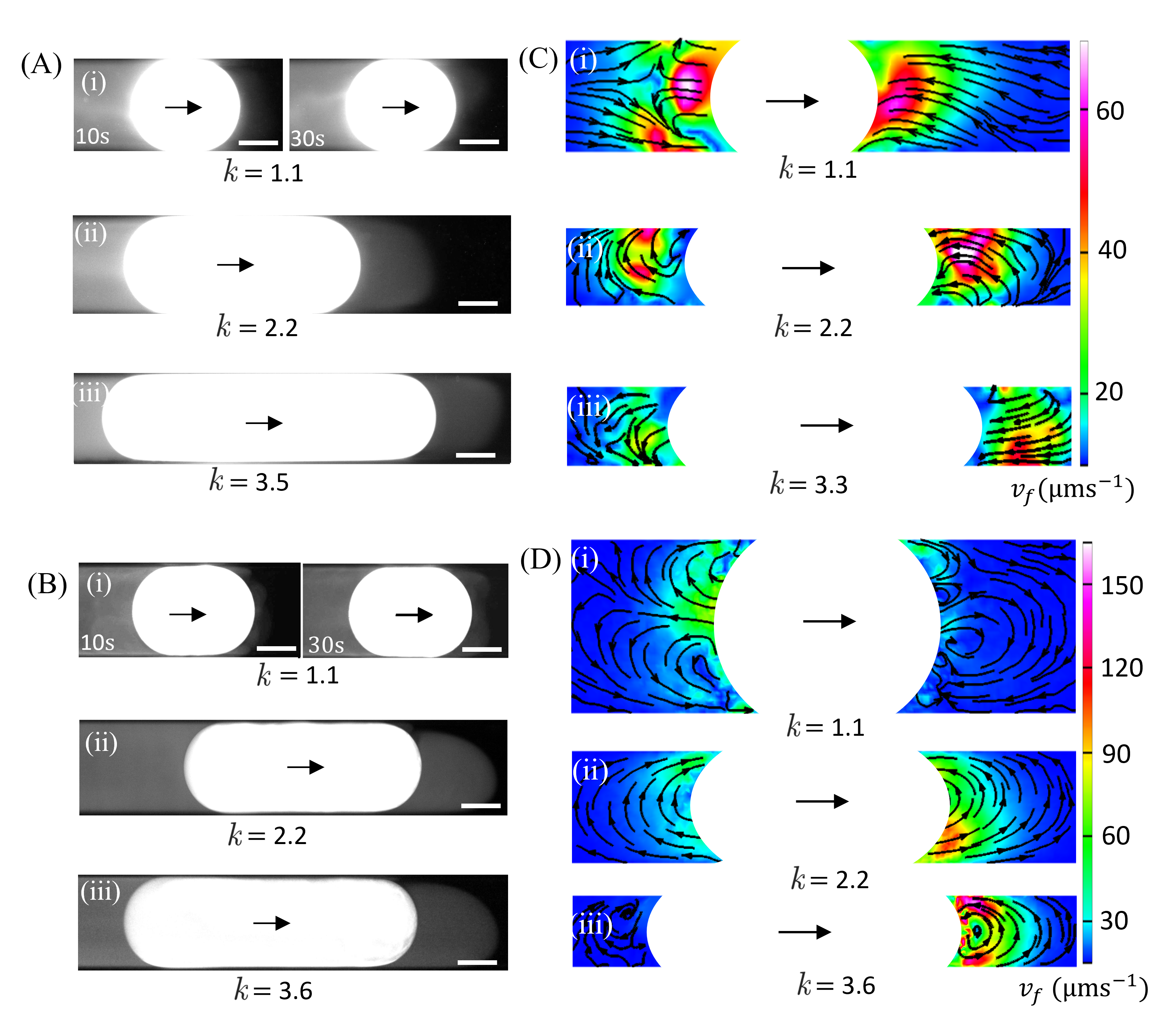
Figure 2: Fluorescence and PIV visualizations reveal chemical field accumulation and complex, confinement-enhanced flow structures around the swimmer under glycerol additive and at increasing k.
Interfacial Instabilities: Traveling Waves and Their Localization
The central contribution is the identification of a confinement-triggered transition from steady, featureless interfaces to pronounced dynamic undulations—traveling interfacial waves—propagating from the anterior to posterior under high Ca and for k=Ld/w0. In 6 wt.\% TTAB alone, interfaces remain static across k=Ld/w1. Addition of glycerol, polymeric solutes, or upscaling TTAB to 35 wt.\% robustly initiates traveling waves, visible as peristaltic deformations in lateral views and confirmed by spatiotemporal mapping of interface heights.
The degree and symmetry of these deformations are tunable via k=Ld/w2. At moderate k=Ld/w3, oscillations develop bilaterally; at larger k=Ld/w4, symmetry-breaking localizes the active deformation to a single lateral side, directly coupled to flow and chemical field spatial asymmetries. These shape fluctuations persist in various high k=Ld/w5 or k=Ld/w6 regimes across different solute types, underlining their generic dependence on the interplay of viscous, capillary, and Marangoni forces rather than specific chemistry.
Figures 8–11 in the Supplementary Information further dissect these regimes, quantifying temporal flow fluctuations, vorticity distribution, and the wavelength-selectivity of interface oscillations as functions of confinement and viscosity ratio.
Scaling and Instability Mechanisms
Quantitative analysis situates the phenomenon within a dimensionless parameter landscape. Traditional Bretherton scaling for the non-dimensional lubricating film thickness applies under steady interface conditions but breaks down as interface instability arises at elevated capillary numbers, with the observed power-law exponent k=Ld/w7 reflecting the active, non-equilibrium dynamics distinct from forced or passive cases.
Mechanistically, the observed shape oscillations differ sharply from Rayleigh–Plateau breakup—characteristic oscillation wavelengths (k=Ld/w8–700 k=Ld/w9m) are an order of magnitude below the capillary circumference, and extensile division is not observed. The results also rule out nematic order–driven instabilities, given the rapid molecular relaxation times of isotropic 5CB under experimental conditions.
Instead, linear stability theory, validated by experimental growth rates and wavelength measurement, identifies a Yih–Marangoni interfacial instability—arising from the interaction of viscosity- and surfactant-gradient–induced stresses at finite Re and nonzero k>10. Instability emerges when the viscosity ratio k>11 and the gap thickness meet the criterion k>12, but only in the high k>13 regime relevant to active droplets. The presence of soluble surfactant increases the spectrum and growth rate of unstable modes, as per the framework in Picardo et al. (2016). This mechanism unifies the observation of undulatory waves across all high k>14, high k>15 conditions irrespective of specific solute chemistry.
Theoretical and Practical Implications
This work demonstrates that geometric confinement, by modulating the local lubrication layer and chemical field gradients, can induce a symmetry-breaking bifurcation from steady to traveling-wave–mediated droplet self-propulsion. The resultant peristaltic-like motion is reminiscent of adaptive euglenoid locomotion but purely physicochemical in origin—suggesting a minimal set of conditions required for adaptive gait switching in active matter.
For synthetic microswimmer design, these results delineate capillary number, viscosity ratio, and Péclet number as universal control parameters governing both swimming kinematics and interfacial stability. Thus, tuning droplet physicochemical properties and channel confines enables programmable transitions between smooth locomotion and wave-driven adaptive propulsion, directly relevant to targeted transport and delivery in microfluidic and biological analog environments.
From the theoretical perspective, the confirmation of Yih–Marangoni instability as the limiting mechanism bridges classical two-layer flow theory with the emergent regime of force-free, active, and dynamically deformable swimmers. This demonstrates that even in fully isotropic, non-nematogenic systems, interfacial activity, and flow-induced surfactant redistribution suffice to spontaneously break interfacial symmetry and generate complex dynamic behaviors.
Conclusion
The study establishes that confined chemically active droplets can exploit interfacial traveling waves as a robust mode of adaptive locomotion, contingent on the competition between hydrodynamic resistance, Marangoni stresses, and physicochemical gradients. The advent of Yih–Marangoni instability in these systems marks a sharp departure from biological or nematic-channel analogs, and opens a route for physically regulated, tunable shape oscillations in synthetic active matter. These insights inform the engineering of next-generation soft microswimmers optimized for navigation in high-drag or topologically restrictive habitats and highlight new directions for the coupling of flow, confinement, and interfacial physics in out-of-equilibrium colloidal systems.

