- The paper introduces a novel TDMA mechanism that reduces actuator count by 55% while enabling full DOF control in tendon-driven continuum arms.
- It employs a vertically-integrated design featuring sub-0.1s rapid clutching and dual-encoder feedback for sub-millimeter tendon accuracy.
- Experimental results demonstrate high fault tolerance, maintaining pose RMSE within 1% despite partial actuator failure.
Time-Division Multiplexing Actuation in Lightweight Tendon-Driven Continuum Robots: Design, Algorithms, and Fault Tolerance
Introduction and Motivation
The deployment of tendon-driven continuum arms for aerospace and other weight-limited robotic applications presents acute tradeoffs among actuation redundancy, fault tolerance, and mass efficiency. Traditional architectures with per-DOF actuation impose excessive weight and complexity, while purely passive or thermal routing solutions suffer from transmission losses and slow dynamics. The paper "Time-Division Multiplexing Actuation in Tendon-Driven Arms: Lightweight Design and Fault Tolerance" (2604.16887) delivers a vertically-stacked, rotational time-division multiplexing actuation (TDMA) mechanism that multiplexes multi-DOF control onto a minimal actuator set, analyzed in the context of the MuxArm prototype.
An explicit focus is directed at intrinsic hardware fault tolerance, load capacity, workspace dexterity, and trajectory optimization under partial actuator loss—a critical demand profile for space, UAV, and hazardous environment applications.
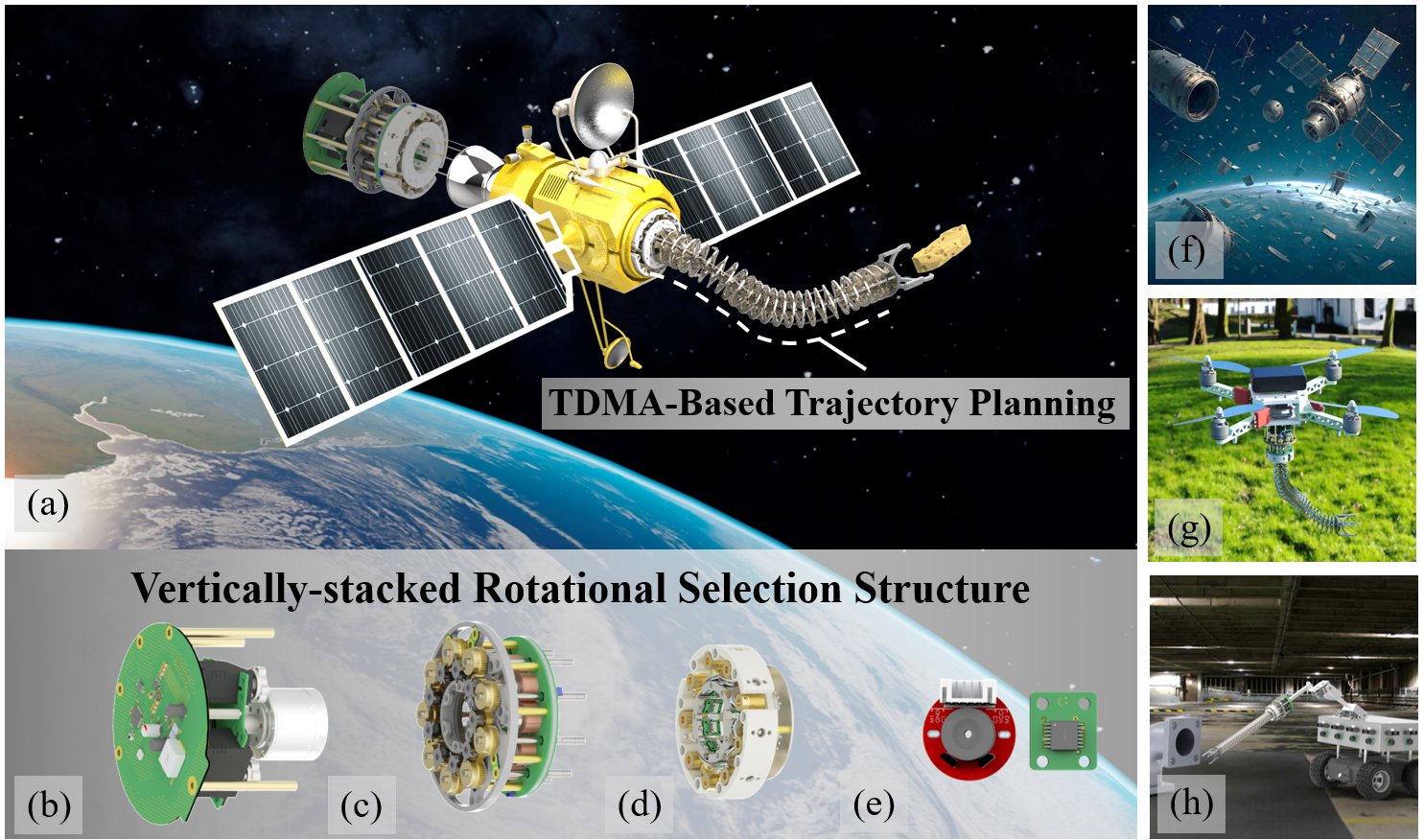
Figure 1: Overview of the tendon-driven robotic arm based TDMA, key hardware modules, and application scenarios for space debris cleanup, UAV grasping, and radiation-hazard management.
Mechanism Design and Hardware Realization
The core hardware realization, the MuxArm, capitalizes on a vertically-integrated TDMA driver structure. The mechanism (Figure 2)—distinct for its axial/radial motor arrangement—achieves selective high-torque engagement to any of nine winding wheels (over three actuation layers), offering full DOF manipulation with only four actuators. The rapid electromagnetic clutch enables sub-0.1s layer selection, while worm-gear reducers deliver high-torque self-locking, and dual-encoder feedback ensures sub-millimeter-level tendon displacement precision. The continuum backbone comprises modular disc-spring elements which provide passive compliance and structural redundancy.
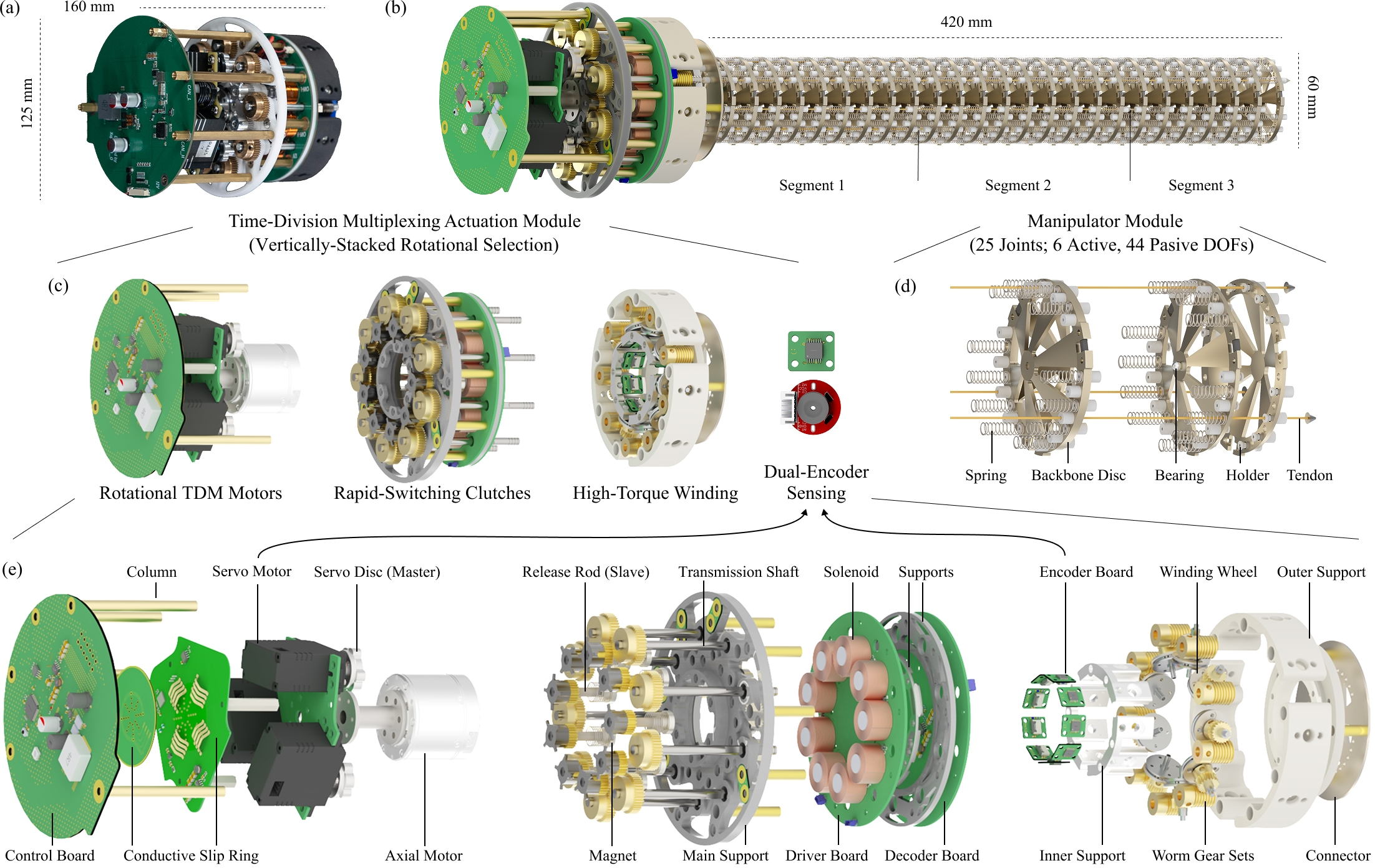
Figure 2: Mechanical design details of the MuxArm, including TDMA module, assembly, and driver module structure for 3D space-optimized actuation.
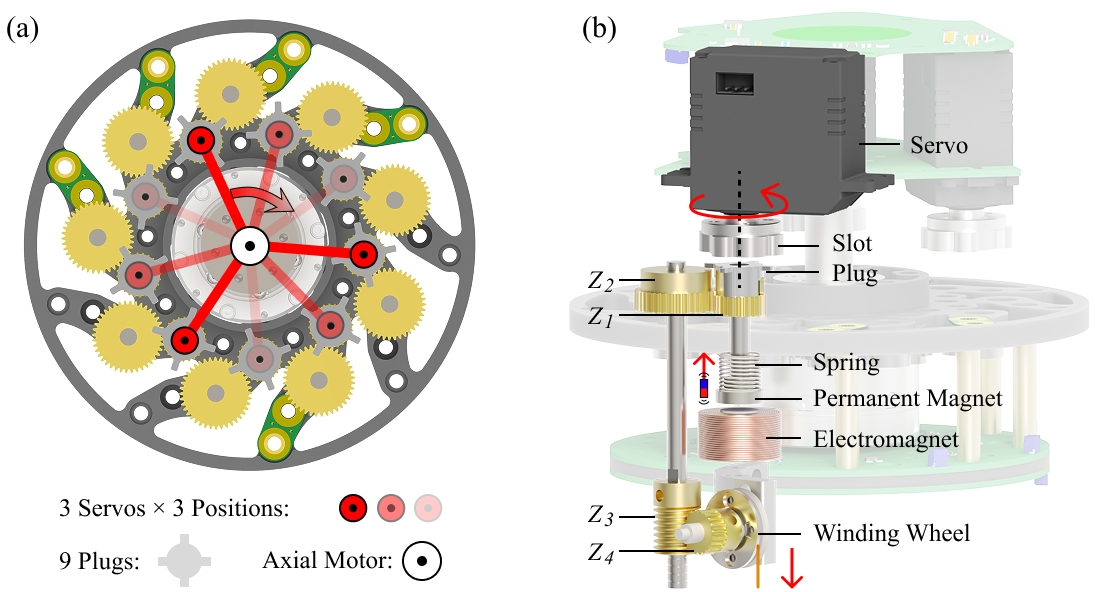
Figure 3: Cross-section and transmission assembly of the TDMA scheme with clutch-geartrain coupling and spring disengagement.
This configuration realizes a 2.17kg self-weight arm capable of sustaining a 10kg payload—a mass reduction and load-to-weight ratio that are non-trivial given aerospace constraints. The system is CAN-bus networked for robust, EMI-resilient control, and achieves actuator cost savings exceeding 88% over traditional architectures by sharing motors across multiple DOFs.
Kinematic and Actuation Modeling
The kinematic formalism models the manipulator as a concatenation of constant-curvature segments, each driven by a triad of tendons (Figure 4). Forward and inverse kinematics are derived in SE(3), with explicit mapping between actuation space (tendon displacements) and configuration space (segment bending angles/azimuth). The segment-level mappings and analytical tendon-length models enable accurate trajectory planning regardless of actuator subset.
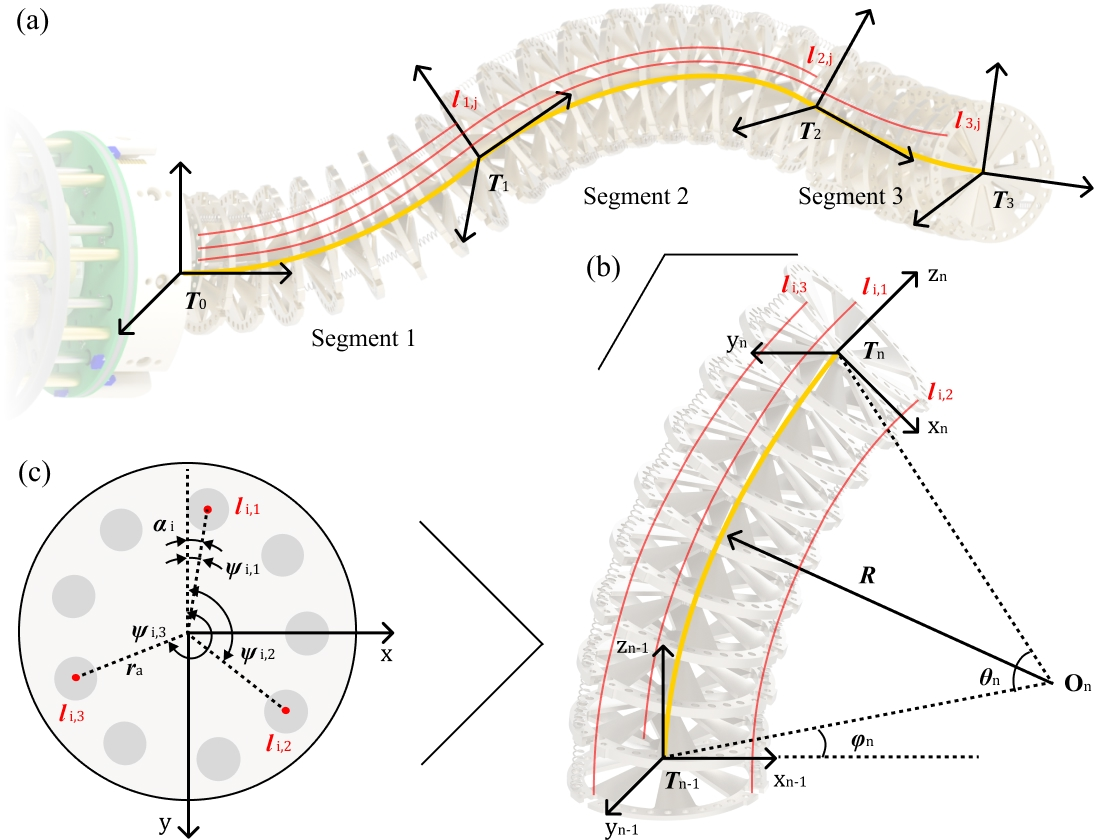
Figure 4: Complete backbone structure, single-segment model, and tendon routing cross-section for the MuxArm.
TDMA Trajectory Generation and Scheduling
A central technical contribution is the trajectory planning and scheduling algorithm, which formulates actuation space motion as a mixed-integer optimization problem constrained by TDMA actuation limits. The algorithm utilizes a BeamStep search method to incrementally generate feasible, minimum-cost trajectories under servo-layer constraints and actuator failure. The cost function encodes travel distance, bending energy, and penalizes axial layer switches to minimize transient tendon tension and reduce motor wear.
The TDMA scheduler maps optimized tendon increments to hardware-level instructions, fusing movements at consistent axial positions and sequencing clutching/motor actions to minimize time and mechanical switching overhead.
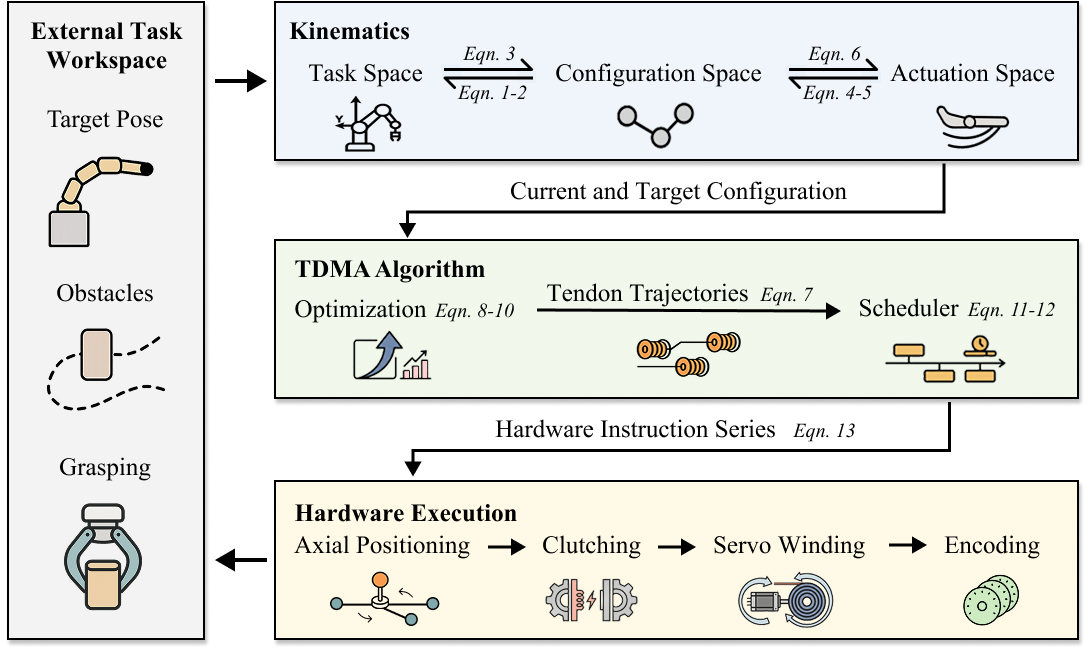
Figure 5: Hierarchical control framework mapping environment and task-space inputs through TDMA optimization to hardware execution.
Experimental Results and Analysis
Algorithm Efficiency and Fault Tolerance
Empirical evaluation benchmarks the proposed TDMA and BeamStep planning pipeline against sequential, reversed, and greedy baseline methods under varying actuator availability (Figures 6,7). Statistically, the algorithm achieves comparable execution times across different numbers of active servos, with only sub-linear time increases under partial actuation regimes.
For instance, with only one out of three radial servos active, total planned time increases by less than 1.6×, instead of the theoretical 3× bound, substantiating the algorithmic efficiency of trajectory scheduling under time-multiplexing. Importantly, trajectory transients are minimized: segment overshoots remain below 15% median across evaluated tasks, compared with frequent >50% transients in baselines.
Fault tolerance is verified through motion capture trials in which up to two servos are disabled. Across all conditions, end-effector pose RMSE remains within 1% of the manipulator length, supporting the authors' claim of preserved full-DOF kinematic performance under actuator redundancy exploitation.
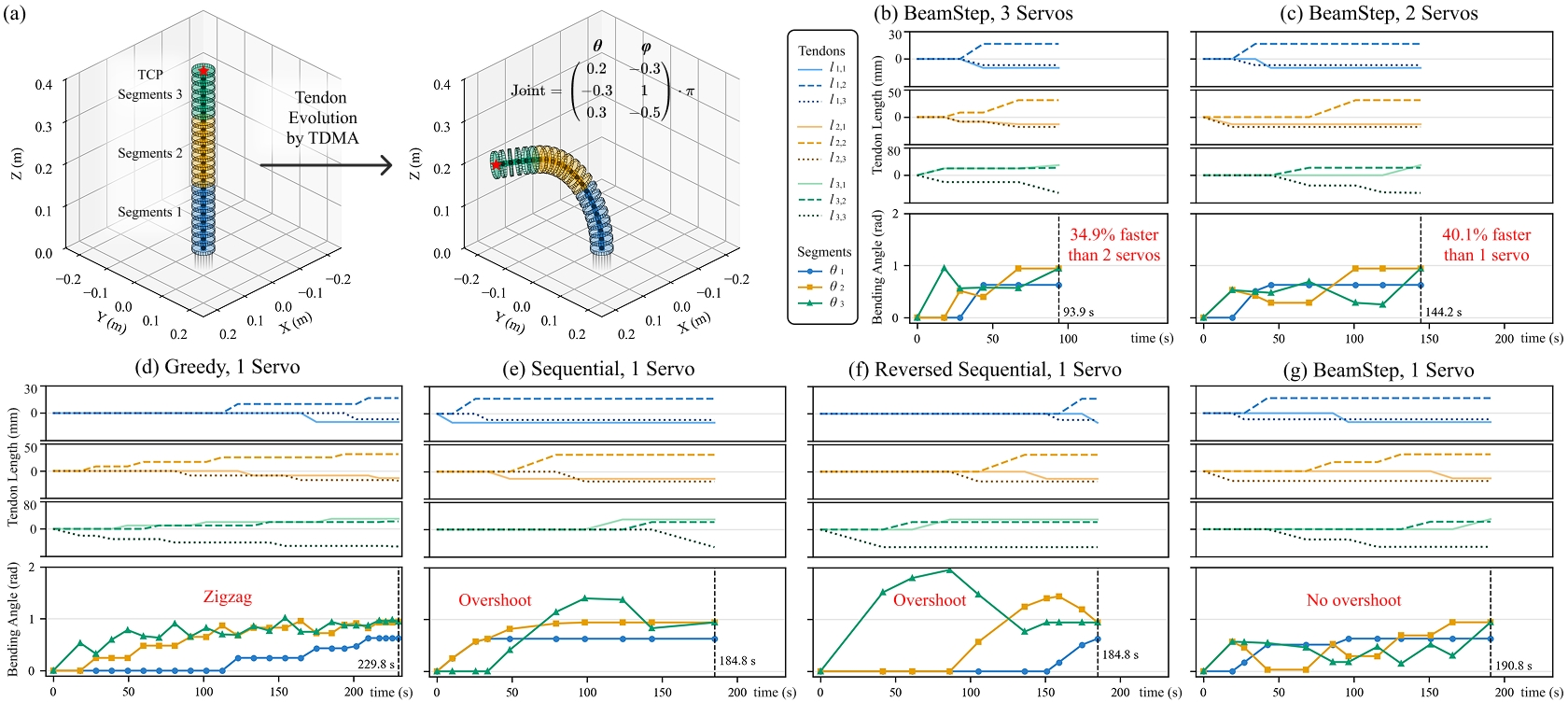
Figure 6: Experimental validation of TDMA-based trajectory planning, with tendon length and bending angle evolution for BeamStep and baseline methods.
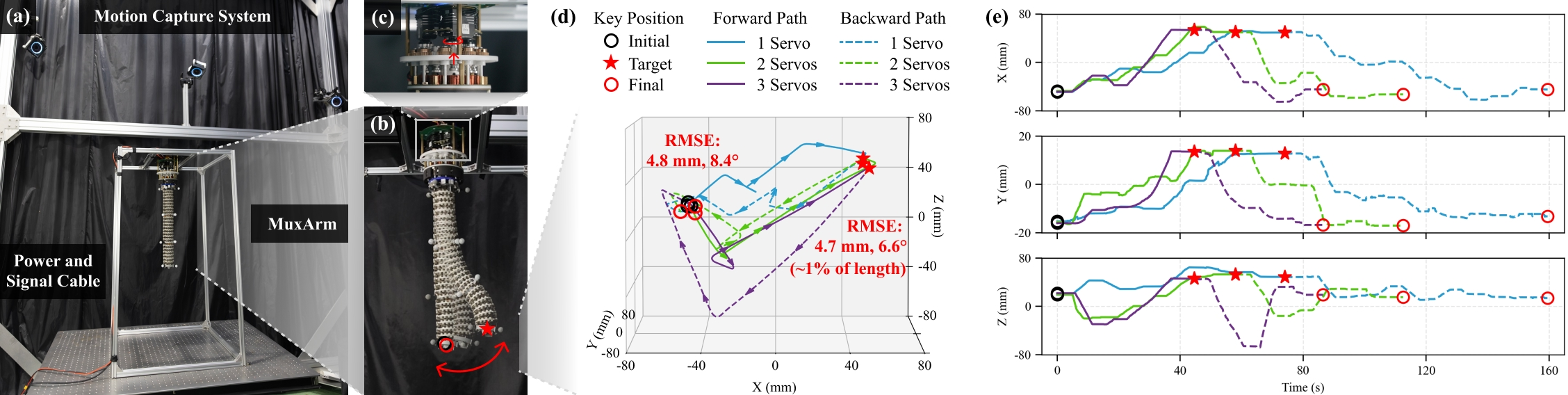
Figure 7: Fault-tolerance validation with task-space trajectories showing accurate pose achievement even with actuator losses, and clutching actuation module details.
Load, Workspace, and Dexterity Characterization
Physical characterization shows the 2.17 kg MuxArm withstanding 10 kg payloads (load/weight ratio = 4.6), with workspace analysis via 109 Monte Carlo samples providing dexterity maps and time-to-target metrics. The manipulator reliably covers a large configuration envelope, with loss of performance only at kinematic boundaries due to unmodeled compliance/friction—not TDMA constraints.
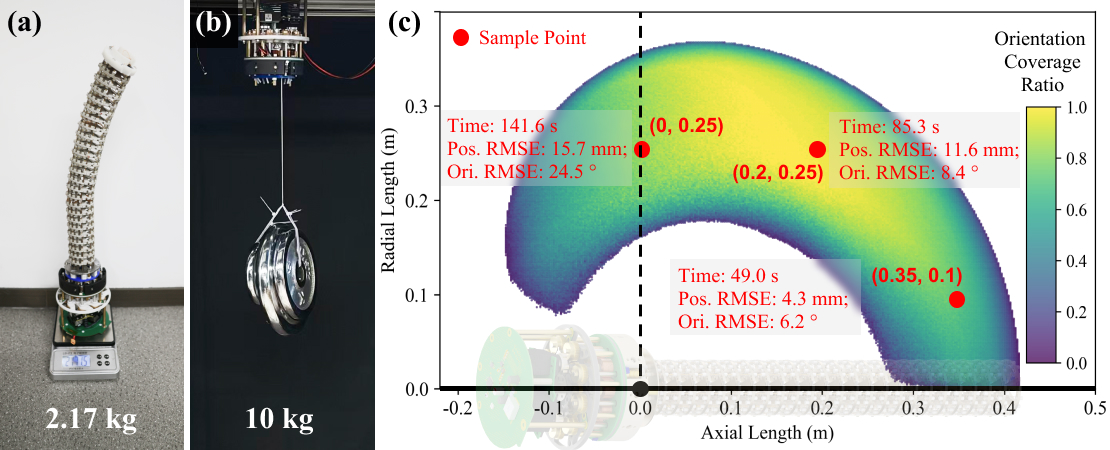
Figure 8: (a) Self-weight, (b) 10 kg payload loading, and (c) workspace dexterity/color map and point performance metrics for the MuxArm.
Manipulation Demonstrations and Cost Structure
Demonstrations in cluttered and confined environments—object extraction through a narrow S-shaped pipe and obstacle-avoidance grasping—substantiate the practical utility of TDMA-based control. The manipulator, mounted on a mobile base, dynamically adjusts local shape for task completion, leveraging redundancy and efficient layer switching.
Cost breakdowns indicate a complete hardware BOM of \$541.85 (excluding gripper/mobile base), with actuator costs heavily reduced via the multiplexed design.
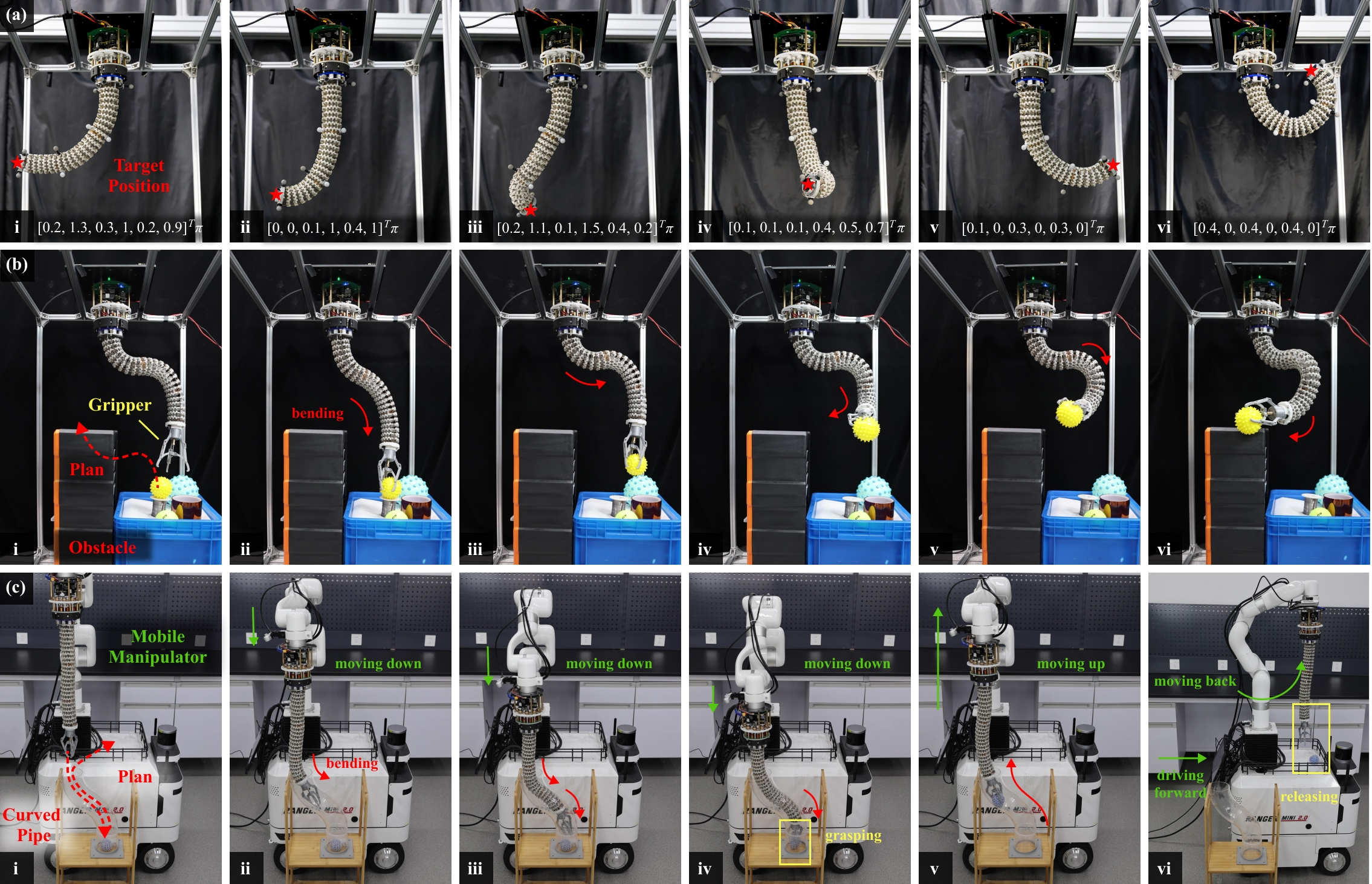
Figure 9: Experimental validation of workspace, cluttered grasping, and pipe extraction tasks illustrating operational versatility.
Implications and Future Directions
This TDMA framework establishes a concrete instance of time-for-space tradeoff in robotic actuation: trading off serial execution for reduced actuator mass and cost, while maintaining fault tolerance and trajectory performance. The approach is particularly salient for aerospace, UAV, and other high-rel-dependability sectors, but is transferable to mobile and hazardous-environment terrestrial robotics as well.
Critically, this architecture invites further research in several vectors:
- Dynamic Modeling: Extension to non-quasi-static domains, integrating tendon/cable elasticity, joint friction, and inertial coupling for high-speed performance.
- Reliability Engineering: Implementation of dual-axial-motor redundancy, active cable condition monitoring, and real-time force sensing in safety-critical scenarios.
- Broader Deployment: Adaptation to non-modular backbones, arbitrary DOF counts, and reconfigurable morphologies, with some parallel lines visible in recent literature on independently lockable joints (Lin et al., 23 Jul 2025).
- Advanced Scheduling: Tightening the optimality of scheduling for large action spaces or high-degree systems, potentially leveraging learning-based or model-predictive techniques.
Conclusion
The paper advances a robust, lightweight, and cost-efficient TDMA actuation architecture for tendon-driven continuum arms, validated through experimental analysis on the MuxArm prototype. The key results include a 55% reduction in actuator count with 10 kg load capacity, maintained kinematic accuracy under partial actuator failure, and operational versatility in complex environments. These findings carry significant implications for deployable robotic systems in space and other weight/volume-restricted domains, catalyzing further inquiry into generalized time-multiplexed actuation and fault-tolerant manipulation.