- The paper introduces a Stackelberg game model that integrates dynamic pricing, capacity scaling, and drainability constraints in multi-tenant GPU clouds.
- It derives a closed-form equilibrium demand map and guardrail criterion to maintain bounded backlogs and ensure safe operation.
- The study demonstrates that an action shield mechanism in reinforcement learning effectively prevents unsafe actions and catastrophic system crashes.
This paper presents a structured analysis of the joint pricing and scaling problem for multi-tenant GPU cloud platforms where system backlogs, pricing, and capacity are dynamically interlinked via endogenous tenant demand. In contrast to traditional approaches that treat workload as exogenous, the framework here explicitly formulates demand as a function shaped by posted unit prices and perceived congestion. The leader (platform) acts by setting prices and capacity, while a large heterogeneous follower population (tenants) responds according to individualized price and delay sensitivities. The resulting closed-loop can enter pathological nondrainable regimes: when delay-insensitive demand persists even under severe congestion, the system may become structurally incapable of clearing backlogs without unbounded price or capacity increases.
Mathematically, the model is formalized as a large-population Stackelberg game. Decision epochs are discrete, with the leader determining a tuple of price and service capacity target. Tenants, partitioned into K mean-field types with varying price/delay sensitivities, select myopic submission rates in response. The fundamental congestion signal is an explicit queue-based delay proxy, and capacity friction is captured via cold-start, setup inertia, and scale-down delays. The resulting state includes backlog, active and pending GPU capacities, and the prior capacity target. The leader then seeks to maximize an infinite-horizon discounted profit objective, balancing revenue, operating costs, SLO-risk penalties, and target-switching frictions.
Equilibrium Demand and Structural Nondrainability
Central to the analysis is the derivation of the unique equilibrium demand map given posted price and congestion. Each type-k follower solves a strictly concave utility maximization, resulting in a closed-form submission rate: λk∗(P,D)=[P+δkDwk−1]+
Aggregating over types (with delay-insensitive types having δk=0), residual demand can remain nonzero even as congestion diverges. This creates an undrainable floor, with queue dynamics potentially admitting no stable fix point under bounded price and capacity—a failure mode not captured in exogenous-demand models.
A closed-form “drainability guardrail” is therefore constructed: Λ0(P)<Sμ
where Λ0(P) is the total residual (delay-insensitive) demand at price P and Sμ is the effective service rate. Violation of this criterion implies that the backlog diverges regardless of congestion, while satisfaction certifies eventual backlog clearance and existence of a unique operating point. The analysis further establishes global convergent dynamics toward the unique steady state if a checkable Lipschitz step-size condition is satisfied. Existence, uniqueness, and convergence are proved through monotonicity and continuity arguments over the induced queueing recursion.
Structural Properties Visualization
The geometric relation between residual demand, service rate, and planning horizon is captured in relative value gap behavior as planning horizons increase:
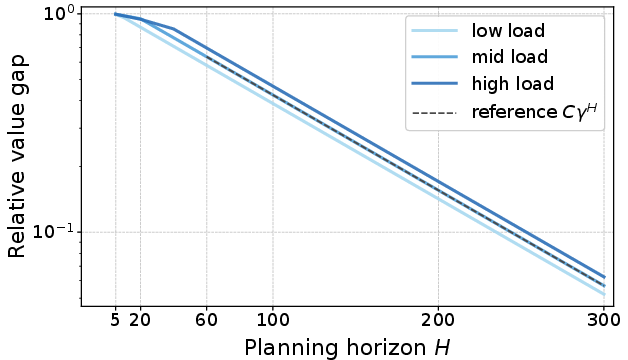
Figure 1: Relative value gap versus planning horizon H; the dashed line is the geometric reference.
Guardrail-Aware Control: Action Shield Mechanism
The insight from fixed-pair analysis motivates translating the static guardrail into a dynamic, optimizer-agnostic “action shield.” The shield acts as an online filter over proposed price/capacity actions: if the residual demand under the candidate action respects the guardrail (with a tunable safety margin ζ), the action is passed through (modifying price if necessary); otherwise, it is projected to an emergency safe region. The implementation uses a friction-aware one-step “effective capacity” proxy computed from the current state and proposed target, ensuring compatibility with the slow transition dynamics typical in real-world GPU clusters.
This mechanism is lightweight, easily composable atop any learning or planning algorithm, and minimally interventionist (modifying actions only when strictly required for safety).
Empirical Analysis: Planning, Off-Grid Execution, and Safe RL
The empirical section demonstrates strong alignment between theory and practice. Vanilla backward dynamic programming (DP) with moderate horizon provides reliable approximations to infinite-horizon value iteration (VI) on the discretized, guardrail-certified system, with empirical relative value gaps exhibiting geometric decay with planning horizon.
Transfer to off-grid (continuous) execution is empirically validated. Returns remain stable and trajectories predicted by DP/VI closely track observed backlog dynamics for sufficiently large horizons.
The role of the action shield in reinforcement learning is directly interrogated via Q-learning. When the shield is ablated, model-free RL policies frequently propose unsafe actions, inducing undrainable regimes and catastrophic crashes (boundary violations or divergence). With the shield enabled, unsafe executions converge to zero, and the cumulative crash rate is stably suppressed.
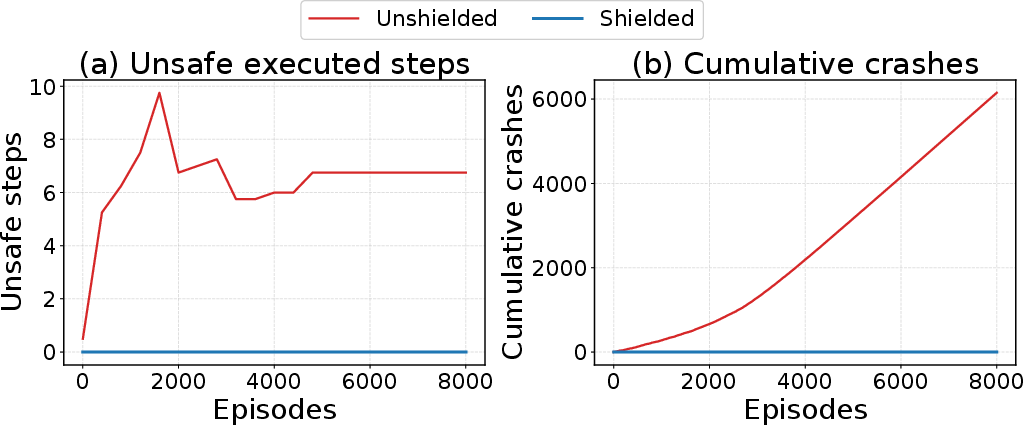
Figure 3: Guardrail ablation in tabular Q-learning under off-grid dynamics.
Further, a “burst demand shift” experiment—tripling tenant utility weights in a test window—probes dynamic robustness. Unshielded greedy execution drives the system into undrainable overflow. In contrast, the shielded agent automatically ratchets up prices to respect drainability, maintaining bounded and recoverable operation throughout the burst.
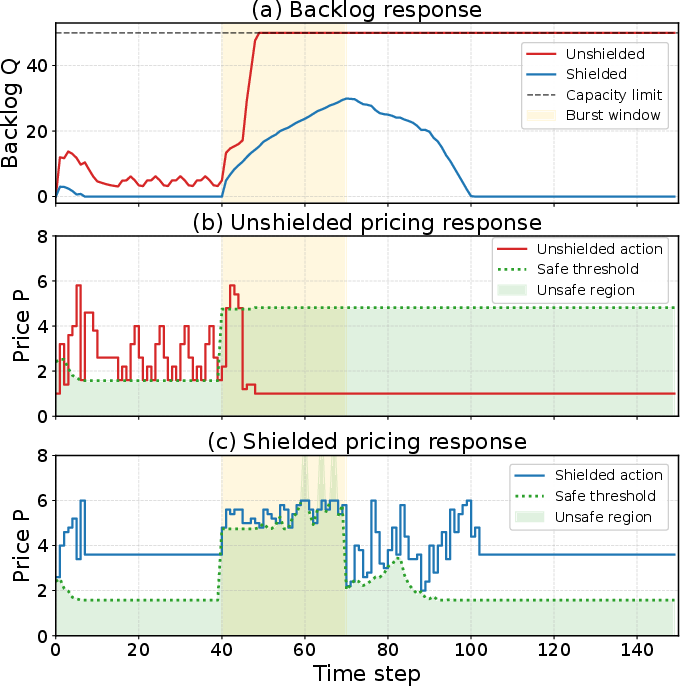
Figure 2: Burst demand shift test. (a) Backlog response under shielded and unshielded execution. (b) Unshielded executed price versus its guardrail threshold. (c) Shielded executed price versus its guardrail threshold.
Theoretical and Practical Implications
The Stackelberg game approach unified with guardrail-based safety goes beyond previous SLO-aware GPU serving and pricing literature by:
- Providing closed-form certificates for safe operation incorporating both pricing and scaling in the presence of endogenous, congestion-coupled demand.
- Revealing structural instability mechanisms absent from exogenous or single-tenant models, specifically the persistence of undrainable regimes due to delay-insensitive workload classes.
- Supporting composable, optimizer-independent safety in dynamic (RL-driven or model-free) settings without requiring structural modification of the control agent.
Theoretical implications include a tractable method to enforce certified safety by mapping security analysis from steady-state (fixed-point) regimes to real-time, friction-aware dynamic shielding. This approach integrates mean-field equilibrium analysis, explicit backlog monotonicity, and certified safety in a framework adaptable to arbitrary, possibly black-box, tenant demand heterogeneity.
Practically, the guardrail-aware control enables robust cloud resource management under significant burstiness, speculative load, and delayed capacity adjustment, broadening the applicability of RL and other online learning algorithms in production multi-tenant GPU/cloud environments.
Future Directions
While the presented framework leverages deterministic demand and stylized congestion proxies for tractability, extending to stochastic demand, uncertain system delays, or partial observability presents an open avenue. Integrating uncertainty quantification, possibly via robust or distributionally robust RL, and generalizing the theory to more complex cost or risk-constraint formulations could enhance real-world applicability. The methodology provides a foundation for certifiable safe RL and shielding in other large-population, endogenous-response resource allocation settings.
Conclusion
The paper establishes a rigorous connection between game-theoretic equilibrium analysis and dynamic safe reinforcement learning for pricing and scaling in GPU-backed cloud platforms. By constructing and operationalizing a drainability guardrail, the work enables certifiably safe and robust control under realistic system frictions and endogenous, heterogeneous tenant demand. The action shield mechanism is shown to be essential for safe online learning and robust operation under bursty, speculative workloads. These insights have potential for broad impact in the design of resilient, learning-driven cloud platforms with endogenous congestion-sensitive demand.
References:
See (2604.16802) for the complete list and model details.