- The paper proposes a consensus clustering method that integrates multiple disturbance scenarios to robustly determine coherent regions in power grids.
- It employs spectral clustering and ensemble learning to assess frequency responses across buses under varied contingencies, enhancing grid partitioning accuracy.
- Empirical results on the MiniWECC system demonstrate improved region balance and resilience, supporting enhanced control and dynamic model reduction in modern grids.
Consensus Clustering for Identification of Power System Coherent Regions under High IBR Penetration
Introduction and Motivation
The increasing integration of inverter-based resources (IBRs) into electrical grids has significantly altered the dynamic response characteristics of modern power systems. With the subsequent reduction in system inertia and the proliferation of variable generation sources, the traditional concept of generator coherency—where groups of generators respond in a similar manner to disturbances—has become less stable and increasingly scenario-dependent. Existing coherency identification techniques, predominantly based on model-driven or measurement-driven methods tailored for single, large contingencies, are inadequate in contemporary grids characterized by high spatial and operational variability in generation mix.
The paper "Consensus Clustering for the Identification of Coherent Regions with Varied Generation Mix" (2604.16222) introduces a multi-view consensus clustering framework that synthesizes information from a diverse set of disturbance scenarios to produce robust, disturbance-invariant coherent regions. This approach increases the reliability of grid partitioning for applications such as dynamic model reduction, emergency control, and wide-area monitoring in power systems with substantial IBR presence.
System Dynamics and Coherency Variability
Traditional coherency-based models rely on disturbances to excite distinct dynamic behaviors, allowing generators with correlated frequency responses to be grouped. However, with the increasing share of IBRs, both the severity and signature of frequency responses resulting from a generator outage become unpredictable and non-linear. This is evidenced by wide deviations in the frequency nadir, ROCOF, and time-to-nadir across different events, even when the lost generation capacities are similar.
As shown in the frequency response profiles for generator trips at bus 4131 (hydro, 7418 MW), and bus 5032 (coal, 3646 MW), the resulting disturbances yield radically different bus-level frequencies and coherency boundaries:
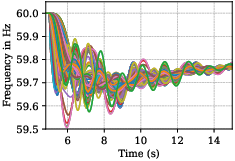
Figure 1: Frequency responses for a trip of generator at bus-4131.
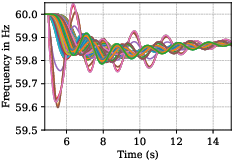
Figure 2: Frequency responses for a trip of generator at bus-5032.
These figures highlight that frequency dynamics, and consequently coherency definitions, are contingent on both the nature and location of the disturbance. Consequently, single-scenario-based clustering is fundamentally insufficient for robust coherency identification in systems with extensive IBR penetration.
Multi-View Consensus Clustering Methodology
To address these limitations, the authors propose a consensus clustering approach leveraging spectral clustering as a base method and an ensemble learning paradigm to integrate multiple contingency scenarios. The process, illustrated below, incorporates statistical similarity (via Pearson correlation), spectral graph theory (through Laplacian construction), and a consensus optimization over multiple contingency-induced clusterings:
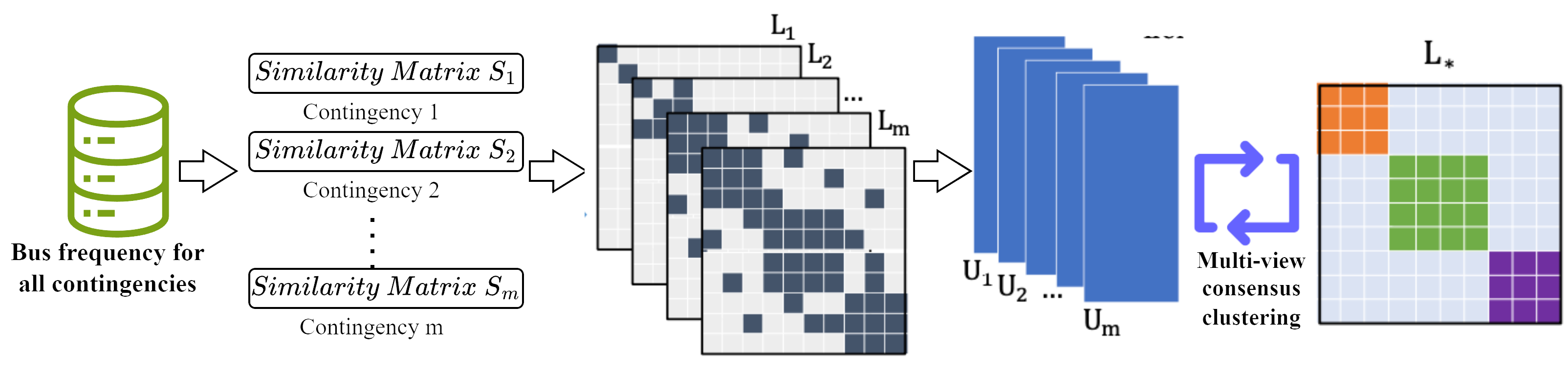
Figure 3: Illustration of consensus clustering algorithm.
Stepwise Procedure
- Similarity Matrix Construction: For each contingency, the frequency responses at all buses are converted into a similarity matrix using the Pearson correlation coefficient. This models the degree of coherent response between all pairs of buses.
- Graph Laplacian and Spectral Embedding: The similarity matrix is mapped to a graph Laplacian, whose spectral decomposition furnishes low-dimensional representations that highlight intrinsic clustering tendencies for each scenario.
- Consensus Laplacian Formation: Spectral embeddings from each scenario are jointly optimized to maximize the trace term in an objective that aggregates all Laplacian matrices via a consensus representation. The optimization alternates between updating global consensus embeddings and scenario-specific embeddings.
- Final Coherent Region Assignment: The final clustering, derived from the consensus Laplacian, guarantees robust partitioning, resilient to idiosyncrasies in any single disturbance scenario.
This multi-view paradigm ensures that the extracted coherent areas are persistent across plausible operating conditions and disturbance types, which is critical for systems with distributed, dynamically interacting sources.
Empirical Results on the MiniWECC System
The approach was evaluated on the MiniWECC 240-bus transmission network, a reduced-order but structurally representative model of the Western Interconnection. Ten severe generator outage scenarios—covering both spatial and source-type diversity—were applied to rigorously test the coherency identification process.
Initial experiments using single-event clustering demonstrated the method's limitations: the resulting clusters often contained disproportionately large regions with tenuous internal dynamic consistency, especially for disturbances that did not propagate sufficient frequency separation system-wide. By contrast, the consensus clustering result achieved a much more balanced and meaningful partitioning, where region boundaries reflected persistent dynamic similarity across the disturbance set.
Notably, in the consensus clustering result, each of the ten coherent regions contained a physically interpretable number of buses, avoiding the pathological dominance of a single, poorly defined region. This is substantiated by the system-wide visualization of coherent regions under different outage scenarios:
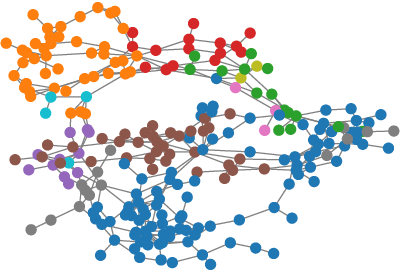
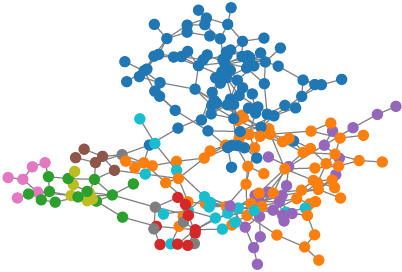
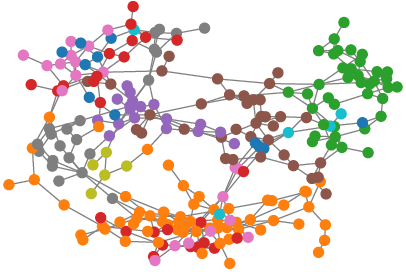
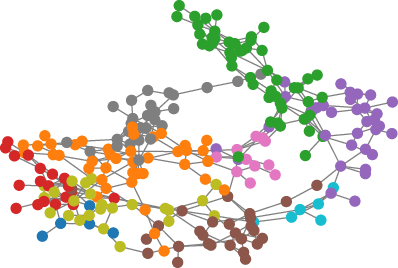
Figure 4: Frequency responses of a coherent region (Gen at 1232) under different generator disturbances.
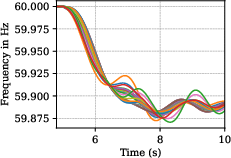
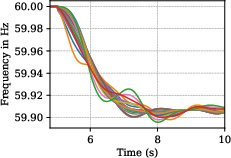
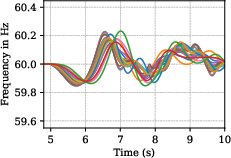
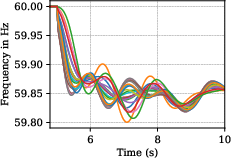
Figure 5: Frequency responses of a coherent region (Gen at 1232) under another scenario.
Inspection of the frequency responses for coherent region 9 under four disturbances reveals that, despite spatial and type-diversity of generator outages, membership buses maintain close dynamic alignment—albeit with some higher-frequency deviations attributable to fast inverter actions. The consensus framework successfully absorbs these local oscillatory characteristics, which are typical in mixed IBR-synchronous grids, preserving overall cluster stability.
Implications and Prospective Directions
Numerical Strengths: The consensus clustering algorithm identified ten robust coherent regions in the MiniWECC system, attuned to persistent dynamic relationships and insensitive to cluster distortions from inadequate single-event excitation. The proposed approach outperformed traditional single-view spectral clustering, particularly in the context of mixed resource portfolios and high IBR shares.
Broader Impact: Reliable coherency identification underpins several critical grid functions. The consensus framework enhances the accuracy of reserve allocation, inertial response estimation, region-specific control actions, and validation of system separation strategies. This robustness is essential under high-renewable or rapidly changing generation portfolios.
Theoretical Implications: Ensemble clustering methods as formulated in this work provide a pathway to further generalizations—incorporating additional operational features (e.g., variable loads, network reconfigurations), alternate similarity measures (beyond linear correlation), or real-time online data streams from PMUs.
Future Development: Potential directions include:
- Dynamic adaptation of consensus parameters for real-time operation;
- Extension to adaptive, time-varying clustering under highly nonstationary grid conditions;
- Integration with wide-area protection and restoration schemes;
- Exploitation of richer time-series analysis (e.g., using deep temporal embeddings) for similarity computation.
Conclusion
The multi-view consensus spectral clustering framework described in this paper systematically addresses the shortcomings of conventional coherency identification in power systems characterized by a varied and dynamic generation mix. Through robust integration of disturbance-diverse frequency responses, the method partitions the network into dynamically meaningful coherent regions, even under high penetrations of IBRs (2604.16222). This provides foundational methodological improvements for the planning, operation, and control of modern and future power grids.

