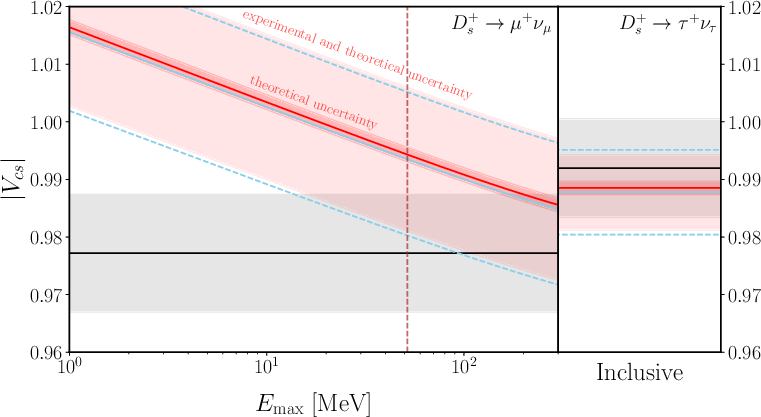
- The paper provides the first analytic derivation of complete one-loop QED corrections to Ds+ leptonic decays, directly impacting the extraction of |V_cs|.
- It combines short-distance EW-QED corrections with long-distance soft-photon emissions using both NDR and HV regularization schemes.
- Incorporating these corrections reduces CKM unitarity tension from 4–5σ to within 1.1–1.6σ, underlining the importance of precise QED modeling.
Complete One-Loop QED Corrections to Ds+ Leptonic Decays and Impact on CKM Unitarity
Motivation and Context
Precise tests of the CKM matrix unitarity are central to probing the flavor structure of the Standard Model (SM) and possible physics beyond it. Recent high-precision lattice QCD results and experimental measurements in charm-meson physics have revealed significant tensions in CKM normalization conditions, particularly concerning the second-row and second-column elements. One suspected source of discrepancy arises from incomplete treatment of radiative corrections in Ds+→ℓ+νℓ (ℓ=μ,τ) decays, especially the interplay of short-distance electroweak-QED (EW-QED) corrections and long-distance QED effects due to soft-photon emission. This study presents the first analytic derivation of the complete one-loop QED corrections in both NDR and HV regularization schemes and quantifies their impact on the extraction of ∣Vcs∣ and the robustness of CKM unitarity tests.
Short-Distance EW-QED Corrections
Short-distance corrections, arising from box and vertex diagrams involving W, Z, and photon exchange, are calculated beyond the leading-log Sirlin prescription. Key features of the formalism include:
- Regularization scheme dependence: Both NDR and HV treatments are considered, revealing small but non-negligible differences in finite (non-logarithmic) terms.
- Explicit subtraction of the radiative corrections to muon decay, ensuring consistent treatment of the Fermi constant GF and avoiding double counting of universal effects.
- Two-loop QCD corrections included, though found numerically subdominant in ∣Vcs∣ extraction.
The final analytic expression encapsulates not only the leading-logarithmic term but also rational finite corrections and renormalization scheme artifacts, demonstrating a reduction in the leading-log correction by 15–24% depending on the scheme.
Long-Distance QED Corrections and Soft-Photon Emission
Long-distance QED corrections are computed using scalar QED for the Ds+ meson, utilizing inclusive and exclusive observable cuts that mirror experimental reality:
- Real and virtual photon emission diagrams (Figures 1–7) are computed analytically, and their infrared divergences are canceled in the summation.
- The soft-photon cutoff Emax is handled in detail, with explicit connection to experimental missing-mass cuts. For μ channels, exclusive selection with a hard Mmiss2 cut restricts Emax∼54 MeV; for τ channels, measurements are quasi-inclusive.
- Resummation of soft-photon emissions is incorporated via the Yennie-Frautschi-Suura exponentiation prescription, ensuring the handling of O(αnlnnEmax) terms.
- Comparison with PHOTOS Monte Carlo is provided, carefully subtracting FSR contributions already incorporated in experimental analyses.
The magnitude of long-distance corrections for μ modes is found to be order percent, exceeding naive expectations due to large logarithmic enhancements from the cut-photon kinematics. For τ modes, corrections are near O(0.2%) due to nonrelativistic final state kinematics.
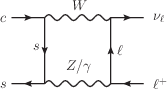
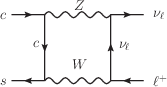
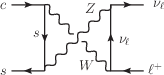
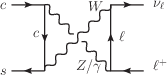
Figure 1: Probability density function of angle between the neutrino and soft photon, showing strong collinearity in the μ channel and more isotropic emission in the τ channel.
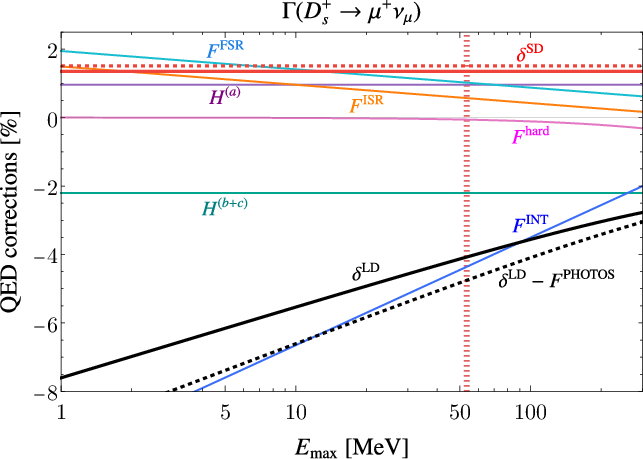
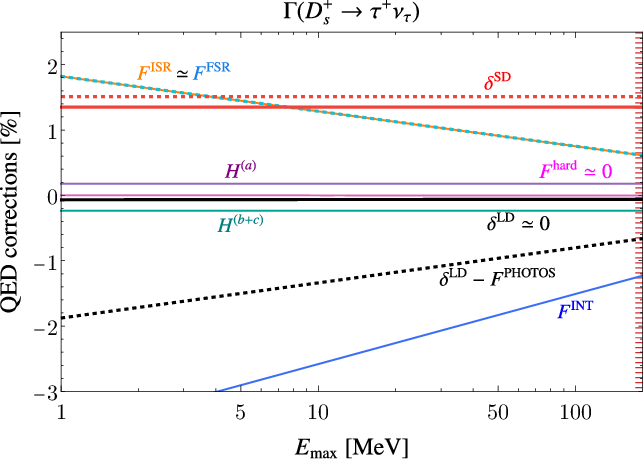
Figure 2: Magnitude of QED corrections to Ds+→μ+νμ (upper) and Ds+→τ+ντ (lower), decomposed by source and Emax dependence.
Numerical Extraction and CKM Unitarity Tests
The complete master formula combines short- and long-distance corrections (with PHOTOS subtracted for consistency) in the extraction of ∣Vcs∣ from current world-average partial widths. The procedure accounts for:
Results show that including the complete radiative corrections restores agreement between fitted ∣Vcs∣ values and CKM unitarity expectation to within 1.1σ (nominal scenario) and 1.6σ (scale factor scenario), substantially alleviating the previously reported 4–5σ tension.
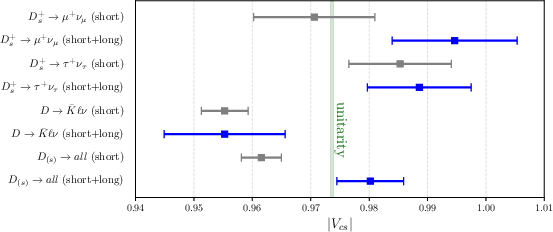
Figure 4: Summary of ∣Vcs∣ determinations from different channels, before and after including long-distance QED effects, compared to CKM unitarity prediction.
Implications and Future Directions
This analysis demonstrates that proper inclusion of both short-distance EW-QED and long-distance QED corrections is crucial for precise CKM unitarity tests in the charm sector. The dominant uncertainty now shifts to the theoretical modeling of QED effects, especially the structure-dependent components of radiative corrections, which remain to be incorporated via future gauge-invariant lattice calculations and improved analytic methods.
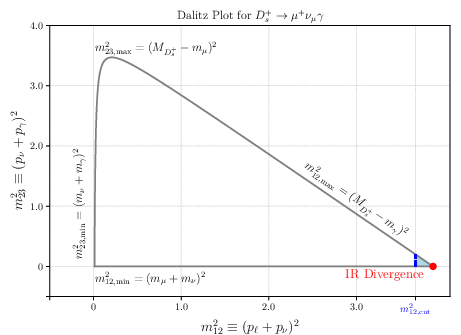
Figure 5: Dalitz plot for Ds+→μνμγ decay, indicating phase space regions relevant for the definition of soft-photon cutoff.
Further progress will also require analogous calculations for the D semi-leptonic channels, CKM normalization conditions in other rows/columns, and enhanced cross-experiment consistency in soft-photon treatment. The bottleneck in confirming CKM unitarity is now the precision of QED corrections, marking a shift from hadronic form factor uncertainties to radiative effects.
Conclusion
The analytic derivation of complete one-loop QED and EW corrections to Ds+ leptonic decays modifies the extraction of CKM matrix elements, directly impacting unitarity tests in the charm sector. The study quantifies the interplay of short- and long-distance corrections, the effect of experimental selection cuts, and the importance of matching theory to experimental radiative corrections frameworks. The present limiting factor for CKM unitarity verification is the precision of QED corrections, motivating future work on structure-dependent radiative effects and lattice QCD+QED calculations targeting charm hadron decays.