- The paper demonstrates a quantum-optomechanical control framework using PID feedback to achieve enhanced mechanical quadrature squeezing below the zero-point limit.
- It integrates a quantum Kalman filter with the SLH formalism, showing how derivative feedback anticipates system dynamics to reduce conditional variance.
- Analytical and numerical results reveal that optimized PID parameters can tailor both transient and steady-state behaviors, with significant implications for precision weak-force sensing.
Squeezing and Measurement of a Mechanical Quadrature via PID Feedback
Introduction
This work presents a quantum-optomechanical control framework leveraging proportional-integral-derivative (PID) feedback for the squeezing and dynamical regulation of a mechanical quadrature. The investigation employs the SLH formalism for open quantum systems, a quantum Kalman filter for optimal operator estimation, and a rigorous analytical and numerical treatment of variances and control transfer functions. Special attention is devoted to the role of derivative and integral feedback, extending the typical proportional-only measurement-based methods, thereby advancing the controllability and measurement precision available in optomechanical platforms.
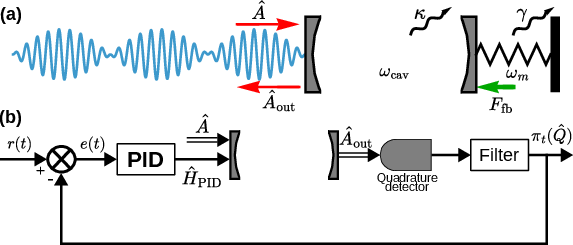
Figure 1: (a) Schematics of the optomechanical system with feedback; (b) PID feedback loop actuating on the estimated mechanical quadrature Q^.
Theoretical Framework
The considered model comprises a mechanical oscillator parametrically coupled to an amplitude-modulated optical cavity, enabling back-action evasion and continuous homodyne detection of a single mechanical quadrature Q^. The cavity output field provides a measurement record processed via a quantum Kalman filter, yielding the best linear estimate πt(Q^) of the true system observable.
The feedback force is engineered in the rotating frame to realize a PID Hamiltonian: H^PID=ℏ2αPγ(r(t)−πt(Q^))P^+ℏ4αIγ2∫tdt′(r(t′)−πt′(Q^))P^−ℏαDdtdπt(Q^)P^.
Treatment of the derivative term is performed beyond standard SLH by incorporating it into the input-output coupling operator formalism and introducing auxiliary corrections in the total feedback Hamiltonian, thereby ensuring mathematical consistency with quantum stochastic calculus.
The time evolution for both the filtered estimate and the associated covariances is derived from the Belavkin-Kushner-Stratonovich equation. Analytical results for the conditional covariance VQ and the unconditional variance VQ, as well as their stationary limits, are obtained in the good-cavity regime (G,γ≪κ).
Feedback-Induced Squeezing Mechanisms
A central result is the discrimination between conditional and unconditional squeezing phenomena. Proportional and integral feedback affect only the unconditional variance, suppressing overall fluctuations by enhanced effective damping, but do not reduce the conditional estimate covariance. In contrast, the derivative feedback term—by formally anticipating the system's dynamical trajectory—directly reduces the conditional variance, and crucially, can simultaneously speed up and amplify the squeezing effect even at the ensemble-averaged (unconditional) level.
The analytical results demonstrate that the achievable steady-state unconditional variance of Q^,
VQ=nth+21−4nBA(nth+21)2[(1+αP)(1+αD)αP+(1+αD)2αD],
can be tuned via feedback parameters to minimize quantum noise below the zero-point limit.
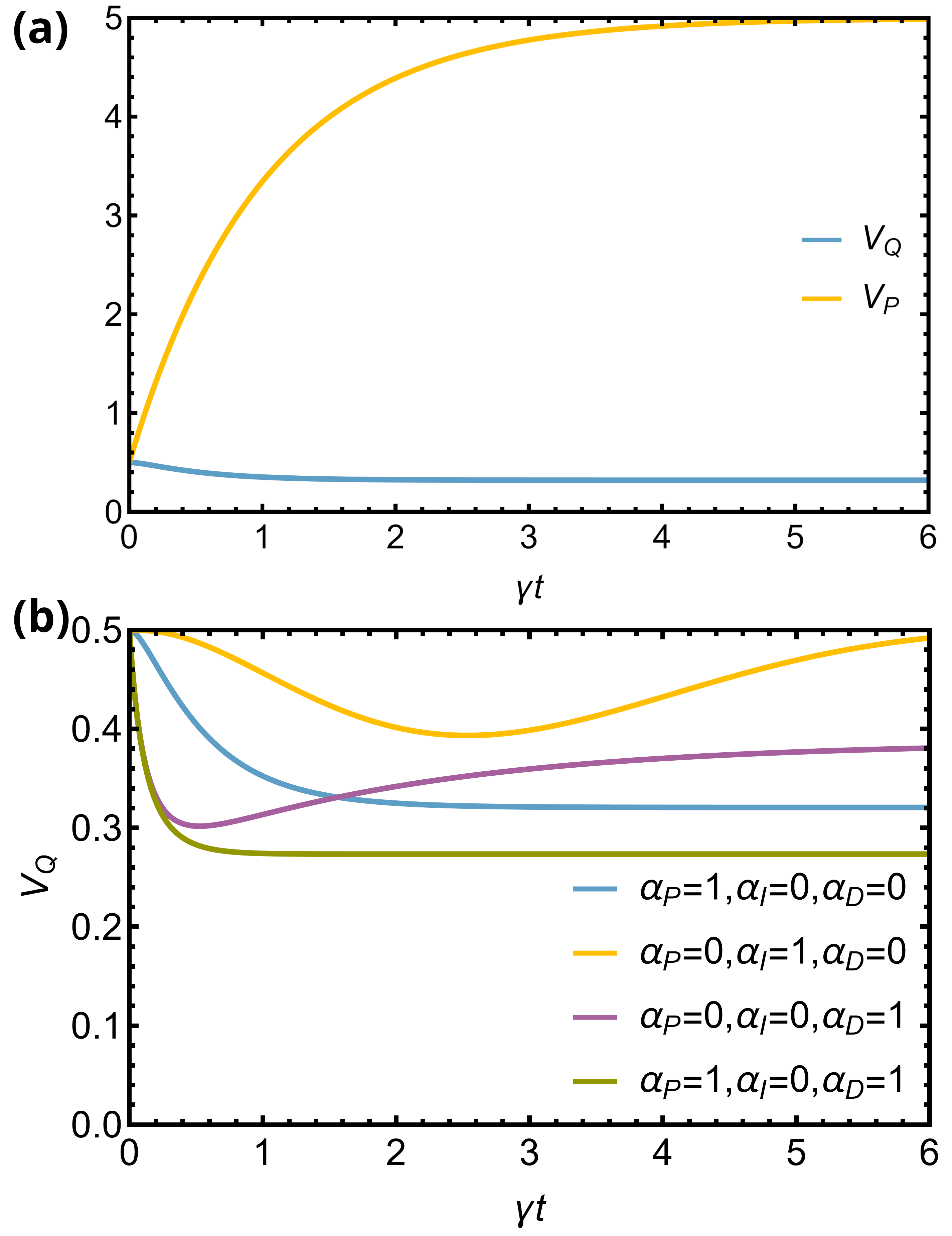
Figure 2: (a) Time-dependent variances of Q^ and Q^0 under proportional feedback; (b) Comparison of steady-state and transient Q^1 variances for different PID configurations.
Numerical evaluations confirm the analytic results. For realistic parameters (Q^2, Q^3, Q^4, Q^5), efficient squeezing is possible, with the Q' variance dropping below the ground state, whileP' broadens via measurement back-action.
Quadrature Control, Transient Response, and Transfer Function Synthesis
A further key contribution is the frequency-domain analysis of the closed-loop transfer function for quadrature tracking. By Laplace transformation, the output-to-setpoint transfer function is
Q^6
revealing zeros and dynamical poles. This structure allows for systematic PID parameter tuning to match target transient response criteria (e.g., overshoot, rise time) and for elimination of the steady-state error (offset) in response to reference signals.
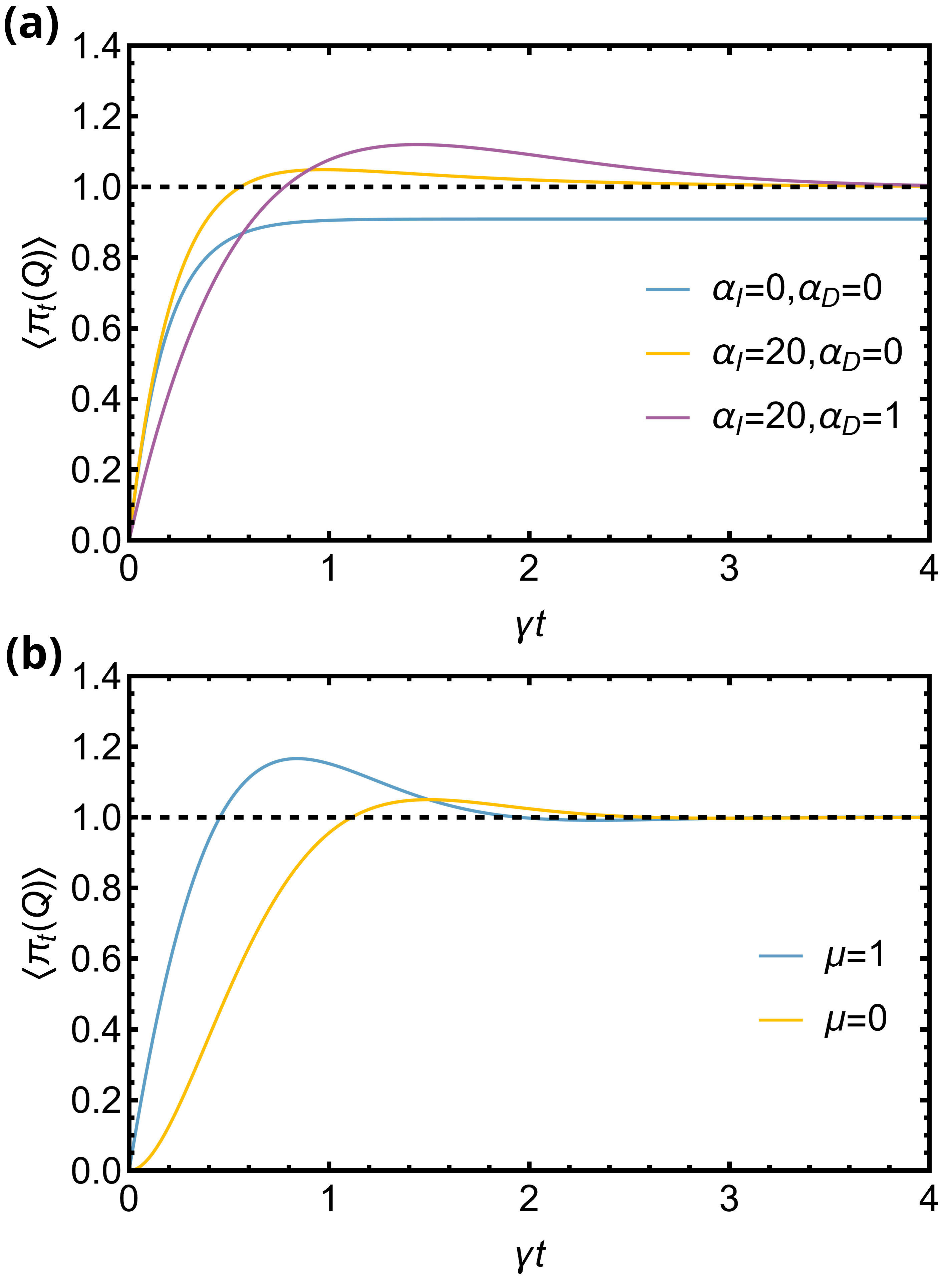
Figure 3: (a) Step response trajectories of Q^7 for various PID parameter sets; (b) Time evolution under optimized PI gain for minimal overshoot and settling time.
Contrary to classical expectations, derivative feedback does not improve the stability or overshoot for quadrature tracking; rather, a PI controller (without derivative term) is optimal. This conclusion is substantiated both by transfer function design calculations and simulation.
Implications and Future Directions
The demonstration that derivative feedback can enhance both the transient and steady-state squeezing of a quantum mechanical quadrature opens new possibilities for quantum-limited measurements and qubit state initialization. Notably, such control improves the performance of weak-force sensors, as the reduction in quadrature fluctuations enables sensitivity enhancements relevant for probing fundamental physics (e.g., quantum gravity tests and ultra-precise force detection).
Moreover, the introduced framework is not specific to the considered optomechanical setup but is extensible to other open quantum systems, including solid-state qubits and hybrid platforms. This raises prospects for leveraging advanced classical control synthesis tools (e.g., robust optimal control, adaptive gain scheduling) within quantum-limited feedback protocols, provided the estimation and actuation chain is operated coherently and with negligible added noise.
Conclusion
This analysis rigorously establishes the role of quantum PID feedback in the squeezing and dynamical stabilization of mechanical quadratures within optomechanical systems. By integrating SLH modeling, quantum Kalman filtering, and systematic feedback synthesis, the results delineate the distinct impacts of proportional, integral, and derivative terms on conditional and unconditional variances, as well as on setpoint-tracking dynamics. The work substantiates how tailored derivative-enhanced feedback enables both rapid and deeply squeezed quadrature states, while combined PI control ensures precise quadrature regulation. These findings have direct significance for the future of quantum measurement and control, with ramifications extending well beyond the present model to broader classes of quantum technologies.
(2604.16202)