- The paper demonstrates that infinitesimal perturbations can convert derogatory EPs into non-derogatory ones while maintaining overall degeneracy order.
- The study employs Jordan canonical forms and Young diagram dominance to classify and visualize exceptional point hierarchies in various matrix dimensions.
- The findings have practical implications for enhancing spectral sensitivity in quantum systems and tailoring Liouvillian dynamics under symmetry constraints.
Hierarchies and Conversions of Non-Hermitian Degeneracies and Exceptional Points
Introduction and Motivation
The study of degeneracies in non-Hermitian systems, particularly exceptional points (EPs), has emerged as a critical topic in the physics of open quantum systems, topological phases, and enhanced sensing technologies. While most works focus on non-derogatory EPs characterized by a single Jordan block, multiblock (derogatory) EPs—where a degenerate eigenvalue is associated with more than one Jordan block—are less explored. This paper systematically analyzes how derogatory EPs can undergo conversion to other EP types via infinitesimal perturbations without altering the total order of degeneracy, elucidates the resulting hierarchies of EP manifolds, and considers the role of symmetry constraints, particularly pseudo-Hermitian symmetry (2604.16139).
Geometry of Degeneracy Manifolds
2×2 and 3×3 Matrix Landscapes
The structure of degeneracies in non-Hermitian matrices is rooted in Jordan canonical form analysis. For 2×2 matrices, there are only two possibilities: diabolical points (two one-dimensional Jordan blocks) and second-order non-derogatory EPs (a single two-dimensional block). The degeneracy surface, given by the condition d222+d12d21=0, forms a conical manifold in parameter space.
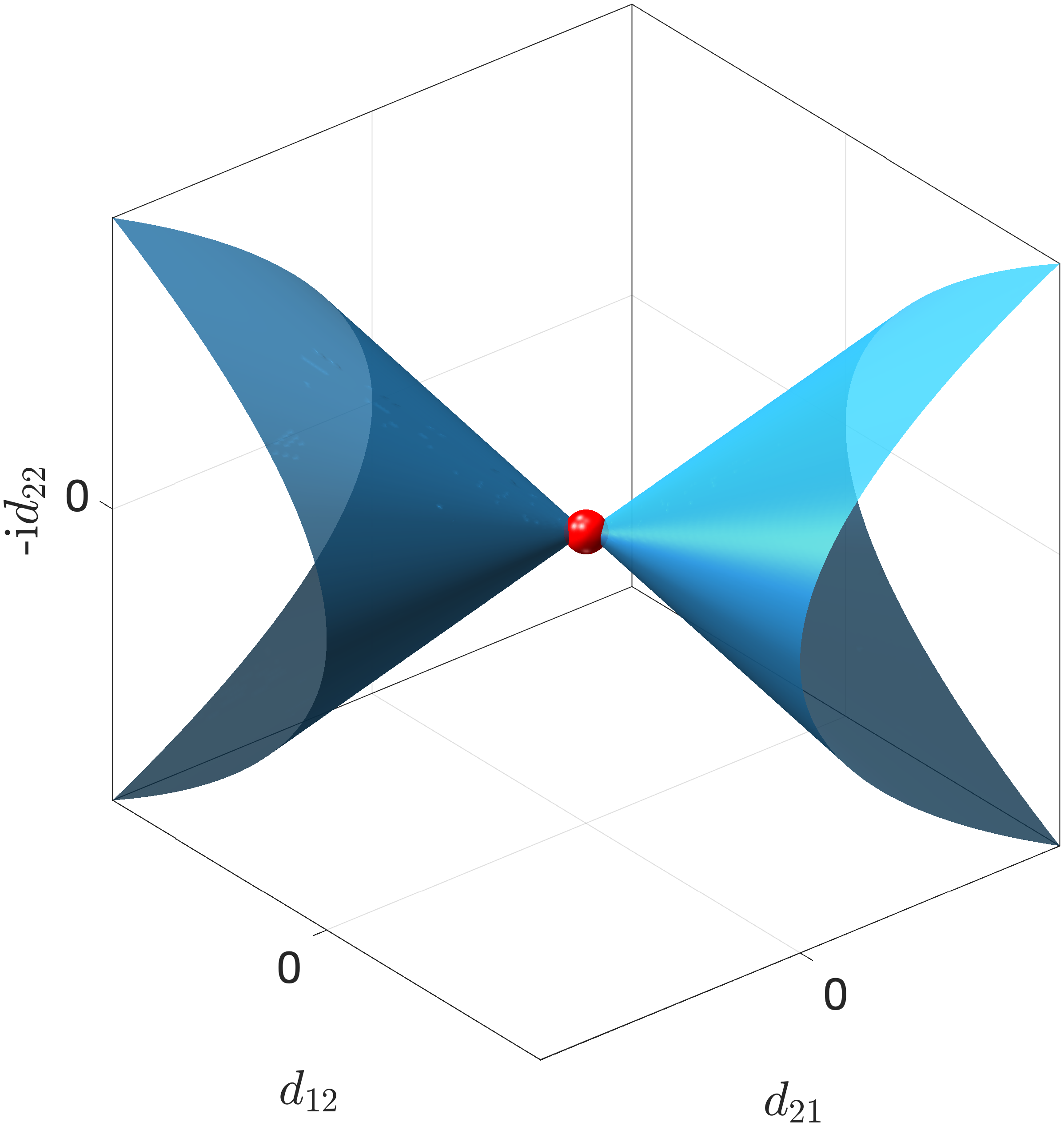
Figure 1: Projection of the degeneracy surface d222+d12d21=0 in R3 with the apex (red point) marking the diabolical point.
For 3×3 matrices, the degeneracies include: non-derogatory EP3 (single three-dimensional block), type-(2,1) EP (two blocks: 2+1), and the tribolical point (three 1×1 blocks). The condition for third-order degeneracies forms a conical hypersurface in C8. The paper demonstrates that infinitesimal, non-generic perturbations of a type-(2,1) EP can create a non-derogatory EP3; geometrically, the (2,1) EPs reside at the boundary of the higher (3) EP manifold.
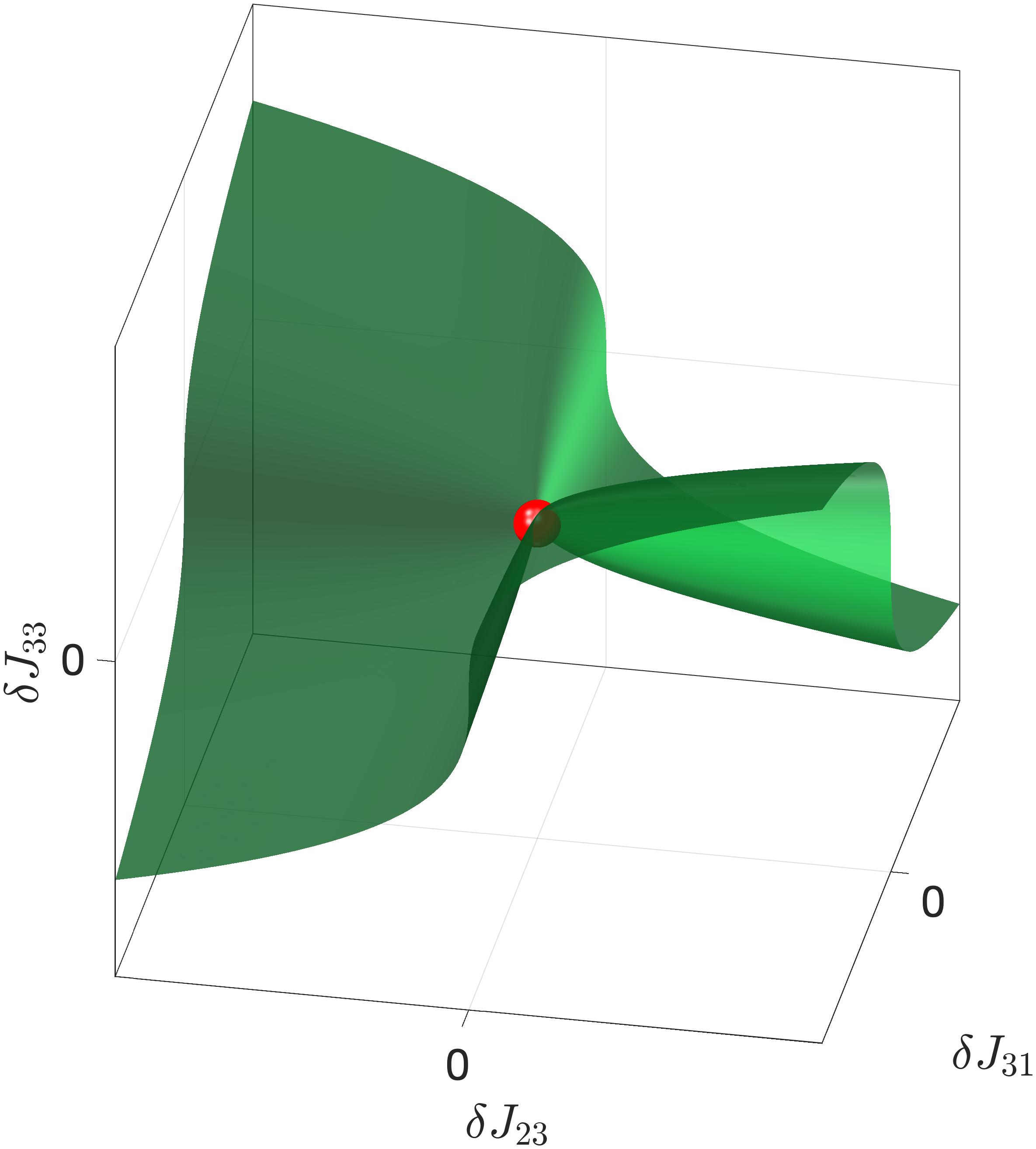
Figure 2: Manifold M3 in the vicinity of a type-(2,1) EP, illustrating the attachment of these points at the boundary of non-derogatory EPs.
Physical Realization and Tunability
A concrete example is given with a non-Hermitian generalization of the Lieb lattice Bloch Hamiltonian, exhibiting a rich structure of triple degeneracies—both type-(2,1) and EP3s—across momentum and non-Hermiticity parameter space.
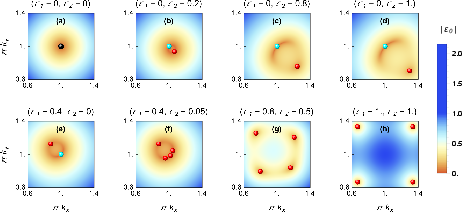
Figure 3: Absolute values of eigenvalues in the spectrum of the non-Hermitian Lieb lattice model, displaying positions of tribolical points (black), type-(2,1) EPs (cyan), and EP3s (red).
This visualization underscores how parameter tuning (momentum, non-Hermiticity) naturally explores the hierarchy and conversion phenomena described theoretically.
Algebraic and Geometric Hierarchies
The mathematical underpinnings of EP manifold hierarchies are formalized in terms of Young diagrams and dominance partial orders. For an 3×30 matrix, degeneracies of fixed order 3×31 are classified by integer partitions (block sizes of the Jordan canonical form). The closure relation of degeneracy manifolds is dictated by the so-called dominance order: type-3×32 EP can be connected to type-3×33 EP if the corresponding Young diagram for 3×34 dominates that for 3×35.
The main result is that in general, any derogatory EP (multiple Jordan blocks) admits infinitesimal perturbations that can increase the size of the largest block (thus enhancing the sensitivity of the eigenspectrum)—a mechanism for engineering higher-order EPs.
Symmetry Constraints: Pseudo-Hermitian Case
Symmetry constraints, such as pseudo-Hermitian symmetry, substantially restrict the possible degeneracy types and conversion rules. The paper provides a rigorous group-theoretic and algebraic classification based on the signature structure of the pseudo-metric operator. For pseudo-Hermitian systems, only those degeneracies and conversions compatible with the signature (number of positive/negative eigenvalues) of the pseudo-metric are allowed—a refinement captured by the introduction of signed Young diagrams.
The utility of these hierarchies is illustrated for the case 3×36 with 3×37 signature:
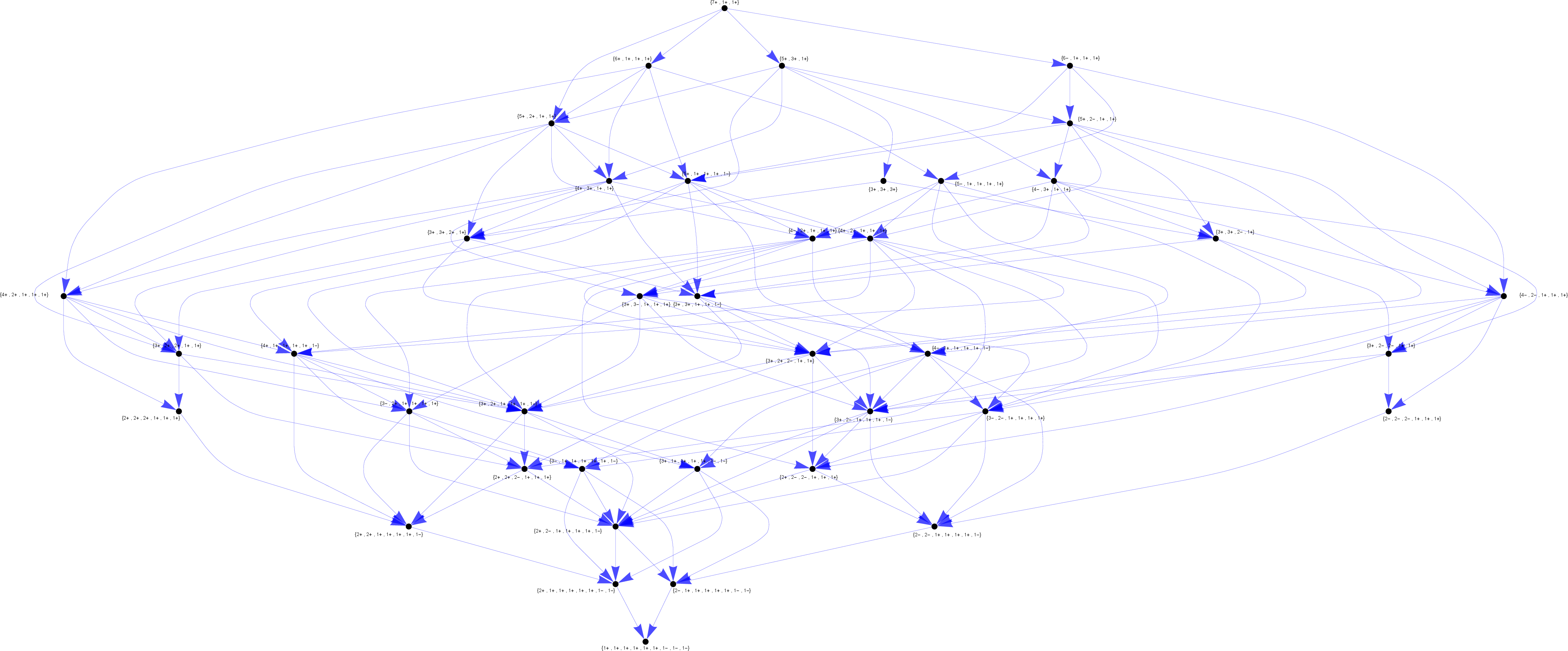
Figure 4: Hierarchy of degeneracies (Young diagrams) with algebraic multiplicity 3×38 for pseudo-Hermitian symmetry (3×39). Only diagrams compatible with the symmetry are retained.
Liouvillian Superoperators and Applications
The theoretical constructs developed for Hamiltonian matrices are applied to Lindblad and Liouvillian superoperators, directly relevant to open quantum systems and dissipative dynamics. In particular, if the non-Hermitian Hamiltonian is tuned to an EP of order 2×20, the corresponding no-jump Liouvillian is defective at a multi-block EP (blocks of size 2×21). Addition of quantum jump terms perturbs this structure and, according to the developed hierarchy theory, can potentially merge blocks—enabling controlled engineering of higher-order EPs in dissipative dynamics.
Implications and Future Directions
This work provides rigorous structural criteria, rooted in algebraic geometry and group theory, for understanding and manipulating the internal block structure of EPs in general non-Hermitian matrices, including physical Hamiltonians and dynamics generators constrained by symmetries. The ability to convert derogatory EPs into non-derogatory or different derogatory EPs via controlled perturbations, even infinitesimal, has important consequences:
- Quantum and Classical Sensing: The sensitivity enhancement near EPs scales with the size of the largest Jordan block, motivating applications in ultrasensitive metrology and sensor design. The work provides a systematic route for maximizing block size by exploiting permissible infinitesimal perturbations.
- Open Quantum System Engineering: Precise control of Liouvillian block structure in dissipative systems can impact decoherence, entanglement, and quantum information protocols.
- Topological and Knot Theoretic Theory: The geometric language of degeneracy manifolds and their boundaries connects directly to recent advances in non-Hermitian topology and nontrivial spectral braiding.
- Symmetry-Restricted Model Design: The construction of automated software tools for Young diagram hierarchy construction (as noted in the text) aids in systematic identification of allowable degeneracy conversions under symmetry constraints.
Potential future work includes the extension of the hierarchy and conversion framework to broader classes of symmetries (beyond pseudo-Hermiticity), systematic exploration of realisable EP conversions in physical systems with experimental constraints, and connections to topological band theory in non-Hermitian lattices.
Conclusion
This study elucidates the fundamental algebraic structure underpinning non-Hermitian degeneracies, establishes a comprehensive framework for EP conversion via infinitesimal perturbations, constructs explicit hierarchies for both generic and symmetry-constrained cases, and provides direct routes for engineered enhancement of spectral sensitivity and degeneracy properties in quantum and classical engineered platforms. The results have direct applications in quantum sensing, open-system dynamics, and non-Hermitian topological phases, and motivate further exploration of the theoretical and practical boundaries of exceptional point physics.