- The paper introduces a universal algebraic framework using Newton polygons and tropical polynomials to determine the scaling and structure of non-Hermitian degeneracies.
- It classifies degeneracies into non-defective and defective types, detailing the associated Jordan block structures and eigenvalue dispersion across various matrix dimensions.
- It demonstrates practical implications in non-Hermitian sensing, topological systems, and quantum metrology through concrete low-rank examples.
Algebraic Characterization of Non-Hermitian Degeneracies: Defectiveness and Asymptotic Dispersion
Introduction and Theoretical Framework
This work systematically formulates the algebraic structure of non-Hermitian (NH) degeneracies, addressing their classification, defectiveness (Jordan block structure), and asymptotic dispersion under perturbations. Traditional Hermitian matrix theory, governed by the von Neumann–Wigner theorem, does not accommodate the complexity of NH degeneracies—specifically, exceptional points (EPs) of various orders and compositions, which are generic in NH settings. The paper identifies two fundamental categories: (i) non-defective (Hermitian-like, diabolic) degeneracies and (ii) defective (exceptional) degeneracies, the latter often involving multi-block Jordan structures or "fragmented" EPs.
A central advance is the generalization of eigenvalue perturbation theory for arbitrary NH matrices via algebraic geometry—particularly, the tropical and Newton polygon approaches. This strategy enables elucidation of not only the order and multiplicity of NH degeneracies but also their response to both generic and symmetry-constrained perturbations. The method bridges the gap between explicit perturbative calculations (often intractable for high-order or multiblock EPs) and an efficient, unifying description applicable to arbitrary matrix dimensions and Jordan types.
The authors introduce a systematic procedure for resolving the leading-order scaling (dispersion exponents) of perturbed eigenvalues near a multi-fold NH degeneracy. Consider a parameter-dependent matrix A(ϵ)=A0+ϵB: the scaling of the roots of its characteristic polynomial is encoded in the sequence of lowest exponents αi of ϵ for each coefficient ai(ϵ), reflected in the vertices of the Newton polygon. The slopes of the lower convex hull directly yield the scaling exponents β for eigenvalue splitting.
Equivalently, the tropicalization of the polynomial provides a piecewise-linear (min-plus) landscape whose non-differentiable points (tropical roots) correspond to scaling exponents, with their multiplicities given by the slope changes. This formalism allows for a transparent algebraic link between the structure of the perturbation and the response of the system, including cases with symmetry-induced accidental degeneracies or protected directions immune to perturbation.
Classification and Dispersion in Low-Rank Examples
The paper gives a comprehensive taxonomy for 2×2, 3×3, and 4×4 NH matrices, mapping each Jordan type and the associated perturbation structure to a specific pattern of tropical roots and their multiplicities.
2×2 and 3×3 Cases
For αi0 matrices, generic perturbation of a rank-2 EP yields roots scaling as αi1, while perturbation of a non-defective degeneracy produces linear (αi2) splitting. For αi3 matrices, fragmented degeneracies split according to the block sizes: EP3s, (2+1) multiblock structures, and non-defective diabolic triple points each manifest distinct tropical root configurations.
αi4 and Multiblock Extensions
All hierarchies of degeneracies (e.g., αi5, αi6, αi7 Jordan block structures) are treated, and their associated scaling exponents and multiplicities precisely catalogued. This exhaustive algebraic classification verifies and generalizes results beyond purely numerical or case-specific analyses seen previously in the literature.
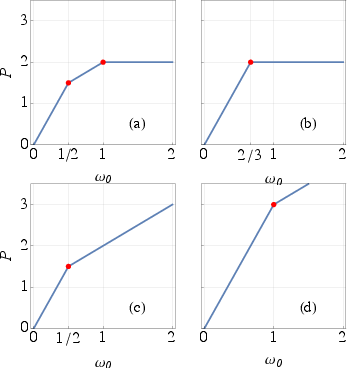
Figure 1: Possible tropical polynomials in αi8, illustrating tropical root locations and multiplicities for various multiblock degeneracy scenarios.
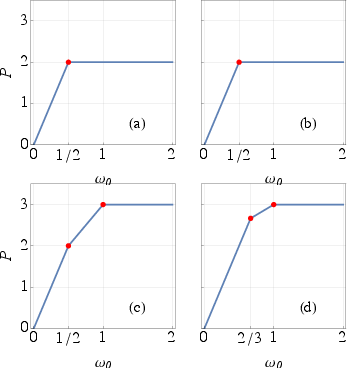
Figure 2: Possible tropical polynomials in αi9 capturing the splitting of fragmented second-order EPs and related degeneracies.
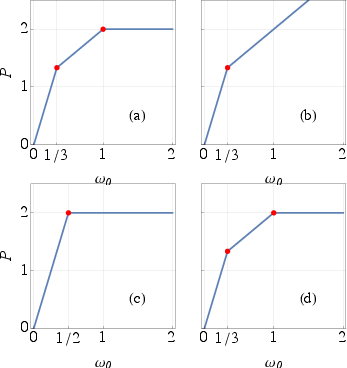
Figure 3: Possible tropical polynomials in ϵ0 showing dispersive patterns for higher-order exceptional points and mixed Jordan block structures.
Physical Implications and Illustrative Models
A wide range of applications—NH sensing, nonreciprocal models, open-system Liouvillian dynamics, and condensed matter systems—are used as testbeds for this algebraic machinery:
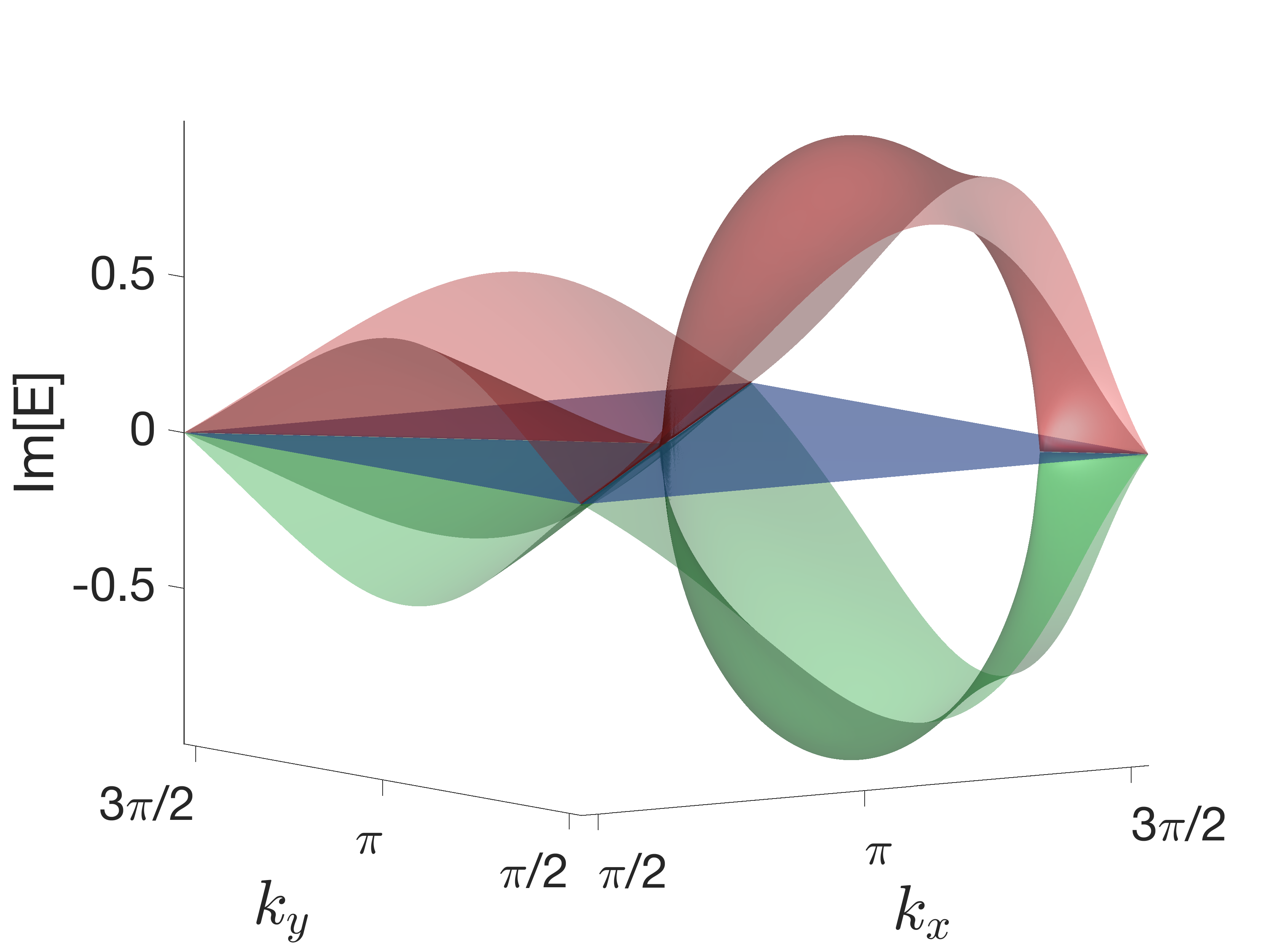
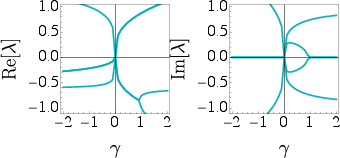
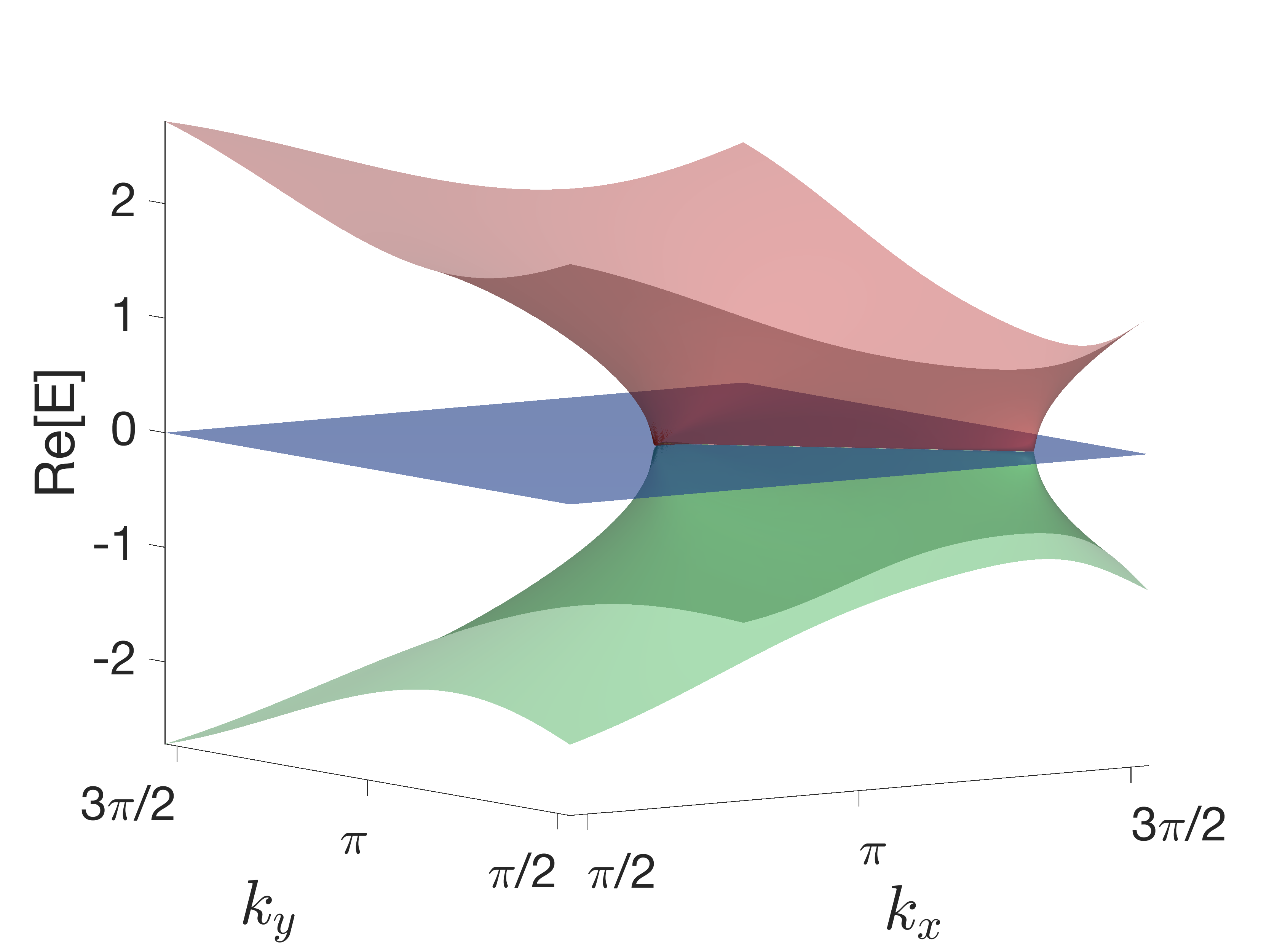
Figure 5: Real and imaginary parts of the spectrum for the NH Lieb's model, revealing dispersive and non-dispersive bands at the symmetry-enforced degeneracy points.
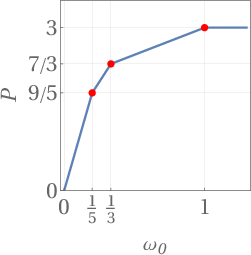
Figure 6: Tropicalized characteristic polynomial ϵ3 of an effective Liouvillian, visualizing the full splitting structure of a dissipative open quantum system.
A particularly strong claim is the universality of the tropical algebraic approach—not only for classifying and predicting all NH degeneracy splittings for arbitrary perturbations (including the elusive derogatory/multiblock cases), but for providing insight into their interconversion. By manipulating the algebraic and geometric structure of the perturbation, it is possible to deterministically switch between different EP types and orders, an operation of direct functional significance in NH device engineering, topological quantum computation, and robust NH state preparation.
The method is extensible to characterization of skin effects (through amoeba and tropical curves), boundary sensitivity, and, crucially, explicit construction of degeneracy manifolds in high-dimensional parameter spaces.
Conclusions
This study establishes a rigorous and general formalism—anchored in Newton polygons and tropical polynomials—for the algebraic characterization and perturbative analysis of all NH degeneracies. The framework is powerful in its ability to handle arbitrary Jordan block structures and both generic and symmetry-constrained perturbations, providing a unifying language across disparate NH platforms. Explicit predictions for exponents, multiplicities, and structural transformation of NH degeneracies are substantiated via detailed low-rank and physical examples.
The implications extend to NH materials engineering, quantum metrology, and topological band theory, with potential for future development into automated computational packages for large-scale NH systems, exploration of critical dynamics at NH quantum phase transitions, and systematic design of multi-EP architectures for robust nonreciprocal and topological phenomena.
Reference: "Characterizing all non-Hermitian degeneracies using algebraic approaches: Defectiveness and asymptotic behavior" (2604.16140)