- The paper introduces geminal wavefunction models that capture explicit electron pairing to treat strong static correlation with favorable computational scaling.
- It details various approximations such as APG, APIG, and APSG, and highlights hybrid strategies with coupled-cluster, RDM, and quantum computational methods.
- The study demonstrates the integration of geminal methods with Jastrow factors and explicit correlation techniques to enhance accuracy and efficiency in electronic structure calculations.
Geminal Wavefunction Models in Chemistry: An Authoritative Synthesis
Introduction and Conceptual Foundations
Geminal wavefunctions, based on explicit electron pairing, provide a physically motivated and variationally rich formalism for capturing strong (static) electron correlation. The theory, originating in Shull's natural spin-orbital analysis, was formalized via Coleman's N-representability and is foundationally linked to both valence-bond methods in chemistry and pairing phenomena in condensed matter (notably Bardeen–Cooper–Schrieffer (BCS) theory). Despite their conceptual appeal, the factorial scaling of geminal wavefunctions—particularly the most general antisymmetrized product of geminals (APG)—posed significant computational barriers that delayed robust practical deployment.
Advances in algorithms, hardware, and formal understanding have enabled a resurgence of geminal-based approaches, positioning them as versatile alternatives for strongly correlated systems while maintaining advantageous cost/accuracy tradeoffs relative to traditional configuration interaction (CI) or coupled-cluster (CC) methods.
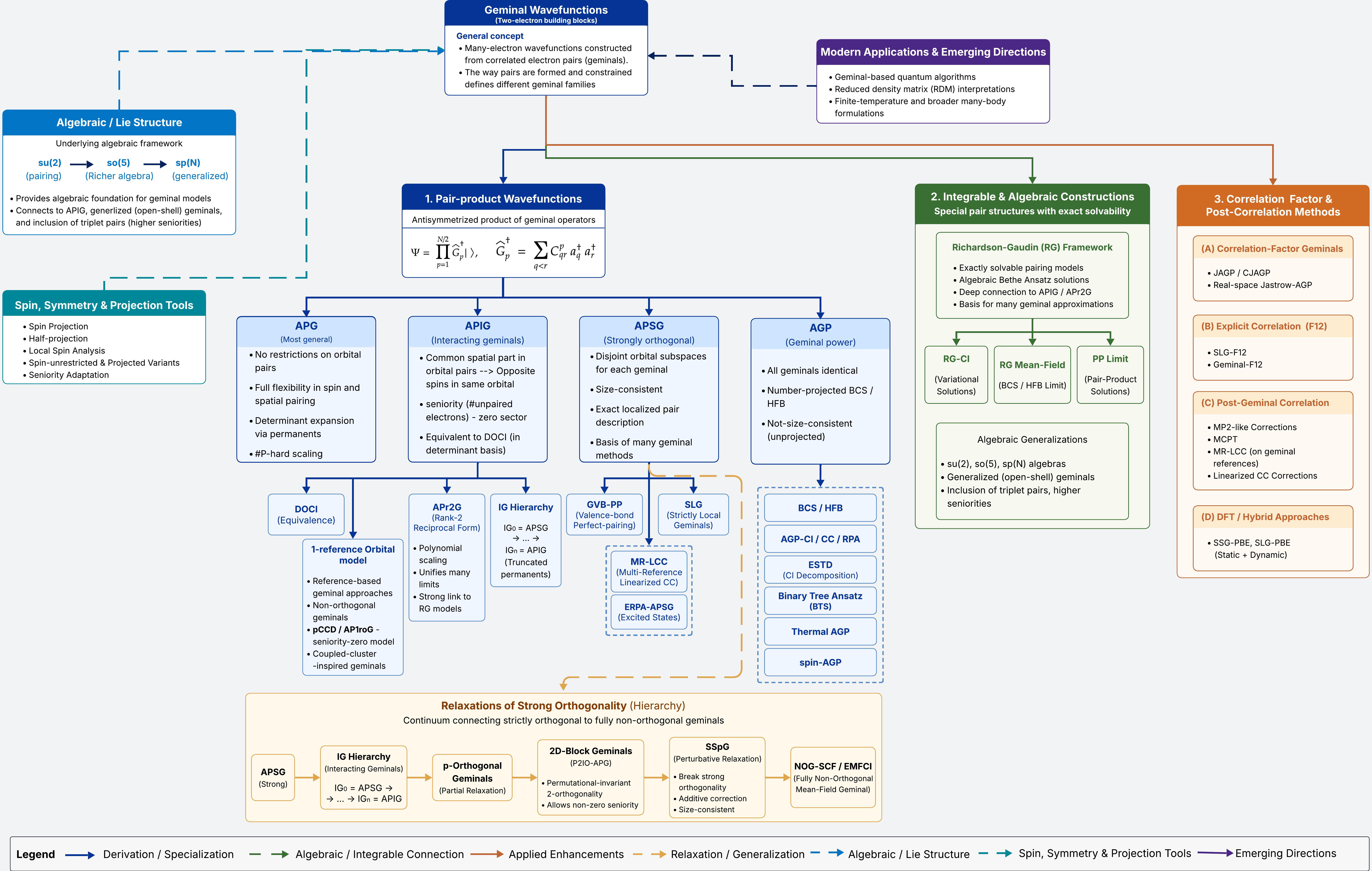
Figure 1: Schematic overview of geminal wavefunction theory highlighting conceptual relationships and methodological developments, mapping classes of pair-product wavefunctions, algebraic/integrable constructions, and correlation treatments into a unified framework.
Structural Hierarchy of Geminal Wavefunctions
Antisymmetrized Product of Geminals (APG) and Tractable Subclasses
The APG represents the unconstrained pair-product wavefunction, with arbitrary linear combinations of spin-orbital pairs for each geminal, leading to coefficient structures involving matrix permanents—a #P-hard challenge. Progress has hinged on approximations that restrict pairing structure, giving rise to tractable families:
- Antisymmetric Product of Interacting Geminals (APIG) and Doubly Occupied Configuration Interaction (DOCI): By using a common spatial orbital basis, direct evaluation remains factorial, but the seniority-zero restriction enables polynomially scaling approximations (e.g., pCCD/AP1roG) that recover dominant static correlation.
- Antisymmetric Product of Strongly Orthogonal Geminals (APSG): Enforcing exclusive orbital domains per geminal yields size-extensive models with block-diagonal RDMs. APSG captures localized bond dissociation well but misses intergeminal (dynamic) correlation unless corrected via perturbation theories, block-correlated extensions, or response-theoretic methods.
- Low-Rank Decompositions and Block-Geminals: Low-rank APG has been shown to recover substantial correlation energy at polynomial cost by retaining only significant eigenvalues of geminal matrices(2604.16133); block-structured (2D-block) geminals further interpolate between fully orthogonal and unconstrained geminals, allowing mixed-seniority configurations at controlled computational cost.
AGP, Richardson–Gaudin, and Algebraic Generalizations
The Antisymmetrized Geminal Power (AGP) wavefunction is a central analytic form, representing number-projected BCS states. AGP allows further formal developments:
- Richardson–Gaudin (RG) states impose a Cauchy structure, enabling efficient evaluation using determinant formulas and direct connections to integrable pairing Hamiltonians. Off-shell, variational RG can be systematically improved and is highly effective for strong correlation in hydrogen networks, outperforming mean-field-based approximations.
- Algebraic Lie-Structured Generalizations: Johnson et al. introduced a singlet-pair framework encompassing AGP, APIG, APSG as specific restrictions within a unifying sp(N) algebraic structure. This formalism enables controlled, physically interpretable extensions to open-shell and block-localized pairing, improving performance for bond dissociation and multireference systems.
Coupled-Cluster and Reference-Orbital Constraints
For computational practicality, 1-reference orbital models (AP1roG/pCCD) retain the pair-product structure with an explicit reference Slater determinant, leading to CC-like parameterizations (mean-field scaling). Orbital optimization is essential for size consistency; orbital-optimized AP1roG matches seniority-zero DOCI results within millihartree accuracy for hydrogen chains and similar systems. Inclusion of "faux singles" operators and hybrid rank-two models further extend the reach of these ansätze, enabling black-box applicability without exhaustive orbital optimization.
Generalized Valence Bond (GVB) and Spin Extensions
GVB theory provides a hierarchy from fully variational nonorthogonal geminals (full GVB) down to the perfect-pairing (GVB-PP) and strong-orthogonality (GVB-PP/SO) forms. The flexibility to represent singlet/triplet mixing within geminals or to permit spin-unrestricted/half-projected combinations (HP-APSG, HP-SLG) addresses deficiencies in conventional pair-only models, such as correct fragment spin in bond dissociation and biradical behavior. Block-correlated CC (GVB-BCCC) and perturbative (GVB-BCPT2) extensions further bridge to dynamic correlation, matching DMRG accuracy for prototypical multireference problems.
Explicit Correlation and Jastrow–Geminal Approaches
Geminal theory naturally intersects with explicitly correlated (R12/F12) and transcorrelated (TC) methods. In R12/F12 approaches, geminals that depend on interelectronic distance r12 accelerate basis-set convergence by enforcing the electron-electron cusp, with Slater and Gaussian geminals as practical choices. F12 parameter reoptimization ("slimmer" geminals) and analytic geminal-projected CI approaches have improved both accuracy and computational efficiency for ab initio calculations.
The transcorrelated method renormalizes the Hamiltonian via a geminal-Jastrow similarity transformation, introducing short-range correlation directly and producing compact, almost single-reference wavefunctions. The non-Hermitian nature of the TC Hamiltonian is addressed via biorthogonality and stochastic solvers (FCIQMC).
The Jastrow-Antisymmetrized Geminal Power (JAGP) ansatz merges an AGP (or APG) pairing reference with a symmetric Jastrow correlator, encapsulating both static and dynamic correlation with a determinant-cost evaluation. The Jastrow factor enforces size consistency (eliminating spurious charge fluctuations) and corrects the nodal surface, enabling chemically accurate fixed-node QMC for challenging systems, including those with strong static correlation. Hilbert-space Jastrow networks and cluster Jastrow extensions (CJAGP) enable flexible symmetry and particle-number projections, further enhancing practical applicability.
Geminals in Quantum Computation
Geminal-based ansätze are recognized for their quantum resource efficiency in quantum simulation algorithms. AGP can be prepared on quantum computers with linear depth and gate count, and supports unitary coupled-cluster extensions with killer operators for static and dynamic correlation. AGP-based reference states provide compact Hilbert space representations, and hybrid approaches (pUCCD, cluster-Jastrow factorizations) yield shallow circuits. The transcorrelated Hamiltonian, implemented with variational quantum imaginary-time algorithms (VarQITE), enables nearly single-reference wavefunctions for strongly correlated systems, drastically reducing qubit overhead and circuit depth required for chemical accuracy on NISQ hardware.
These developments illustrate a symbiosis between modern quantum chemistry and the emerging quantum hardware paradigm, suggesting that geminal-based frameworks will be central to scalable quantum chemistry simulations.
Theoretical Perspectives and Extensions
Reduced density matrix (RDM) approaches offer a complementary perspective; geminals appear as eigengeminals of the two-particle reduced Hamiltonian, and energy functionals based on statistical populations (e.g., via Fermi–Dirac-type distributions) provide efficient, if non-variational, alternatives. Machine learning frameworks further exploit geminal representations to learn N-representable 2-RDM occupation statistics, reducing the many-electron problem to effective two-particle models.
Extensions to open-shell and odd-electron systems leverage Pfaffian-based ansätze for unified singlet/triplet/unpaired electron treatment, and spin-unrestricted geminal products with projection schemes to maintain spin purity, opening the theory to a broad landscape of radical, biradical, and near-degenerate systems.
Future Prospects
The resurgence of geminal-based wavefunction theory is driven by the imperative of simultaneously achieving accuracy, interpretability, and scalability for strongly correlated electronic systems. The marriage of algebraic structure, variational flexibility, and physical intuition—alongside hybridization with coupled-cluster, RDM, Jastrow, and quantum computing methodologies—positions geminal models as foundational elements in the ongoing evolution of electronic structure theory.
Practical and Theoretical Implications
- Scalability: Geminal-based approaches now routinely deliver static (and, via corrections, dynamic) correlation at costs competitive with mean-field or polynomial-scaling CC methods.
- Interpretability: The pair structure provides chemically meaningful descriptors (e.g., localized bonding, entanglement, spin-pairing).
- Quantum Algorithms: Resource-efficient ansätze for variational quantum eigensolvers and hybrid classical–quantum platforms will rely heavily on geminal-inspired structures.
- Dynamical and Excited State Extensions: Systematic inclusion of dynamical correlation, excited states, and open-shell adaptation is progressing rapidly via coupled-cluster hybridizations, block-correlated perturbation, and response-theoretic generalizations.
Conclusion
The geminal wavefunction paradigm—rooted in explicit electron-pairing—provides a unified and adaptable platform for addressing strong correlation across chemistry and physics. Through refined structural approximations, integration with explicitly correlated and tensor-network methods, and adaptation to quantum algorithms, geminal-based models are poised for broad impact across computational chemistry and many-body electronic structure theory. The ongoing development of hybrid methods, algorithmic optimizations, and applications to larger challenging systems suggests a fertile trajectory for further advancement in the field.