- The paper introduces an explicit virial expansion derivation quantifying convergence and Debye limits through detailed PIMC benchmarks.
- It examines electron-electron correlations and bound-state effects on plasma transport and free energy with analytic precision.
- The work provides precise analytic coefficients that inform improvements in simulation methods for fully ionized and uniform electron gases.
The Virial Expansion of Plasma Properties: Analytical Benchmarks for Numerical Simulation
Overview and Research Context
This work presents a systematic formulation of plasma thermodynamic and transport properties through virial expansions derived via quantum-statistical Green's function techniques. The analysis focuses on two prototypical systems: the uniform electron gas (UEG) and the fully ionized hydrogen plasma. The virial expansion's convergence properties, exact analytic coefficients, and interplay with path-integral Monte Carlo (PIMC) simulations are examined, with strong emphasis on benchmarking numerical results against theoretical limits. The approach also provides insight into how bound-state formation and electron-electron correlations impact the applicability and accuracy of virial expansions.
A central result is the explicit construction of the virial expansion for free energy and related thermodynamic properties, derived using diagrammatic Green's function techniques with careful treatment of screening and long-range Coulomb interactions. The expansion is formulated not in integer powers of density, but with half-integer and logarithmic corrections characteristic of Coulomb systems:
βf(T,n)=i∑[niln(niΛi3)−ni]−FDebye(T)n3/2−F1(T)n2lnn−F2(T)n2+…
The hydrogen plasma virial expansion for the normalized pressure,
2nβp=1−ADebye(T)nBohr1/2−A2(T)nBohr+…,
employs exact and semi-analytic expressions for coefficients, including the Beth-Uhlenbeck formula for the quantum-statistical second virial term. Notably, bound-state and scattering state contributions are systematically included.
Comparison with PIMC results enables direct benchmarking. A virial plot of all PIMC data for βp/2n as a function of nBohr1/2/THa3/2 demonstrates excellent agreement with the Debye limit and reveals the density range where higher-order terms or bound-state effects become significant.
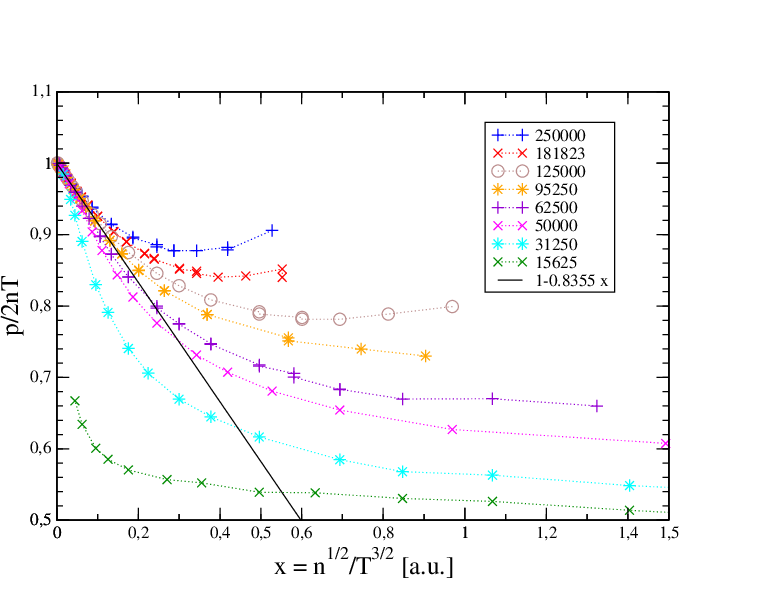
Figure 1: βp/(2n) as a function of nBohr1/2/THa3/2; PIMC simulations systematically approach the Debye analytic limit at high temperature and low density.
However, extraction of higher-order virial coefficients is limited by the precision of available PIMC data. Linear fitting methods for effective virial coefficients are described, but reliable determination of coefficients such as A3(T) is currently precluded by statistical uncertainties at low density.
The UEG serves as a critical target for analytic-numeric cross-validation since bound states are absent and exceptionally accurate PIMC is feasible. The virial expansion for the specific mean potential energy v(T,n) is expressed as:
v(T,n)=vDebye(T)nBohr1/2+v1(T)nBohrln(κ2λ2)+v2(T)nBohr+...
Systematic analysis of simulation data with virial plots (effective coefficients as functions of suitable variables) reveals rapid convergence at low density, with clear identification of the region where higher-order terms must be included. The analytic values of vDebye(T), 2nβp=1−ADebye(T)nBohr1/2−A2(T)nBohr+…,0, and 2nβp=1−ADebye(T)nBohr1/2−A2(T)nBohr+…,1 are reached with PIMC data at sufficiently low density.
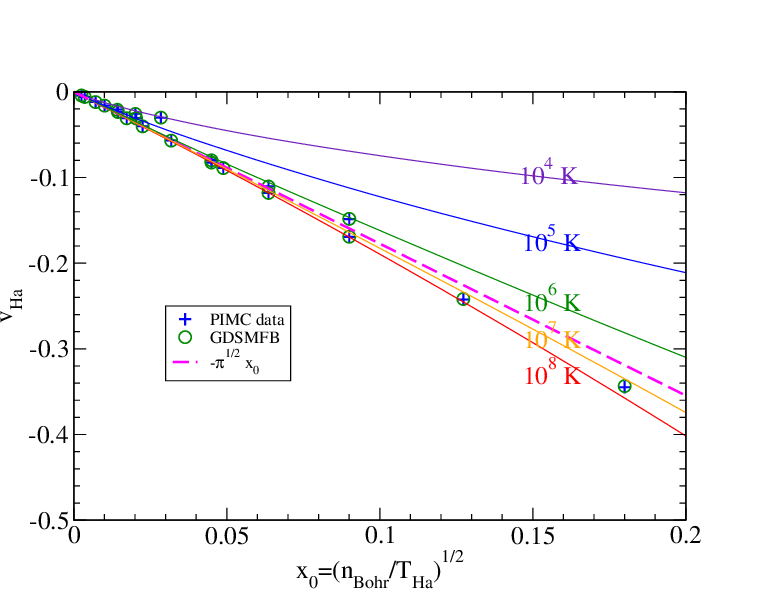
Figure 2: Potential energy 2nβp=1−ADebye(T)nBohr1/2−A2(T)nBohr+…,2 as a function of 2nβp=1−ADebye(T)nBohr1/2−A2(T)nBohr+…,3, illustrating the approach to the Debye limit and the necessity of higher virial terms for lower temperatures.
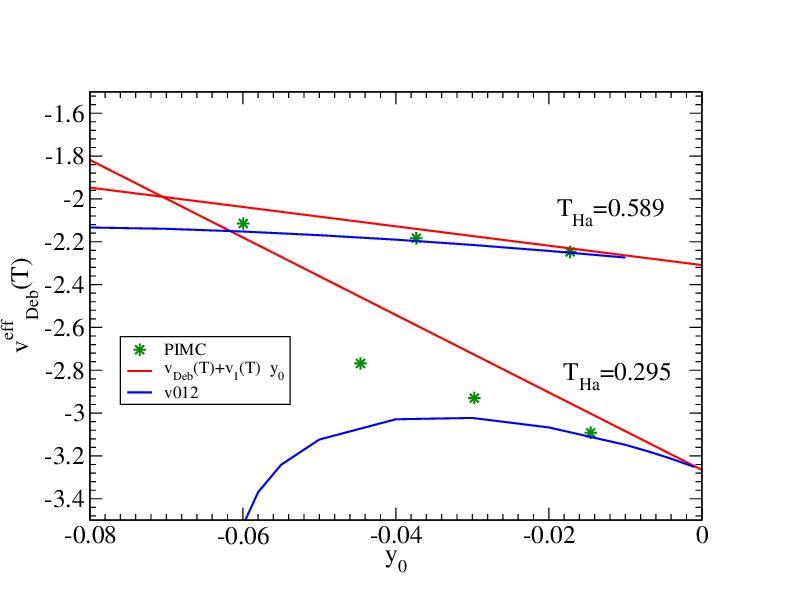
Figure 3: The effective Debye virial coefficient 2nβp=1−ADebye(T)nBohr1/2−A2(T)nBohr+…,4 demonstrates the asymptotic approach to analytic values, with small deviations highlighting the window of virial expansion validity and accuracy.
The methodology precisely delineates the parameter space where the virial expansion is reliable and exposes subtle differences arising from model definitions, particularly in the subtraction of linear terms for the UEG versus neutral two-component plasma.
Analytical Treatment of Plasma Transport: Conductivity and Dielectric Function
Linear response theory yields expressions for electrical conductivity and the dielectric response through equilibrium correlation functions. The virial expansion of the resistivity for fully ionized hydrogen includes classic Spitzer terms, logarithmic corrections, and Debye-Onsager effects:
2nβp=1−ADebye(T)nBohr1/2−A2(T)nBohr+…,5
The first Spitzer coefficient is reproduced exactly (2nβp=1−ADebye(T)nBohr1/2−A2(T)nBohr+…,6), while subsequent coefficients are less well characterized analytically, especially their temperature dependence and the influence of bound-state formation.
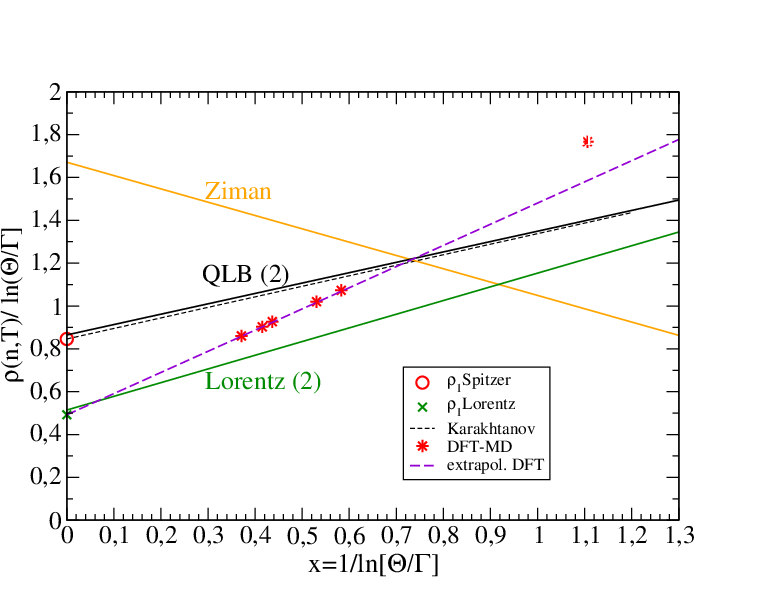
Figure 4: Virial plot for the resistivity; analytic benchmarks and simulation data are directly compared, illustrating which effects (e.g., missing 2nβp=1−ADebye(T)nBohr1/2−A2(T)nBohr+…,7 collisions) cause residual discrepancies in current state-of-the-art DFT-MD and related approaches.
DFT-MD simulations show linear behavior but systematically miss the Spitzer limit, reflecting missing 2nβp=1−ADebye(T)nBohr1/2−A2(T)nBohr+…,8 collisions. The analysis highlights the need for path-integral Monte Carlo evaluation of dynamic correlation functions to obtain true benchmarks for transport in the low-density regime.
Dielectric function expansions are discussed in the context of their intricate relation to both thermodynamics and transport, with an outline of a generalized virial expansion for the polarization function and collision frequency, involving both power-law and logarithmic terms in density. Implementation is acknowledged as complex and currently incomplete.
Implications and Directions for Future Research
The analysis underscores the value of combining analytic and numeric approaches. Virial expansions deliver rigorous benchmarks for equations of state and transport coefficients at low density. PIMC and related simulations test analytic results, make it possible to extract higher-order virial coefficients, and illuminate the precise density/temperature domains where these expansions remain quantitatively accurate.
The limitations uncovered also motivate several lines of future investigation:
- High-precision PIMC for dynamic properties: Improved algorithms addressing sign problems and finite-size effects are necessary for directly benchmarking response functions, such as electrical conductivity and dynamic structure factors, across the low-density limit.
- Analytic continuation of virial approaches to bound-state regime: The present virial expansions break down when bound states dominate. Ongoing work generalizes the virial expansion to self-energies and includes continuum contributions to describe partial ionization or Mott transitions consistently.
- Benchmarking and correction of DFT-MD: Systematic comparison with analytic virial terms guides the modification of popular ab initio molecular dynamics approaches, particularly by quantifying and correcting for missing electron-electron collision effects.
- Development of unified interpolation formulas: The combination of analytic low-density limits and PIMC at higher densities permits high-fidelity interpolation formulas covering the phase space of interest for technical and astrophysical plasma modeling.
Conclusion
This work provides an authoritative reference for virial expansions as benchmarks in plasma physics, articulated through explicit analytic expressions and meticulous comparison with high-accuracy numerical simulations. The demonstrated methodology establishes a rigorous protocol for extracting virial coefficients, validating simulation methods, and delineating the accuracy domain of both analytic and numeric approaches. The discussion highlights both resolved issues—such as confirmation of Debye and Beth-Uhlenbeck physics—and open challenges, notably the extension of virial expansions to the regime of bound-state formation and dynamical response properties. As ongoing computational advances make ever more precise simulations possible, the framework outlined here will remain central to the theoretical and applied description of dense and warm plasmas.