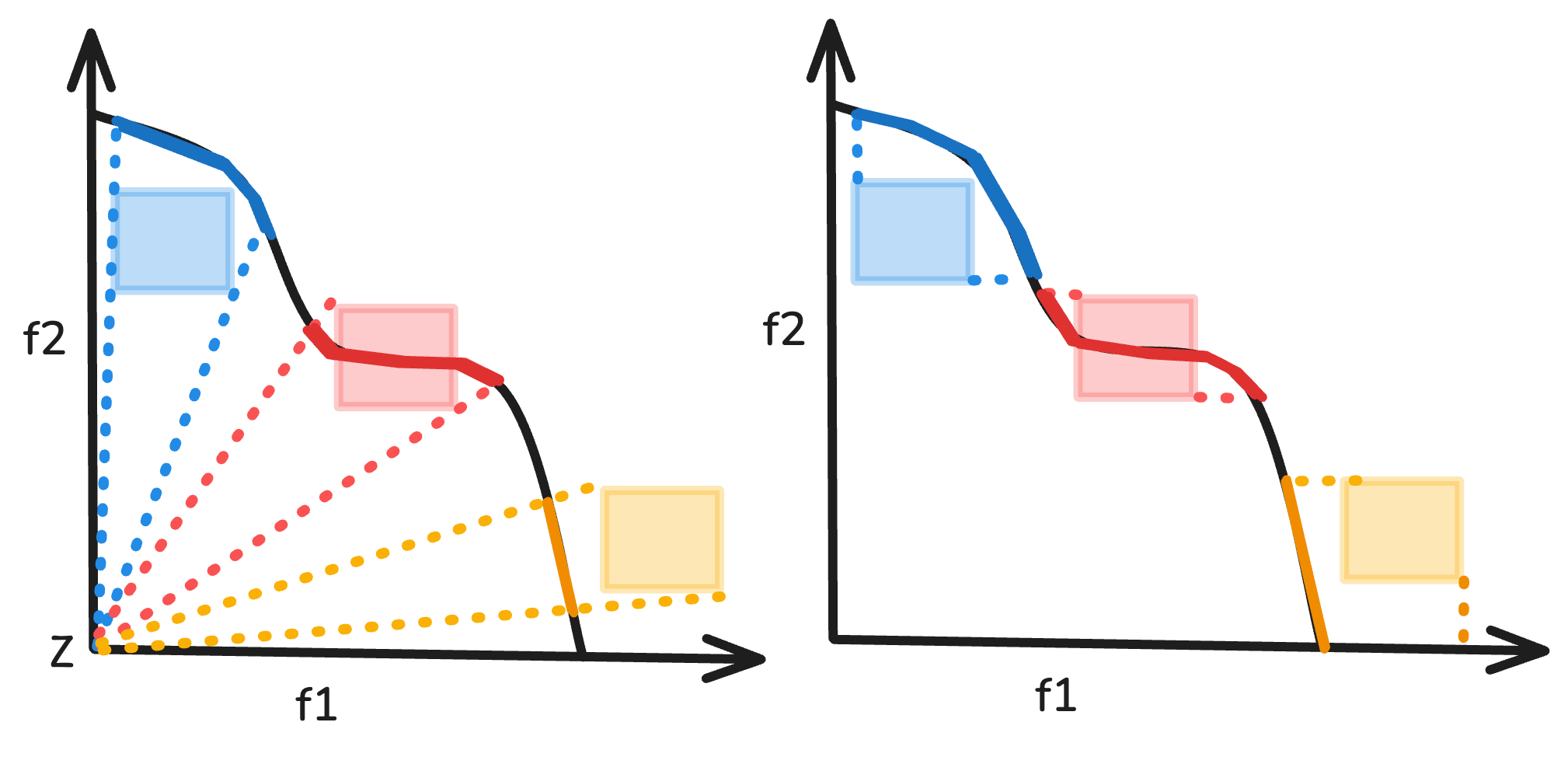
- The paper introduces STAGE-BO, a novel MOBO algorithm that uses adaptive ε-constraints to target under-explored regions of the Pareto front.
- It replaces hypervolume maximization with a geometric gap-filling strategy, minimizing fill distance while maintaining competitive performance in HV and IGD metrics.
- Empirical results across unconstrained, constrained, and preference-aware settings demonstrate its scalability, robustness, and uniform coverage benefits.
Multi-Objective Bayesian Optimization via Adaptive ε-Constraints Decomposition
Introduction and Motivation
The paper introduces STAGE-BO, a novel algorithm for Multi-Objective Bayesian Optimization (MOBO) that addresses key challenges in black-box, expensive multi-objective optimization landscapes. The typical goal in MOBO is to identify a well-approximated Pareto front, representing the set of solutions where no objective can be improved without degrading another. Traditional approaches often rely on hypervolume (HV) maximization, which, despite being Pareto compliant, tends to bias the solution set by concentrating sampling density near the "knees" of the front and underrepresenting more uniform or flat regions. This inherent bias is theoretically justified and empirically observable on standard benchmarks.
Moreover, hypervolume-based acquisition is computationally intractable for higher numbers of objectives and does not provide direct mechanisms for integrating hard constraints or user preferences. Surveys of existing alternatives (scalarization, information-theoretic, and diversity-guided approaches) demonstrate no consensus or clearly superior method in balancing coverage, scalability, and extensibility across unconstrained, constrained, or preference-aware settings.
STAGE-BO: Algorithmic Approach
STAGE-BO is founded upon the ε-constraint method, which guarantees Pareto-optimality by optimizing one objective while constraining the others at specific thresholds. The critical innovation is the adaptive and geometric selection of these ε values: STAGE-BO explicitly seeks to fill the largest geometric gaps on the estimated Pareto front—those regions that remain under-explored by previous queries. This is achieved by:
- Sampling a spectral path from the surrogates (typically independent GPs for each objective).
- Solving a surrogate multi-objective problem (using NSGA-II) to estimate the posterior Pareto front.
- Identifying the "maxmin" gap, i.e., the point on the estimated front furthest from any observation, using the fill distance metric.
- Selecting a rotated primary objective to optimize (ensuring coverage), and converting the remaining objectives into constraints set at the coordinates of the identified maxmin point, thereby formalizing an adaptive ε-constraint subproblem.
- Solving the resulting constrained acquisition problem using Constrained Expected Improvement (cEI).
This decomposition is performed sequentially, ensuring the next query is always directed to address the most substantial under-represented region of the space.
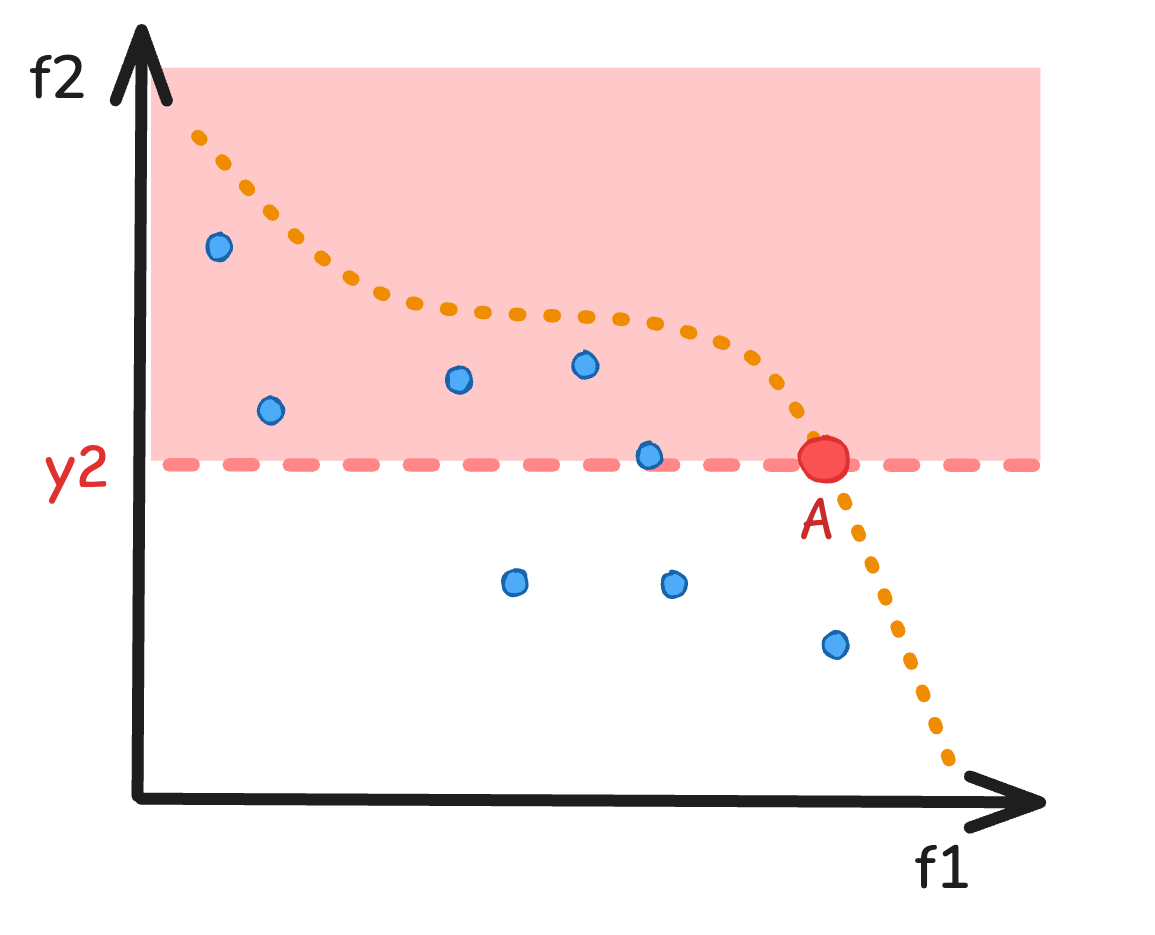
Figure 1: Illustration of the STAGE-BO algorithm. Blue dots are observations; the dashed orange curve is the current posterior Pareto front sample; the red point marks the largest gap to observed points, with the search region shaded accordingly.
While HV is the dominant performance measure in MOBO, it admits explicit bias towards specific front geometries. To counteract this, STAGE-BO optimizes for uniform front coverage by minimizing the fill distance (FD), defined as the maximum minimum distance from any point on the true Pareto front to the nearest observed solution. Theoretical results indicate that minimizing FD leads to an upper bound on the widely-used IGD (inverted generational distance), strongly favoring diverse and representative approximate solutions. Experimental evidence confirms that, on classical benchmarks (e.g., ZDT1, ZDT2), STAGE-BO yields IGD values an order of magnitude lower than reference HV maximizers, despite achieving similar HV.
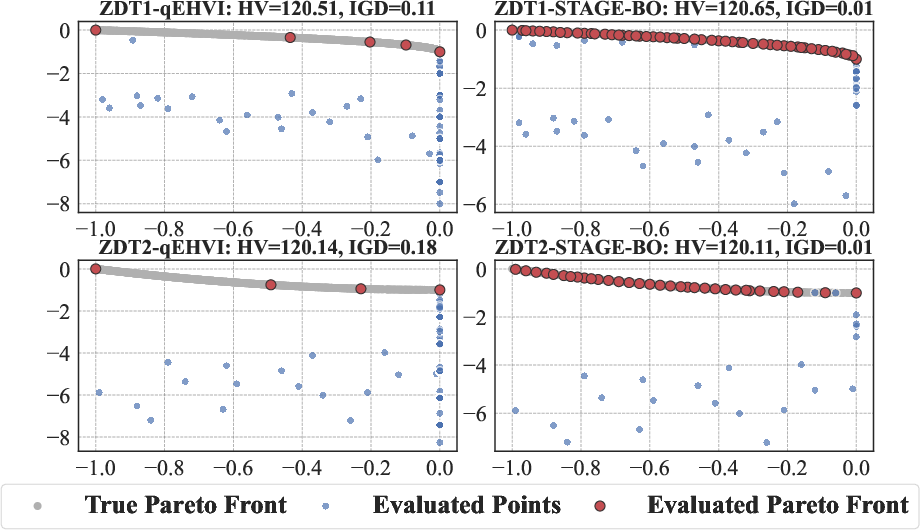
Figure 2: On ZDT1/ZDT2, both qEHVI (HV maximizer) and STAGE-BO reach comparable hypervolume, but STAGE-BO achieves a much lower IGD, indicating superior uniform coverage and motivating the need for multiple quality metrics.
Extensions: Constraints and Preferences
A key advantage of the ε-constraint decomposition is its seamless extensibility to additional use cases:
Empirical Evaluation
The experimental benchmark includes both synthetic (ZDT, DTLZ) and real-world tasks (spring, rocket injector, water planning, gear train, etc.), comparing STAGE-BO to state-of-the-art baselines such as qEHVI, qParEGO, qPOTS, COMBOO, and JESMO. Across unconstrained, constrained, and preference-aware settings, multiple metrics are examined: HV, IGD, IGD+, fill distance, and feasibility ratios.
- Unconstrained MOBO: STAGE-BO consistently achieves IGD and fill distance lower by significant margins, often without loss of HV despite not explicitly maximizing it.
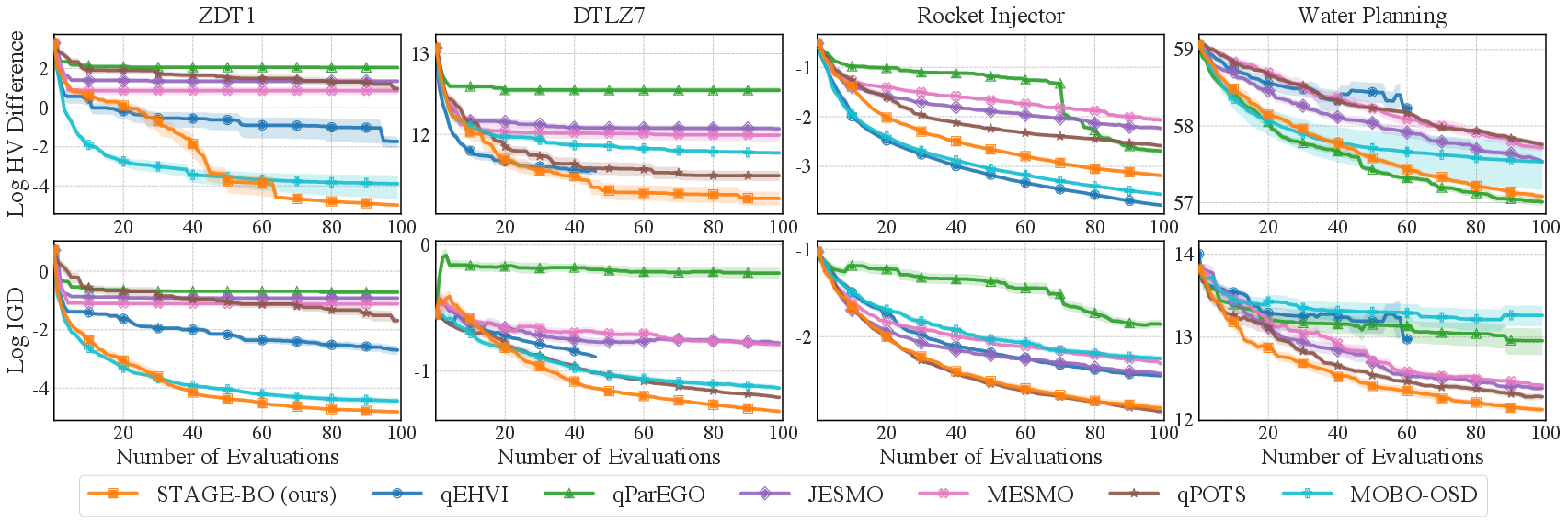
Figure 4: Comparison of STAGE-BO with top baselines on synthetic and engineering multi-objective benchmarks. STAGE-BO matches or surpasses in HV, and consistently outperforms in IGD.
- Constrained MOBO: STAGE-BO maintains low IGD and fill distance and is superior or competitive in feasible solution ratios.
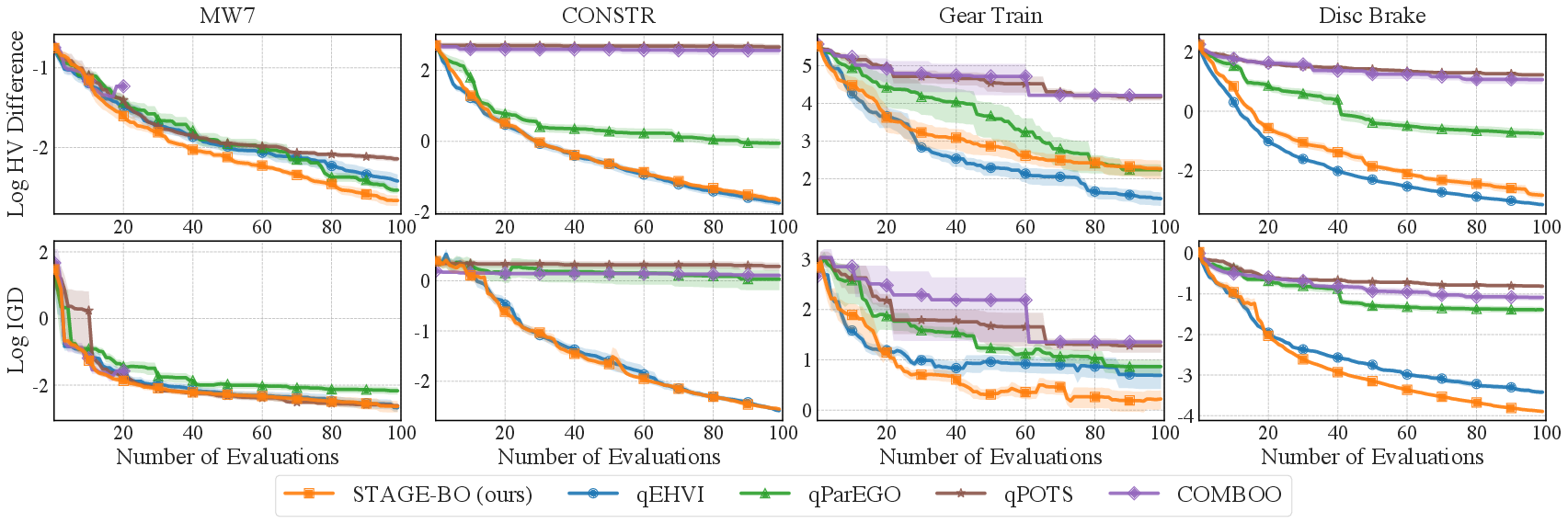
Figure 5: On constrained multi-objective problems, STAGE-BO achieves superior coverage while maintaining competitiveness in HV.
- Preference-aware MOBO: The method successfully focuses queries inside preferred regions, yielding fast convergence in both HV and IGD in those domains.
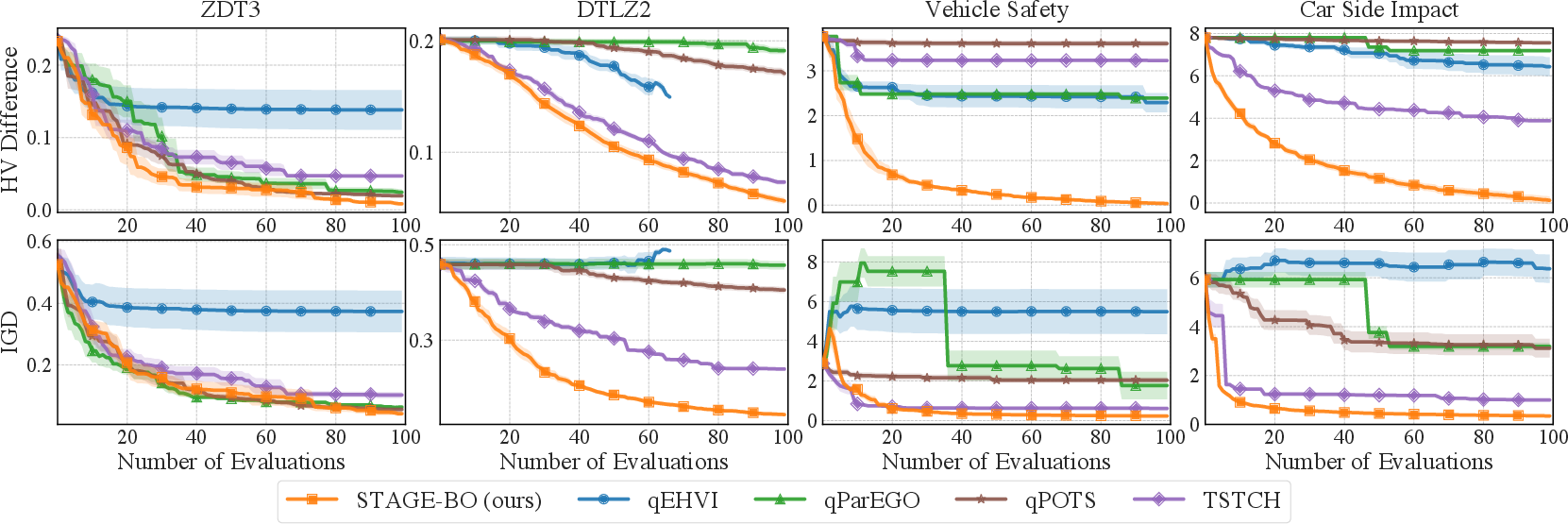
Figure 6: STAGE-BO rapidly fills user-defined regions of interest, demonstrating strong performance in both HV and IGD under preference constraints.
- Computational Efficiency: STAGE-BO is tractable for higher numbers of objectives (m≥4), where hypervolume-based methods become prohibitively expensive.
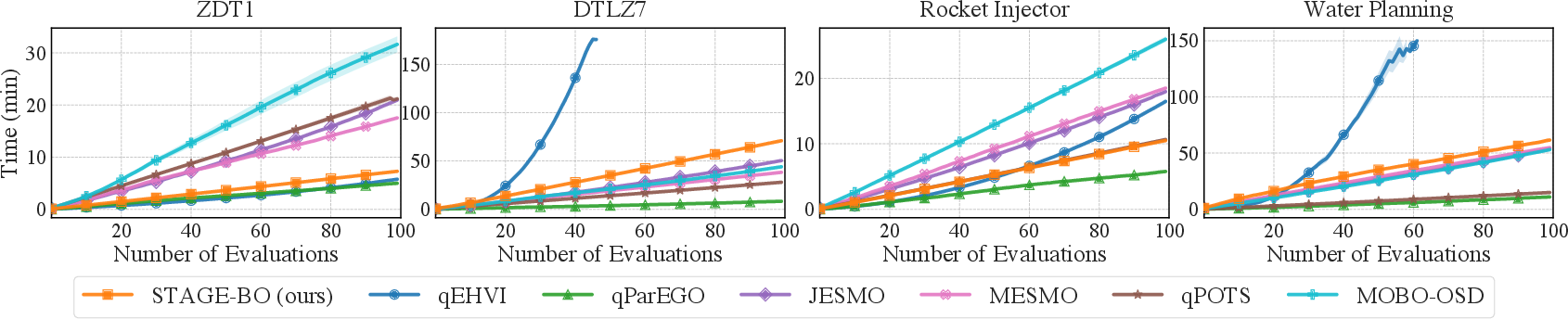
Figure 7: Evaluation time per iteration for STAGE-BO and baselines. STAGE-BO remains efficient as the number of objectives increases.
Ablation, Robustness, and Other Metrics
Ablation studies confirm the requirement both for explicit gap-seeking (maxmin fill distance) target selection and the use of cEI to extract useful queries; random alternatives fail to maintain coverage or diversity.
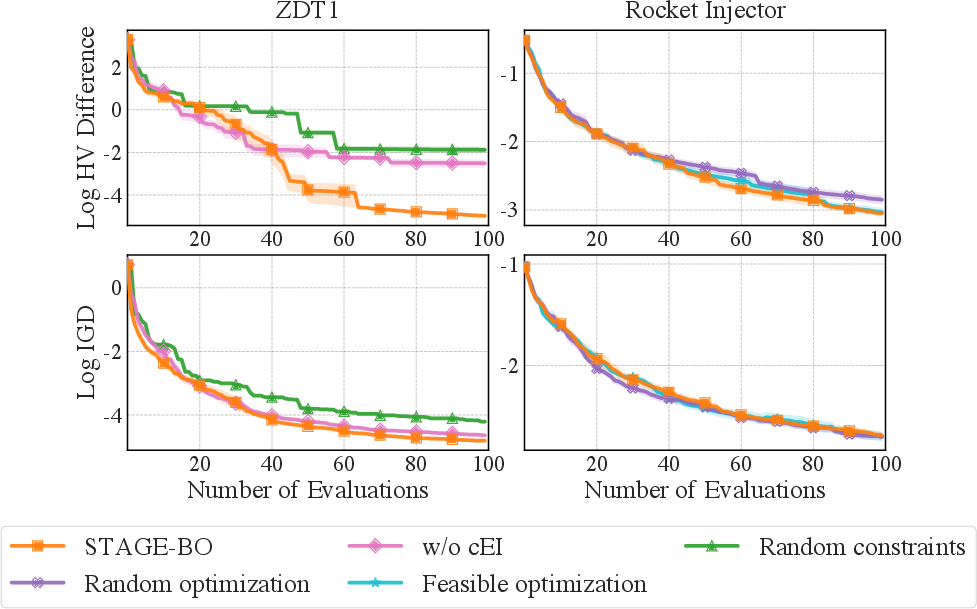
Figure 8: Fill-distance-based constraint setting and the use of cEI acquisition are necessary for strong performance; the method is robust to variations in the primary objective selection schedule.
The method is also shown to be robust to various ways of cycling through objectives for primary optimization.
Expanded evaluations (IGD+, fill distance, feasible ratios) further reinforce the superiority of the approach across a wide range of real and synthetic tasks.
Implications and Future Directions
The paper's decomposition-based approach, especially its explicit geometric gap-filling construction, offers a contrasting methodology to prevailing MOBO strategies that rely on scalarization or HV maximization. This reformulation offers several concrete advantages:
- Uniform Pareto coverage: By explicitly minimizing fill distance, the discovered solutions inherit strong diversity and uniformity properties—features that are undervalued in classical hypervolume-focused methods.
- Algorithmic extensibility: The use of ε-constraint subproblem reduction makes adding further semantic constraints (physical, regulatory, preference, region of interest) straightforward and theoretically justified, with no need for specialized acquisition redesign.
- Computational scalability: By avoiding explicit HV computation, the method scales better to higher-dimensional objectives.
- Robustness: The approach does not depend on arbitrary weight sampling or scalarization mappings, leading to more reproducible and interpretable sampling behavior.
These characteristics have notable implications for applications in engineering design, automated machine learning, and other domains where physical constraints and expert preferences are central, and where computational cost precludes exhaustive exploration.
Potential future extensions include enhancing robustness to noisier observations (as the current approach may be sensitive to measurement noise during gap detection), and exploration of alternative geometric metrics or acquisition designs. There is also scope for integrating STAGE-BO as a modular component within larger systems (e.g., AutoML pipelines, architecture search) that must handle multi-faceted objective and constraint structures.
Conclusion
STAGE-BO provides a unified, geometry-driven framework for multi-objective Bayesian optimization—effective across unconstrained, constrained, and preference-informed tasks. By replacing the classical paradigm of hypervolume optimization with adaptive fill-distance minimization through ε-constraint gap filling, the methodology achieves superior Pareto coverage, competitive maximization of scalar quality measures, and high computational tractability. These properties establish STAGE-BO as a practically robust, theoretically motivated, and extensible approach for sample-efficient multi-objective optimization.