Discover and Prove: An Open-source Agentic Framework for Hard Mode Automated Theorem Proving in Lean 4
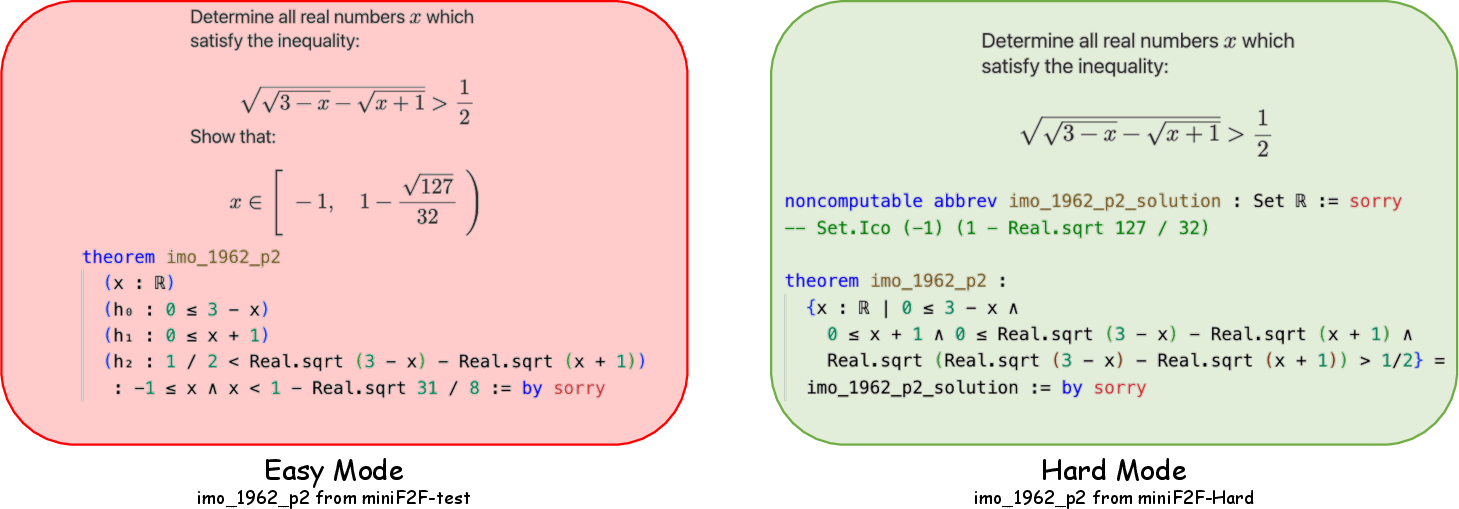
Abstract: Most ATP benchmarks embed the final answer within the formal statement -- a convention we call "Easy Mode" -- a design that simplifies the task relative to what human competitors face and may lead to optimistic estimates of model capability. We call the stricter, more realistic setting "Hard Mode": the system must independently discover the answer before constructing a formal proof. To enable Hard Mode research, we make two contributions. First, we release MiniF2F-Hard and FIMO-Hard, expert-reannotated Hard Mode variants of two widely-used ATP benchmarks. Second, we introduce Discover And Prove (DAP), an agentic framework that uses LLM natural-language reasoning with explicit self-reflection to discover answers, then rewrites Hard Mode statements into Easy Mode ones for existing ATP provers. DAP sets the state of the art: on CombiBench it raises solved problems from 7 (previous SOTA, Pass@16) to 10; on PutnamBench it is the first system to formally prove 36 theorems in Hard Mode -- while simultaneously revealing that state-of-the-art LLMs exceed 80% answer accuracy on the same problems where formal provers manage under 10%, exposing a substantial gap that Hard Mode benchmarks are uniquely suited to measure.
Paper Prompts
Sign up for free to create and run prompts on this paper using GPT-5.
Top Community Prompts
Explain it Like I'm 14
What this paper is about
This paper is about teaching AI to solve hard math problems more like real students do. The authors point out that many current tests for math AIs are too easy because they secretly include the final answer inside the problem the AI has to prove. They call that Easy Mode. Real students don’t get the answer up front—they have to figure it out first and then prove it—so the authors define a tougher and fairer setting called Hard Mode.
To support research in Hard Mode, they:
- Rebuilt two popular math datasets so they don’t leak the answers.
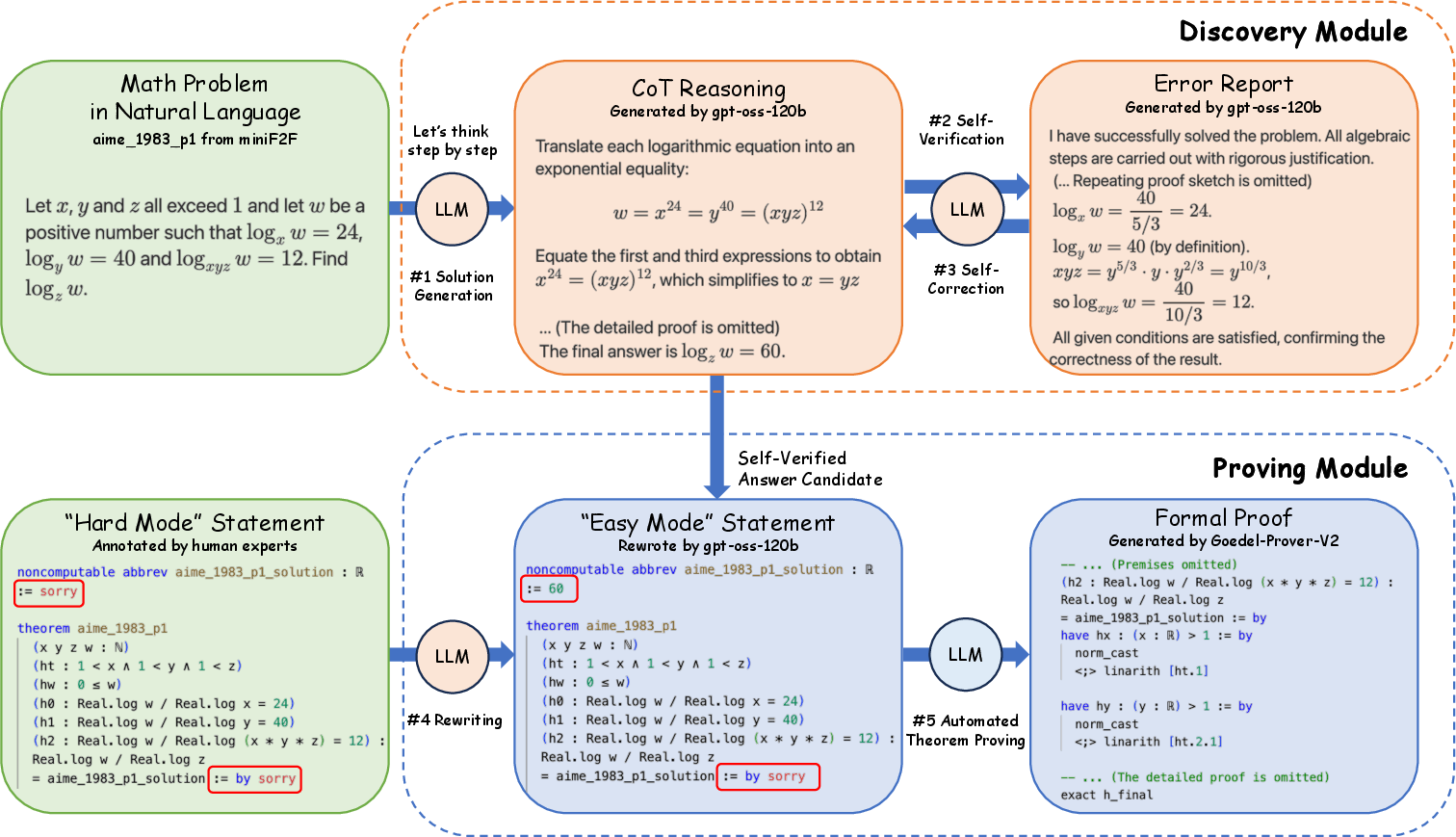
- Built a new AI framework, called Discover and Prove (DAP), that first finds the answer in normal language and then writes a formal proof in the Lean 4 proof system.
What questions are they asking?
The paper focuses on three simple questions:
- Can we evaluate math AIs in a way that’s fair and closer to what humans face (no answers given)?
- Can an AI first discover the answer on its own and then formally prove it in Lean 4?
- How much better are AIs at finding answers in natural language compared to writing full formal proofs?
How did they do it?
They did two main things: fixed the tests and built a two-part solver.
Fixing the tests (making Hard Mode datasets)
Many existing problem collections (benchmarks) accidentally make things easier by including the answer in the formal statement. The authors re-annotated two widely used datasets—MiniF2F and FIMO—into Hard Mode versions (MiniF2F-Hard and FIMO-Hard). That means:
- The formal problem doesn’t reveal the final answer.
- The statement matches what a human contestant is asked to do.
- They also corrected mistakes and converted everything to Lean 4 so it all compiles and is consistent.
Think of it like rewriting the worksheet so it doesn’t give you the solution in the question and makes sure the question is clear and fair.
Building the Discover and Prove (DAP) framework
DAP has two modules that work like a strong student and a careful grader.
- Discovery Module (the “student”): It reads the problem in normal language, thinks through the steps, checks its own work, fixes mistakes, and comes up with the final answer. Then it rewrites the Lean 4 problem so that this answer is plugged in (turning the Hard Mode problem into an Easy Mode one without leaking the answer during solving).
In brief, it: - Generates a solution with step-by-step reasoning. - Self-checks for errors and corrects them if needed. - Rewrites the formal problem to include the discovered answer (so it’s ready for proving).
- Proving Module (the “formal checker”): It takes that rewritten Lean 4 statement and uses a state-of-the-art automated prover to produce a rigorous, computer-checked proof.
An everyday analogy: first you solve the problem in your notebook (answer and reasoning), then you neatly write up the official solution for the teacher to check.
What did they find?
Their approach sets new records on tough math benchmarks:
- On PutnamBench (problems inspired by the famous Putnam competition), their system is the first to formally prove 36 theorems in Hard Mode, with 19 of those being the solution-type problems where the answer must be discovered first.
- On CombiBench (combinatorics problems), they solve 10 in Hard Mode, beating the previous best (which solved 7–8).
They also uncovered an important gap:
- Modern LLMs are very good at guessing or calculating the right answer in plain language (over 80% accuracy on some sets).
- But turning that into a fully formal Lean proof is much harder (under 10% success on the same problems).
This shows that “finding the answer” and “writing a verified proof” are two very different challenges—and Hard Mode is a good way to measure both.
They also tested different design choices and found:
- Letting the model discover the answer first and only then rewriting the problem for the prover works better than trying to do everything in one step.
- Their design avoids “cheating” proofs where the AI copies the answer that’s hidden in the formal statement, because in Hard Mode the answer isn’t in the statement to begin with.
- Adding self-checking (the agentic steps) helps more on harder problems, but may not matter much on easier ones.
Why this matters
- Fairer testing: Hard Mode better matches real contest conditions, so we get a truer picture of what math AIs can do.
- Stronger tools: DAP shows that splitting the job into “discover the answer” and “prove it formally” can push performance forward.
- Clear next steps: The big gap between natural-language reasoning (finding answers) and formal proof writing (verifying them) points to where research should focus—bridging those two skills.
- Trust and reliability: Formal proofs can be checked by a computer to be 100% correct. That’s important for education, research, and any application where mistakes are costly.
In short, this paper makes the tests more realistic, builds an open-source system that does both discovery and proving, reaches new results on tough benchmarks, and highlights where AI math solvers need to improve next.
Knowledge Gaps
Knowledge gaps, limitations, and open questions
Below is a concise, actionable list of what remains missing or unresolved in the paper, organized to guide future research.
- Data contamination and leakage control: No quantitative audit of training-data overlap with MiniF2F/FIMO sources or Hard Mode variants; need leakage-controlled splits, provenance tracking, and decontaminated evaluations.
- Independent validation of re-annotations: No inter-annotator agreement metrics, adjudication protocol, or third-party audit reported; release of adjudication logs and community validation needed.
- Formal equivalence of Hard Mode restatements: No systematic method to verify that rephrased Hard Mode statements are logically equivalent to the original problems’ requirements (e.g., iff vs. only-if); need automated semantic checks (property-based testing, model-based counterexample search, SMT-backed equivalence).
- Residual hint leakage in “Hard Mode” statements: The structure of the statement (e.g., target type as a set, variable names, side conditions) may still leak solution form; need measurements of informativeness and ablation of statement choices to quantify leakage.
- Scope and coverage of benchmarks: Hard Mode variants created only for MiniF2F and FIMO; limited topic and modality coverage (e.g., geometry with diagrams, inequalities, functional equations); need broader, diversified Hard Mode datasets (including ProofNet-style, university-level texts, and geometry with diagram tools).
- Cross–proof-assistant generalization: DAP is Lean 4–only; no evidence for portability to Isabelle/HOL or Coq; need replication and adaptation to multiple assistants to test framework generality.
- Rewriting-stage correctness guarantees: The LLM-generated rewrite from Hard to Easy Mode is not verified for semantic fidelity; develop automatic validators that ensure the rewritten statement precisely encodes the discovered answer without weakening/altering the goal.
- Detection and prevention of spurious proofs: Spurious proofs are observed but only manually identified; need systematic detectors (e.g., tactic-level audits for rfl/definitional-equality exploits, context sanitization) and standardized “no-cheat” evaluation protocols.
- Prover bottleneck diagnosis: The paper shows a large gap between Discovery (>80% answers) and Proving (<10% formal proofs) but lacks granular failure categorization; need instrumentation to attribute failures to missing lemmas, tactic weaknesses, search limits, or library gaps.
- Compute and efficiency reporting: No wall-clock, compute cost, or energy reporting for self-verification iterations or Pass@32 prover sampling; need cost–performance curves and budgets to compare methods fairly.
- Variance and reproducibility: No multi-seed variability, confidence intervals, or Pass@K curves; provide run-to-run variance and sensitivity to sampling temperature and K for statistically robust comparisons.
- Robustness to paraphrase and formalization style: Not evaluated under paraphrased problems, alternative formalizations, or mathlib version changes; need tests for stability to problem restatements and library updates.
- Calibration and abstention in Discovery: No assessment of confidence calibration, abstention strategies, or ranking of multiple answer candidates; develop methods to detect uncertainty and reduce propagation of wrong rewrites.
- Tool-augmented discovery: Discovery uses self-verification only; no exploration of retrieval, CAS, SMT, or external solvers; test hybrid pipelines to improve hard algebra/number theory/functional-equation cases.
- Tighter NL–formal interaction: The Proving Module receives only final answers; explore passing sketches, candidate lemmas, or structured subgoals and studying when/why such hints help or hurt formal search.
- Fairness and comparability across baselines: Mixed Pass@K settings in prior work and this paper; define standardized evaluation budgets (K, tokens, time) and report normalized metrics.
- Hard Mode definition and standardization: “Two sorrys” convention is Lean-specific and may not fully capture discovery difficulty across problem types; formalize a task-agnostic Hard Mode protocol and guidelines for constructing non-leading statements.
- Extending Hard Mode to proof-only tasks: Many competition problems are proof-based with no numeric answer; define Hard Mode for constructions, existence, or characterization tasks where the “answer” is a structure or invariant.
- Automated detection of misalignments: ~35 fixes were manual; need automated pipelines to flag common misalignment patterns (e.g., missing attainability checks, added extraneous premises) at scale.
- Security/sandboxing of the formal environment: No discussion of restricting unsafe features or exploiting environment quirks; define a “safe mode” tactic whitelist and sandboxed REPL to prevent non-mathematical shortcuts.
- Integration with lemma synthesis and library growth: No attempt to couple DAP’s Proving Module with lemma-generation (e.g., Seed/lemma-style synthesis); evaluate whether incremental library learning reduces the Discovery–Proving gap.
- Generalization beyond seen distributions: No OOD tests (new competitions, unseen years), adversarial perturbations, or curriculum progression; assess transfer and brittleness.
- Evaluation beyond solved counts: No metrics for proof quality (length, minimality, readability), time-to-solve, or human-acceptability; add qualitative and efficiency measures.
- Prompt and rewriting robustness: No sensitivity study to prompt variants, instruction length, or rewriting templates; evaluate brittleness and design prompt-robust pipelines.
- Geometry and diagrammatic reasoning: DAP and datasets do not cover diagram-dependent problems; integrate diagram parsers/constructive geometry tools and evaluate end-to-end.
- Lean 3→4 port verification: FIMO port correctness is claimed by compilation but not by formal semantic preservation; add regression tests or bisimulation checks to ensure no subtle meaning changes.
- Training on Hard Mode: Current provers are trained on Easy Mode distributions; create Hard Mode training corpora and study whether in-distribution training reduces the Proving gap.
- Release logistics and licensing: Precise release locations, licenses, and versioning for MiniF2F-Hard/FIMO-Hard and scripts are not specified; provide artifacts, checksums, and clear licenses to enable community auditing.
Practical Applications
Overview
The paper introduces two main contributions with practical implications: (1) MiniF2F-Hard and FIMO-Hard, expert-reannotated “Hard Mode” Lean 4 benchmarks that remove answer leakage and correct semantic misalignments; (2) Discover and Prove (DAP), an open-source, agentic pipeline that first discovers answers via a natural-language reasoning LLM with self-verification, then rewrites problems into “Easy Mode” for a formal Lean prover to produce verified proofs. Below are concrete applications across industry, academia, policy, and daily life.
Immediate Applications
The following can be adopted now with current tools (Lean 4, Goedel-Prover-V2, advanced reasoning LLMs) and modest engineering effort.
- Benchmarking and capability tracking for reasoning models
- Sectors: AI/ML industry, academia
- What: Use MiniF2F-Hard and FIMO-Hard to evaluate “answer discovery” and “proof construction” separately, revealing gaps that Easy Mode obscures.
- Tools/workflows: Internal eval suites; dashboards tracking NL reasoning accuracy vs. formal proof rates; regression gates in release pipelines.
- Assumptions/dependencies: Access to Lean 4, proof assistants, and strong reasoning LLMs; compute budget for Pass@N evaluation.
- More faithful evaluation for competition-style math systems
- Sectors: Education, EdTech, AI competitions
- What: Replace answer-embedded benchmarks with Hard Mode so systems must independently find answers then prove them.
- Tools/products: Leaderboards and contests adopting Hard Mode splits; training platforms for Olympiad preparation.
- Assumptions: Instructor/expert acceptance of Lean 4-based tasks; onboarding for Lean environment.
- Auto-grading and verification of math assignments with answer discovery + proof
- Sectors: Education (secondary, undergraduate), EdTech platforms
- What: DAP to propose answers, generate formal proofs, and flag inconsistencies; acts as a grader or proof-checker.
- Tools/products: LMS plug-ins that accept student NL solutions, reconstruct formal targets, and verify correctness.
- Assumptions: Curriculum alignment; mathlib coverage; teacher workflows accommodating Lean verification.
- Tutor-like feedback that distinguishes discovery from proof-writing
- Sectors: Education, consumer learning apps
- What: Provide step-by-step “discover-then-prove” guidance; explain where a student’s hypothesized answer fails to prove.
- Tools/products: Interactive problem-solving modules; hint generators that respect Hard Mode framing.
- Assumptions: Reliable NL explanations; UX that displays both hypothesized answers and formal proof checks.
- Open-source pipeline for combining NL reasoning with formal provers
- Sectors: Software, AI tooling, research groups
- What: Adopt DAP’s modular architecture (answer discovery + rewrite + prover) to stitch best-in-class LLMs with Lean provers.
- Tools/workflows: Kimina-Server + Goedel-Prover-V2 integrations; API adapters to swap in stronger models over time.
- Assumptions: Engineering capacity to integrate REPLs and manage job queues; model API/weights availability.
- Dataset QA and curation methodology to prevent answer leakage
- Sectors: AI/ML industry, academic datasets, benchmark publishers
- What: Apply the Hard Mode principle to other domains (e.g., QA, code, planning) to remove latent “solutions” from prompts.
- Tools/workflows: Reannotation pipelines; checklists for semantic alignment; LLM-as-a-judge only as a prefilter, not ground truth.
- Assumptions: Access to subject-matter experts; time for cross-annotation and consensus.
- “Anti-cheating” evaluation design for provers and agents
- Sectors: AI safety, evaluation, academia
- What: Use DAP’s decoupling and rewriting to avoid spurious proofs that exploit answer definitions or copied conditions.
- Tools/workflows: Proof filters; adversarial tests showcasing failure modes (e.g., rfl-style cheats).
- Assumptions: Auditors can inspect proofs or enforce proof-style constraints; consistent benchmark policies.
- Procurement-grade testing for reasoning assistants
- Sectors: Government, enterprise IT, EdTech procurement
- What: Hard Mode tests to evaluate whether vendors’ systems truly discover solutions vs. relying on embedded answers.
- Tools/products: RFP evaluation kits, pass/fail thresholds per task class (discovery vs. proof).
- Assumptions: Standardized scoring and documentation; clarity on dataset contamination risks.
- Workflow template for research labs: discover → rewrite → prove
- Sectors: Academia, corporate research
- What: A repeatable, auditable loop that logs NL traces, SV reports, rewrites, and final proofs for each result.
- Tools/workflows: Experiment managers (Weights & Biases), artifact stores for Lean files and SV logs.
- Assumptions: Lab infra for reproducibility; versioned mathlib and Lean snapshots.
- Instructor/contest organizer utilities
- Sectors: Education, competitions
- What: Tools to convert existing “solution-style” problems into Hard Mode Lean tasks with canonical statements and free parameters.
- Tools/products: Semi-automated rephrasing scripts; templates reflecting the paper’s annotation conventions.
- Assumptions: Lean 4 familiarity; time for manual review of auto-suggested rewrites.
Long-Term Applications
These require further research, scaling, or ecosystem maturation (e.g., broader coverage of formal libraries, stronger provers, tighter NL–formal co-reasoning).
- Safety-critical decision support with verifiable reasoning
- Sectors: Healthcare, aerospace, energy, finance
- What: NL agents hypothesize decisions or plans; formal backends verify constraints and invariants before execution.
- Tools/products: “Verified Reasoning Gate” services embedding DAP-like pipelines into workflow engines.
- Assumptions: Formal specifications for domain policies; mappings from domain rules to formal logics; certification pathways.
- Program synthesis and software verification via “guess-then-prove”
- Sectors: Software, DevSecOps
- What: LLMs propose specs, invariants, or candidate code; formal tools (Coq/Isabelle/Dafny/Lean/SMT) prove correctness.
- Tools/products: IDE plugins that alternate between NL invariant discovery and formal verification; CI gates enforcing proofs.
- Assumptions: High-quality specs; extensible formal libraries; developer adoption of verification workflows.
- Planning and control for robotics with formally verified safety envelopes
- Sectors: Robotics, autonomous systems
- What: Agents plan in NL/structured policies; the “rewrite-then-prove” step verifies feasibility/safety against dynamics and constraints.
- Tools/products: Controllers that only execute plans with proven safety properties.
- Assumptions: Accurate system models; formalized control invariants; real-time proof or trusted offline libraries.
- Financial product and compliance logic with proof-backed audits
- Sectors: Finance, insurance, regtech
- What: Propose strategies or term sheets; prove regulatory and risk constraints formally; archive machine-checked proofs for audits.
- Tools/products: “Proof-as-a-Service” layers for compliance; automated rule updates with semantic diffs and reproofs.
- Assumptions: Formalized regulations; interoperability between legal DSLs and proof assistants; regulator acceptance.
- Standards for benchmark design and model evaluation
- Sectors: Policy, standards bodies, research consortia
- What: Codify “Hard Mode” requirements (no embedded answers, canonical statements) in public testing standards.
- Tools/products: Benchmark certification programs; guidance for avoiding leakage and spurious solutions.
- Assumptions: Community consensus; governance for benchmark updates; transparent versioning.
- Cross-formal-system generalization (Coq, Isabelle, Agda, SMT)
- Sectors: Formal methods, software verification, academia
- What: Port DAP’s pipeline and Hard Mode datasets across proof assistants; unify APIs for modular swapping of solvers.
- Tools/products: Interop frameworks; proof translation layers; shared rewriting schemas.
- Assumptions: Mature cross-translation; standard libraries; consistent treatment of subgoals.
- Auto-formalization pipelines that avoid answer leakage by design
- Sectors: AI/ML data engineering, EdTech
- What: Next-gen auto-formalizers that produce Hard Mode statements with free parameters and aligned goals.
- Tools/products: Data generation services; alignment validators; human-in-the-loop review UIs.
- Assumptions: Better NL-to-formal translators; scalable human oversight; robust semantic checkers beyond LLM-as-a-judge.
- NL–formal co-reasoning agents with tight feedback loops
- Sectors: AI assistants, research, education
- What: Agents that switch modalities dynamically—use formal feedback to refine NL reasoning and vice versa (beyond answer-only handoff).
- Tools/products: Interactive theorem-proving copilots; step-level synchronization and proof-repair strategies.
- Assumptions: Faster provers; richer tactic feedback; training data for joint NL–formal optimization.
- Large, verified solution libraries for education and research
- Sectors: Education, academia
- What: Community-built repositories of discovered answers and machine-checked proofs for contest and textbook problems.
- Tools/products: Searchable, tagged corpora; lesson-generation from verified proofs; scaffolding exercises aligned to Hard Mode.
- Assumptions: Licensing, QA governance; sustained contributor community; curriculum integration.
- Generalized “discover-then-verify” pattern for business rules and operations
- Sectors: Logistics, supply chain, operations research
- What: LLMs propose schedules/routes; formal or solver-based checks validate constraints/objectives before deployment.
- Tools/products: Workflow orchestrators that convert plans into solver-friendly forms (MILP/SMT), then gate by satisfiability.
- Assumptions: Accurate constraint models; integration with solvers; acceptable runtimes.
- Cheating-resistant evaluation and certification for LLM tools
- Sectors: AI governance, enterprise IT
- What: Certification suites that prove systems can’t exploit structural leaks (e.g., answer definitions) to pass tests.
- Tools/products: Red-team toolkits; provable constraints in evaluation harnesses.
- Assumptions: Access to system internals or robust black-box tests; maintenance as models evolve.
Key Dependencies and Assumptions (cross-cutting)
- Strong reasoning LLMs and formal provers remain necessary (compute budgets, model availability).
- Lean 4 ecosystem maturity (mathlib coverage, REPL stability); portability to other systems takes engineering effort.
- Semantically correct formalizations require expert oversight; auto-formalization still limited.
- Dataset contamination can inflate perceived performance; trustworthy evaluations need provenance tracking.
- Organizational readiness to adopt formal verification (training, process change) affects feasibility.
Glossary
- ablation: A method of systematically removing or disabling components of a system to assess their impact on performance. "Ablation Study on Agent Effectiveness"
- abbrev: A Lean keyword for defining an abbreviation (a definition meant for convenient unfolding) that can influence how proofs reduce or simplify. "including the abbrev solution definition"
- agentic framework: An architecture that treats an AI system as an autonomous agent coordinating multi-step reasoning, tools, and feedback loops. "an agentic framework that uses LLM natural-language reasoning with explicit self-reflection"
- auto-formalization: Automatic translation of natural-language mathematical problems into formal statements in a proof assistant language. "auto-formalization methods automatically translate informal problems into formal statements."
- Automated Theorem Proving (ATP): The use of software systems to automatically construct and verify formal proofs. "The key strength of automated theorem proving (ATP) is that formal proofs can be checked rigorously and automatically by proof assistants"
- Chain-of-Thought (CoT): A prompting technique that elicits step-by-step reasoning paths from LLMs. "Powered by CoT prompting and RLVR training"
- draft proof: A natural-language or semi-structured preliminary proof used to guide or inform a formal prover. "natural-language draft proofs"
- Easy Mode: A benchmark setting where the correct final answer is embedded in the formal statement, simplifying the proof task. "rewrites Hard Mode statements into Easy Mode ones"
- formal methods: Approaches that use formal languages and proof assistants to state and verify mathematical results with machine-checked rigor. "formal methods use formal languages such as Lean \cite{moura2021lean} and Isabelle \cite{nipkow2002isabelle}"
- Hard Mode: A stricter benchmark setting where the system must first discover the answer and then construct a formal proof without the answer being supplied. "a fully open-source, agent-based ATP framework for Hard Mode ATP tasks"
- Isabelle: An interactive theorem prover used for formalizing and verifying mathematical proofs. "use formal languages such as Lean \cite{moura2021lean} and Isabelle \cite{nipkow2002isabelle}"
- Lean 3: The earlier major version of the Lean theorem prover and its ecosystem, with notable syntax and library differences from Lean 4. "ProofNet and miniF2F were originally released as Lean 3 datasets"
- Lean 4: The current major version of the Lean theorem prover language and system used for formalization and ATP experiments. "proving Hard Mode Lean 4 theorems"
- Lean REPL: The interactive Read–Eval–Print Loop environment for Lean that supports incremental proof development and tool interaction. "Lean 4 REPL"
- lemma-style: A proof-construction strategy that focuses on generating and composing lemmas as intermediate steps toward a final theorem. "lemma-style whole-proof reasoning model"
- LLM-as-a-judge: An evaluation approach where a LLM is used to assess or validate outputs (e.g., formalizations) instead of a deterministic checker. "LLM-as-a-judge~\cite{ying2024lean}"
- Mathlib: The core mathematical library for Lean, providing foundational definitions, theorems, and APIs. "Mathlib APIs were reorganised"
- out-of-distribution: Refers to inputs that differ significantly from the data seen during training, often causing performance drops in learned models. "producing large out-of-distribution performance drops"
- Pass@32: An evaluation metric indicating success if at least one correct solution is found among 32 sampled attempts. "All results are Pass@32 unless otherwise specified."
- proof assistant: Software that checks the correctness of formal proofs against a fixed logical foundation and library. "checked rigorously and automatically by proof assistants"
- proof-search: Algorithmic exploration of proof states to find a sequence of steps that establishes a goal. "Beyond pure proof-search approaches"
- rewriting: In this paper’s pipeline, the transformation of a Hard Mode statement into an equivalent Easy Mode statement by inserting the discovered answer. "(4) Rewriting: Using the Lean 4 Hard Mode statement"
- RLHF: Reinforcement Learning from Human Feedback, a training method that uses human preferences or judgments to shape model behavior. "Reinforcement Learning from Human Feedback (RLHF)"
- RLVR: A reinforcement learning approach that uses verifiable signals (e.g., correctness checks) as rewards during training. "Powered by CoT prompting and RLVR training"
- self-correction: A process where a model revises its own solution after identifying errors through analysis or feedback. "(3) Self-Correction: The reasoning LLM is instructed to generate a revised solution"
- self-reflection: The explicit meta-reasoning step where a model examines its own reasoning to improve solution quality. "LLM natural-language reasoning with explicit self-reflection"
- self-verification: A mechanism where the model checks its generated reasoning for errors before finalizing an answer or proof. "(2) Self-Verification: The reasoning LLM is instructed to inspect its steps"
- semantic alignment: The degree to which a formal statement accurately captures the meaning of the original natural-language problem. "cannot guarantee semantic alignment"
- semantic misalignments: Discrepancies between formalized statements and the intended problem semantics, leading to incorrect or incomplete tasks. "Fixing semantic misalignments"
- spurious proofs: Proofs that pass the checker for superficial or unintended reasons without solving the intended mathematical task. "spurious proofs (cheating behavior)"
- subgoal syntax: A prover’s representation of pending proof obligations as subgoals within a proof state, often with a specific notation. "Isabelle's subgoal syntax"
- tactic-based: A procedural proof style where proofs are scripted via tactics (commands) rather than written declaratively. "tactic-based Lean proofs"
- theorem prover: A system (often automated or semi-automated) that constructs or searches for formal proofs given a statement and axioms. "state-of-the-art open-source theorem prover"
Collections
Sign up for free to add this paper to one or more collections.