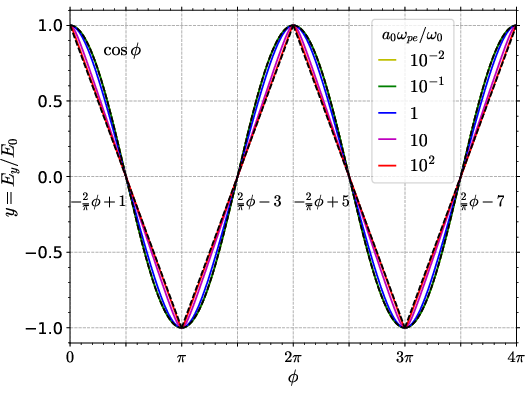
- The paper demonstrates that induced scattering in pair plasmas is governed by the nonlinearity parameter a₀ωₚₑ/ω₀ rather than by the wave amplitude alone.
- A fully relativistic two-fluid model combined with PIC simulations reveals a transition from undistorted cosine profiles to sawtooth-like forms under strong coupling.
- The findings imply that fast radio bursts traverse magnetar winds with minimal scattering losses due to high incident wave-plasma energy ratios.
Induced Scattering of Strong Waves in Pair Plasmas: An Authoritative Essay
Motivation and Context
The investigation of induced (stimulated) scattering of strong electromagnetic waves in pair plasmas is critical for understanding wave-plasma interactions relevant to the propagation of fast radio bursts (FRBs) generated by magnetars. High-amplitude FRB pulses traverse magnetar winds with strength parameter a0>1, and their escape depends on whether induced scattering (SBS/Compton) significantly impedes their propagation. Conventional treatments employ linear theory valid for a0≪1, but the pertinence of nonlinear effects when a0>1 in tenuous pair plasmas remains contentious, inviting a rigorous kinetic and analytical re-examination.
The paper constructs a fully relativistic, cold two-fluid model and associated Maxwell equations for linearly polarized monochromatic plane waves in a pair plasma. All field and particle quantities are recast as functions of the wave phase, ϕ=ω0t−k0x, with the condition ω0/k0>c ensuring superluminal propagation.
The analytical approach yields a set of self-consistent equations characterizing the plasma response, wave field profile, dispersion, and current. The plasma parameters—Lorentz factor, four-velocity, density—are derived as explicit functions of the normalized electric field y=Ey/E0. Crucially, the nonlinear plasma feedback is shown to be governed not by a0, but by the nonlinearity parameter a0ωpe/ω0, encapsulating the ratio of the driven quiver energy to the plasma energy scale.
The steady-state solution reveals two asymptotic regimes:
The dispersion relation parameter a0≪15, encoding frequency shifts and group velocity, is also shown to depend exclusively on a0≪16, asymptoting to unity in the linear regime and decreasing for strong nonlinear coupling.
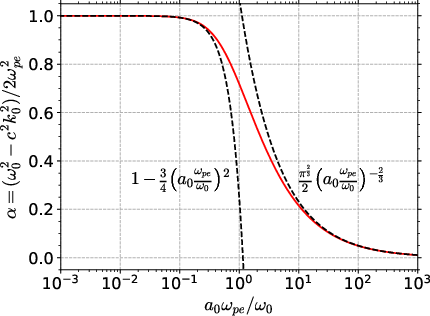
Figure 2: The plasma dispersion parameter a0≪17 as a function of a0≪18.
Induced Scattering: Parametric Instability Theory
Induced scattering is quantified as a parametric instability—stimulated Brillouin (SBS) or Compton scattering—whose linear growth rate and wavenumber are well-characterized analytically for a0≪19. The analysis is extended by incorporating Lorentz boosts from the bulk plasma motion driven by intense incident waves, showing that the laboratory-frame growth rates and scattered wavenumbers depend both on a0>10 and the incident amplitude a0>11.
The transformation to the center-of-momentum frame allows the linear SBS theory to be extrapolated to a0>12 provided a0>13. In this regime, the maximal growth rates and scattered wavenumbers agree with Lorentz-boosted predictions, except in strong-coupling cases where the thermal speed a0>14 is below threshold.
Kinetic Simulations: Validation and Nonlinear Dynamics
One-dimensional particle-in-cell (PIC) simulations are employed, systematically exploring combinations a0>15 to keep a0>16 fixed (linear regime), varying both a0>17 and a0>18. The simulations confirm the theoretical predictions for growth rates and wavenumbers, including the a0>19-dependent Lorentz boost effect.
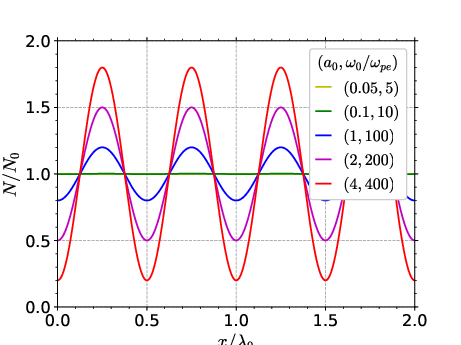
Figure 3: Initial spatial profiles of normalized laboratory density ϕ=ω0t−k0x0 for selected ϕ=ω0t−k0x1.
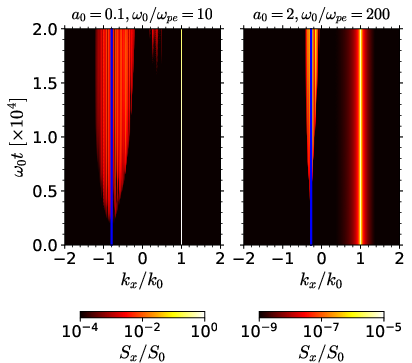
Figure 4: Temporal evolution of the Poynting flux spectrum, discriminating incident and backscattered components, for distinct parameter sets.
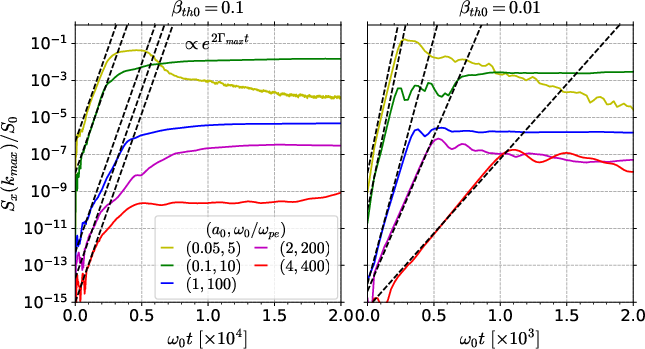
Figure 5: Growth dynamics of the Poynting flux at the fastest-growing mode, for variable ϕ=ω0t−k0x2 and ϕ=ω0t−k0x3, evidencing theoretical agreement.
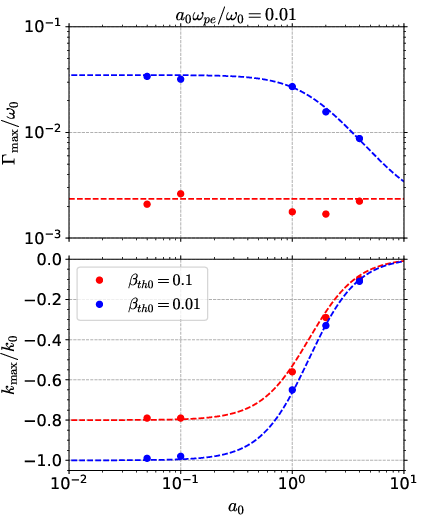
Figure 6: Maximal SBS growth rate (top) and corresponding wavenumber (bottom) as functions of incident amplitude ϕ=ω0t−k0x4, for fixed nonlinearity parameter.
Nonlinear saturation of SBS is shown to depend sensitively on the dimensionless energy ratio ϕ=ω0t−k0x5. When this ratio is large (ϕ=ω0t−k0x6), the incident wave remains largely unscattered; only a minor fraction of the energy is transferred to the plasma over the simulation timescale. For small ratios (ϕ=ω0t−k0x7), SBS induces substantial dissipation and plateau formation in the velocity distribution, a precursor to the quenching of further resonant interaction.
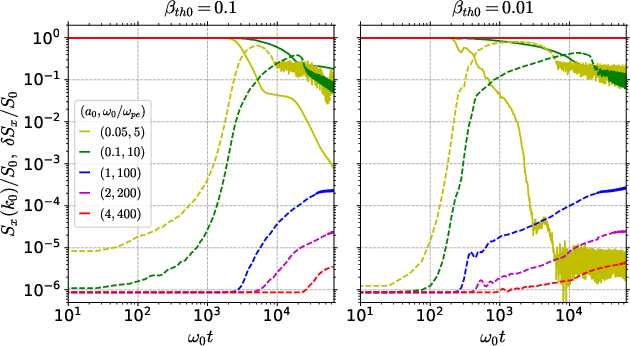
Figure 7: Time-evolution of incident and scattered Poynting flux, showing saturation dynamics and the impact of ϕ=ω0t−k0x8.
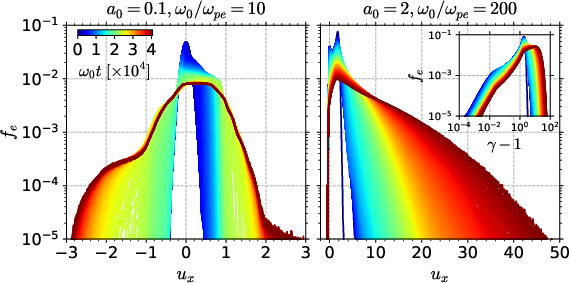
Figure 8: Longitudinal four-velocity ϕ=ω0t−k0x9 distributions tracked over time, illustrating SBS-induced heating and distribution flattening.
Astrophysical Implications for FRB Propagation
Applying these results to FRB propagation in magnetar winds, the relevant parameters are ω0/k0>c0, ω0/k0>c1, and ω0/k0>c2 at ω0/k0>c3 cm for fiducial magnetar wind models. This places FRBs in the regime where linear SBS theory holds, Lorentz boosts are essential, instability growth rates are rapid, but the saturation level is minimal due to large wave-plasma energy ratios.
Practically, FRBs are predicted to traverse the magnetar wind with negligible energy loss via SBS, despite prompt particle heating and velocity distribution broadening. The complex interplay of scattered wave escape, filamentation instability, broadband pulse structure, and wind acceleration further diminishes nonlinear SBS effects in realistic astrophysical environments.
Theoretical and Future Directions
The determination that nonlinear plasma feedback can be neglected when ω0/k0>c4 advances the theoretical foundation for strong wave-plasma interaction models in both astrophysical and laboratory contexts. The identification of ω0/k0>c5 as the governing parameter, irrespective of amplitude ω0/k0>c6, is a robust result supported by both kinetic simulations and analytical theory. Saturation dynamics controlled by the energy ratio ω0/k0>c7 are likely universal for SBS-driven heating.
Extensions to magnetized plasmas, where the relevant parameter may shift to ω0/k0>c8, promise further refinement, and multi-dimensional, broadband, and open-boundary simulations are signposted as next steps in bridging theory with observational constraints and laboratory experiment design.
Conclusion
The paper rigorously shows that induced scattering of strong electromagnetic waves in unmagnetized pair plasmas is dictated by the nonlinearity parameter ω0/k0>c9, not amplitude y=Ey/E00, with linear theory valid even for y=Ey/E01 as long as y=Ey/E02. Kinetic simulations verify Lorentz boost effects and support the extrapolation of linear SBS arguments to strong-wave regimes. The incident wave energy ratio y=Ey/E03 governs nonlinear saturation, and large values inhibit dissipation, ensuring FRB transparency in magnetar winds for physically motivated parameter sets. Broader theoretical implications include extensions to magnetized environments and guidance for experimental plasma wave studies.