- The paper identifies a Lorentz-invariant nonlinearity parameter that defines weakly (εₚ < 1) and highly (εₚ > 1) nonlinear regimes in pair plasmas.
- Numerical simulations using OSIRIS validate analytical predictions, demonstrating scaling laws like the εₚ⁻²/³ propagation length and shock formation at high nonlinearity.
- These findings have practical implications for interpreting FRB signatures in astrophysics and guiding experiments with next-generation multi-petawatt laser pair plasma facilities.
Interaction of Strong Electromagnetic Waves with Unmagnetized Pair Plasmas
Overview
The paper presents a comprehensive analytical and numerical study of the nonlinear propagation of strong electromagnetic (EM) waves through unmagnetized pair plasmas (electron-positron plasmas) in the cold, collisionless regime. The authors identify a single Lorentz-invariant nonlinearity parameter, εp, that dictates the physical regime and propagation characteristics. Two principal regimes emerge: the weakly nonlinear regime with εp<1 dominated by induced Compton scattering, and the highly nonlinear regime with εp>1 where the wave acts as a relativistic piston, driving a shock into the plasma. The results are of direct relevance to understanding FRB propagation in neutron star magnetospheres and the design of next-generation pair plasma experiments.
The system is described using a two-fluid (electron and positron) model with the EM pulse modeled as a linearly polarized monochromatic wave. The electron and positron fluids have equal number density and counter-stream in the y-direction. The key physical parameters are: the upstream plasma frequency ωP, the wave frequency ω0, the wave strength parameter a0, and the Lorentz factor γ0 of the incoming plasma. Nonlinearity is encapsulated in the parameter εp≡a0/(ω0/ωP), which distinguishes the pair plasma case from electron-proton plasmas.
Linear stability analysis in the so-called "wave frame" yields the most unstable wavenumber and the growth rate of the induced Compton instability. In the weakly nonlinear regime (εp≪1), the induced Compton scattering results in a finite "linear propagation length," i.e., the number of wavelengths that can travel before significant attenuation scales as εp<10.
Simulation Framework and Regimes
The kinetic behavior is probed via extensive 1D particle-in-cell simulations using OSIRIS, spanning εp<11 from εp<12 to εp<13 and εp<14 from a few to thousands, covering the entire transition from the weakly to the highly nonlinear regime.
Weakly Nonlinear Regime: εp<15
In this regime, EM waves undergo induced Compton scattering as predicted from linear theory, leading to significant envelope modulation and attenuation on the propagation length scale εp<16. The simulations demonstrate the initial phase-averaged Poynting flux is preserved, but as the wave penetrates the plasma, large-amplitude density and four-velocity fluctuations emerge at distances consistent with the analytical threshold for nonlinear effects.
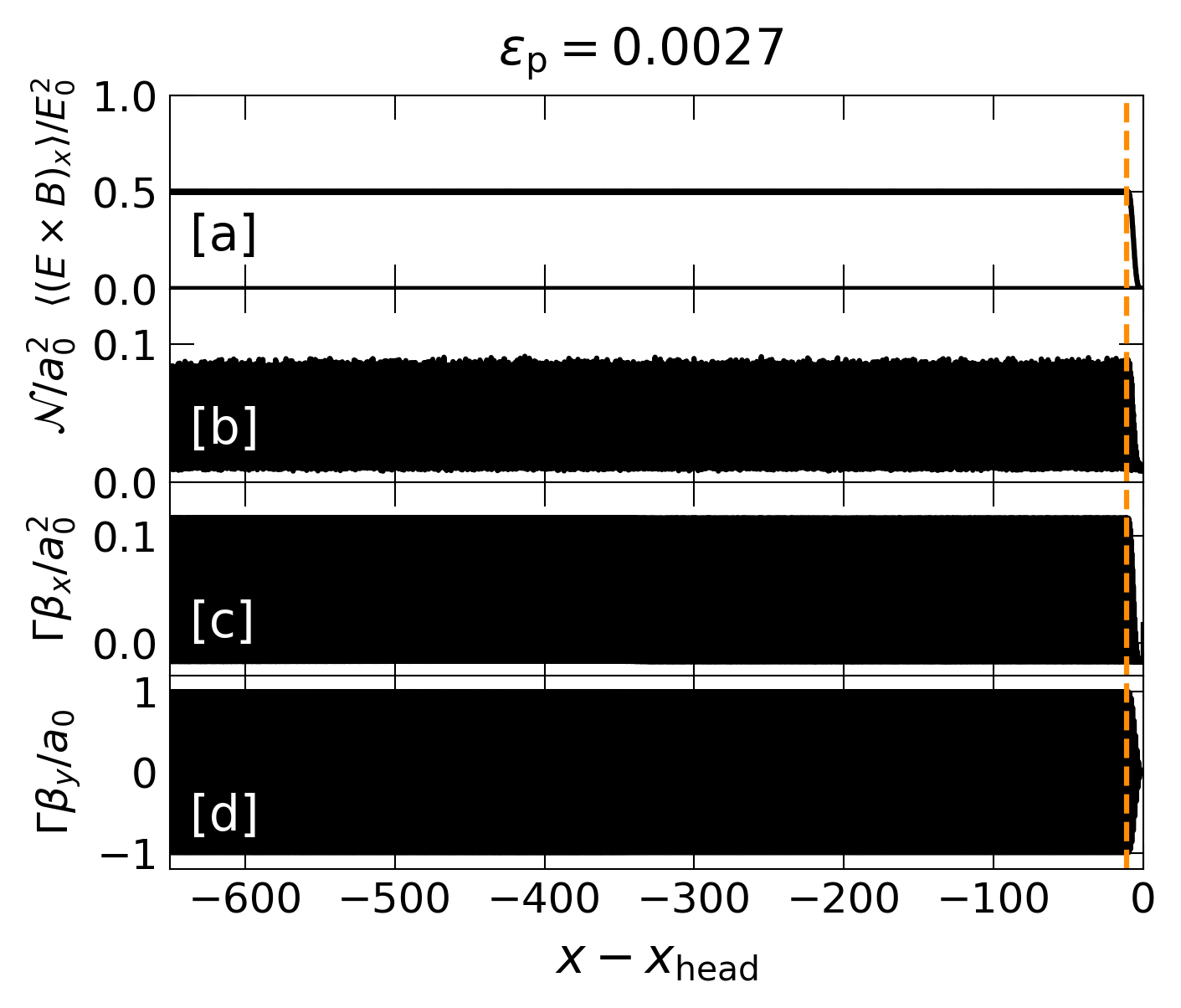
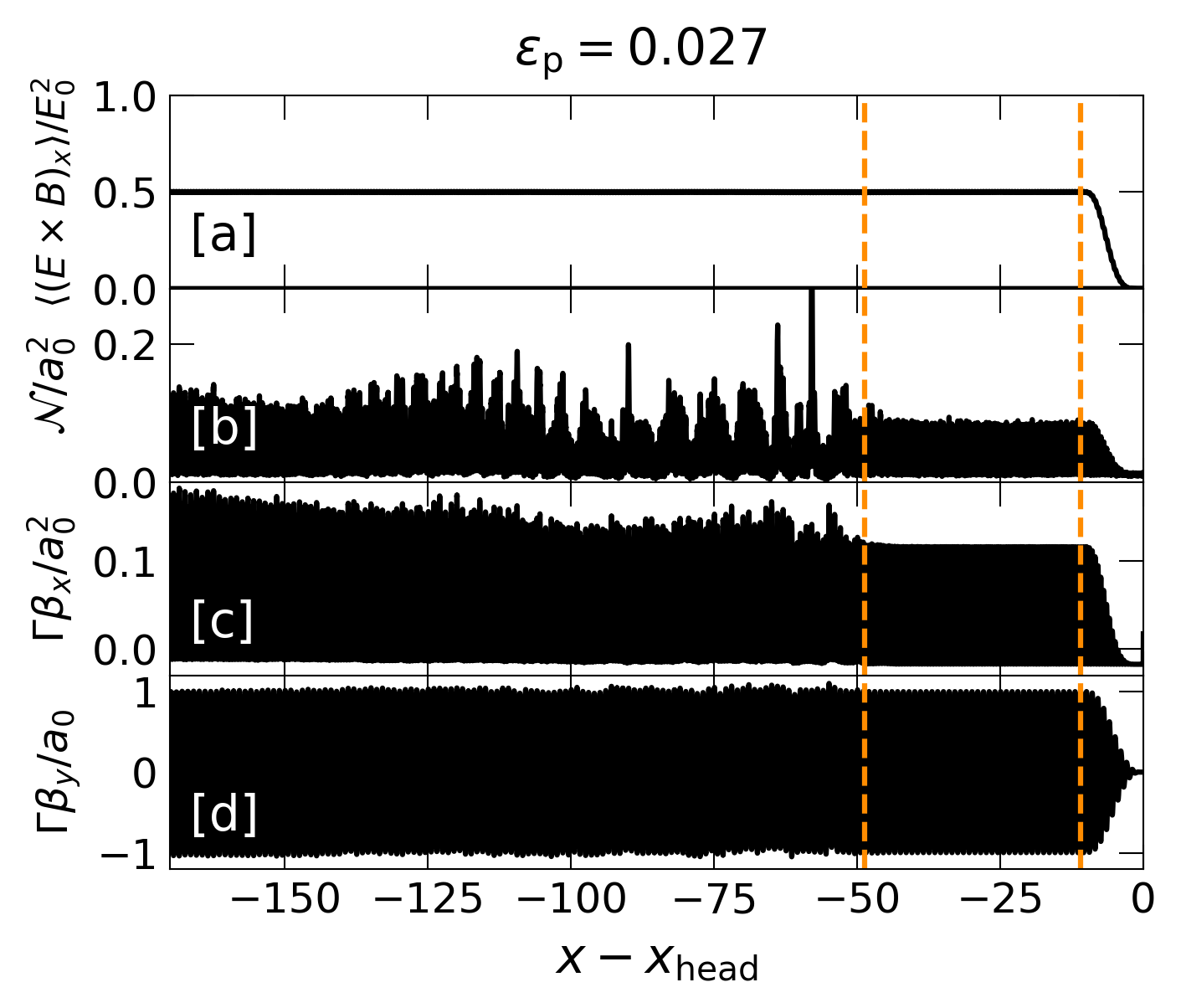
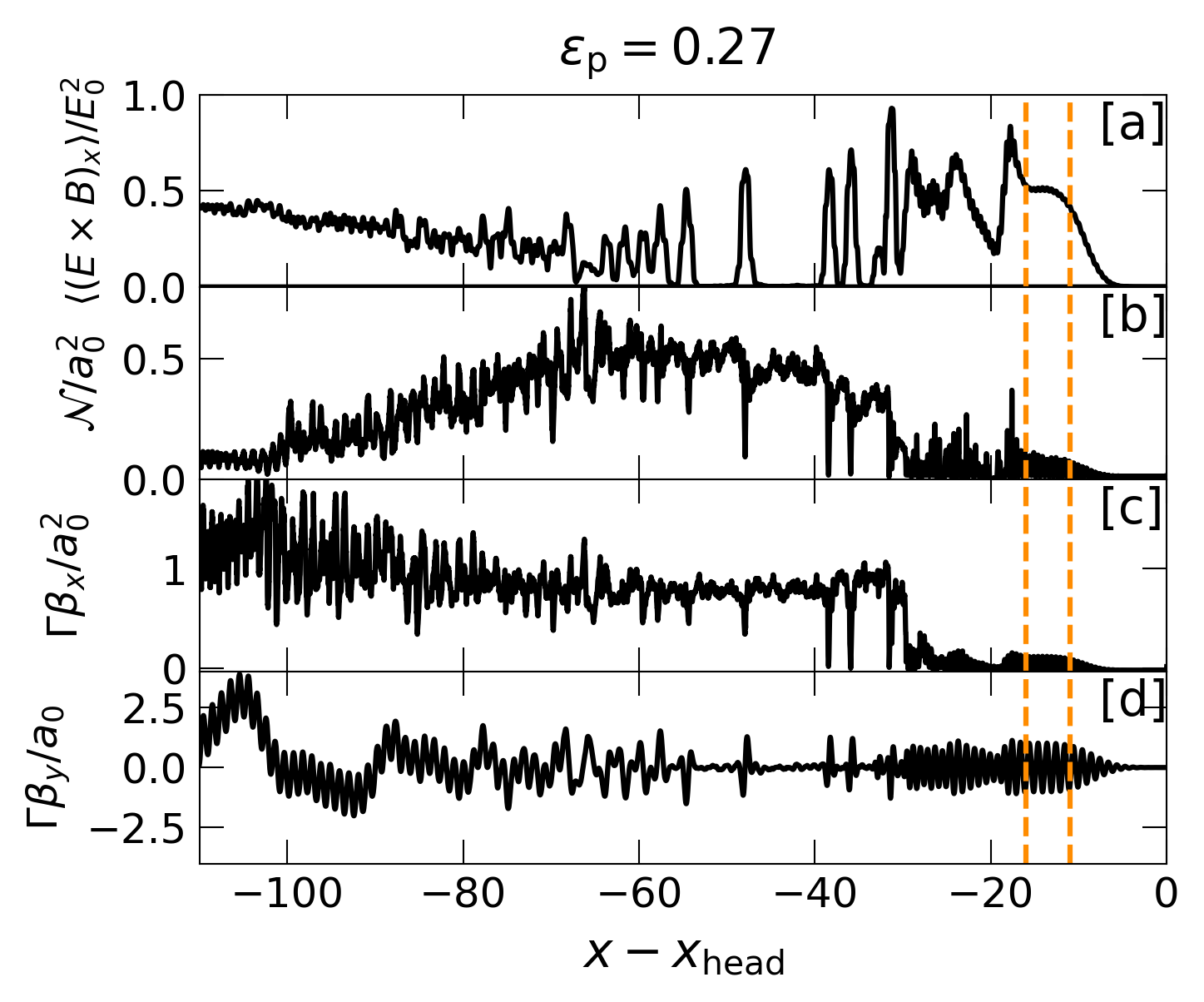
Figure 1: Spatial evolution of Poynting flux, density, and four-velocity for εp<17 and varying εp<18; nonlinear effects appear closer to the pulse head with increasing εp<19.
The propagation is further quantified in terms of the number of undisturbed wavelengths ("linear propagation length"), which is found to collapse to the predicted εp>10 scaling across a wide parameter space, providing robust numerical verification.
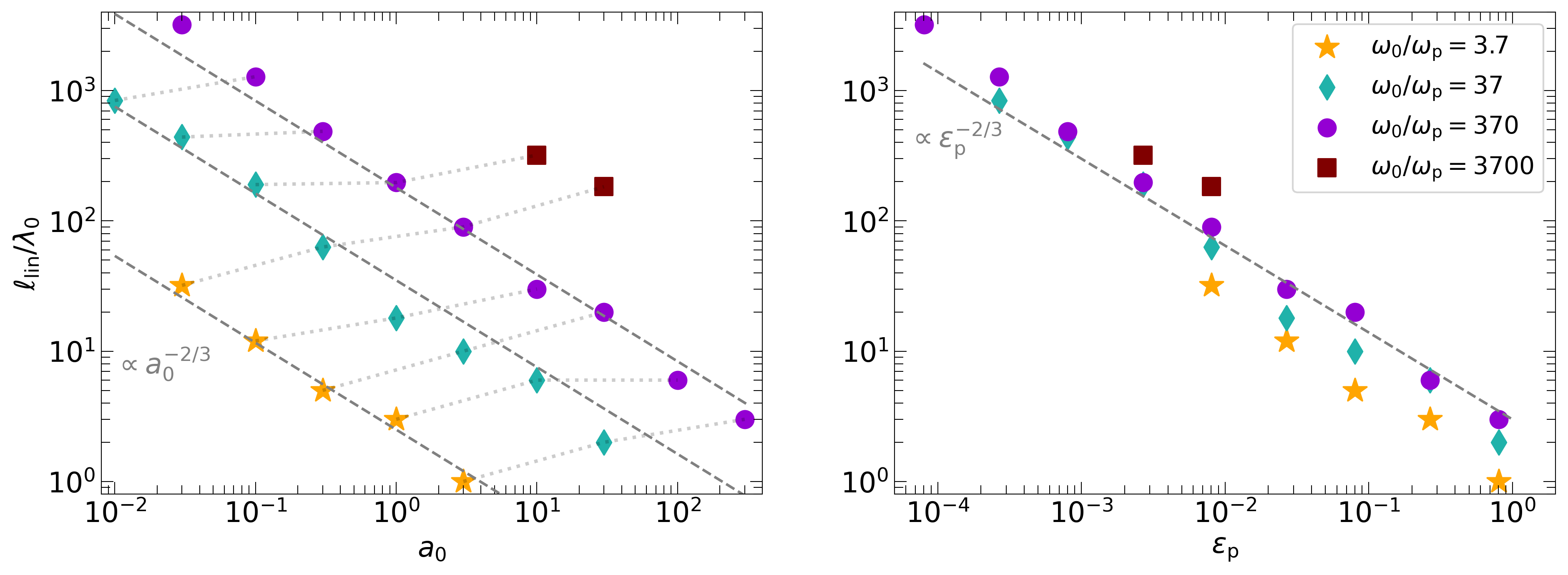
Figure 2: Scaling of linear propagation length versus εp>11 and εp>12, demonstrating the predicted εp>13 and εp>14 behavior.
Highly Nonlinear Regime: εp>15
As εp>16 increases above unity, propagation stops after only a fraction of a wavelength. The EM pulse acts as a relativistic piston, reflecting the incoming plasma and launching a shock structure without classical charge separation (i.e., no "double layer" as in electron-proton plasmas). The theoretical momentum balance determines the piston Lorentz factor and downstream parameters, which are in quantitative agreement with the simulation results. Downstream, plasma density and four-velocity oscillate at twice the incident wave frequency due to the time-dependent nature of the energy density, while the transverse motion is suppressed due to field attenuation.
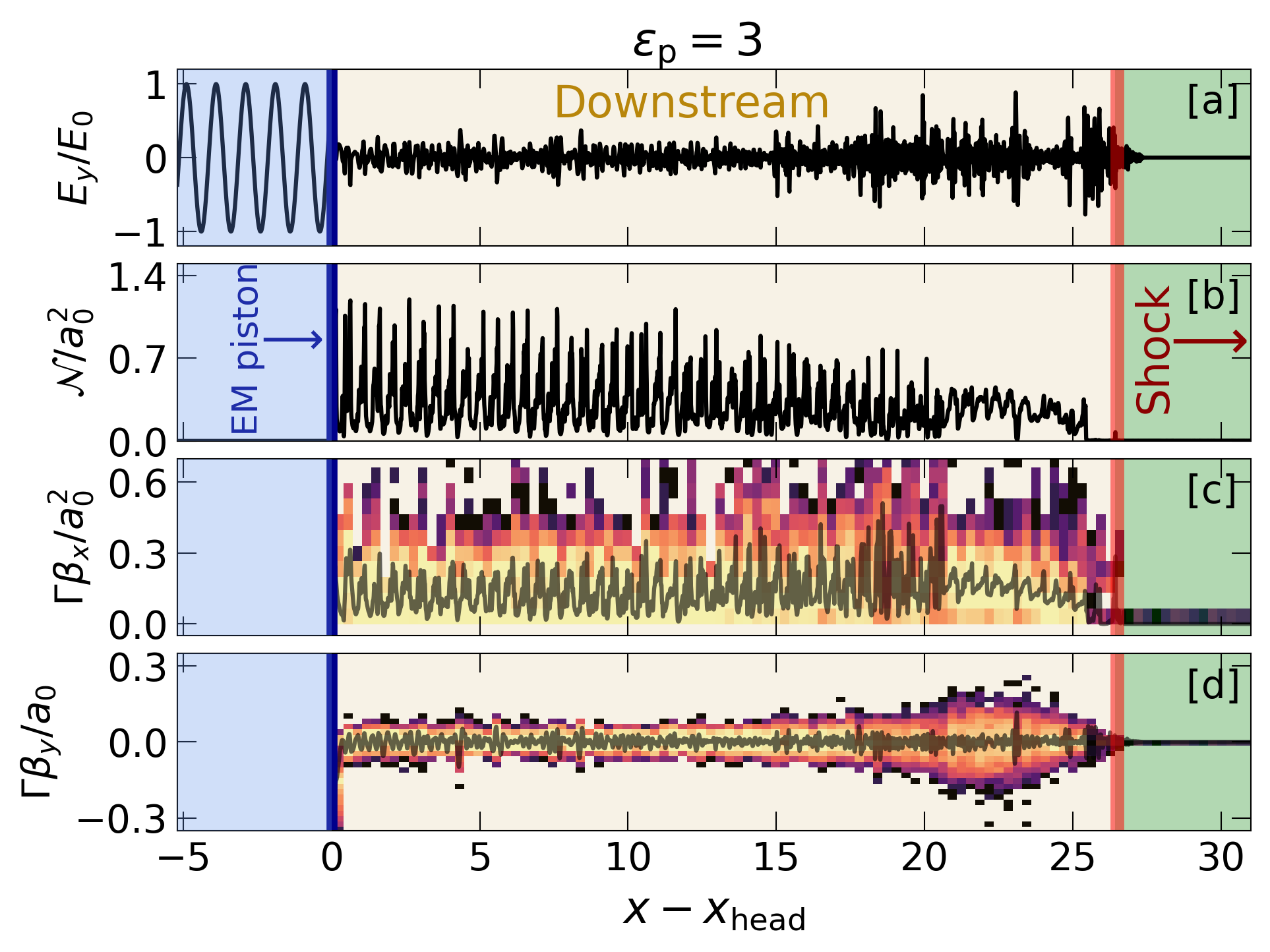
Figure 3: Structure of the interaction in the εp>17 regime: the EM pulse is unable to propagate and launches a shock front (marked).
Regime Diagram and Scaling Verification
The results are synthesized into a regime diagram. The separatrix at εp>18 is unambiguously confirmed. The scaling of the linear propagation length with nonlinearity and the correspondence between analytical and simulation results provide strong support for the theoretical treatment. Additional simulation campaigns with variable Lorentz factors and temperatures confirm the universality and weak sensitivity to these parameters.
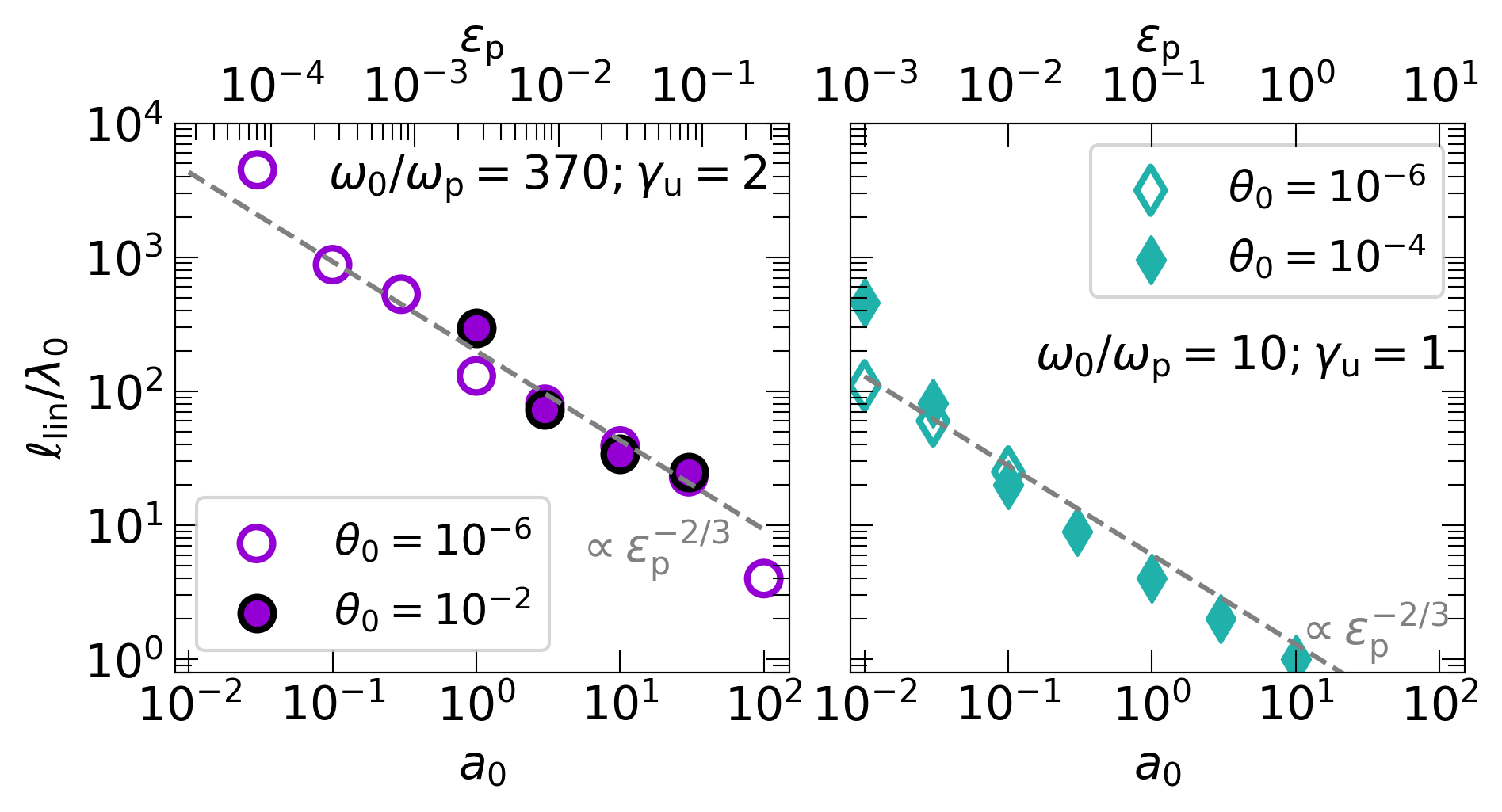
Figure 4: Dependence of linear propagation length on upstream Lorentz factor and temperature, demonstrating universality of the εp>19 scaling.
Implications for Astrophysics and Laboratory Plasmas
Astrophysical Context: The findings provide a quantifiable criterion for the escape and attenuation of coherent radio pulses such as FRBs and giant radio pulses from neutron star magnetospheres. The results directly constrain whether high-y0 coherent pulses can traverse pair-dominated neutron star magnetospheres or are absorbed via nonlinear induced Compton processes. This has ramifications for the interpretation of observable FRB pulse morphologies, their microsecond structure, and the transparency of magnetar environments [Beloborodov_24, Sobacchi+24a]. The regime transition at y1 delineates possible observing windows for escaping GHz emission.
Laboratory Experiments: The outcome directly informs the design of multi-petawatt-class laser pair plasma facilities, outlining how much of an injected coherent pulse will be reflected, absorbed, or transmitted as a function of intensity and density [Chen&Fiuza_23, Dover+25]. The regime of strong pump absorption and shock launching is therefore unavoidable for large y2 and low y3.
Contradictory Claims: The finding that not a single wavelength propagates in the plasma for y4 contradicts prior naive extrapolations from weak turbulence and invites reevaluation of scenarios where strong pulses were previously assumed to escape low-density magnetospheres.
Future Directions
The results motivate extensions toward multidimensional geometries, inclusion of finite temperature, strong background fields, anisotropy, and pulse broadbandness. Such generalizations are directly pertinent to more realistic FRB and laboratory scenarios. The development of predictive models incorporating these nonlinear effects remains a key challenge for modeling compact object magnetospheres and laser-produced pair plasmas.
Conclusion
The paper establishes a unified analytical and numerical framework for nonlinear EM wave propagation in cold, unmagnetized pair plasmas. The identification of the nonlinearity parameter y5 as the governing quantity, the precise delineation of the transmission and absorption regimes, and the verification of scaling laws form a solid foundation for interpreting strong wave-plasma interactions. These results significantly impact the astrophysical modeling of NS magnetospheres and the optimization of laboratory plasma systems.