- The paper introduces FARS, integrating fuzzy logic with adaptive reward shaping to improve convergence and stability in reinforcement learning tasks.
- It employs both Mamdani and Sugeno fuzzy inference methods to generate context-aware rewards tailored to dynamic environmental challenges.
- Experimental results on autonomous drone racing benchmarks show up to a 5% improvement in success rate and reduced variance in complex scenarios.
Fuzzy Logic Theory-based Adaptive Reward Shaping for Robust Reinforcement Learning (FARS): An Expert Analysis
Introduction and Motivation
Reward design remains a critical challenge in reinforcement learning (RL), particularly in high-dimensional domains with long horizons, such as autonomous drone navigation and racing. Sparse or suboptimal reward signals can degrade policy learning by impeding efficient exploration and increasing the risk of policy collapse. While potential-based reward shaping offers denser intermediate feedback, these designs depend heavily on brittle, manually tuned coefficients, making them susceptible to task variations and hyperparameter sensitivity.
This paper introduces Fuzzy Adaptive Reward Shaping (FARS), a methodology fusing fuzzy logic principles into RL reward functions. By integrating human-interpretable linguistic rules and domain heuristics, FARS aims to construct context-aware, adaptive reward landscapes that promote rapid convergence, reduce variance, and impart robustness to reward design.
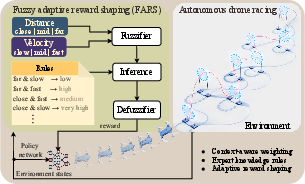
Figure 1: Schematic overview of the fuzzy adaptive reward shaping (FARS) method, contrasting conventional crisp reward design with the fuzzy logic-based approach leveraging human-interpretable linguistic rules for context-aware shaping.
Methodology and Fuzzy Reward Design
FARS leverages a fuzzy inference system to enhance the state-dependent adaptivity of rewards in RL. Instead of scalar, hand-tuned intermediate rewards, the approach deploys linguistic if-then rules encoding velocity and distance—such as "if far and fast, then large reward; if near and slow, then high reward"—motivating agile long-range transit and precise control near sparse targets.
The fuzzy system is evaluated in two canonical forms:
- Mamdani inference, generating smooth, continuous reward surfaces.
- Sugeno inference, producing more piecewise-constant structure due to constant rule outputs.
Both encode the same underlying heuristic: maintain speed when far from goals, decelerate gracefully for precision as proximity increases.
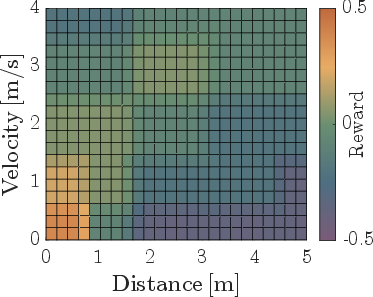
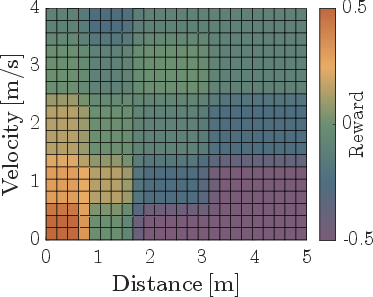
Figure 2: Velocity–distance reward surfaces rvd from (a) Mamdani and (b) Sugeno fuzzy inference, mapping state to reward with continuous and piecewise structures, respectively.
Experimental Design: Autonomous Drone Racing Benchmark
The efficacy of FARS is examined in drone racing environments constructed within IsaacLab. The agent’s RL objective is to navigate sequential zigzag gates—requiring coordination of forward flight, lateral maneuvering, and terminal hovering—across three scenarios: Easy, Medium, and Hard. Complexity is tuned by varying gate spacing, diameter, orientation perturbations, and vertical offsets.
All conditions employ continuous action spaces, PPO-based actor–critic methods, and identical network architectures. Reward configurations are held fixed across environments to rigorously interrogate generalization and robustness.
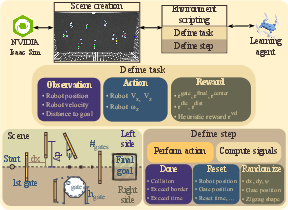
Figure 3: Overview of the proposed training environment and task pipeline in IsaacLab, including state–action design and randomized zigzag gate placement for robust evaluation.
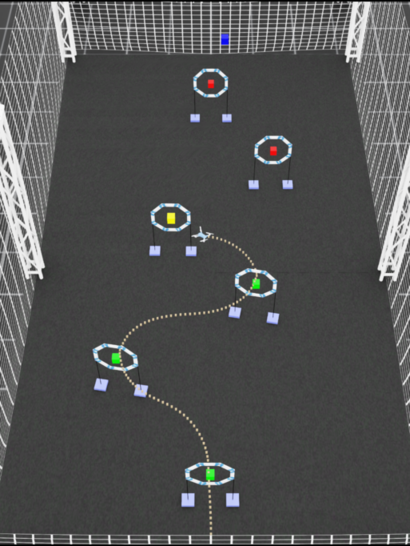
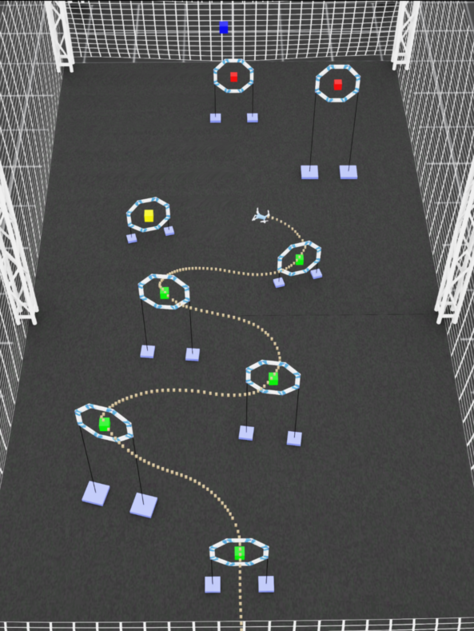
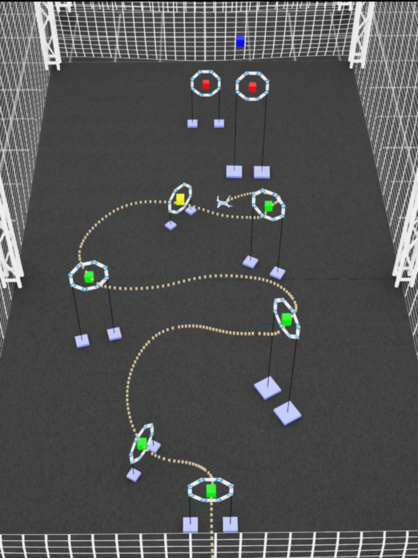
Figure 4: Example randomly generated zigzag environments across Easy, Medium, and Hard difficulties, visualizing gate placements, trajectories, and goal regions in simulation.
Numerical Evaluation and Results
Training and evaluation across five random seeds per reward configuration reveal the following:
- Easy Scenario: All formulations (non-fuzzy, Mamdani, Sugeno) exhibit rapid convergence, achieving >95% final gate-passing success. Differences between approaches are minimal, given the low variance and high predictability of the environment.
- Medium Scenario: Robust performance continues for all reward structures, with most achieving >90% final gate success. Minor advantages are detected in non-fuzzy approaches for final goal hovering, but variance remains low and differences marginal.
- Hard Scenario: The advantages of FARS become pronounced. Fuzzy rewards (both Mamdani and Sugeno) converge faster, show reduced variance, and achieve more stable gate-passing rates, exceeding 90% average success. Notably, the non-fuzzy configuration exhibits higher instability across seeds, with fluctuations in success rates, while fuzzy variants remain consistently high-performing and stable.
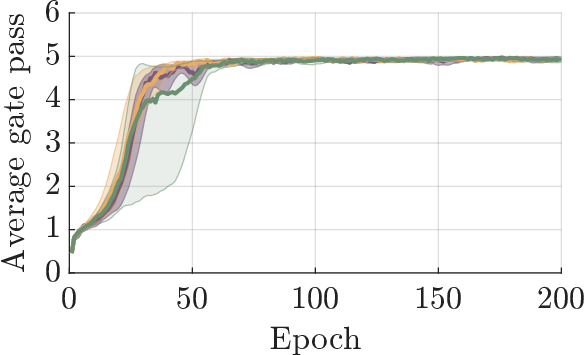
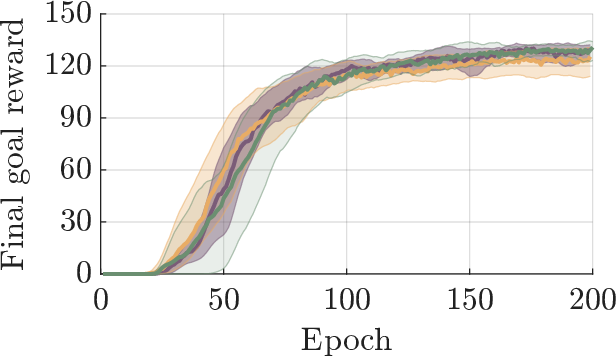
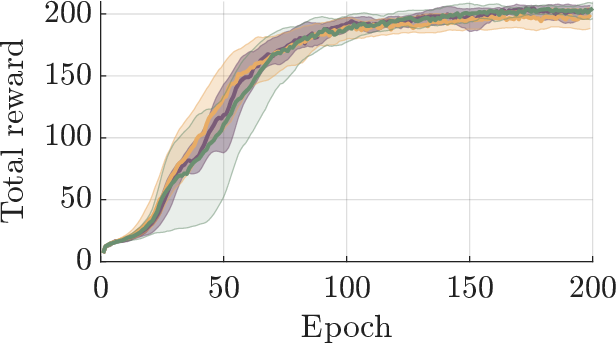
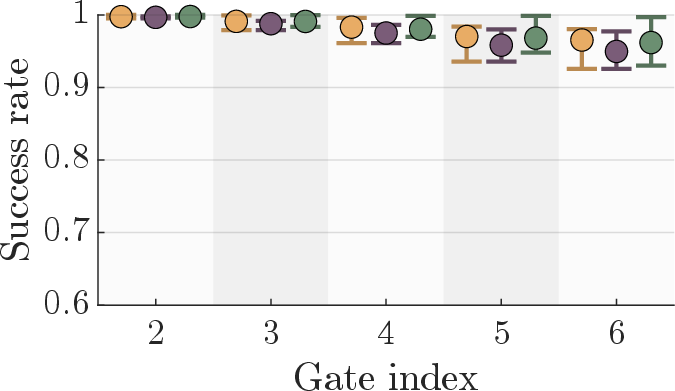
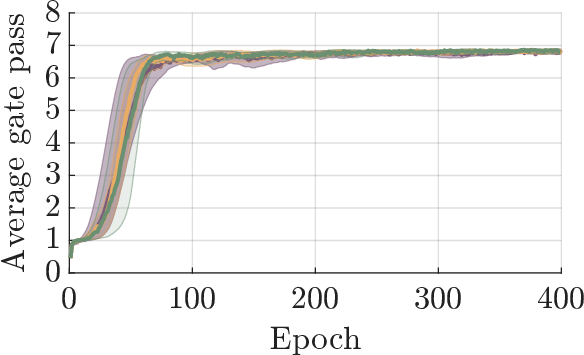
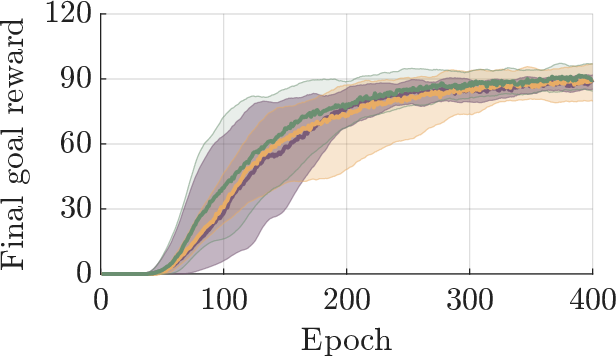
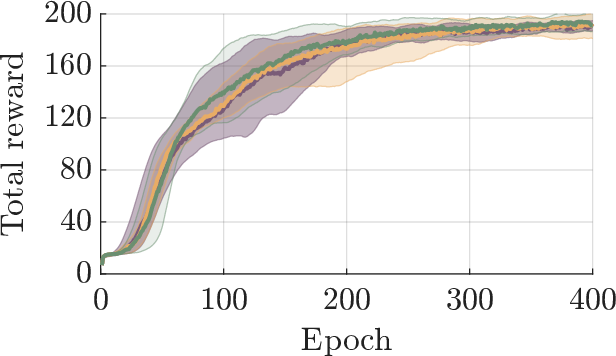
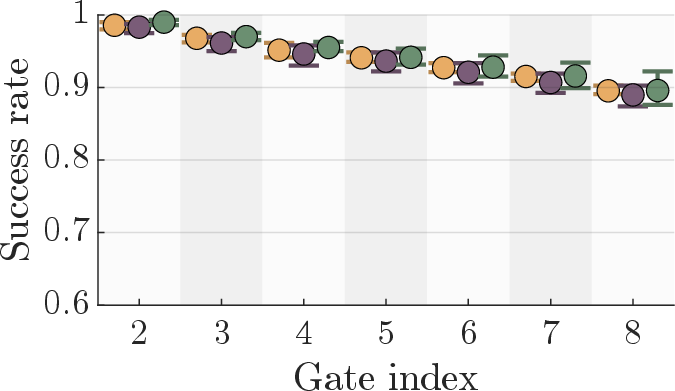
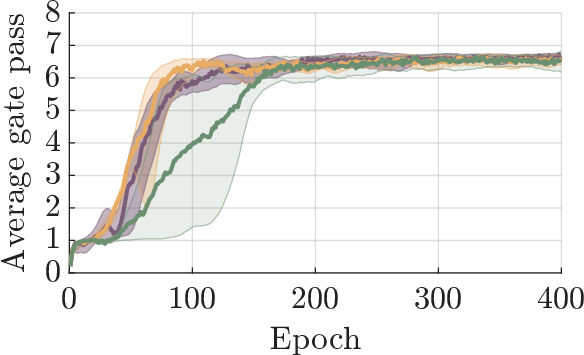
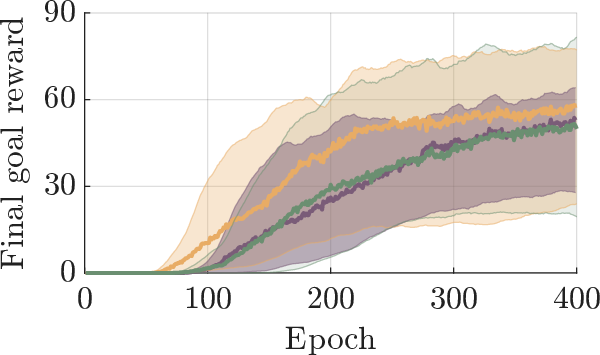
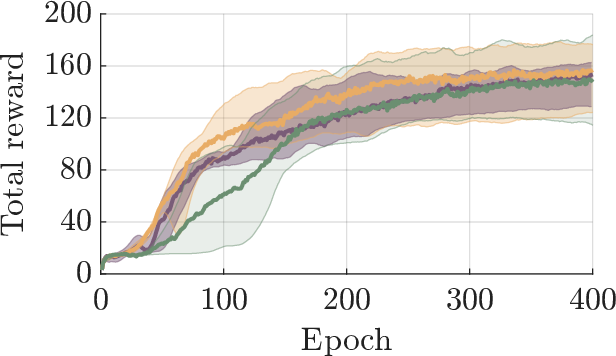
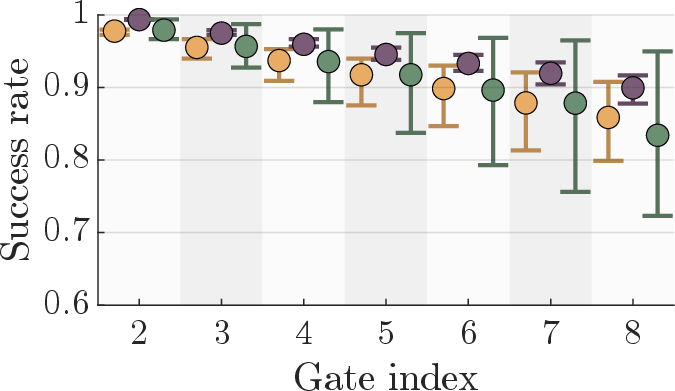
Figure 5: Training and evaluation results for the Easy, Medium, and Hard scenarios, showing mean and variance across seeds and highlighting success rate stabilization and improvement from fuzzy reward shaping, especially as scenario difficulty increases.
Strong numerical results: In the most challenging scenario, fuzzy-shaped rewards led to up to a 5% absolute improvement in gate-passing success compared to non-fuzzy baselines and faster convergence to optimal policy regimes.
Contradictory findings: While non-fuzzy rewards sometimes matched or marginally outperformed fuzzy approaches in the simplest singular setting, this reversed as environment complexity and stochasticity rose, demonstrating the principal claim that fuzzy approaches yield greater robustness and stability under uncertainty.
Implications and Theoretical Considerations
FARS demonstrates that interpretable, adaptive, context-aware reward formulations can fundamentally alter the efficiency and reliability of DRL correspondence in challenging settings. By directly encoding domain-inspired heuristics into the reward function, fuzzy logic circumvents brittle hand-tuning and provides a framework for dynamic, policy-aligned feedback.
Practically, FARS eases the reward engineering burden: membership functions and rule bases replace exhaustive grid search or heuristic coefficient tuning, and reformulations can transfer across diverse environments without extensive scenario-specific reconfiguration.
Theoretically, this approach highlights the value of integrating elements from symbolic AI (fuzzy logic) with sample-based learning. The resulting reward landscape is better shaped for both exploration and exploitation, unlocking faster acquisition of complex behaviors and mitigating convergence pathologies associated with ill-posed reward signals.
Future Directions
Potential future research includes:
- Extending FARS to onboard real-world UAVs for sim-to-real transfer analysis, directly measuring robustness under physical and sensory noise.
- Investigating meta-learning or evolutionary adaptation of fuzzy membership functions and rule sets during training for further automation.
- Integrating FARS with emerging multimodal RL agents and visual-LLMs for semantic reward specification (Fu et al., 2024).
Conclusion
Fuzzy Adaptive Reward Shaping (FARS) provides an effective methodology for constructing adaptive, interpretable, and robust reward functions in RL, particularly in complex robotic navigation tasks. Experimental results substantiate the claim that fuzzy logic-infused reward shaping improves training stability and final performance as environments become more challenging and uncertain. This approach offers a balanced path between dense, hand-tuned reward engineering and domain-informed, generalizable designs—opening avenues for more explainable and practically viable reinforcement learning deployments in robotics and beyond.
Paper Reference: "Fuzzy Logic Theory-based Adaptive Reward Shaping for Robust Reinforcement Learning (FARS)" (2604.15772)

