- The paper demonstrates that HQRN exactly maps classical ResNet functionality to quantum circuits by allowing weight portability through quantum residual blocks.
- It employs cascaded quantum residual blocks to capture both diagonal and off-diagonal correlations, enabling robust discrimination of complex quantum states.
- Empirical results on MNIST and entanglement classification confirm HQRN's near-classical performance with classical inputs and quantum advantage with nonclassical data.
Introduction and Motivation
The longstanding challenge in quantum machine learning (QML) is to formulate neural architectures that not only extend classical inductive biases into the quantum regime but also effectively process the full complexity of quantum data—namely, density operators embodying both diagonal and off-diagonal correlations. Classical neural networks, limited to operations over vectors or distributions, cannot consistently comprehend or leverage the information encoded in general quantum states. Existing works on quantum convolutional, recurrent, or even “residual” architectures have not yielded rigorous functional equivalence with their classical analogs, especially in the context of deep and scalable designs suitable for practical quantum advantage.
This paper introduces the Hybrid Quantum Residual Network (HQRN), which formalizes a constructive and exact correspondence between deep classical ResNets and their quantum analogs endowed with quantum residual connections. Importantly, for computational basis (diagonal) inputs, the HQRN reduces strictly to a classical residual network, meaning optimized weights from classical models can be ported directly to quantum networks—a critical property for practical training and deployment. Conversely, for general mixed quantum states, HQRN exploits non-commuting observable statistics and encodes off-diagonal correlations, enabling discrimination of quantum features inaccessible to the classical regime.
Architecture and Theoretical Foundation
The architecture generalizes the classical residual block (mapping zk=zk−1+F(zk−1)) to accept and propagate quantum information through Quantum Residual Blocks (QRBs) operating on density matrices. Each QRB applies a pair of parametrized unitaries, collects measurement outcomes, subjects them to nonlinear (activation) functions and normalization, and combines the resulting post-measurement diagonal density with the incoming state weighted by a tunable α. This ensures information flow akin to classical residual connections while accommodating quantum superpositions and mixtures.
The crux is that, for diagonal inputs, the recursion reduces to classical operations with identical functional form, allowing practical mapping of classical weights to quantum circuits via unitary dilation and Trotterization. For general quantum inputs, this recursive mixture and measurement-based nonlinear update aggregates nonlocal features layer-wise, systematically capturing information from the full density matrix beyond the probability simplex.
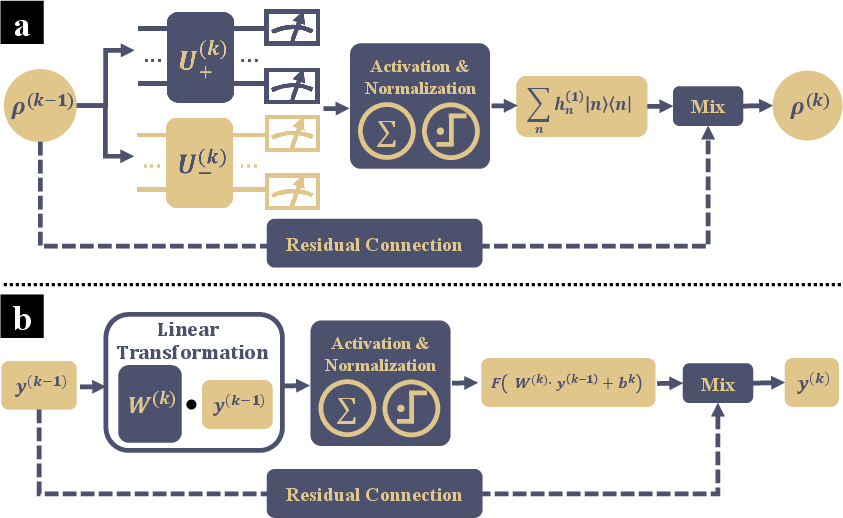
Figure 1: Architecture of a quantum residual block depicting both quantum and corresponding classical pathways central to the HQRN formalism.
This design supports universal approximation of mappings from quantum state space to the diagonal simplex, echoing the universality theorem for classical networks, and establishes the first formal and operational bridge between deep quantum and classical ResNets.
Empirical Evaluation: MNIST Digit Recognition
To verify strict functional equivalence in the classical regime, the HQRN was benchmarked on MNIST handwritten digit classification, with images mapped to 64-dimensional normalized probability vectors (interpreted as diagonal density matrices). Ten consecutive QRBs were employed. Direct transfer of classical weights into the corresponding quantum unitaries allowed immediate reproduction of learning curves, with quantum models trained using realistic shot noise via finite measurement.
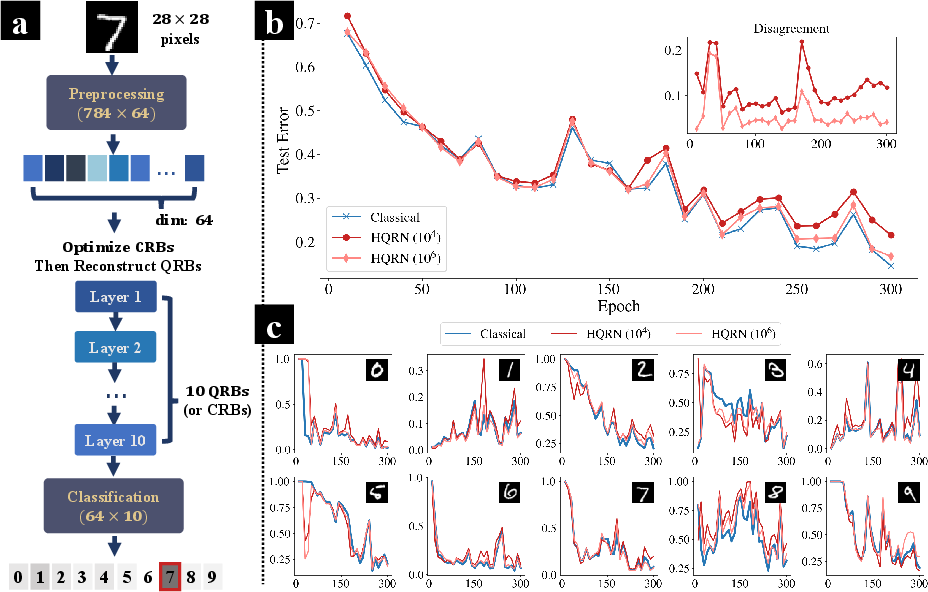
Figure 2: HQRN reproduces classical ResNet error trajectories and class-wise accuracy on MNIST, with disagreement vanishing as measurement noise is suppressed.
When the number of shots Ns is moderately large (104 to 106), the HQRN’s test error closely approaches the classical baseline. The frequency of divergent classification (disagreement) drops from around 12% at Ns=104 to approximately 3% at Ns=106. Critically, the class-wise error distribution confirms model indistinguishability at convergence. Spikes in model disagreement during certain optimization phases can be traced to heightened sensitivity to stochastic fluctuations—these provide empirical confirmation that HQRN is functionally congruent with its classical baseline in the classical input regime, validating both the theoretical mapping and the practical reconstruction protocol.
Quantum Regime: Entanglement Classification
To demonstrate quantum advantage, the HQRN was tasked with classifying entangled versus separable states in bipartite mixed-state datasets—containing not only standard Werner states, but also random separable and "adversarial" separable states (constructed to mimic the measurement statistics of entangled pairs under Pauli-Z and other bases). Standard classical classifiers, including the diagonalized ResNet, are incapable of separating adversarial states from genuinely entangled pairs due to overlap in classical measurement outcomes.
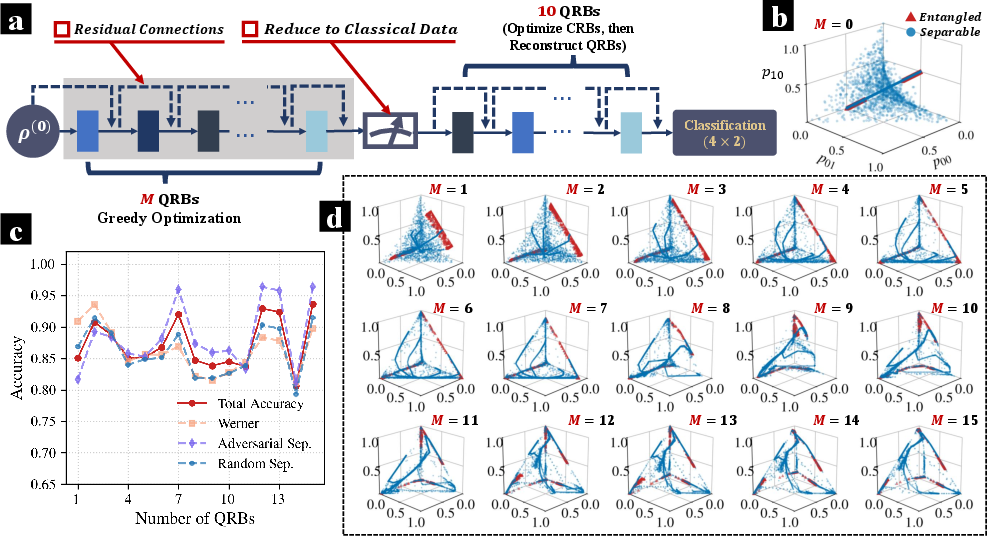
Figure 3: HQRN enables discrimination between entangled and separable (including adversarial) quantum states through a cascaded sequence of QRBs that iteratively unfold class manifolds in measurement probability space.
The HQRN first applies M QRBs to the input quantum state (maintaining full quantum evolution), then uses the output as input for a classical residual classifier on the post-measurement probability vector. Notably, as the QRB depth α0 increases, the learned unitaries perform iterative basis rotations that amplify the class-separability in the measurement simplex—an effect unattainable by purely classical processing or single-basis measurement.
Strong numerical results show:
- Classification accuracy rises sharply as α1 increases, with peaks corresponding to depths at which the quantum network unfolds the state manifolds, optimally separating adversarial from truly entangled states.
- The network achieves high accuracy even in regimes where adversarial separable and entangled states are indistinguishable by classical (measurement-only) statistics.
- The dynamical evolution of class manifolds through QRB cascades is evidenced by the measured trajectories in the simplex, confirming the hierarchical disentanglement enabled by quantum residual learning.
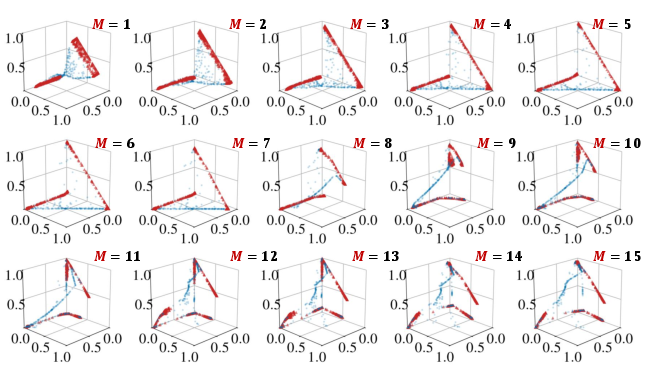
Figure 4: Layer-wise measurement evolution for Werner states, demonstrating that increased QRB depth systematically separates entangled and separable distributions.
This establishes a contradictory claim to earlier hybrid models: the HQRN provides tangible advantage on quantum state discrimination tasks where classical architectures and their corresponding measurement-only quantum embeddings provably fail.
Practical and Theoretical Implications
The HQRN is distinguished by several practical and theoretical merits:
- Trainability and Scalability: By enabling quantum models to inherit classically optimized weights in the diagonal-input regime, the approach circumvents barren plateaus and optimization instability common to deep variational quantum circuits, facilitating deployment on near-term hardware.
- Unified Architecture: The formal mapping positions HQRN as the first genuinely unified deep framework for hybrid learning—recovering classical behavior where appropriate while manifesting quantum advantage for entangled, mixed or otherwise nonclassical data.
- Resource Efficiency: Cascaded measurement and mixing protocols exhibit linear resource scaling (number of copies per layer), maintaining tractable overhead for practical experiments.
- Quantum Feature Extraction: The recursive extraction of off-diagonal information by QRBs generalizes feature hierarchies to the quantum regime, underlying potential speedups in QML, particularly for structured quantum state discrimination and tomography.
The framework opens routes toward robust, deep quantum networks that leverage quantum correlations for discriminatory power, underpinned by rigorous classical-quantum equivalence that facilitates transfer learning and model initialization.
Conclusion
The Hybrid Quantum Residual Network delineated in this work establishes the first formal and operational bridge between classical deep residual learning and quantum neural architectures. It guarantees strict weight portability in the classical regime and enables the hierarchical extraction of quantum correlations inaccessible to classical classifiers. Empirical evaluation confirms functional equivalence on classical benchmarks and demonstrates quantum advantage in adversarially constructed entanglement discrimination tasks, substantiating claims of theoretical and practical import. HQRN thereby offers a scalable template for future deep quantum learning systems, with immediate relevance for near-term quantum hardware deployment and the broader theoretical foundations of quantum machine learning.
(2604.15626)

