- The paper introduces a new tropical intersection multiplicity and a global formula for limit cycles in tropical compactifications.
- It develops the 'firework algorithm' to compute degenerations and intersections of tropical ψ-hypersurfaces on M0,n.
- Results ensure effective boundary strata appear with coefficients of 0 or 1, aligning with classical Chow computations in moduli spaces.
Degenerations in Tropical Compactifications and Tropical Intersection Theory of M0,n
Introduction and Main Results
This paper (2604.15511) provides a significant advancement in tropical intersection theory, specifically in understanding degenerations of subvarieties in tropical compactifications. The authors generalize classical results by Dickenstein-Feichtner-Sturmfels and Katz, developing a global formula for the limit cycles of a degenerating family of subvarieties in tropical compactifications and demonstrating the efficacy of this theory on the moduli space M0,n of stable rational curves with marked points.
The work proceeds in two main parts:
- Theoretical Development: A new tropical intersection multiplicity is introduced, adapted to non-transversal intersections along skeleta of tropical fans.
- Applications to M0,n: The formula is applied to compute degenerations of products of ψ-classes, pursued via a novel combinatorial-algorithmic approach called the "firework algorithm".
Limit Cycles in Tropical Compactifications
The main theoretical contribution is a formula for the flat limit (limit cycle) [(X0)] of a smooth r-codimensional family X⊂M inside a tropical compactification M, where M is a closed subvariety of a torus and M is its compactification in a toric variety defined by a fan M0,n0 with support equal to the tropicalization M0,n1. For such M0,n2 and for a degeneration of M0,n3, the authors give an explicit sum formula over the M0,n4-skeleton M0,n5 of cones of M0,n6: M0,n7
Crucially, the local multiplicity M0,n8 is defined via a new perturbative rule compatible with tropical compactifications, even in the absence of local affine linearity, extending previous formulations that only worked in ambient tori or under strong transversality assumptions.
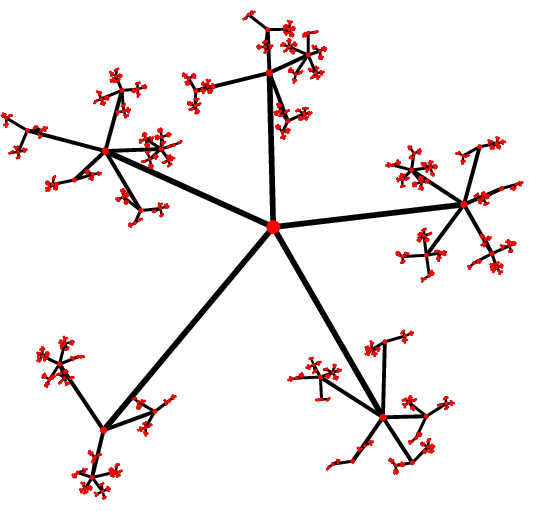
Figure 2: A schematic illustration of the firework algorithm, where successive intersections propagate away from the cone point of M0,n9, mirroring the recursive structure of tropical cycle intersection.
New Definition of Tropical Intersection Multiplicity
This local intersection multiplicity is based on perturbing skeleta and computing lattice indices in the "star" of the tropical fan at intersection points, carefully adapting the displacement rule to the ambient stratified geometry of M0,n0. The authors show that this multiplicity is:
- Independent of the choice of perturbation and maximal cone,
- Reduces to classical intersection multiplicity in the toric case,
- Compatible with the push-forward of tropical cycles under toric morphisms.
They demonstrate that the limit cycle depends only on the local geometry of M0,n1 near the intersection with the skeleton M0,n2, not the global intricacies of the degenerating family.
Tropical M0,n3-Hypersurfaces and Kapranov Maps
In applying the theory to M0,n4, the authors systematically tropicalize the Kapranov maps, which are modifications of the moduli space induced by classical M0,n5-classes—tautological cotangent line classes. They introduce a new class of tropical M0,n6-hypersurfaces, which differ from the traditional subfan-based M0,n7-classes of Mikhalkin and Kerber-Markwig:
- Definition: Tropical M0,n8-hypersurfaces arise from tropicalizing hypersurfaces determined by Kapranov maps and hyperplanes with coefficients having distinct valuations.
- Flexibility: They encode explicit degenerative behavior and intersections of divisors via the tropicalization, sensitive to coefficient valuations (unlike subfan-based M0,n9).
The intersection points of these tropical hypersurfaces with skeleta are precisely characterized by a recursive combinatorial structure.
The Firework Algorithm
To compute the cycle class resulting from the intersection of several tropical ψ0-hypersurfaces, the authors develop the "firework algorithm". This recursive procedure enumerates the finite points of intersection on the ψ1-skeleton of ψ2 by inductively constructing them from lower-dimensional skeleta. At each stage:
- Directions are launched ("firework paths") from intersection points found in the previous stage,
- Edge lengths are prescribed to be distinct orders of magnitude to enforce transversality,
- The recursion ensures that each codimension-ψ3 intersection point corresponds injectively to a combinatorial type (tree) in the moduli space.
This combinatorial metric process allows for explicit computation of all effective boundary strata appearing in the limit of degenerating intersections of ψ4-hypersurfaces, with each stratum appearing at most once.
Numerical Results and Theoretical Implications
The main results establish that the coefficients for each codimension-ψ5 boundary stratum in the cycle expansion of the limit are either ψ6 or ψ7. In particular:
- Each geometric product of ψ8-classes or their pullbacks along forgetful morphisms is expressed as an effective sum of boundary strata.
- No boundary strata appear with negative or higher multiplicity.
- The method is valid beyond the situations where classical tropical or intersection-theoretic approaches are applicable.
These findings align with, but are not implied by, classical computations in the Chow ring of ψ9, such as those derived from Keel's presentation or the Kontsevich-Manin relations. The geometric, combinatorial, and tropical perspectives cohere, reinforcing the utility of refined tropical compactification techniques.
Relation to Existing Intersection Theory
The authors carefully contrast their "valued coefficient" [(X0)]0-hypersurfaces with the classical tropical [(X0)]1-classes. The tropical intersection theory here produces geometric representatives (via degeneration) for Chow cycle classes, directly realizable in terms of limit cycles of complete intersections of explicitly constructed hypersurfaces—a finer geometric object than the mere intersection product in Chow.
Additionally, the approach generalizes the previous work of Gillespie-Griffin-Levinson on [(X0)]2-classes, making explicit the tropical nature behind certain geometric expressions for products of tautological classes.
Broader Implications and Future Directions
Practical implications:
- The firework algorithm provides a concrete, efficient, and geometric method for calculating intersection products of [(X0)]3-classes on [(X0)]4, which are omnipresent in enumerative geometry and moduli problems.
- Since the method reduces to local combinatorial calculations, it is well-suited for computer implementation and may inform algorithms in computational algebraic geometry and tropical geometry.
Theoretical implications:
- The generalization of intersection theory to tropical compactifications sans local affine linearity opens new avenues for the study of moduli spaces and their degenerations, and may inform approaches to higher genus or other moduli problems.
- The new tropical intersection multiplicity concept may find further applications in situations featuring highly stratified ambient spaces where classical transversality fails.
Future developments:
- The adaptation to higher genus and more general tautological classes remains an open direction, with recent related progress in the tropicalization of [(X0)]5-classes.
- Exploring potential relationships between the firework combinatorics and graph-theoretic structures on moduli spaces (such as parking functions, rigid graphs, etc.) promises rich combinatorial insight.
Conclusion
This work provides a unified, efficient, and geometric approach to the computation of degenerating subvarieties and their intersections in tropical compactifications, fully realized in the rich setting of [(X0)]6. The interplay of tropical geometry, combinatorics, and algebraic geometry in this context sharpens our understanding of cycles and degenerations in moduli spaces and equips researchers with new tools for intersection-theoretic computations, both theoretically and algorithmically.