- The paper introduces a GMHE-inspired cosmological model that modifies the Friedmann equations and challenges ΛCDM tensions through a tunable entropic parameter n.
- It demonstrates that variations in n alter the cosmic acceleration transition and higher-order cosmographic parameters, affecting the linear growth of density perturbations.
- The study applies the Sheth-Mo-Tormen formalism to reveal n-dependent shifts in halo abundance and mass function, providing observable tests for modified gravity.
Introduction and Theoretical Framework
This work develops and analyzes a cosmological scenario derived from a generalized mass-to-horizon entropy (GMHE) relation, rooted in the thermodynamic-gravity correspondence. The approach generalizes the standard Bekenstein-Hawking area law by considering a nonlinear relationship between the mass enclosed by the apparent horizon and the horizon radius. The resultant gravity theory modifies the Friedmann equations, affecting both background cosmological evolution and the linear growth of structure. The model is parameterized by a nonlinearity index n, with n=1 returning the ΛCDM case.
A primary motivation is to address theoretical and observational tensions in ΛCDM, such as the H0 and σ8 discrepancies, while providing a systematic framework to explore entropic modifications compatible with the Clausius relation. The entropy functional reduces to various nonextensive and quantum-corrected forms (e.g., Tsallis-Cirto and Barrow entropies) for specific choices of n. The theory is constructed to ensure the generalized entropy is consistent with gravitational dynamics and cosmological thermodynamic equilibrium.
Modified Friedmann Dynamics and Cosmography
The background cosmological expansion is fundamentally altered by the entropic parameter n, resulting in power-law corrections to the Friedmann equations. The evolution of the Hubble parameter E(z) is strongly n-dependent—deviations from n=1 cause nontrivial modifications in the expansion rate at all redshifts.
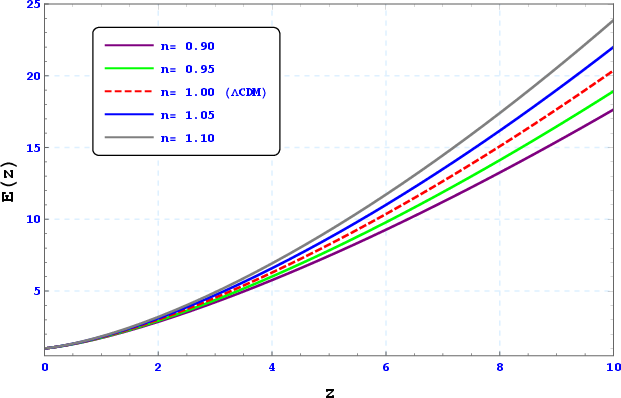
Figure 1: Normalized Hubble parameter E(z) as a function of redshift for different n=10, highlighting the expansion rate modifications relative to ΛCDM.
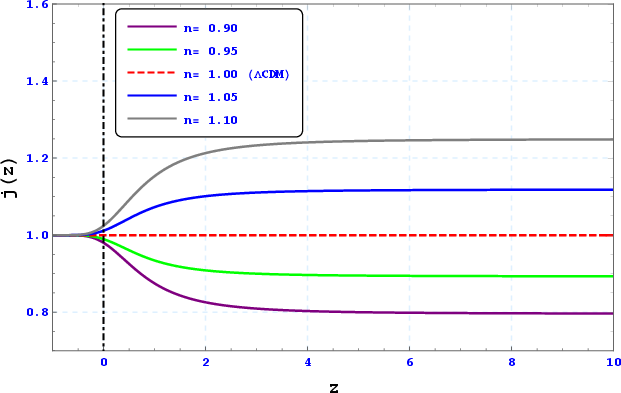
Despite the modified expansion, the effective equation of state and n=11 parameters maintain the same functional dependence as ΛCDM due to the conservation structure, but the true physical impact emerges in the cosmographic sector: the deceleration, jerk, snap, lerk, and n=12-parameters all exhibit explicit model-dependence for n=13.
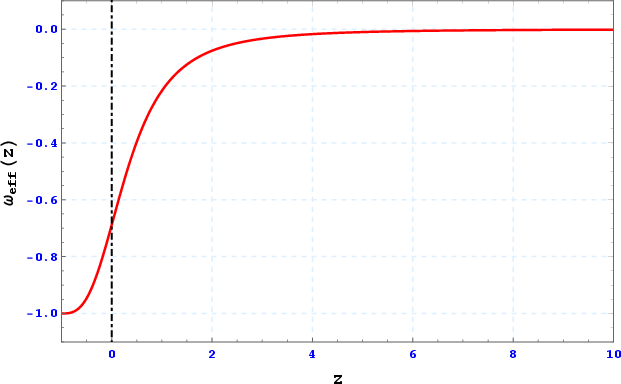
Figure 2: The evolution of the effective equation of state n=14 with redshift; the behavior converges to the de Sitter value at n=15 irrespective of n=16.
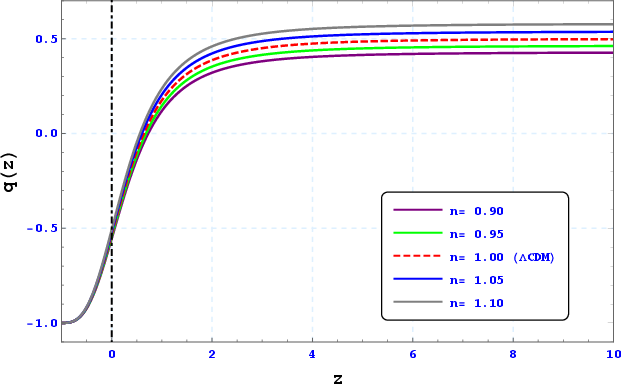
Figure 3: Deceleration parameter n=17 shows a shift in the transition redshift between deceleration and acceleration as n=18 varies.
Significantly, the model generically predicts:
The model comprehensively passes geometric diagnostic "null tests" designed to rule out both flat and non-flat ΛCDM via the σ80, σ81, σ82, and σ83 functions—an important demonstration of theoretical distinguishability:
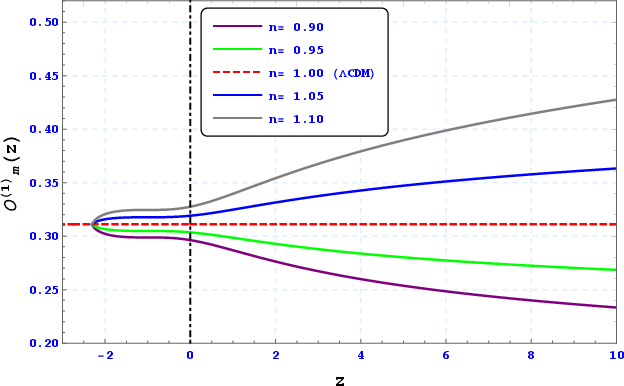
Figure 5: The σ84 diagnostic identifying explicit deviations for σ85; this falsifies ΛCDM in both flat and non-flat scenarios.
The analysis extends beyond background dynamics, focusing on the linear growth of density perturbations using the top-hat spherical collapse (SC) model, cast within the modified Friedmann context. The key result is an explicit, exact growth equation for the matter density contrast σ86, incorporating the nonlinearity parameter σ87.
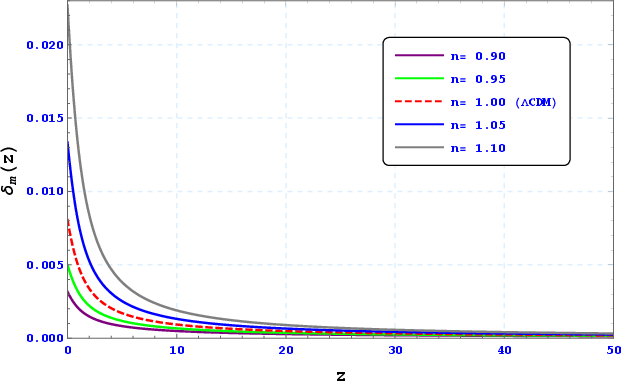
Figure 6: Redshift evolution of the linear matter density contrast σ88 for varying σ89. Larger n0 yields faster growth and earlier nonlinearity, diverging from the ΛCDM growth law.
Summary of structural implications:
- For n1, perturbations grow more efficiently, with early structure formation and enhanced clustering.
- For n2, growth is slower, potentially addressing the n3 problem by suppressing small-scale structure.
- The logarithmic growth rate n4 and n5 both display nontrivial dependence on n6 at low n7 (late times), where differences from ΛCDM are maximized.
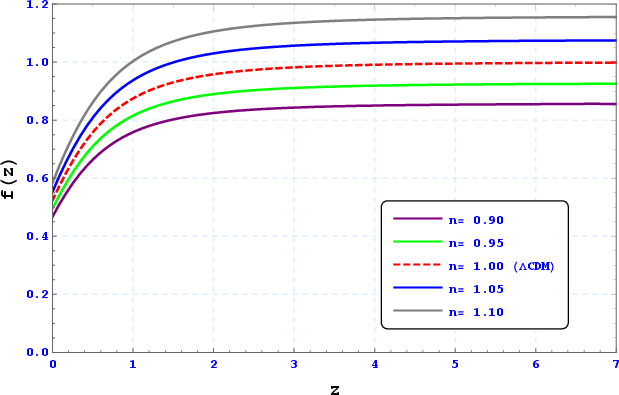
Figure 7: Logarithmic growth rate n8 as a function of redshift, quantifying the suppression or enhancement of structure formation due to n9.
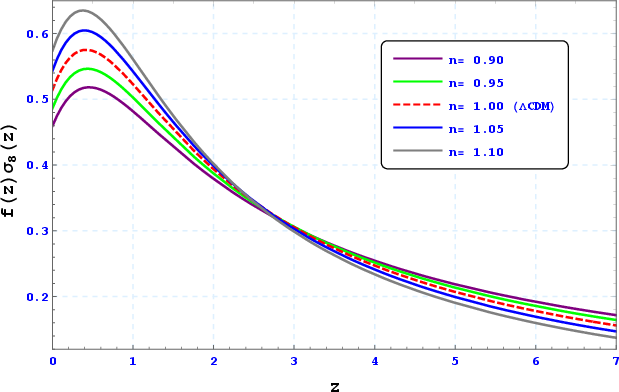
Figure 8: Product n0 demonstrates how the entropic parameter n1 shifts the epoch of maximal growth, potentially impacting interpretations of redshift-space distortion data.
Nonlinear Collapse: Halo Mass Function and Number Counts
The Sheth-Mo-Tormen (SMT) formalism is deployed to analyze the halo mass function and number counts, explicitly incorporating the entropic modifications into the multiplicity and mass function calculations. The model predicts:
- A shift in the formation epoch of massive halos for varying n2, with more massive halos being less abundant and forming later as n3 increases.
- The overall number of collapsed halos decreases with increasing n4, consistent with reduced growth at late times.
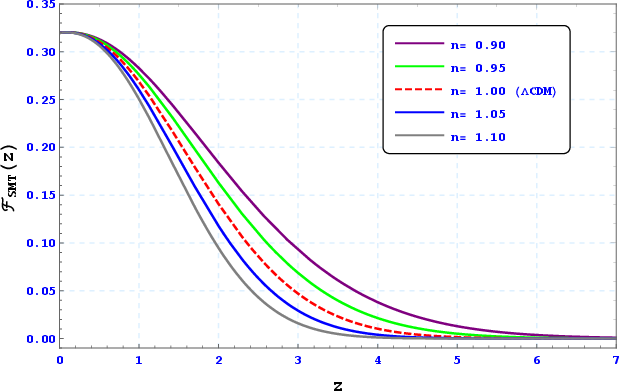
Figure 9: SMT halo multiplicity function n5 for n6, illustrating sensitivity to n7 and the resulting shift in the mass function's peak.
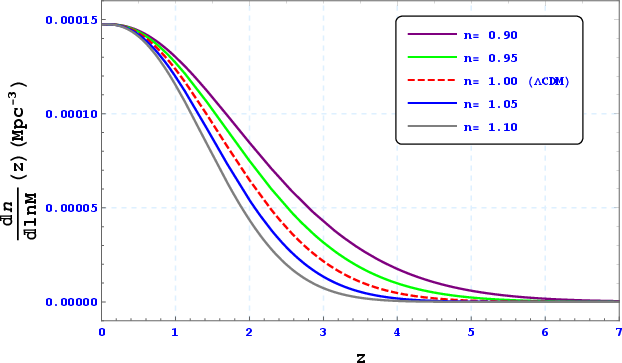
Figure 10: Differential halo mass function n8 versus redshift for a fixed mass, indicating changes in structure abundance.
Full-sky number counts per redshift and mass bin, calculated over comoving volume, exhibit an n9-dependent suppression in number counts for larger structures, and align with the hierarchical formation paradigm: smaller halos are more numerous and form earlier.
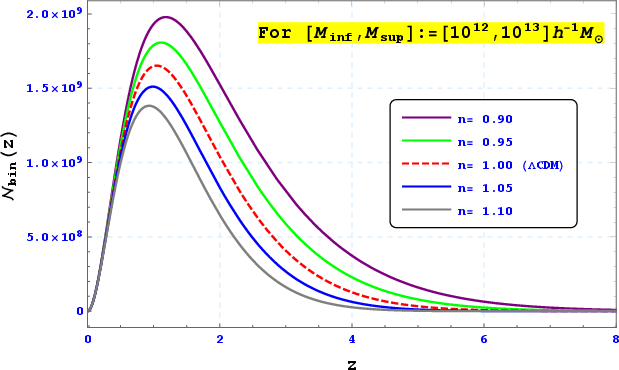
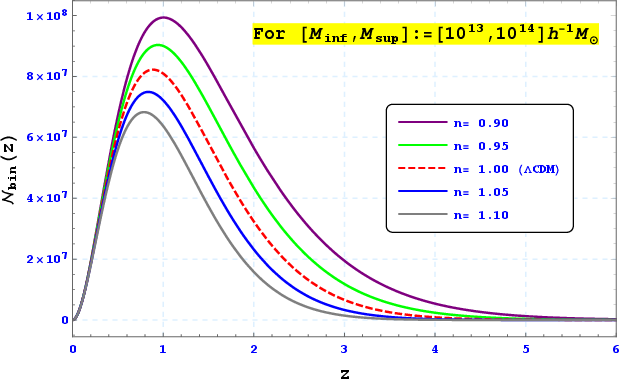
Figure 11: Number counts E(z)0 as a function of redshift for two mass bins, highlighting how the structure abundance and formation epoch respond to the entropy exponent E(z)1.
Implications, Observational Prospects, and Future Directions
The GMHE-inspired modification realizes a family of cosmological models with clear, falsifiable deviation from standard ΛCDM at both the background and perturbative levels. Theoretical implications include:
- The model reproduces the essential features of cosmic acceleration, but predicts observable alterations in the growth rate, structure formation, and cosmographic diagnostics.
- The presence of a tunable entropic parameter E(z)2 allows the possibility to ameliorate or exacerbate current cosmological tensions (E(z)3, E(z)4) by shifting the expansion and growth histories.
- The unambiguous falsification of ΛCDM by diagnostic functions and the modification of the matter power spectrum place these models squarely within reach of next-generation cosmological and large-scale structure surveys.
On the practical front, the framework is amenable to confrontation with data from CMB, SNe Ia, BAO, cosmic chronometers, and direct probes of growth (e.g., redshift-space distortions and weak lensing number counts). Future developments should:
- Extend the analysis to nonlinear structure formation, which is dominant in the late universe and sensitive to physics beyond ΛCDM.
- Perform Markov Chain Monte Carlo constraints using multi-probe datasets to quantify the permitted range of E(z)5.
- Study the impact on high-redshift observables and the implications for early structure and reionization.
Conclusion
The GMHE-inspired cosmology provides a technically consistent and phenomenologically rich generalization of standard gravity and cosmology, introducing testable deviations from ΛCDM in both the background and the evolution of structure. The E(z)6 parameter smoothly deforms all observable sectors, and its effects are manifest in expansions, growth rates, and halo statistics. This establishes the GMHE framework as a principal candidate for probing the intersection of gravitational thermodynamics and observational cosmology and motivates comprehensive future observational tests using both linear and nonlinear structure probes.