- The paper introduces a representation-theoretic framework for computing LXEB scores and second moments, enabling efficient classical evaluation in photonic experiments.
- The paper proves average-case anticoncentration in saturated Boson Sampling, providing explicit bounds that support complexity-theoretic quantum advantage claims.
- The paper offers efficient numerical tools and extends its methodology to various photonic architectures, impacting certification protocols and complexity estimations.
General Framework for Anticoncentration and Linear Cross-Entropy Benchmarking in Photonic Quantum Advantage Experiments
Introduction and Motivation
Quantifying quantum advantage in large-scale photonic systems necessitates robust certification and benchmarking protocols, prominently the linear cross-entropy benchmarking (LXEB) metric. While LXEB is standardized and well-understood for random quantum circuits on qubit platforms, its extension to photonic architectures—especially for Boson Sampling (BS) and Gaussian Boson Sampling (GBS)—has been hindered by a lack of systematic theoretical treatment. Current analytical and computational approaches for LXEB in photonic settings are generally limited to the dilute regime (m≫n2) or lack tractable expressions for experimentally relevant system sizes, particularly the saturated regime where m∼n.
This paper (2604.15258) presents a comprehensive representation-theoretic approach that addresses this gap by providing (i) a general procedure for classical computation of average LXEB scores and output probability second moments for a broad class of photonic quantum advantage experiments, (ii) a proof of average-case anticoncentration in saturated Boson Sampling, and (iii) computational tools that extend to tasks such as entanglement quantification and certification sample complexity estimation.
Representation-Theoretic Framework and Algorithmic Reductions
The technical core leverages the decomposition of two-copy bosonic Hilbert spaces (Symn(Cm)⊗Symn(Cm)) into irreducible representations of U(m). For any product-state input on m optical modes, transformation by a Haar-random interferometer and subsequent photon-number detection leads to output statistics whose second moments under Haar averaging can be reduced to computing purities of particle-reduced states (over bosons), encapsulated in traces of "bosonic swap" operators. The authors provide explicit formulas for these projectors and demonstrate that the resulting expressions for average LXEB scores are efficiently computable in time polynomial in n and m.
The framework applies uniformly across standard BS, GBS, Scattershot BS, Displaced GBS, and their lossy/partial- distinguishability variants, regardless of the mode-to-photon scaling (including the saturated regime), as long as mode product structure is preserved after commuting loss channels.
The high efficiency and generality of the algorithm are summarized and visualized in the paper’s workflow, showing a clear factorization of reference LXEB computation into detector-dependent and state-dependent terms constructed from analytic or efficiently computable primitives.
Anticoncentration Results and Computational Complexity Implications
A major contribution is the derivation of explicit second-moment-based bounds for the output statistics in saturated Boson Sampling. By relating LXEB reference values and second moments, and harnessing the Paley-Zygmund inequality, the authors rigorously prove:
- For standard Fock-state Boson Sampling with m=Θ(n), the distribution anticoncentrates on average over mode-occupation output patterns, i.e., a non-negligible fraction of output probabilities are at least a constant fraction of the mean probability ∼1/∣Sm,n∣.
- This result was previously conjectured in the original complexity-theoretic foundations of Boson Sampling but never established for the saturated regime. It brings the complexity-theoretic evidence for quantum advantage of photonic devices onto the same footing as leading qubit-based proposals (e.g., Random Circuit Sampling, IQP) in terms of the Stockmeyer reduction: additive approximate counting can now be promoted to multiplicative error on a constant fraction of instances.
The formal statement is that for collision-free BS in saturated regime, the average-case anticoncentration score AC(m,n) remains m∼n0 for all m∼n1, supporting quantitative hardness-of-approximate-simulation arguments under worst-case-to-average-case conjectures for the permanent (2604.15258).
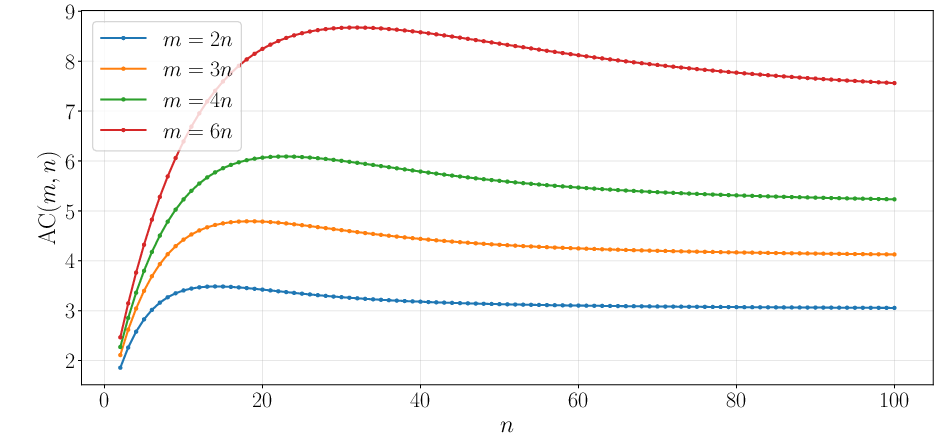
Figure 1: Numerical values of m∼n2 demonstrate tight upper bounds and empirical volume-law scaling, confirming strong average-case anticoncentration in the saturated regime.
Efficient Numerical Evaluation and Validation
The formalism's practical value is demonstrated with efficient numerical computation of LXEB reference values and empirical benchmarking studies. Monte Carlo results confirm:
- Concentration of the empirical LXEB estimator to the analytical reference value with increasing sample size and system size.
- Monotonic suppression of LXEB fidelity with increasing optical losses, as expected from noise models and as systems enter classically simulable regimes.
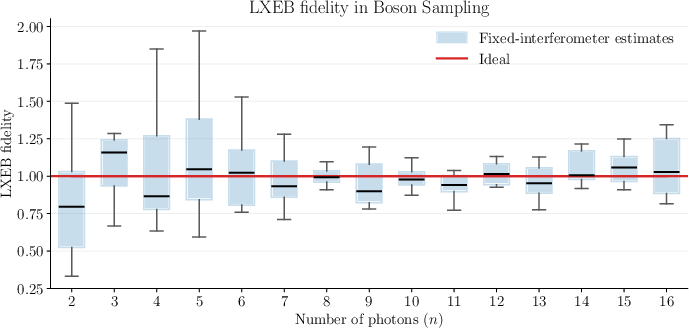
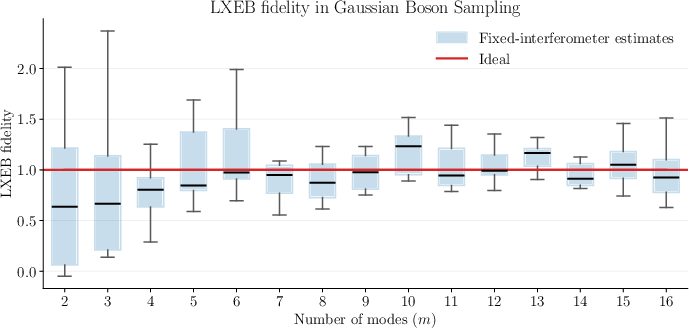
Figure 2: Comparison of analytical and estimated LXEB reference values. For each value of m∼n3, the box plot shows the distribution of LXEB fidelity estimates for independent Haar interferometers; the analytical prediction (red) matches the empirical medians.
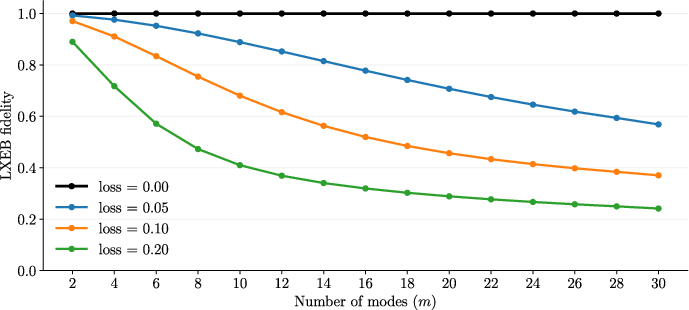
Figure 3: LXEB fidelity as a function of m∼n4 for lossy GBS. Increasing loss parameter m∼n5 reduces the benchmark score, with suppression more pronounced in larger systems.
Extension to Generalized Boson Sampling and Certification Complexity
The method extends to GBS, Scattershot, and Displaced GBS. In GBS or variants with only a few (sub-linear number) squeezed/active modes, the second-moment approach does not yield strong anticoncentration; the average-case score scales polynomially or even exponentially, predicting failure of Stockmeyer-promoted hardness in these families unless the number of non-vacuum modes scales linearly.
The framework also delivers:
- Strong lower bounds on the certification sample complexity for photonic quantum advantage experiments. The number of samples required for device-independent certification still grows exponentially, matching results from qubit platforms.
- A proof of the m∼n6 case of the Hunter-Jones conjecture for moments of random permanents, a result of independent mathematical interest.
Additionally, the bosonic swap machinery leads to efficient calculation of particle Renyi-2 entropies; exact average values following a volume law are established for random Dicke/Fock states.
Theoretical and Practical Implications
This work rigorously establishes that LXEB can and should be used as a scalable benchmarking tool for photonic quantum advantage across all current parameter regimes. It clarifies that:
- In the experimentally relevant saturated regime, confirmation of average-case anticoncentration enables robust complexity-theoretic reductions needed for quantum advantage claims.
- Second-moment analysis is optimal for Fock-state BS, but insufficient for GBS unless a linear number of modes are genuinely non-vacuum.
- Device-independent certification remains out of reach in terms of sample complexity, supporting the need for tailored, hybrid, or model-dependent approaches.
- Extensions to threshold detectors, loss-mitigated/correlated-loss circuits, and higher-moment invariants remain promising open problems.
Conclusion
This paper delivers a unifying, representation-theoretic methodology that retrofits linear cross-entropy benchmarking and anticoncentration theorems to the experimental realities and theoretical difficulties of photonic quantum advantage. Its efficient tools, broad regime coverage, and complexity-theoretic rigor will have immediate impact on experiment design, verification protocols, and further theoretical developments in quantum sampling complexity (2604.15258).

