- The paper demonstrates that an optimized positive-P classical algorithm accurately reproduces experimental GBS statistics, challenging conventional quantum advantage claims.
- The simulation leverages thermalized squeezed state models and iterative whitening transformations to incorporate realistic detector and decoherence effects with quadratic scaling.
- The study reveals that, under full experimental imperfections, classical methods outperform state-of-the-art GBS experiments in key low-order statistical metrics.
Benchmarking Quantum Advantage in Gaussian Boson Sampling
Introduction
This paper scrutinizes claims of quantum advantage derived from Gaussian boson sampling (GBS) experiments, introducing a scalable classical algorithm leveraging positive-P phase-space methods. Contrary to widely held assumptions, the paper demonstrates that for current large-scale GBS experiments, including Jiuzhang 2–3 and Borealis, classical simulation remains competitive with or surpasses experimental results regarding adherence to ideal quantum output statistics, once full experimental imperfections are considered. These findings have significant implications for the certification of quantum advantage in photonics-based quantum computing platforms.
Gaussian Boson Sampling Fundamentals
GBS entails inputting multi-mode pure squeezed states through linear photonic networks, with output photon-counting in each mode yielding exponentially hard-to-compute random bit-strings. When losses, decoherence, and parameter errors are accounted for, the theoretical hardness of simulating GBS distributions may not align with experimental realizability. Quantum advantage requires that the experimental data be distinguishable from classical predictions within a regime of computational intractability for classical methods.
The positive-P and Glauber-Sudarshan P representations are foundational for the analysis. Sufficient thermal noise can render the state classical, and thus efficiently simulable. The authors leverage a thermalized squeezed state model, characterized by decoherence parameters and loss corrections, to accurately reflect experimental imperfections.
Classical Simulation Algorithm
The proposed algorithm projects positive-P samples onto the physical subspace corresponding to detector measurements. It incorporates detector models (threshold detectors and photon-number-resolving detectors) and iteratively applies whitening-coloring transformations to match target means, variances, and covariances. The sampler's initial state distribution is optimized for squeezed states to minimize projection error, using parametrizations that enhance compactness in phase space.
The computational efficiency is noteworthy: the sampler achieves quadratic scaling with mode number, enabling simulation of up to 1152-mode systems (as in Jiuzhang 3) within minutes on commodity hardware. Comparisons reveal that classical tensor-network approaches (e.g., matrix-product-state methods) are memory-bound and thus nonviable for next-generation experiments.
Evaluation Metrics and Results
Full system total variation distance is cited as the only measure with formal complexity-theoretic guarantees, but is computationally unattainable for experimental regime sizes. Instead, the study evaluates grouped count distributions (GCDs), various order marginals, and cross-entropy benchmarking (XEB). Comparisons use maximum Z-scores to quantify the statistical significance of deviation from ground-truth quantum statistics.
Across a battery of experiments, the positive-P sampler either matches or outperforms experimental data, as well as state-of-the-art classical squashed-state, greedy cumulant-matching, and matrix-product-state samplers on all low-order statistical observables, even when experimental device imperfections and realistic decoherence are included.
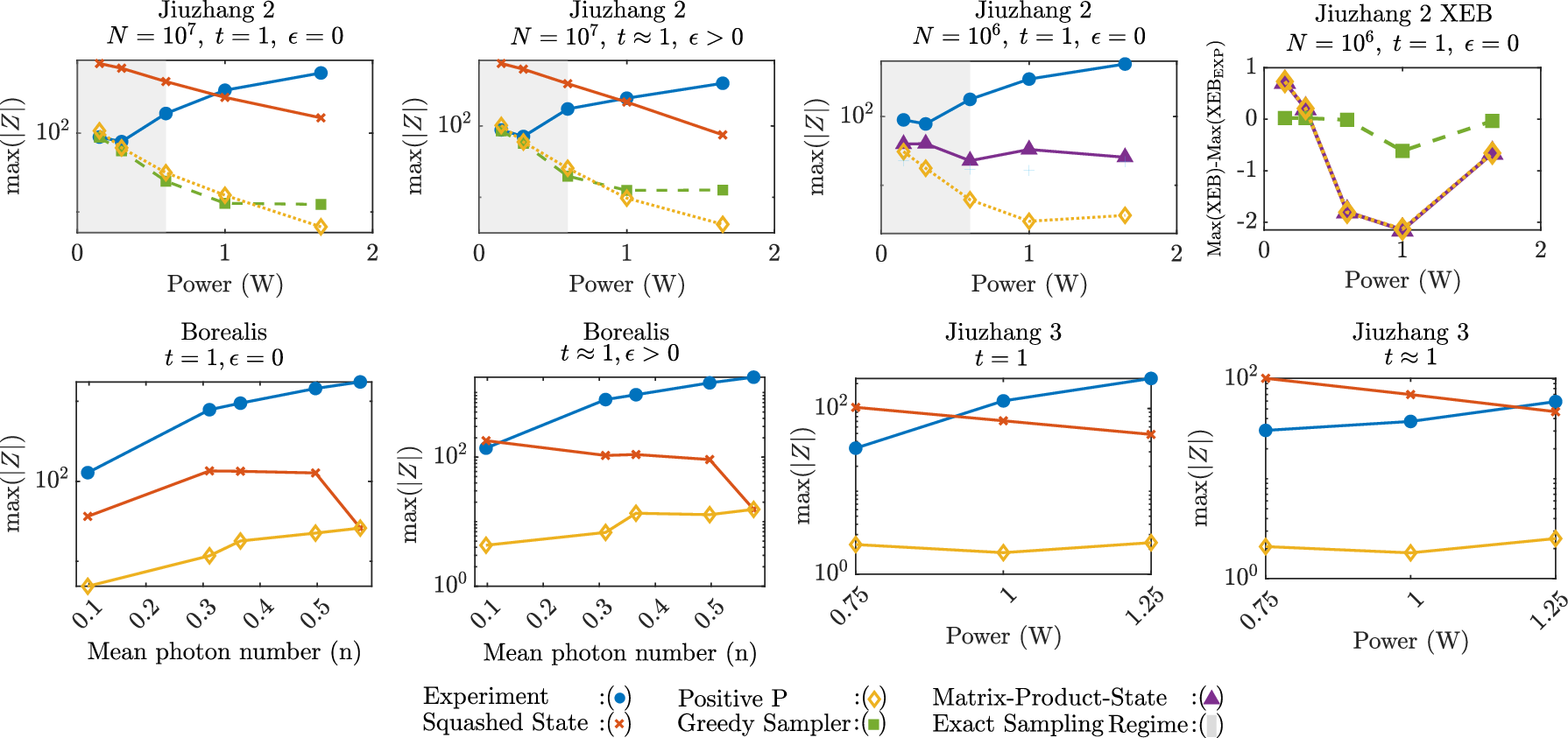
Figure 1: Comparison of experimental and classical sampler deviations from ground-truth using maximum Z-score and XEB; lower values indicate closer agreement, with the positive-P sampler outperforming both experiments and alternative classical algorithms across regimes.
Specifically, the Jiuzhang and Borealis datasets are better matched by the classical sampler than by the experiments themselves in terms of GCDs and first- to twentieth-order marginals. Even after including decoherence and transmission corrections in the ground-truth model, this superior performance is robust. For instance, all Z-scores obtained by the sampler are well below the threshold for statistical disagreement (∣Z∣≤3), while experiments frequently violate this bound.
Implications and Theoretical Significance
The primary implication is that the presence of nontrivial experimental imperfections—beyond mere losses—facilitates efficient classical simulation of GBS output. This finding challenges the certification of quantum advantage by current photonic hardware, indicating that claimed advantage regimes may not have actually realized intractable quantum sampling, but rather a classically tractable variant due to noise and decoherence.
The developed methodology systematically benchmarks quantum experiments against state-of-the-art classical simulation, exposing not only shortcomings in experimental quantum simulation claims but providing a reproducible path to improved verification standards. The approach can be extended to other architectures and may reveal limits of quantum advantage claims as experimental complexity increases.
Practical Outlook and Future Research
The classical sampler's tractability up to multi-thousand mode systems suggests that future demonstrations of quantum advantage must either improve hardware noise, decoherence, and calibration, or adopt experimental architectures inherently more robust to classical simulation. The paper forecasts that as hardware improves, such benchmarking methods will refine the boundary for true quantum-classical separation.
Algorithmically, the methodology invites extensions incorporating more detailed physical noise models, as well as applications in certifying other quantum random number generators and linear optical processors. The software stack provided (XQSIM) enables open verification and future reproducibility.
Conclusion
This work demonstrates, via detailed numerical and statistical analysis, that current flagship GBS experiments have not yet achieved unequivocal quantum advantage over optimized classical simulation. The efficient positive-P phase-space-based sampler should now serve as a necessary benchmark for all GBS-based quantum computing experiments, refining both practical implementations and the broader theoretical understanding of quantum advantage in the NISQ era.