- The paper introduces a UV-motivated EFT where integrating out a heavy Dirac fermion generates correlated threshold corrections to the inflaton potential and gauge couplings.
- It demonstrates that transient, helicity-selective gauge field amplification produces a sharply localized chiral gravitational wave signal at deci-hertz frequencies.
- The framework confines gauge production to a finite e-fold interval, avoiding excessive PBH formation and ensuring consistency with CMB constraints.
Axion Inflation from Heavy-Fermion One-Loop Effects
Overview and Motivation
This paper ("Axion Inflation from Heavy-Fermion One-Loop Effects" (2604.13674)) presents a top-down, UV-motivated effective field theory (EFT) for axion inflation with gauge coupling sourced by integrating out a heavy Dirac fermion whose mass depends on the inflaton field. The framework naturally generates correlated threshold corrections to both the inflaton potential and the gauge field sector—including a Coleman-Weinberg deformation, vacuum polarization, and anomaly-induced Chern-Simons coupling. These effects modify the standard axion-gauge inflationary dynamics, leading to transient, helicity-selective gauge field amplification and a sharply localized chiral gravitational wave (GW) signal at deci-hertz frequencies.
Effective Field Theory Construction
The starting point is a UV theory with a heavy Dirac fermion Ψ coupled to the axion inflaton ϕ via a complex mass term parametrized by smooth profile functions TS(ϕ) and TP(ϕ). Integrating out Ψ at one loop yields the following elements in the low-energy effective action:
- Coleman-Weinberg correction: A localized deformation of the inflaton potential, V~(ϕ), modifying inflaton dynamics near the threshold ϕ∼ϕp.
- Vacuum-polarization correction: Field-dependent renormalization of the gauge kinetic term I1(ϕ)FμνFμν.
- Anomaly-induced Chern-Simons coupling: I2(ϕ)FμνF~μν, with I2(ϕ) determined by the heavy threshold and UV anomaly matching.
These threshold-induced correlating structures are sharply localized in field space, manifesting via a tanh profile centered at ϕ0, and impact only a bounded range of e-folds. The formulation respects UV symmetries and avoids arbitrary ad hoc couplings in the gauge sector.
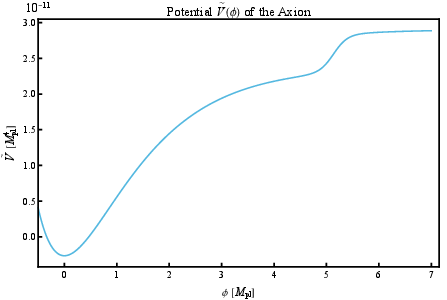
Figure 1: Shape of the effective inflaton potential ϕ1, which exhibits a plateau and a localized threshold transition around ϕ2, affecting the inflaton velocity transiently.
Dynamics and Gauge Field Production
The inflationary dynamics are governed by the deformed potential and modified gauge couplings. The localized threshold triggers particle production primarily via the anomaly-induced Chern-Simons term, acting as a dynamical switch for gauge field amplification. The instability parameter ϕ3 is enhanced transiently when ϕ4 suppresses the gauge kinetic term, facilitating efficient amplification of one gauge field helicity while the other remains in vacuum.
Numerical analysis reveals a strong hierarchy between the polarizations, with transient, localized amplification driven by the Chern-Simons instability and negligible contribution from the pump term:
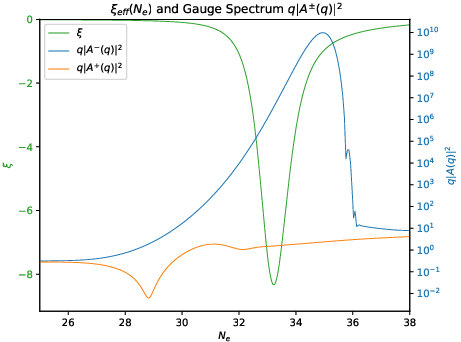
Figure 2: Evolution of ϕ5 and the gauge field spectra ϕ6, demonstrating transient, localized, helicity-selective gauge field amplification at the threshold.
The threshold profile is tuned so that gauge production avoids significant late-time amplification, thereby preventing strong backreaction and excessive primordial black hole (PBH) formation.
Sourced Gravitational Waves
Helicity-selective gauge field amplification acts as a source of tensor perturbations, yielding a parity-violating GW background. The resulting present-day GW energy density spectrum ϕ7 is sharply peaked in the deci-hertz band, with ϕ8 for the dominant helicity. This amplitude is within the projected sensitivity of space-based interferometers such as BBO and DECIGO, with the signal being highly chiral and confined to a narrow frequency window.
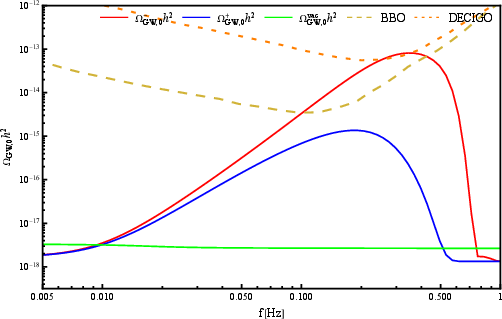
Figure 3: Present-day GW energy spectrum ϕ9 for each polarization and vacuum contribution. The chiral GW signal is sharply localized and within reach of future interferometers.
The scalar sector, sourced by the same transient gauge instability, exhibits a similarly localized enhancement in the curvature power spectrum. The peak remains below stringent PBH constraints, maintaining compatibility with dark matter bounds and not inducing excessive small-scale density perturbations.
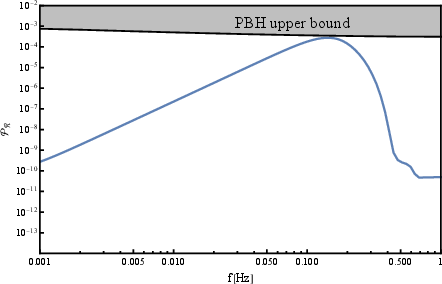
Figure 4: Curvature power spectrum TS(ϕ)0 sourced by the transient gauge instability, showing a sharp peak at deci-hertz frequencies and remaining below PBH constraints.
Theoretical and Phenomenological Implications
The analysis demonstrates that correlated features in axion-gauge inflation—often introduced independently in bottom-up models—can emerge from a common heavy threshold in a UV-complete context [Ellis:2020ivx, Quevillon:2021sfz]. This EFT structure enforces correlated variations across the potential and gauge couplings, generates a transient enhancement of both the instability parameter and gauge field amplification, and enables controlled realization of detectable stochastic GW backgrounds without violating PBH or CMB constraints.
Claims supported by strong numerical results:
- The model yields a GW background with TS(ϕ)1 at deci-hertz frequencies,
- The sourced scalar power spectrum is sharply localized and does not exceed PBH abundance bounds,
- The correlated threshold structure confines gauge production to a finite e-fold interval, decoupling it from late-time inflation dynamics and reheating.
Contradictory with standard axion-gauge models:
- Standard monotonic axion models with always-on Chern-Simons coupling produce excessive late-time gauge amplification, potentially extending inflation and violating PBH constraints [Barnaby:2011qe, Garcia-Bellido:2016dkw]. Here, the threshold-induced localization prevents such issues.
- The threshold-based mechanism achieves efficient gauge production and GW signal without requiring parametrically large coupling constants, relying instead on controlled suppression via TS(ϕ)2 and dynamical switching via TS(ϕ)3.
The approach can be extended to more intricate UV completions and multiple threshold profiles, leading to richer phenomenological structures such as multi-peak or oscillatory GW and scalar spectra.
Outlook and Future Directions
This framework bridges the gap between UV physics and phenomenological inflationary model building, showing that heavy sector thresholds can orchestrate correlated features in the inflaton potential and gauge couplings. Future work could analyze non-aligned or asymmetric threshold profiles, multi-step or oscillatory transitions, and explicit string or GUT completions, further enriching the observational signatures and enhancing the predictive power of axion inflationary models.
The sharp GW signal provides a concrete target for future interferometer searches and offers a discriminant for models with transient chiral gauge production. Extensions of this method could systematically relate axion relics and anomaly-driven signatures to the heavy sector content of UV theories, enabling a broader exploration of early universe phenomenology.
Conclusion
This paper develops a UV-motivated, one-loop EFT for axion inflation, integrating out a heavy Dirac fermion with inflaton-dependent mass. The resulting correlated threshold corrections transiently enhance and localize gauge field production, yielding a sharply peaked, chiral stochastic GW signal at deci-hertz frequencies, consistent with PBH and CMB constraints. The theoretical structure avoids arbitrary couplings and late-time amplification issues endemic to standard axion-gauge models. The approach integrates UV principles with inflationary phenomenology, providing a pathway for more predictive and testable models in early universe cosmology.