Ultrafast all-optical quantum teleportation
Abstract: Light's intrinsic carrier frequency of hundreds of terahertz theoretically enables information processing at terahertz clock rates. In optical quantum computing, continuous-variable quantum teleportation is the fundamental building block for deterministic logic operations. This protocol transfers unknown quantum states between nodes using quantum entanglement and real-time feedforward of measurement outcomes. However, electrical feedforward bottlenecks currently restrict operational bandwidths to approximately 100 megahertz, preventing the exploitation of light's ultimate speed. Here we show 1-terahertz-bandwidth all-optical quantum teleportation, completely bypassing this electronic limitation. By transferring Bell measurement outcomes optically, we successfully teleported vacuum states across the terahertz band and real-time random coherent wavepackets with a 42-picosecond temporal width. Evaluating the intrinsic state transfer quality, we achieved teleportation fidelities of $\mathcal{F}=0.784$ for the broadband vacuum states and $\mathcal{F}=0.770$ for the dynamic coherent wavepackets. Both results strictly surpass the classical limit of $\mathcal{F}=0.5$, demonstrating genuine quantum teleportation at ultrafast speeds. Our results establish that optical quantum processing speeds are constrained solely by the nonlinear medium's 1-picosecond-scale response, rather than classical electrical interfaces. This methodology provides a cornerstone for terahertz-clock quantum computers capable of overcoming Moore's law, and paves the way for a high-capacity, telecom-compatible quantum internet.
Paper Prompts
Sign up for free to create and run prompts on this paper using GPT-5.
Top Community Prompts
Explain it Like I'm 14
What this paper is about (in plain words)
This paper shows a way to “teleport” the shape of a light signal from one place to another using only light, and to do it incredibly fast—up to terahertz speeds (that’s a trillion steps per second). The trick is to avoid slow electronics and keep everything in the optical world. The authors prove this by demonstrating all‑optical quantum teleportation that works across a huge range of colors (1 terahertz of bandwidth) and in real time for ultra‑short (42 picosecond) light pulses.
What questions the researchers asked
- Can we perform quantum teleportation entirely with light (no electronic detours), so the speed is limited only by optics?
- Will this work across a terahertz‑wide band and for ultrafast, picosecond‑long light pulses?
- Can the quality be high enough to beat what’s possible with ordinary (non‑quantum) methods?
How they did it (with simple analogies)
Think of teleportation here as copying the “wiggles” of one light wave onto another distant light wave without directly sending the original. It uses two ingredients: shared quantum links and a set of instructions sent forward.
Here’s the idea in everyday terms:
- Entanglement = a pair of “magic twins.” Imagine two coins that always match in special ways no matter how far apart they are. The team creates this pair with special optical devices.
- Measurement and instructions = taking a snapshot and sending directions. They do a joint check on one twin and the incoming light signal. That measurement produces “directions” (what change to make) so the other twin can take on the same “wiggles” as the original.
- All‑optical feedforward = passing the instructions as light, not as electronics. Instead of converting light to electrical signals (which slows things down), they keep the directions as light and use optical parametric amplifiers (OPAs)—think of them as ultra‑fast optical megaphones—to boost and apply those directions directly in light.
- Two kinds of tests:
- Frequency test (how it behaves across many colors): They checked performance across a 1‑terahertz spread using an optical spectrum analyzer (like measuring how well it works for lots of musical notes at once).
- Time test (how it behaves moment by moment): They sent in fast, randomly changing light pulses only 42 picoseconds long (a picosecond is a trillionth of a second) and watched whether the output followed those changes in real time.
Some helpful terms:
- Terahertz (THz): 1,000,000,000,000 steps per second. Extremely fast.
- Picosecond (ps): 0.000000000001 seconds. Extremely short.
- Fidelity: a score from 0 to 1 for how well the teleported output matches the input (1 is perfect).
- Classical limit (0.5 fidelity): the best you can do without quantum entanglement.
- No‑cloning threshold (~0.667): above this, your copy is better than any possible duplicate made by ordinary (non‑quantum) means.
What they found
- All‑optical speed: By keeping everything in light (no light‑to‑electronics‑back‑to‑light detours), they reached a 1‑terahertz teleportation bandwidth. That’s at least 10,000 times faster than typical electronic limits (~100 megahertz).
- High quality (beats classical): They teleported
- “Vacuum” states (essentially the quietest possible light, used to test noise) across the terahertz band with fidelity F ≈ 0.784.
- Real‑time, random light pulses 42 picoseconds long with fidelity F ≈ 0.770.
- Both fidelities are well above the classical limit of 0.5 and even above the tougher “no‑cloning” benchmark of about 0.667. In short, this is genuine, high‑quality quantum teleportation at ultrafast speeds.
- The true speed limit is optical, not electronic: Their results show the remaining limit comes from how fast the optical materials respond (around 1 picosecond), not from any electronics.
Why this is impressive:
- The team didn’t just show it works at one frequency or in slow motion—they showed it works across a huge range and on ultrafast, rapidly changing signals, which is what real optical processors need.
Why it matters
- Toward terahertz‑clock quantum computers: In many optical quantum computing designs, teleportation is the main “logic gate.” Making it all‑optical and ultrafast unlocks processors that tick at terahertz rates—far beyond today’s kilohertz–megahertz quantum platforms.
- Faster and more scalable: Faster clocks mean you can process more steps in the same wall‑clock time. In time‑multiplexed optical designs, shortening pulses to picoseconds also means you can fit many more “quantum modes” into the same hardware, potentially reaching millions of parallel channels.
- Energy and sustainability: Instead of using many slower chips in parallel (which burns lots of power), a single ultrafast optical processor can do more work with less energy.
- Network‑ready: The system uses telecom‑friendly wavelengths, making it a good fit for fiber‑optic networks and future 6G‑class systems—useful for building a high‑capacity, long‑distance quantum internet.
The bottom line
The researchers built and tested an all‑optical quantum teleportation system that works across a 1‑terahertz band and in real time for picosecond pulses, with proven quantum‑level performance. This removes a long‑standing speed bottleneck and lays the groundwork for ultrafast, scalable, and network‑ready optical quantum computers and communications.
Knowledge Gaps
Knowledge gaps, limitations, and open questions
The paper demonstrates terahertz-bandwidth, all-optical CV quantum teleportation using waveguide OPAs, but several aspects remain unaddressed or only partially explored. The following concrete gaps and questions can guide follow-on work:
- Scope of teleported states: Only vacuum and coherent states were teleported; non-Gaussian states (e.g., cat, GKP, single-photon states) and strongly squeezed states were not demonstrated. Can the system preserve Wigner negativity and nonclassical features at THz bandwidth?
- Fault-tolerance relevance: Reported fidelities (≈0.77–0.78) are not benchmarked against known thresholds for CV fault tolerance (e.g., for GKP or other encodings). What fidelity/squeezing and loss budget are required per gate for scalable, fault-tolerant MBQC at THz, and how will this platform meet them?
- Process-level characterization: Teleportation was assessed via variances/fidelity; no broadband quantum process tomography or transfer function reconstruction was provided. What is the frequency-resolved gain, phase, and added-noise profile of the teleporter across the full 2 THz span?
- EPR resource characterization: The entanglement bandwidth and strength (e.g., squeezing spectrum, Duan–Simon criterion vs frequency) were not reported. How uniform is the EPR correlation across 1 THz, and what limits it?
- Feedforward latency and timing budget: End-to-end latency (from Bell measurement to displacement) was not quantified. Can the optical feedforward and optical delay lines ensure corrections are applied within the wavepacket duration (ps scale) for time-domain MBQC? What is the jitter tolerance and measured timing jitter?
- Real-time readout limitation: The 42 ps time-domain test was bounded by electronics; ps-level operation was inferred from frequency-domain bandwidth. Can direct ultrafast optical sampling or electro-optic sampling validate true sub-10 ps real-time response without electronic bottlenecks?
- Spectral–temporal mode definition: The paper does not detail how orthogonal temporal/spectral modes are defined and isolated across 1 THz. What is the inter-mode crosstalk, and how does dispersion affect mode orthogonality and fidelity?
- Dispersion and phase stability: Quantitative dispersion management and phase stability (pump–signal phase locking, phase noise across 1 THz, long-term drift) were not characterized. What are the requirements and achieved metrics for stable phase-sensitive operation over hours?
- OPA noise figure and pump noise: Excess noise contributions from PSA/OPA (e.g., pump RIN/phase noise transfer, spontaneous Raman/Brillouin, photorefraction) were not decomposed. What is the measured noise figure for the amplified quadrature, and how does it scale with gain and bandwidth?
- Loss budget and de-embedding: Intrinsic fidelities were inferred by de-embedding an assumed 10% detection loss; uncertainty in this estimate and sensitivity analysis were not provided. What is the full loss/error budget (with uncertainties) across generation, feedforward, and measurement?
- Dynamic range and linearity: The amplitude range, linearity, and potential saturation/distortion of displacement and PSA stages for high-speed, large-amplitude wavepackets were not reported. What are the maximum teleportable amplitudes at THz rates without distortion?
- Adaptive MBQC operations: MBQC requires fast, adaptive measurement basis control (phase angles) conditioned on prior outcomes. How will dynamically programmable, per-mode optical phase shifts and displacement signs/gains be implemented at THz rates?
- Cascaded teleportations: Only a single teleportation step was demonstrated. How do loss and noise accumulate over multiple cascaded teleportations (as required in MBQC), and what is the observed fidelity after 2–N stages at THz bandwidth?
- Multimode/multiplexed operation: Parallel/WDM teleportation and time-domain multiplexing at ps spacing were not shown. What are inter-channel crosstalk, pump depletion effects, and resource overhead when scaling to hundreds–millions of modes?
- Integration and packaging: The setup relies on discrete PPLN waveguides and free-space/fiber coupling; on-chip integration, coupling losses, and thermal management were not addressed. What is the path to low-loss, phase-stable, monolithic integration?
- Energy per operation: Claims about energy advantages were qualitative; there was no measurement of pump power per teleported mode or energy/bit at THz rates. What are the actual energy costs and how do they compare to electronic counterparts?
- Telecom network deployment: Fiber-distance teleportation with all-optical feedforward was not demonstrated. How do fiber attenuation, PMD, and chromatic dispersion across 1 THz sidebands affect fidelity over km-scale links, and what compensation is needed?
- Latency at distance and buffering: For remote nodes, speed-of-light delays exceed ps wavepacket durations. What optical buffering or feedforward scheduling is required for long-haul teleportation, and how does this impact clocking and error rates?
- Compatibility with classical traffic: Coexistence with classical WDM channels (ASE noise, XPM, FWM) in telecom fibers was not studied. What isolation and filtering are required to preserve quantum fidelity in realistic network environments?
- Maximum achievable bandwidth: The asserted ~1 ps nonlinear response limit was not experimentally measured. What is the OPA’s impulse response and true 3 dB/10 dB bandwidth limits considering group-velocity mismatch and quasi-phase-matching constraints?
- Displacement implementation details: The exact optical displacement mechanism (e.g., interference with calibrated strong fields) and its calibration accuracy across 1 THz were not detailed. What is the frequency-dependent displacement accuracy and noise penalty?
- Measurement methodology via OSA: Using an OSA for quadrature-noise characterization provides time-averaged spectra; calibration details (RBW, ENBW, noise floor, shot-noise reference method) were sparse. How robust is the OSA-based quadrature noise inference across 1 THz?
- Polarization management: Polarization stability and its impact on PSA gain and homodyne alignment across the band were not discussed. What polarization control strategies are needed for stable operation in fiber and chip platforms?
- Environmental robustness: Sensitivity to temperature and photorefraction (notable in PPLN at 772 nm pumping) and long-term reliability were not quantified. What temperature control and mitigation are necessary for stable THz operation?
- Error mechanisms vs frequency: The slight frequency dependence of variances hints at nonuniformity; a detailed map of excess noise and gain flatness vs frequency was not provided. What are the dominant frequency-dependent error sources?
- Thresholds for non-Gaussian gate teleportation: The claim that fidelities are “high enough to support non-Gaussian state teleportation” was not substantiated with thresholds and error models. What are the quantitative requirements and demonstrated margins?
- Synchronization and clock distribution: THz-clock operation requires sub-ps timing distribution and synchronization among pumps, LOs, and modes. What are the demonstrated and required timing jitter and clocking schemes for scalable systems?
- Interfacing with photon-number measurements: Universal CV MBQC requires non-Gaussian measurements (e.g., photon counting or cubic-phase resources). How can such measurements or resources be integrated with all-optical, THz-rate feedforward?
- Cross-platform compatibility: Interfacing this CV teleporter with discrete-variable qubits (hybrid architectures) was not explored. Can DV states be teleported or converted without degrading nonclassicality at THz bandwidths?
- Error bars and stability over long runs: Reported error bars are dominated by OPA gain fluctuations; longer-term stability, drift rates, and recalibration intervals were not given. What are the operational stability metrics over hours–days?
- Benchmarking against state-of-the-art: A quantitative comparison to prior broadband CV teleportation (bandwidth, fidelity, energy, latency) was limited. Can standardized benchmarks be established for fair cross-platform evaluation?
Practical Applications
Immediate Applications
The paper demonstrates 1-THz-bandwidth, all-optical continuous-variable (CV) quantum teleportation by replacing electrical feedforward with phase-sensitive amplification (PSA) in waveguide optical parametric amplifiers (OPAs) at telecom wavelengths. This enables practical, near-term use in R&D, measurement, and telecom prototyping, even before large-scale quantum computing and networks are realized.
- Ultrafast all-optical feedforward modules for CV quantum optics labs (Academia; Photonics/Quantum)
- What: Deploy PSA-based, all-optical displacement/feedforward loops as drop-in replacements for O–E–O paths in CV experiments to eliminate ~100 MHz electronic bottlenecks and reach THz-class processing for teleportation, entanglement swapping, and measurement-based gates.
- Tools/products/workflows: Standalone PPLN waveguide PSA modules; fiber-coupled entanglement/displacement blocks; phase-locking controllers for CW pumps; alignment and calibration workflows for THz-bandwidth homodyne+OPA readout.
- Assumptions/dependencies: Availability of high-gain, low-noise PSAs; stable pump–signal phase control; low-loss fiber components; trained personnel to operate squeezing/entanglement sources.
- Broadband preamplified homodyne detection for ultrafast metrology (Industry/Academia; Test & Measurement, Sensing)
- What: Use PSA “preamplification” to overcome detector inefficiency and extend homodyne/electro‑optic sampling into the THz sideband regime for characterizing ultrafast optical fields, squeezed states, and modulators.
- Tools/products/workflows: PSA-augmented homodyne receivers; calibration protocols anchored to the paper’s classical-limit (+4.77 dB) benchmark; THz-bandwidth noise spectral analyzers using OSAs with PSA front ends.
- Assumptions/dependencies: Detector linearity with amplified signals; pump-induced noise control; phase stabilization across wide bandwidths.
- Telecom-compatible ultrafast quantum optics testbeds (Industry/Academia; Telecom/6G, Networking)
- What: Build fiber-based benches at 1545 nm to prototype quantum-compatible links (e.g., entanglement distribution, teleportation-based channel characterization) using the demonstrated THz-bandwidth all-optical feedforward.
- Tools/products/workflows: Fibered PPLN OPA/PSA subsystems; WDM integration; synchronization with existing coherent transceivers for co-propagation tests; impairment-tolerant phase control schemes.
- Assumptions/dependencies: Sufficient optical power for CW pump at 772.66 nm; environmental stabilization (temperature, vibration); compatibility with incumbent fiber infrastructure.
- Component benchmarking under quantum-relevant, THz conditions (Industry; Photonics Manufacturing, QA)
- What: Use the teleportation protocol’s noise/fidelity metrics (e.g., fidelity >0.77, excess noise well below classical limit across 1 THz) as standardized stress tests for OPAs, squeezers, and detectors.
- Tools/products/workflows: Production QA lines that log quadrature variances vs. sideband frequency; gain-fluctuation tracking (σ≈0.06 dB) as a stability KPI; automated lock acquisition/hold routines.
- Assumptions/dependencies: Reproducible EPR generation; traceable shot-noise calibration; serviceable lifetime of waveguide OPAs under continuous pumping.
- Training platforms for time-domain multiplexed MBQC (Academia; Education, Quantum Information)
- What: Use the 42-ps coherent-wavepacket teleportation workflow to teach/control time-bin mode extraction, ultrafast feedforward, and real-time quadrature processing for MBQC curricula and student labs.
- Tools/products/workflows: Mode-defining windowing tools aligned to autocorrelation decay; software-defined pipelines for THz-sideband data analysis; lab exercises comparing classical vs. quantum teleportation regimes.
- Assumptions/dependencies: Access to ultrafast oscilloscopes for readout (even if intrinsic processing is all-optical); safe operating procedures for high-power pumps.
- Input to standards and roadmaps for quantum-ready optical networks (Policy/Standards; Telecom/6G, Quantum Internet)
- What: Inform requirements for quantum-compatible optical infrastructure (e.g., loss budgets, phase stability, PSA interoperability) and guide spectrum/technology roadmaps anticipating 6G–quantum convergence.
- Tools/products/workflows: Draft test profiles using classical-limit and no-cloning thresholds; reference topologies for entanglement-based services over C-band fiber; guidance for PSA safety/EMC compliance.
- Assumptions/dependencies: Engagement with standards bodies (e.g., ITU-T, ETSI); cross-lab intercomparisons to validate metrics; consensus on CV vs. DV network primitives.
Long-Term Applications
The results establish that CV teleportation—core to measurement-based quantum computing—can run at THz clock rates, with fidelity exceeding both classical and no-cloning thresholds. Realizing the following applications will require advances in squeezing, loss reduction, non-Gaussian resources, integration, and networking.
- Terahertz-clock, measurement-based optical quantum computers (Industry/Academia; Computing, Software, AI)
- What: Build general-purpose CV MBQC processors with picosecond time-bin modes and million-qumode scalability, exploiting all-optical feedforward to execute gates at THz rates.
- Tools/products/workflows: Integrated photonic chips combining PPLN OPAs, low-loss beam splitters, and on-chip phase control; compilers that map algorithms to time-domain cluster states and optical-displacement schedules; thermal and phase stabilization packages.
- Assumptions/dependencies: Fault-tolerant CV schemes with non-Gaussian resources (e.g., GKP, cubic phase states); >10 dB squeezing with ultralow loss; error-correction overheads compatible with ps-scale modes; robust cluster-state generation at THz bandwidths.
- Energy-efficient quantum–photonic supercomputers (Industry; HPC, Energy)
- What: Replace massive parallelization with single-processor THz clocks to reduce data center power and footprint while delivering wall‑clock quantum speedups for simulation, optimization, and AI.
- Tools/products/workflows: Photonic quantum accelerators co-packaged with classical control; optical cryogenics-free operation where possible; green-computing benchmarks quantifying energy per operation vs. classical HPC.
- Assumptions/dependencies: Viable large-scale error correction; reliable non-Gaussian state factories; supply chains for low-loss, wafer-scale PPLN and silicon nitride photonics; software stacks for hybrid quantum-classical workflows.
- High-capacity, telecom-compatible quantum internet and ultrafast repeaters (Industry/Policy; Telecom/6G, Security)
- What: Deploy THz-bandwidth teleportation within quantum repeater nodes for high-throughput entanglement distribution, enabling scalable quantum key distribution, distributed quantum computing, and clock/network synchronization.
- Tools/products/workflows: All-optical Bell-state measurement and feedforward in repeater chains; WDM multiplexing of entanglement channels; compatibility layers with 6G fronthaul/backhaul; quantum service orchestration and monitoring.
- Assumptions/dependencies: Quantum memories or equivalent buffering with ps-mode compatibility (or multimode alternatives); low-loss long-haul links; entanglement purification/switching at scale; network synchronization at sub-ps precision.
- Measurement-device-independent and teleportation-based CV-QKD at Tb/s-class rates (Industry; Cybersecurity)
- What: Use teleportation as a primitive for high-rate, measurement-device-independent CV-QKD to mitigate detector side-channel risks while leveraging telecom infrastructure.
- Tools/products/workflows: PSA-based, all-optical displacement at relay nodes; multi-channel WDM key generation; real-time parameter estimation using PSA-enhanced homodyne readout.
- Assumptions/dependencies: Security proofs incorporating broadband PSA dynamics; field-deployable phase stabilization; component drift management; certification frameworks for quantum-grade devices.
- Distributed quantum sensing and ultrafast sensor networks (Industry/Academia; Healthcare, Industrial IoT, Navigation)
- What: Teleport quantum states between sensors or to processing hubs at ps timescales for enhanced timing, imaging, or field sensing, leveraging squeezed/entangled resources and all-optical feedforward.
- Tools/products/workflows: PSA-assisted sensor front-ends; networked homodyne receivers; synchronization and calibration protocols for ps-bin modes; edge–cloud quantum processing.
- Assumptions/dependencies: Robust entanglement distribution in noisy environments; integration with classical sensor networks; application-specific metrological guarantees.
- Photonic AI accelerators with quantum-enhanced linear operations (Industry; AI/ML, Robotics)
- What: Incorporate ultrafast all-optical feedforward and CV transformations as high-speed analog primitives for linear algebra and signal transforms, with potential quantum noise advantages in niche regimes.
- Tools/products/workflows: Programmable photonic meshes combined with PSAs for gain/phase control; MBQC-inspired optical instruction sets for matrix operations; calibration via teleportation-based self-tests.
- Assumptions/dependencies: Precision/accuracy trade-offs acceptable for AI inference; integration with digital control loops; mitigation of cumulative phase and gain errors at THz rates.
- Monolithic, co-packaged all-optical teleportation chips (Industry; Semiconductors, Photonics)
- What: Fabricate foundry-grade, wafer-scale chips integrating PPLN or AlN nonlinear waveguides, beam splitters, and on-chip PSAs to deliver turnkey teleportation/MBQC primitives.
- Tools/products/workflows: Heterogeneous integration (LiNbO₃ on SiN/Si); on-chip pump routing and stabilization; thermal phase shifters and feedback; electronic–photonic co-design kits for quantum photonics.
- Assumptions/dependencies: Yield and uniformity of nonlinear films; low-propagation-loss waveguides at C-band; scalable phase locking without bulky optics; reliability over temperature/aging.
- Standards and regulation for THz-band quantum photonics (Policy; Standards, Safety)
- What: Establish performance, interoperability, and safety standards for PSA-based quantum modules, including spectra allocation, pump safety, EMC, and calibration references for THz-sideband devices.
- Tools/products/workflows: Cross-lab round-robin tests using fidelity and excess-noise metrics; certification procedures for entanglement/teleportation performance; alignment with 6G spectrum and optical safety codes.
- Assumptions/dependencies: Broad stakeholder engagement; stable metrological references; alignment across regional standards bodies.
Notes on feasibility across applications:
- Core dependencies highlighted by the paper include high-gain, broadband, low-noise PSAs; low optical loss; precise phase control; and telecom compatibility.
- Transitioning from laboratory demonstrations to products requires ruggedization, miniaturization, and automated stabilization.
- Fault-tolerant CV quantum computing further depends on scalable non-Gaussian resource generation and efficient error-correction codes compatible with picosecond time bins.
Glossary
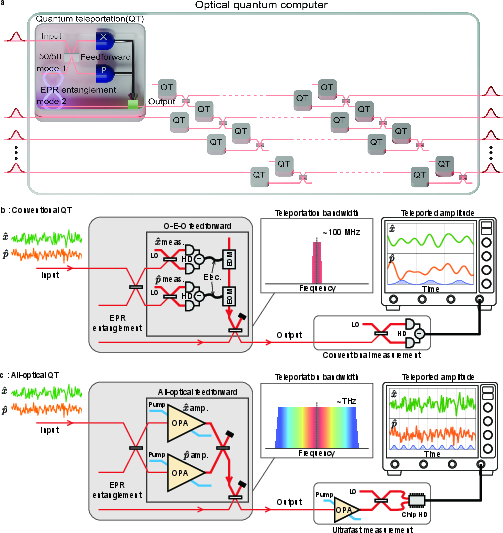
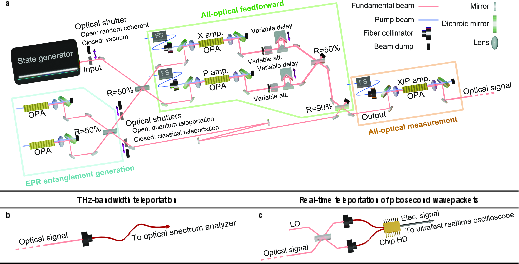
- all-optical feedforward: Implementing the classical correction step of teleportation entirely in the optical domain, avoiding electronic conversion. "The setup comprises EPR entanglement generation, all-optical feedforward, and all-optical measurement"
- all-optical quantum teleportation: A teleportation protocol where both measurement outcomes and corrective operations are carried optically, enabling ultrabroad bandwidths. "Here we show 1-terahertz-bandwidth all-optical quantum teleportation, completely bypassing this electronic limitation"
- atomic ensembles: Collections of atoms used as a medium for quantum operations or storage, often limited by narrow spectral lines. "recent all-optical teleportation using atomic ensembles remains trapped in the megahertz order due to narrow atomic transition lines"
- autocorrelation function: A measure of how a signal correlates with itself over time delays. "the specific duration required for the autocorrelation function of the input coherent amplitude to decay to zero"
- beam-splitter operations: Linear optical transformations that mix optical modes by splitting and recombining light. "Large-scale quantum circuits are executed through a sequence of quantum teleportations and beam-splitter operations"
- Bell measurement: A joint measurement projecting two modes onto entangled (Bell) basis states, yielding classical outcomes for feedforward. "By transferring Bell measurement outcomes optically"
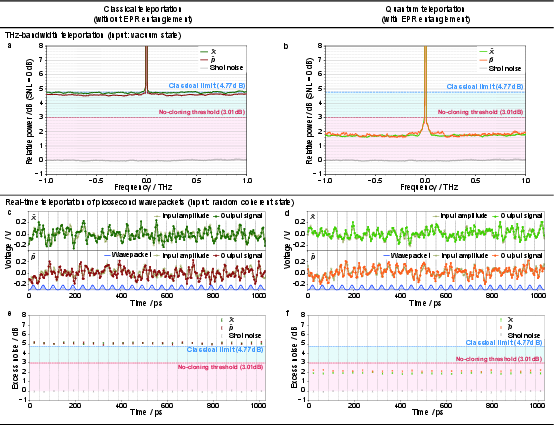
- classical limit (teleportation): The maximum fidelity achievable without entanglement; for coherent states this is 0.5. "Both results strictly surpass the classical limit of "
- coherent state: A minimum-uncertainty quantum state resembling a classical field, often used as an input benchmark. "we conducted real-time amplitude measurements in the time domain. We injected dynamic 'random coherent states'"
- continuous-variable (CV) quantum teleportation: Teleportation protocol operating on field quadratures (continuous degrees of freedom) rather than qubits. "In optical quantum computing, continuous-variable quantum teleportation is the fundamental building block for deterministic logic operations"
- continuous-wave (CW): A laser operating with constant amplitude in time, as opposed to pulsed operation. "The parametric processes in these OPAs are driven by a continuous-wave (CW) frequency-doubled pump beam"
- detection loss: Inefficiency in measurement that attenuates the observed signal and noise. "Accounting for the \qty{10}{\percent} final detection loss yields an intrinsic teleportation fidelity of "
- electro-optic modulator (EOM): A device that modulates light using an applied electric field. "EOM: electro-optic modulator"
- Einstein-Podolsky-Rosen (EPR) entanglement: Strongly correlated two-mode quantum state exhibiting reduced joint quadrature uncertainties. "sharing an ideal Einstein-Podolsky-Rosen (EPR) entangled state completely circumvents this penalty"
- excess noise: Noise above the shot-noise limit introduced by imperfections or finite entanglement. "corresponding to \qty{+3.01}{\decibel} of excess noise"
- feedforward: The process of using measurement outcomes to conditionally correct or displace the output state. "This protocol transfers unknown quantum states between nodes using quantum entanglement and real-time feedforward of measurement outcomes"
- fidelity (teleportation fidelity): A quantitative measure of how close the teleported state is to the input state. "we achieved teleportation fidelities of for the broadband vacuum states and for the dynamic coherent wavepackets"
- homodyne detector (HD): A measurement setup that reads field quadratures by interfering signal light with a local oscillator. "time-domain analysis using broadband homodyne detectors (HDs) coupled with an ultrafast real-time oscilloscope"
- local oscillator (LO): A strong reference laser used in coherent detection (e.g., homodyne) to define measurement phase. "LO: local oscillator"
- measurement-based quantum computing (MBQC): A model where computation is driven by sequential measurements on an entangled resource state. "the most promising architecture is measurement-based quantum computing (MBQC)"
- optical parametric amplifier (OPA): A nonlinear device that amplifies or squeezes optical fields via parametric interaction in a medium. "By implementing the feedforward operation directly in the optical domain using OPAs"
- optical parametric oscillator (OPO): A cavity-based parametric device that generates squeezed or amplified light but with limited bandwidth. "Traditional PSA relies on optical parametric oscillators (OPOs), where optical cavities strictly cap the bandwidth to the megahertz regime"
- optical spectrum analyzer (OSA): An instrument that measures optical power versus optical frequency. "frequency-domain characterization using an optical spectrum analyzer (OSA)"
- optical-to-electrical-to-optical (O-E-O): Conversion pipeline where optical signals are converted to electrical signals and back to optical, introducing bandwidth limits. "Conventional quantum teleportation utilizing an optical-to-electrical-to-optical (O-E-O) feedforward scheme"
- periodically poled lithium niobate (PPLN): A nonlinear crystal with engineered domain inversion for efficient parametric processes. "We employ highly efficient periodically poled lithium niobate (PPLN) waveguide optical parametric amplifiers (OPAs)"
- phase-sensitive amplification (PSA): Parametric amplification that depends on the optical phase, capable of amplifying one quadrature while deamplifying the other. "replacing O-E-O circuits with direct optical feedforward via phase-sensitive amplification (PSA)"
- pump beam: The high-energy laser field that drives parametric interactions in nonlinear media. "The parametric processes in these OPAs are driven by a continuous-wave (CW) frequency-doubled pump beam"
- quadrature amplitudes: The two canonical continuous variables (often denoted x and p) describing the phase-space components of an optical field. "In the continuous-variable (CV) regime, quantum information is encoded in the quadrature amplitudes and "
- quantum no-cloning limit: A fidelity threshold (2/3 for coherent states) beyond which a teleported copy must be the best possible, beating any cloner. "the system strictly surpasses the more stringent quantum no-cloning limit of "
- qu-modes: Temporally or spectrally multiplexed quantum modes serving as logical carriers in MBQC architectures. "the number of multiplexed qu-modes is directly dictated by the temporal duration of the quantum wavepackets"
- random coherent states: Time-varying coherent signals with randomized amplitudes used to test dynamic processing. "We injected dynamic 'random coherent states' with picosecond-scale temporal variations"
- shot noise limit: The fundamental quantum noise floor due to photon number fluctuations in coherent states. "three times the shot noise limit (approximately \qty{+4.77}{\decibel})"
- sidebands: Frequency components offset from the optical carrier that carry information or noise. "averaged over the sidebands (\qtyrange{-1.0}{-0.2}{\tera\hertz} and \qtyrange{0.2}{1.0}{\tera\hertz})"
- telecom-compatible quantum internet: A quantum networking vision leveraging standard telecommunications wavelengths and infrastructure. "and paves the way for a high-capacity, telecom-compatible quantum internet"
- terahertz (THz) clock rate: Operation rates on the order of 1012 cycles per second, exploiting optical carrier bandwidth. "optical quantum computing possesses the inherent potential to shatter this speed limit by operating at terahertz (THz) clock rates"
- time-domain multiplexed measurement-based quantum computing (MBQC): A scalable MBQC approach that packs many quantum modes into successive time slots in a loop. "this terahertz clock rate fundamentally transforms the scalability of time-domain multiplexed measurement-based quantum computing (MBQC)"
- vacuum state: The quantum ground state of an optical mode with zero photons, used as a reference input. "we successfully teleported vacuum states across the terahertz band"
- wavelength-division multiplexing: A technique that separates information into multiple wavelength channels for parallel transmission or readout. "we can directly incorporate established ultrafast classical photonics techniques—such as wavelength-division multiplexing and electro-optic sampling—for even faster information extraction"
Collections
Sign up for free to add this paper to one or more collections.