- The paper demonstrates that a two-spin Tavis–Cummings model exhibits a compact A₂ singularity which drives a unique monodromy structure in its integral fibration.
- It employs both numerical parallel transport and analytic Lax pair and Picard–Lefschetz methods to rigorously establish the system’s topological and bifurcation properties.
- The study highlights that the nontrivial monodromy precludes global action–angle variables, with implications for semiclassical quantization and quantum systems.
Hamiltonian Monodromy and the A2 Singularity in a Three-DOF Tavis-Cummings System
Introduction and Motivation
The paper addresses the topological structure of singular Lagrangian fibrations in integrable Hamiltonian systems with three degrees of freedom (DOF), focusing on a classical two-spin Tavis-Cummings (TC) system. Traditionally, singularities such as focus-focus points (locally A1) and their associated nontrivial monodromy have played pivotal roles in the symplectic and topological classification of two-DOF integrable systems, with the Jaynes-Cummings (JC) system as the archetypal example. In contrast, little is known about the possible singularities and global topology that can emerge in higher-DOF systems, especially those lacking a global T2 symmetry. This work makes significant progress by exhibiting an explicit physical model that realizes a compact A2 singularity, elucidating the topological and monodromy structure arising from it.
System Description and Integrability
The classical two-spin TC model considered here is defined on M=Su2×Sv2×R2, corresponding to two classical spins and a harmonic oscillator. The Hamiltonian is parameterized by resonance and coupling constants, with the canonical integrability roots computable via Lax pair formalism. The specific "special Tavis-Cummings" (STC) system is defined by:
δ1=21,δ2=23,ω=1,g=1,
which satisfies a resonance condition δ1+δ2=2ω. The momentum mapping F=(H1,H2,K) delivers explicitly three commuting integrals.
The system admits only a global S1 symmetry; no global T2 action is available due to the nontrivial coupling structure, distinguishing it from previously classified semitoric systems.
Critical Values, Singularity Structure, and Bifurcation Analysis
A comprehensive analytic and numerical study of the rank-0, rank-1, and rank-2 singularities of the integral map is provided. Key findings:
- Rank-0 singularities are fixed points of the A10 action and include elliptic-elliptic-elliptic (EEE) and elliptic-focus-focus (EFF) types.
- Rank-1 singularities fall in families:
- Four focus-focus-regular (FFR) threads A11 through A12 (solid black lines in critical value space) meet at a central degenerate critical value A13.
- Additional elliptic-elliptic-regular (EER) branches appear at the boundary.
- Rank-2 singularities identify the boundary structure.
The set of critical values displays a complex interconnection, including the joint at A14. This central value plays a fundamental topological and dynamical role, as the coalescence of FFR threads at A15 is topologically novel among known physical models.
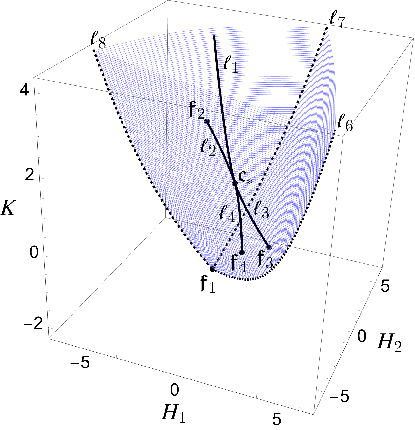
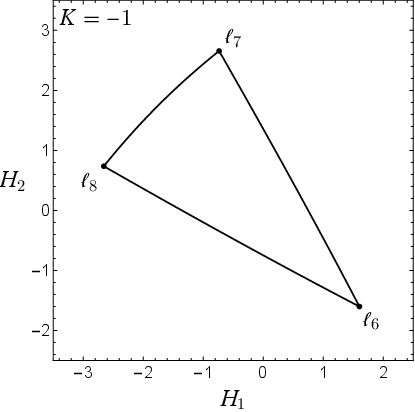
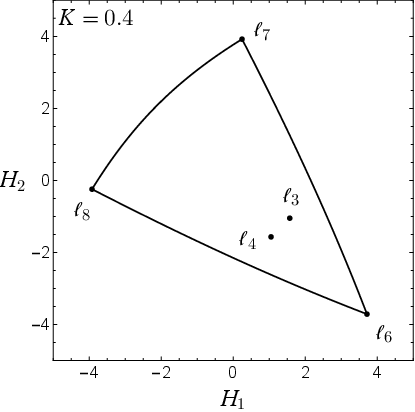
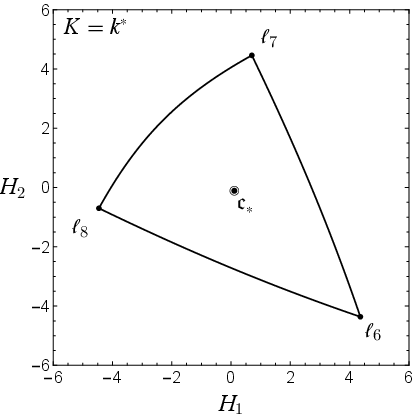
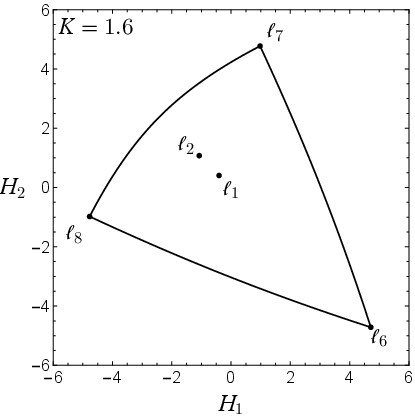
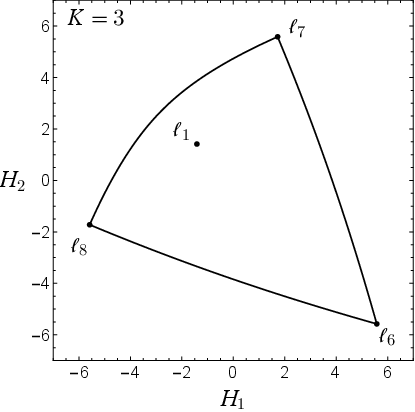
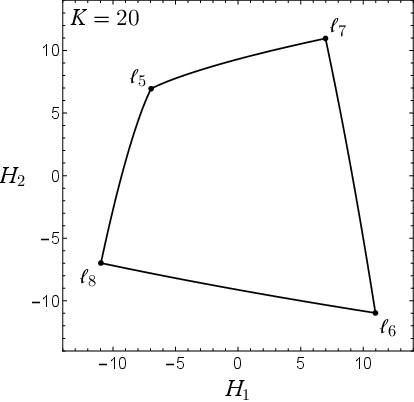
Figure 1: Critical values of the STC system in A16 space. Solid black lines are rank-1 FFR threads, meeting at the central value A17. Dashed lines are EER threads. Thin blue lines indicate rank-2 singularities. Bottom: Horizontal A18 slices of these critical sets.
Global Topology and Hamiltonian Monodromy
Monodromy is computed using both direct numerical parallel transport of torus cycles and via reduction to 2-DOF subsystems. The main results are:
- The fundamental group of the set of regular values is free on three generators, A19, due to removal of critical "threads" in value space.
- The monodromy matrices around the basic loops (threads) are:
T20
(see section for precise conventions).
This strongly precludes the existence of global action-angle variables, even locally except near the FFR families, highlighting the nontrivial nature of the Lagrangian fibration and the role of non-toric monodromy.
Local Structure: The T21 Singularity and Picard-Lefschetz Correspondence
Focusing on the central critical value T22, the local reduced fibration is shown to be topologically equivalent (via explicit coordinate reduction and Taylor expansion) to the versal unfolding of the T23 (cusp) singularity:
T24
with T25, T26.
- The singular reduced fiber at T27 is homeomorphic to T28 with a single T29 singularity.
- Around A20, four FFR threads coalesce, structurally organizing the local bifurcations and monodromy.
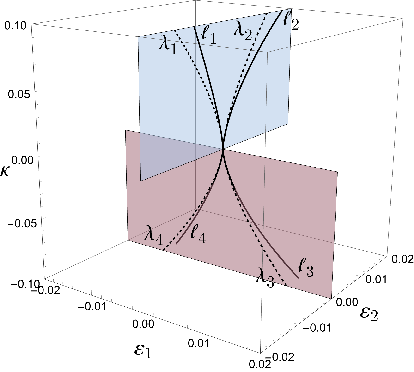
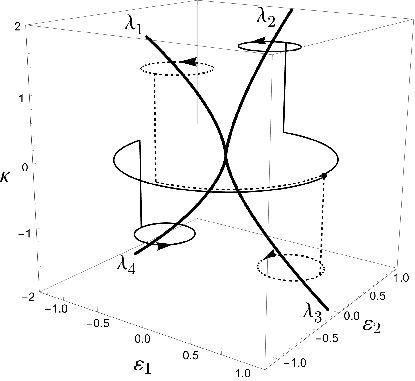
Figure 3: (Left) Discriminant locus A21 for A22, showing imaginary and real "threads" and correspondence with STC critical values. (Right) Loops used in Picard-Lefschetz monodromy computations.
The Picard-Lefschetz theory is deployed to analyze the (co)homological monodromy of the fibration in the neighborhood of A23. There is an exact correspondence between the computed Hamiltonian monodromy matrices and those for the vanishing cycles of the A24 unfolding. For instance, the matrix for a loop around two merging focus-focus singularities at the cusp matches the structure:
A25
whose eigenvalues are nontrivial roots of unity, distinct from the generic focus-focus case.
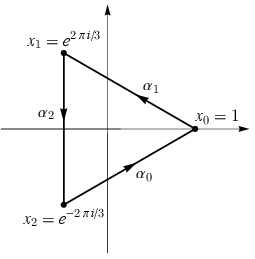
Figure 2: Schematic of the upper sheet of the Riemann surface A26, with cycles relevant to the vanishing cycle monodromy (Picard-Lefschetz analysis).
Implications and Perspectives
Theoretical significance: This work demonstrates for the first time in an explicit physical model the realization of a compact A27-type (cusp) singularity in an integrable Hamiltonian system. The central singularity organizes the bifurcation structure and monodromy in ways previously known only for focus-focus (A28) cases. This expands the known landscape for singular Lagrangian foliations and strongly indicates that higher A29 singularities may also be accessible in physically meaningful models, possibly in multi-spin Tavis-Cummings generalizations.
The precise correspondence between Hamiltonian and Picard-Lefschetz monodromy supports a general paradigm relating the algebraic geometry of spectral curves (via Lax pairs) and the topological invariants of integrable systems. The explicit computation establishes this bridge beyond the standard focus-focus setting.
Practical considerations:
- The presence of such singularities and their monodromy implies the impossibility of global action-angle variables, with consequences for semiclassical quantization of these systems (such as the appearance of quantum monodromy).
- The identification of M=Su2×Sv2×R20 and potentially higher degeneracies serves as a prototype for understanding more complex quantum/semiclassical spectra and could influence the design of control or manipulation protocols in quantum optics and information settings utilizing multi-spin photon-cavity couplings.
Future Directions
Several open problems and conjectures are outlined:
- Extension to the M=Su2×Sv2×R21-spin Tavis-Cummings model as a candidate for systems realizing higher M=Su2×Sv2×R22 singularities;
- Systematic analysis of degeneracy and bifurcation transitions under parameter variation, particularly robustness under resonance detuning;
- Further investigation of the role of singular Lagrangian fibrations in the context of mirror symmetry and symplectic topology;
- Extension of spectral Lax pair methods for topological and dynamical classification of integrable systems beyond two DOFs.
Conclusion
This paper establishes the existence of a compact M=Su2×Sv2×R23 singularity in the integral fibration of a three-DOF integrable Hamiltonian system derived from the Tavis-Cummings model with two classical spins. The work characterizes its bifurcation diagram, fibration topology, and explicit monodromy, and demonstrates a direct algebraic-topological correspondence with Picard-Lefschetz theory. These results enrich the theory of integrable systems and provide new directions for the study of singularities and monodromy in higher-dimensional settings.