- The paper introduces MirrorBench, a benchmark that evaluates self-centric intelligence in MLLMs through mirror-based embodied interaction scenarios.
- It employs a tiered evaluation protocol with controlled prompt ablation and metrics like TSR, SIR, FCR, and PCR to differentiate model performances.
- Findings reveal that many models confuse mirror imagery with real embodiment, highlighting the need for enhanced self-modeling in embodied AI.
MirrorBench: A Systematic Evaluation of Self-Centric Intelligence in MLLMs via Mirror-Based Embodied Interaction
Introduction
The study presents MirrorBench, a benchmark targeting the systematic evaluation of self-centric intelligence in Multimodal LLMs (MLLMs), by transplanting the mirror self-recognition (MSR) paradigm into embodied AI. Previous embodied MLLM benchmarks have concentrated on the external objective performance of agents, primarily evaluating their ability to perceive, reason, and act on external objects or goals. In contrast, self-referential understanding—critical for adaptive, robust behavior in unstructured environments—has been largely neglected.
MirrorBench fills this gap by immersing MLLMs in a simulated environment containing a mirror and a mark placed on their own virtual embodiment. The benchmark incrementally elevates reasoning demands through controlled prompt ablation, enforcing a progression from basic visual perception to high-level self-representation. This design facilitates a fine-grained, diagnostic assessment of the emergence of self-centric cognitive capability in large models.
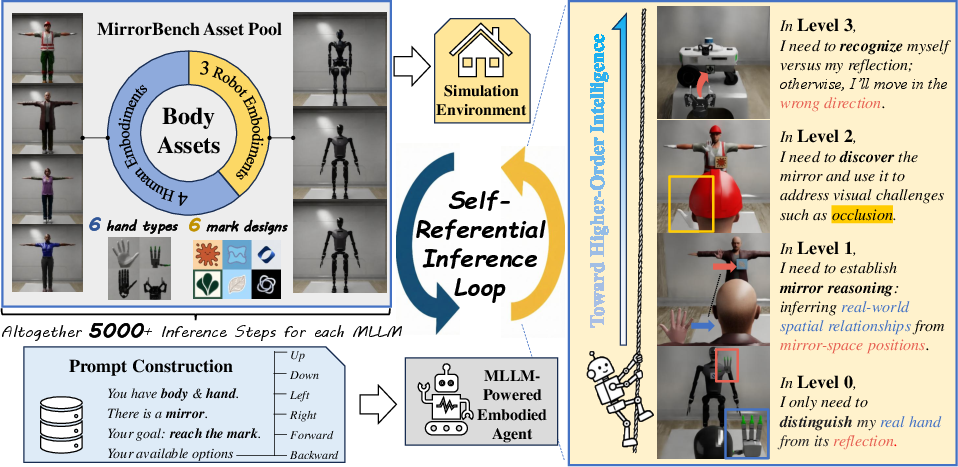
Figure 1: Overview of the MirrorBench evaluation pipeline with levels of cognitive complexity and example scenes illustrating the inference loop for self-referential behavior.
While contemporary MLLM evaluation datasets have evolved from conventional vision-language question answering (VQA) toward interactive embodied intelligence scenarios, most retain a focus on external tasks (e.g., navigation, manipulation) and omit the assessment of agent-centric reasoning. The MSR test, originating in comparative psychology, has seen limited and methodologically inconsistent adoption in robotics, often dependent on strong prior knowledge or simplified settings. Unlike prior robotic MSR tests, MirrorBench maintains strict control over scenario information and systematically isolates reasoning demands through prompt-level ablation.
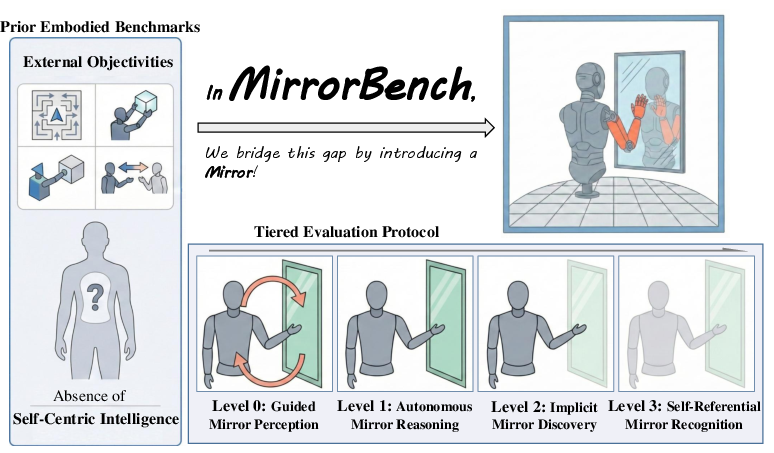
Figure 2: MirrorBench bridges the gap between objective-focused embodied benchmarks and the evaluation of self-centric intelligence by introducing a mirror-based, tiered protocol.
MirrorBench Benchmark Design
Environment and Task Construction
Each MirrorBench scenario consists of an agent (human or robot body), a controllable hand, a visible mark (on the agent), a mirror, and relevant scene descriptions. The asset pool and instantiation parameters yield over 5,000 inferences per MLLM, providing diverse and challenging scenarios.
Tiered Evaluation Protocol
MirrorBench operationalizes a four-level hierarchy, manipulating prompt structure to escalate cognitive requirements while holding the embodied scene constant:
- Level 0: Guided Mirror Perception — Full disclosure of the mirror's existence and stepwise, CoT-guided prompts reduce the task to structured visual reasoning.
- Level 1: Autonomous Mirror Reasoning — Mirror presence is specified but no CoT; the model must independently align real and mirrored embodiments for control.
- Level 2: Implicit Mirror Discovery — No mention of a mirror; success demands the agent infers the mirror's presence from perceptual consistency.
- Level 3: Self-Referential Mirror Recognition — Both the mirror and the mark’s attachment to self are undisclosed; only models with emergent self-representation can generalize to task completion.
This controlled progression enables attribution of performance deficits to the absence of specific self-centric capabilities, rather than environmental complexity.
Metrics
Task performance holistically combines four metrics: Task Success Rate (TSR), Step-wise Improvement Ratio (SIR), Final Completion Ratio (FCR), and Peak Completion Ratio (PCR). TSR captures end-task completion. SIR quantifies action-by-action progress, while FCR and PCR respectively capture aggregate and maximal achieved task proximity.
Experimental Results
Evaluation encompasses 18 MLLMs (7 proprietary, 11 open-source) alongside human and random baselines. The human agent consistently achieves scores approaching the upper metric bounds. Proprietary MLLMs outperform the random baseline in most cases, whereas the majority of open-source models—especially those with smaller parameter count—fail to exceed random performance, particularly at higher levels.
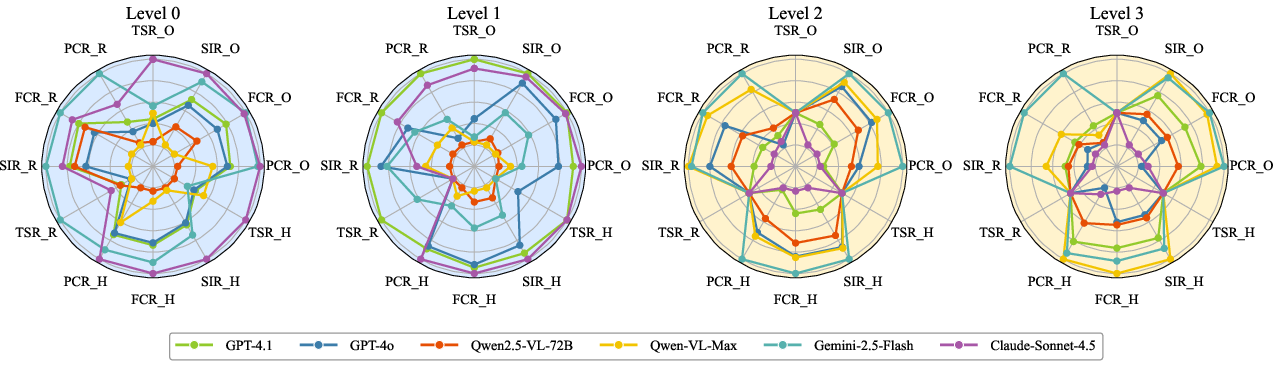
Figure 3: Radar visualization of representative MLLM metrics across levels, highlighting variation by model size and class as cognitive demands increase.
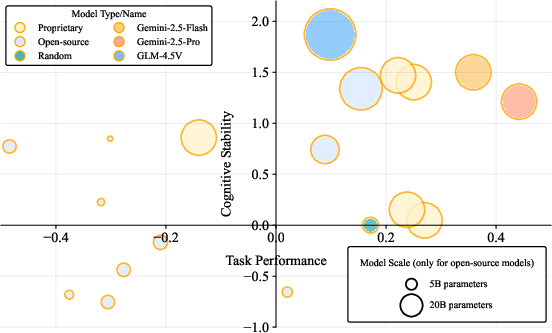
Figure 4: Cognitive Stability plotted against task performance for MLLMs. Bubble area reflects model scale; high-performing models cluster with monotonic, stable degradation.
Cognitive Stability and Reasoning Dynamics
A salient outcome is the tight correlation between cognitive stability—a measurement of monotonically declining performance across levels—and benchmark achievement. Large, proprietary models demonstrate normative degradation as difficulty rises, signifying an alignment with expected reasoning challenges. In contrast, smaller models often exhibit non-monotonic trajectories or anomalous metric spikes, evidencing brittle or stochastic policies.
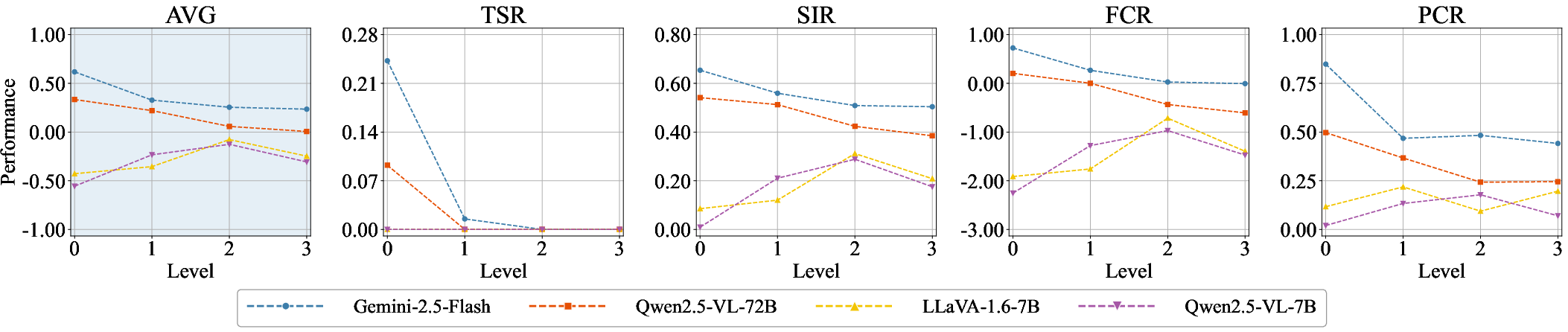
Figure 5: Metric trajectories for four MLLMs across complexity levels. Large models show consistent decline, while small open-source models display erratic or paradoxical trends.
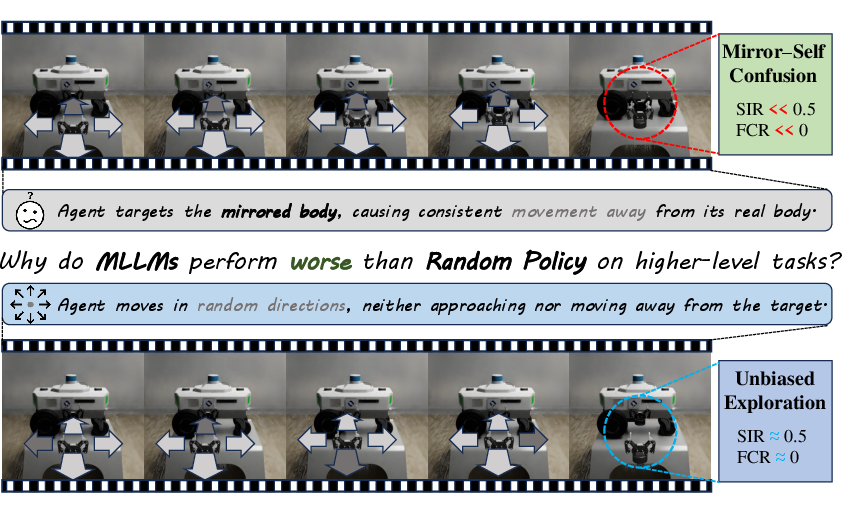
Figure 6: Illustration of the failure mode where an MLLM persistently confuses mirrored with real embodiment, yielding worse-than-random behavior.
Failure Analysis and Out-of-Distribution Generalization
Observation of failure modes reveals that models lacking genuine self-referential understanding often converge to "mirror-self confusion," consistently targeting the reflection rather than the real embodiment—sometimes scoring below a random policy. A further systemic finding is lower cross-level performance in robot-body conditions, indicative of OOD generalization issues due to human-centric pretraining of most MLLMs.
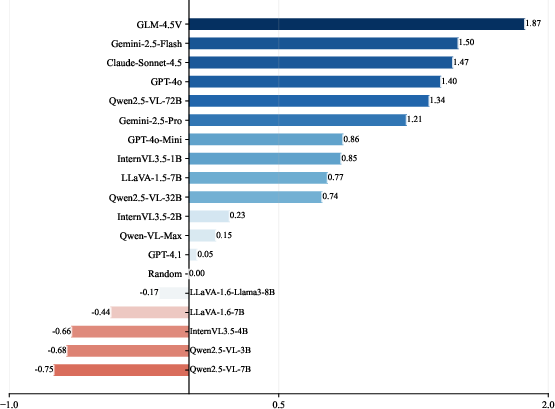
Figure 7: Comparative ranking of MLLMs by Cognitive Stability, reinforcing that proprietary and large models achieve superior consistency.
Implications and Future Research
MirrorBench empirically demonstrates that extant MLLMs, including leading proprietary architectures, lack robust emergence of self-centric intelligence as operationalized by the mirror-test paradigm. High-order self-representation remains unachieved at scale, with virtually all models collapsing to near-zero success on unsupervised or implicit self-recognition tasks (Levels 2 and 3), irrespective of parameter count, architecture, or prior exposure.
The practical implications are pronounced for embodied AI, where robust, generalizable behavior increasingly demands dynamic internal modeling of agent-environment boundaries and self-to-world mappings. Theoretically, the findings reassert the distinctness of self-referential reasoning from other forms of scene understanding and spotlight self-centric capability as a clear bottleneck for general intelligence emergence.
Future progress demands advances in self-modeling, potentially integrating domain-adaptive training, continual embodiment exposure, or novel architectural priors that encode self/environment distinction.
Conclusion
MirrorBench constitutes the first systematic, MSR-grounded evaluation of self-centric intelligence in MLLMs, revealing severe and persistent deficiencies in embodied self-representation. The pronounced gap between human and artificial agents on this benchmark establishes a concrete diagnostic for future research and a clear objective for the development of more adaptive, trustworthy embodied AI.