- The paper introduces an active cavity magnon system that employs Floquet modulation to enhance weak magnetic field detection at room temperature.
- Methodology includes gain compensation to narrow linewidths and generate Floquet sidebands, achieving a sensitivity of 121 pT/√Hz at 80 MHz.
- Experimental results confirm a linear response of sideband amplitudes with tunable pump power, offering a compact solution for precision magnetometry.
Overview of Weak Magnetic Sensing via Floquet Driving
The research highlights advancements in weak magnetic sensing through a novel configuration of an active cavity magnon coupled system, leveraging Floquet modulation for enhanced detection capabilities. This system integrates a printed circuit board (PCB) setup with yttrium iron garnet (YIG) to achieve room-temperature operation and overcomes limitations associated with conventional high-sensitivity magnetic sensors.
Active Cavity Magnon Coupled System Design
The paper presents an innovative sensor design utilizing a cavity magnon coupled system comprising a planar resonant cavity and a YIG sphere. The system's configuration is outlined with embedded gain circuits and inductive coils around the YIG sphere to generate alternating magnetic fields parallel to static fields. The schematic and functional principle of the setup are demonstrated in Figure 1.
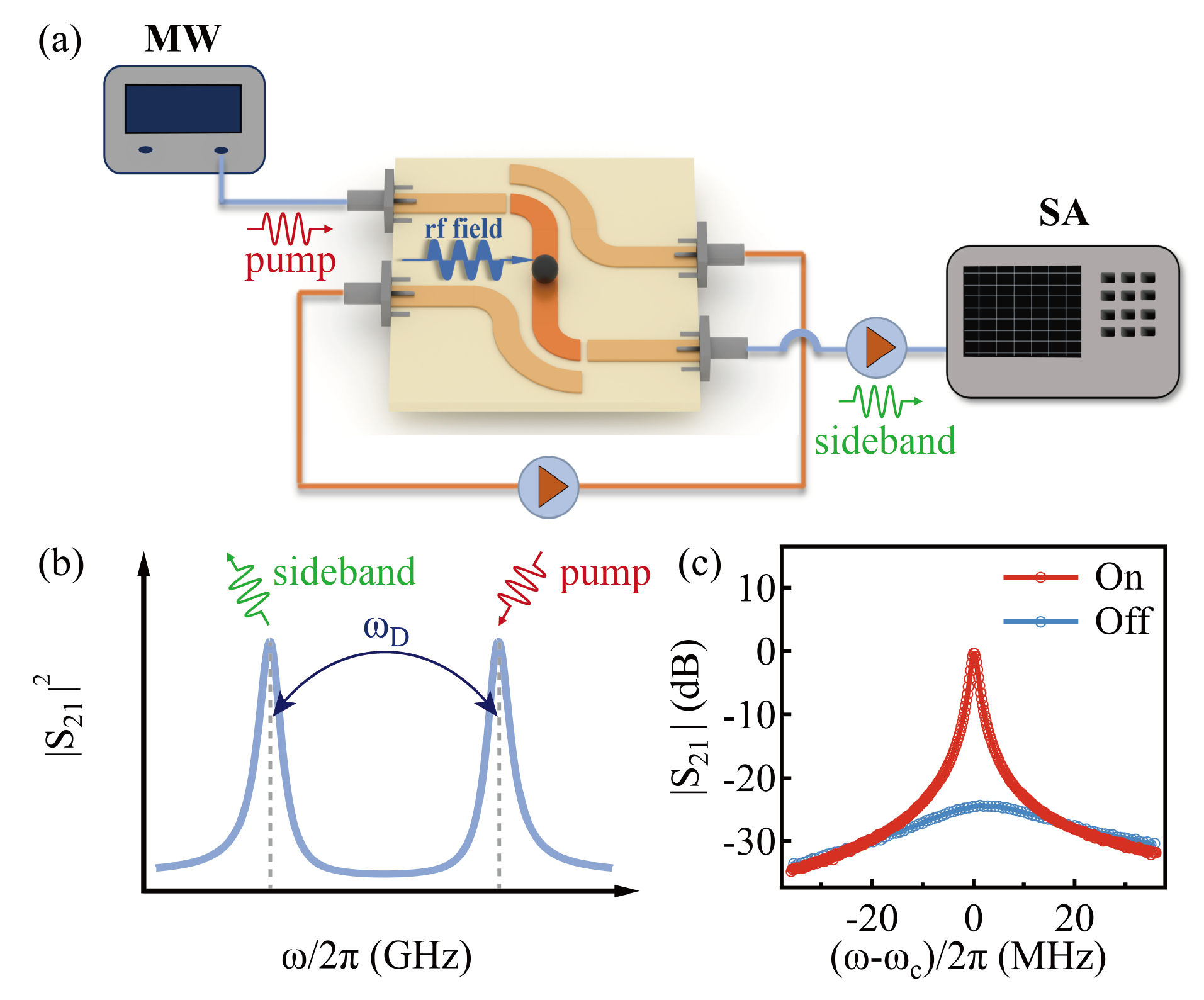
Figure 1: Setup and working principle of the microwave-driven active cavity magnon coupled system for sensing alternating magnetic fields.
The experimental framework enables tunable gain application to mitigate intrinsic dissipative effects within the cavity mode, thus enhancing the system's quality factor significantly. Integration of gain mechanisms offers a strategic counteraction against Ohmic losses which have traditionally hindered precision measurement capabilities in such systems.
Floquet Modulation and Enhanced Sensitivity
The exploitation of Floquet modulation in this system introduces new dimensions to signal processing and amplification. The modulation results in sideband signals, decipherable through the hybrid modes of the system, thus facilitating the detection of weak magnetic fields. As elaborated in Figure 2, transmission spectra exhibit substantial improvements in signal intensity with gain application across varying pump powers and external biases.

Figure 2: Transmission spectra depict the effect of tunable gain and bias voltage on cavity mode linewidth and signal amplification.
The research introduces a gain-compensated approach that narrows the linewidth and utilizes Floquet sidebands to achieve linear detection of weak alternative fields, quantified at a sensitivity of $121\text{ pT}/\sqrt{\text{Hz}$ at operational frequencies of 80 MHz. Such sensitivities push the boundaries of room-temperature miniaturized sensors in contrast to traditional bulky cryogenic systems.
Experimental Validation and Results
Through systematic experimentation, the paper validates theoretical predictions using spectral analysis to establish the linear relationship between sideband signal amplitudes and applied alternating field strengths. Measurements underscore the efficiency of the active cavity magnon system in enhancing detection sensitivity, as expounded in Figure 3.
(Figure 3)
Figure 3: Linear response of sideband signal amplitude in relation to alternating magnetic field strength; noise level assessments revealing sensitivity achievements.
The results reveal the substantial amplification of signal responses under optimized pump conditions, emphasizing the non-linear dynamics and gain-controlled interactions within the cavity magnon system. Notably, the experimental insights correlate well with theoretical models, substantiating the potential of integrating active cavity mechanisms with Floquet engineering for improved magnetic sensing applications.
Conclusion
The integration of Floquet modulation within active cavity magnon systems presents promising advancements for magnetic sensing technology, setting noteworthy milestones in sensitivity enhancement while maintaining compact, room-temperature configurations. The paper demonstrates the capability of such systems to provide high-resolution magnetic sensing, paving the way for future development of compact and practical magnetometry devices.
This work marks a pivotal contribution to sensor technology by combining electric gain tuning with Floquet modulation under non-Hermitian architectures, effectively transforming room-temperature magnetic sensing strategies. Through expanded pathways for signal control and amplification, these innovations forecast prospects for extensive applicability in fields requiring precision magnetic field detection.