- The paper introduces a soft-feedback detector that incorporates soft-decision feedback to mitigate error propagation in AFDM systems.
- It leverages the banded channel matrix in the DAFT domain for efficient complexity reduction and rapid convergence without full matrix inversion.
- Numerical evaluations demonstrate a 3 dB SNR gain at BER=10⁻³, positioning the SFD as a competitive solution for 6G high-mobility communications.
Low-Complexity Soft-Feedback Detector for AFDM Systems
Context and Motivation
Affine Frequency Division Multiplexing (AFDM) has been identified as a robust waveform for high-mobility communications, notably resilient against Doppler shifts and achieving full diversity in doubly dispersive channels. However, AFDM's adoption is constrained by severe inter-symbol interference (ISI) due to its chirp-based subcarrier structure. Conventional equalization techniques, such as MMSE, become computationally prohibitive due to the banded channel matrix arising in AFDM, distancing the system from practical implementation in high-throughput and latency-sensitive scenarios.
Recent advances have focused on reducing complexity—linear MRC-DFE-based approaches and message passing (MP) detectors utilize band structure and sparsity. Nonetheless, a persistent trade-off exists: low-complexity detectors suffer from error propagation, while soft-information detectors (e.g., Turbo or MP) offer superior performance at increased computational cost.
AFDM Signal Model and Banded Matrix Structure
The AFDM signal model leverages the discrete affine Fourier transform (DAFT) domain, using a unitary DAFT matrix for modulation. Chirp-periodic prefix (CPP) in time domain symbols provides resilience against multipath, allowing full diversity gains. The received signal, affected by P paths in a doubly dispersive channel, results in a DAFT-domain channel matrix Heff with a distinct banded structure—each column containing L non-zero entries, tied to fractional Doppler shifts and delay parameters.

Figure 1: Illustration of the approximate band matrix structure. Gray cells represent non-zero entries, while white cells represent zero entries.
This banded matrix structure is central to low-complexity algorithms: it enables linear complexity by restricting operations to local bands, avoiding full matrix inversion as in MMSE settings.
Soft-Feedback Detector (SFD): Architecture and Algorithmic Innovations
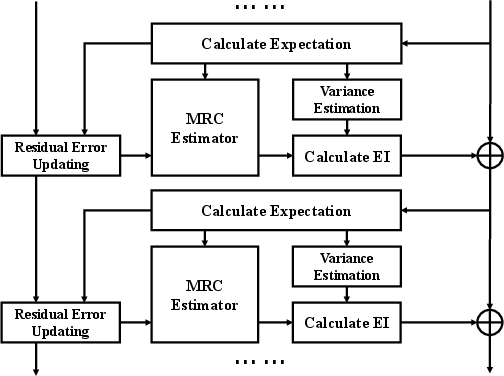
The proposed Soft-Feedback Detector (SFD) adopts the MRC estimator architecture. The detector introduces a soft-decision feedback mechanism, leveraging the a priori symbol distribution during iterative detection to suppress error propagation. Each symbol estimate is augmented with extrinsic information obtained from log-likelihood ratios (LLRs), rather than relying solely on hard symbol estimates.
The iterative structure of SFD is detailed as follows:
This iteration structure ensures information accumulation, substantially limiting the error propagation inherent to classical DFE and resulting in reliable, rapid convergence.
Computational Complexity Analysis
The computational complexity of SFD is dominated by sparse matrix-vector multiplications and soft-information update operations. SFD scales as O(NiterNL), similar to MRC-DFE, but introduces only a constant overhead for soft feedback calculation. Compared to MMSE (O(N3)) and MP (O(NL2)), SFD achieves the lowest total complexity among iterative detectors for practical AFDM parameters.
The cost of special functions (tanh and exponential) is minimized through LUT-based implementations, incurring only a marginal FLOP overhead.
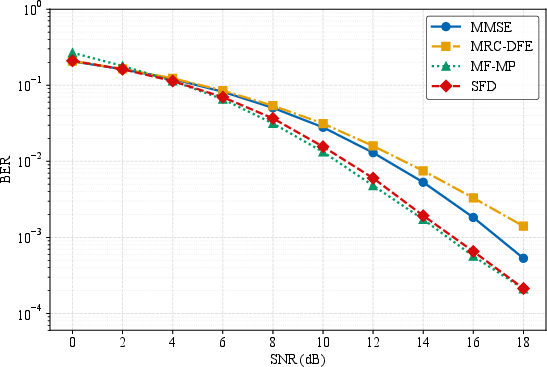
Simulation results highlight the efficacy of SFD relative to MRC-DFE, MMSE, and MF-MP detectors. The evaluation employs a doubly dispersive channel with P=4 paths, N=512 subcarriers.
- Convergence Behavior: SFD achieves lower MSE at all evaluated SNRs and attains lower error floors beyond two iterations, confirming reduced error propagation due to soft feedback.
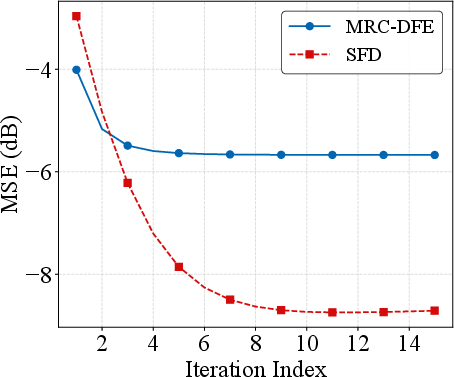
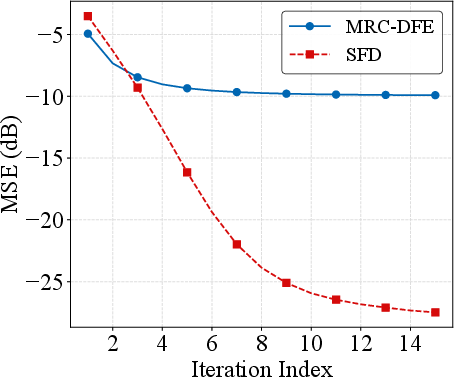
Figure 3: Convergence performance comparison.
These results validate the SFD as the optimal trade-off point between detector accuracy and computational efficiency. The emphasis on soft-decision feedback substantiates marked improvements over hard-feedback strategies, without burdening the hardware with excessive computation.
Theoretical and Practical Implications
The SFD provides a formal mechanism for integrating soft-information in MRC-based AFDM detectors, thereby establishing a computationally efficient framework that is theoretically grounded in probabilistic symbol estimation. The diminished role of matrix inversion highlights directions for further algorithmic optimization in high-mobility scenarios.
From a practical perspective, SFD's low complexity aligns with AFDM's role in emerging 6G deployments, where high-mobility and large bandwidths place stringent demands on runtime detection performance. The detector is poised for adaptation in edge devices, vehicular networks, and NTNs, though its current realization is restricted to SISO systems.
Future Research Directions
- Extension of SFD to MIMO AFDM systems remains an open challenge, requiring new formulations for soft feedback and complexity management in higher dimensional channel matrices.
- Investigation into joint channel estimation and detection, integrating SFD principles, offers potential for further robustness.
- For modulation orders beyond QPSK, adaptability of the proposed soft feedback mechanism requires analysis of convergence properties and reliability scaling.
- Hardware implementation studies leveraging LUT-based nonlinearity approximation will yield insight into real-world deployment feasibility.
Conclusion
The Soft-Feedback Detector (SFD) introduces a principled, low-complexity approach to AFDM data detection, leveraging soft-decision feedback for improved accuracy and rapid convergence. Empirical results demonstrate SFD's superior performance, with an SNR gain of 3 dB over MRC-DFE at operational BER thresholds, and a competitive complexity profile. While the current model is SISO-specific, its architecture lays the foundation for scalable, robust AFDM detectors in 6G and beyond (2604.14666).